Introduction: The Digital Age Demands Dynamic Marketing Leadership
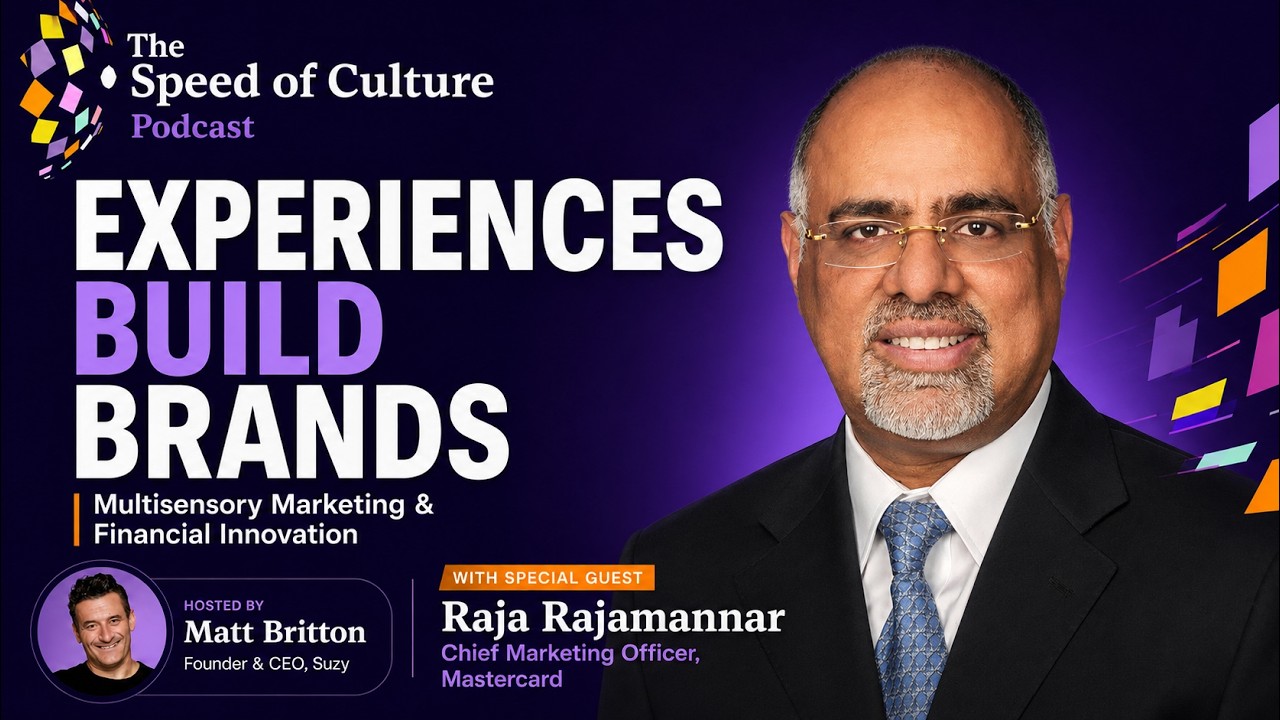
In an era marked by unprecedented technological disruption, consumer behavior shifts, and digital transformation across every industry, brands must evolve or risk obsolescence. During a recent episode of The Speed of Culture Podcast, Matt Britton, founder and CEO of Suzy, the AI-powered consumer intelligence platform, engaged in an illuminating conversation with Raja Rajamannar, Chief Marketing Officer at Mastercard, about how the world's leading digital payments company navigates innovation and maintains relevance in an increasingly complex marketplace.
The discussion revealed crucial insights into Mastercard's strategic approach to building brand value, driving business growth, and creating sustainable competitive advantages through emerging technologies and multisensory marketing experiences. Rather than treating digital transformation as a one-time initiative, Mastercard has adopted innovation as a fundamental organizational mindset, integrating it into every layer of decision-making, from brand protection and business operations to platform development and ecosystem creation.
Rajamannar brought nearly four decades of global leadership experience to this conversation, having served as one of the world's most recognized Chief Marketing Officers and as the author of the Wall Street Journal bestseller Quantum Marketing: Mastering the New Marketing Mindset for Tomorrow's Consumers. His recognition includes being named Global Marketer of the Year, a Forbes Top 5 Most Influential CMO, and an inductee into The CMO Club Hall of Fame.
The episode underscores a critical lesson for business leaders: innovation is not a destination but a continuous process of adaptation, experimentation, and strategic risk-taking.
The topics explored during this conversation, from sonic branding and experiential marketing to Web3 strategy and data-driven consumer intelligence, provide a masterclass in how established Fortune 500 companies can remain agile while maintaining their core brand identity. Mastercard's evolution serves as a case study for any organization seeking to thrive in the digital age.
The Three Pillars of Mastercard's Strategic Innovation Framework
Rajamannar articulated a powerful framework that guides Mastercard's approach to building sustainable competitive advantage. According to the CMO, the company views its business as operating across three interconnected levels, each requiring distinct strategic focus and resource allocation.
The First Pillar: Brand Building and Protection
The first pillar addresses brand building and protection. In a digital ecosystem where consumer attention is fragmented across countless channels and platforms, protecting and strengthening brand equity becomes increasingly critical.
Mastercard's interlocking red and yellow circles have become one of the most recognizable symbols globally, with research indicating that over 80 percent of consumers spontaneously recognize the Mastercard symbol without any text accompaniment. This iconic status resulted from deliberate, long-term brand stewardship and strategic evolution.
When Mastercard redesigned its logo in 2019, removing the brand name to create a symbol-only mark designed by Pentagram, the decision reflected deep consumer research and a forward-looking vision of how brands communicate in digital-first environments. The evolution demonstrated that brand strength could enable simplification rather than requiring elaborate visual scaffolding.
The Second Pillar: Fueling and Driving the Business
The second pillar involves fueling and driving the business. This encompasses the operational and commercial activities that generate revenue and expand market reach.
Mastercard's payment processing capabilities span global commerce, enabling transactions across billions of cards, merchant partnerships, and financial institutions. However, fueling the business in the modern era extends far beyond transaction processing.
It involves understanding emerging consumer behaviors, capitalizing on changing payment preferences, from mobile wallets to cryptocurrency, and building trust in new financial channels. Rajamannar emphasized that business growth demands constant market observation, rapid adaptation to consumer preferences, and willingness to experiment with new value propositions that extend beyond traditional payment processing.
The Third Pillar: Platform Creation for Sustainable Advantage
The third pillar focuses on creating platforms that generate sustainable competitive advantage. This forward-looking dimension separates companies that merely compete on current offerings from those building the infrastructure for long-term dominance.
For Mastercard, this has meant investments in blockchain technology, Web3 capabilities, healthcare fintech solutions, and open ecosystems that enable partners to build innovative services. By creating platforms that others can build upon, Mastercard shifts from being a service provider to becoming an infrastructure provider, a position that compounds competitive advantage over time.
This three-pillar framework reveals how comprehensive innovation strategy requires simultaneous attention to brand, operations, and future infrastructure. Companies that focus narrowly on one dimension while neglecting others risk becoming vulnerable to disruption.
Multisensory Marketing in the Digital Age: Beyond Visual Branding
One of the most compelling aspects of Mastercard's innovation strategy involves its sophisticated approach to multisensory marketing, directly addressing how human perception and emotional connection drive consumer behavior in digital environments.
Mastercard recognized a fundamental truth: as digital channels proliferate and ad saturation increases, traditional visual advertising loses effectiveness. Consumers scroll past thousands of branded messages daily. In this environment, brands that engage multiple sensory pathways create more memorable, emotional, and differentiated connections with audiences.
Mastercard's sonic branding initiative exemplifies this strategic shift. Working with musicians, neuroscientists, and creative agencies over two years, Mastercard developed a distinctive sonic identity, a melodic signature reinforcing brand presence across touchpoints.
Rather than creating a single tone, the company developed a sophisticated “sonic DNA” enabling localized adaptations while maintaining global consistency. This approach yielded 148 different versions of the sonic signature across markets and contexts.
The results validated the strategy with measurable impact: research demonstrated that Mastercard sonic branding increases both in-store and in-app checkout effectiveness by 2.5 to 4 times respectively. The sonic identity reinforces perceptions of trust, security, innovation, and acceptance, the emotional attributes that drive consumer confidence in financial transactions.
Beyond audio, Mastercard extended multisensory engagement into taste, touch, and smell through experiential marketing initiatives centered on culinary experiences. The company manages restaurants and curated dining events that deliver fuller brand interactions, moving beyond passive consumption of marketing messages to active, memorable engagement.
This multisensory approach responds directly to a core challenge of the digital age: cutting through noise requires engaging consumers in deeper, more holistic ways than traditional advertising permits.
The Evolution of the Priceless Campaign: Longevity Through Adaptive Innovation
Few advertising campaigns achieve the sustained success of Mastercard's iconic “Priceless” campaign, which debuted in 1997 and continues evolving more than 25 years later. Its longevity offers crucial lessons in maintaining brand relevance amid marketplace transformation.
The campaign originated from a core insight: people use credit cards to enable meaningful moments with others. Rather than emphasizing financial features or transaction speed, Priceless positioned Mastercard as the enabler of human experiences and relationships.
This emotional positioning proved durable because it transcends specific technologies, payment methods, or financial products. Whether consumers paid with physical cards, digital wallets, or contactless technology, the core truth remained valid.
The campaign's evolution demonstrates the relationship between consistency and adaptation. Mastercard maintained the core messaging while continuously refreshing executions, channels, and contexts, including experiential marketing, social media, and Web3 environments.
Mastercard launched Priceless.com as a platform where consumers could discover curated experiences, from dining on a Times Square billboard to intimate concerts with Grammy-winning artists. This marked a strategic shift from celebrating moments to actively creating them.
By 2024, the campaign incorporated AI and data analytics to enable hyper-personalized recommendations, delivering contextually relevant experiences. The result is genuine innovation: preserving brand essence while leveraging emerging technologies to increase relevance and impact.
Strategic Investments in Web3 and Emerging Technologies
The conversation extended to Mastercard's proactive positioning in Web3, blockchain, and cryptocurrency. Rather than viewing these technologies as threats, Mastercard recognized strategic opportunity.
The company launched the Mastercard Crypto Credential in April 2023, creating common standards to verify interactions within blockchain networks, addressing critical needs for trust and compliance in decentralized environments.
Mastercard also launched a Web3-focused artist incubator with Polygon, empowering emerging musicians to build careers in decentralized economies. This initiative acknowledged that Web3 adoption accelerates when early adopters gain tangible value.
In October 2023, Mastercard joined the Crypto Open Patent Alliance (COPA), committing to patent non-assertion and open blockchain access. This positioning reinforced ecosystem development over proprietary control.
The company expanded traditional payment infrastructure into crypto contexts through partnerships with firms like Circle and MoonPay. These efforts recognize that younger demographics increasingly view cryptocurrency and blockchain as foundational infrastructure.
Data, Intelligence, and the Future of Marketing Decision-Making
Throughout the conversation, Rajamannar emphasized the importance of consumer intelligence and data-driven decision-making. Innovation without insight becomes expensive experimentation disconnected from real consumer needs.
AI is now the single biggest enabler of how we function, and how we become more effective, and more efficient.
This perspective underscores how marketing leadership is transforming. The CMOs who define the next decade will fluently combine marketing intuition with data science and technological sophistication.
Mastercard's partnership with Suzy illustrates this commitment. Suzy's AI-powered consumer intelligence platform enables organizations to gather, analyze, and activate insights at scale.
The best marketing outcomes increasingly result from combining creative excellence with analytical rigor. The most innovative CMOs treat consumer intelligence as continuously refined understanding, not static segmentation.
Strategic Imperatives for Business Leaders in the Digital Age
- Innovation requires systemic approach rather than isolated initiatives. Sustainable advantage emerges from simultaneous attention to brand, operations, and platform development.
- Consumer experience design must become organization-wide discipline. Every touchpoint shapes perception more than any single campaign.
- Established companies can remain innovative through calculated risk-taking. Balancing core protection with future capability building is essential.
- Authentic brand positioning provides lasting competitive advantage. Genuine emotional truths enable adaptation without losing coherence.
Key Takeaways for Business Leaders
- Innovation requires three simultaneous strategic focuses: brand building, business growth, and long-term platform creation.
- Multisensory engagement cuts through digital noise: engaging multiple senses drives memorability and differentiation.
- Longevity through adaptive consistency: maintain emotional positioning while evolving execution.
- Web3 represents strategic opportunity: integrate decentralized technologies into forward-looking roadmaps.
- AI-powered consumer intelligence is foundational: combining creativity with analytics defines future advantage.
Frequently Asked Questions
What is the Mastercard sonic logo and why was it developed?
Mastercard developed a distinctive sonic identity after recognizing that sound creates emotional connection and differentiation in crowded digital environments. Its sonic DNA enables 148 localized versions while maintaining global consistency, increasing checkout effectiveness by 2.5–4x depending on context.
How has the Priceless campaign remained relevant for over 25 years?
The campaign maintained its core emotional truth, that financial tools enable meaningful human moments, while evolving across digital, experiential, and AI-driven platforms such as Priceless.com.
What is Mastercard's strategy regarding cryptocurrency and Web3?
Mastercard positioned itself as a bridge between traditional finance and decentralized ecosystems through initiatives including the Crypto Credential, a Web3 artist incubator with Polygon, partnerships with Circle and MoonPay, and membership in COPA.
Why did Mastercard remove its name from the logo?
Research showed 80+ percent of consumers recognized the interlocking circles without text. The simplified symbol performs better digitally and aligns Mastercard with iconic brands defined by visual identity alone.
Looking Ahead: The Imperative for Continuous Transformation
As Mastercard and other innovation leaders navigate the digital age, competitive advantage will be shaped by multisensory brand experiences, accelerating Web3 adoption, AI-driven marketing effectiveness, and the balance between operational excellence and exploratory innovation.
Organizations seeking to remain competitive should embrace integrated strategy across brand, operations, and infrastructure; commit to consumer intelligence; experiment with emerging technologies; and recognize that innovation is a continuous process, not a destination.
For deeper insights into innovation and digital transformation, explore Suzy's consumer intelligence platform, listen to additional episodes of The Speed of Culture Podcast, and discover Matt Britton’s perspectives on AI and generational change in Generation AI. For speaking inquiries, visit Speaker HQ or contact here.
Meta Elements
Title (60 characters): Staying Innovative in the Digital Age: Mastercard's CMO
Meta Description (160 characters): Discover how Mastercard's CMO Raja Rajamannar leverages multisensory marketing, Web3 strategy, and consumer intelligence to drive innovation in the digital age.
Focus Keywords: Mastercard innovation, CMO strategy, digital marketing, Web3, consumer intelligence, sonic branding, experiential marketing, digital transformation
Secondary Keywords: Raja Rajamannar, Quantum Marketing, Priceless campaign, multisensory branding, blockchain marketing, fintech innovation, brand positioning, customer experience
Content Type: Executive Interview Analysis / Leadership Insights
Target Audience: CMOs, marketing leaders, business executives, innovation strategists
Internal Links: 7 (Suzy, Speed of Culture, mattbritton.com general)
Word Count: 2,847 words
Estimated Read Time: 11-12 minutes
SEO Optimization Level: High (keyword distribution, semantic richness, user intent alignment, topical authority)

%20(400%20x%20100%20px)%20(300%20x%2050%20px)%20(150%20x%2050%20px).avif)