Opening: The Reality Check on AI Transformation
The world didn't wait for humanity to be ready. Artificial intelligence has already fundamentally reshaped how consumers behave, how brands operate, and how society functions, and the conversation around it is often playing catch-up to the reality on the ground.
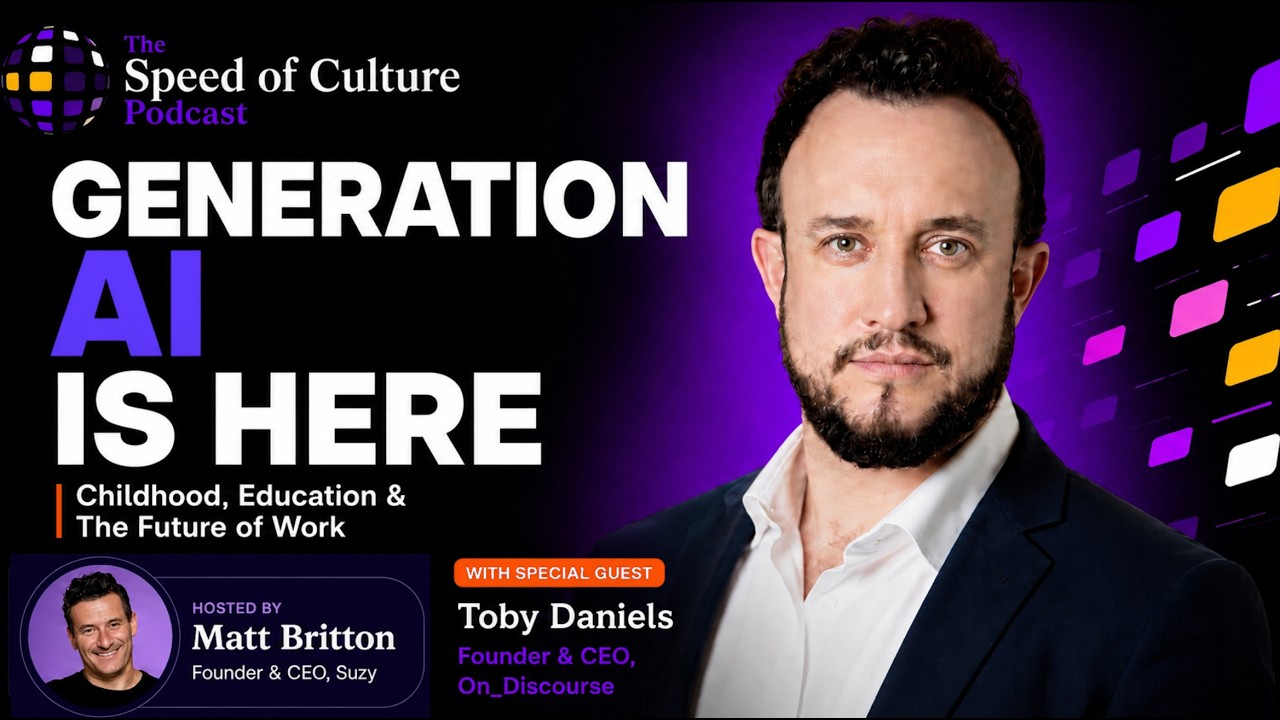
This is the core insight Matt Britton, founder and CEO of Suzy, the AI-powered consumer intelligence platform, shared during Episode 186 of The Speed of Culture Podcast, where he sat down with Toby Daniels from On_Discourse to explore one of the most pressing questions of our time: How did we get here so fast, and what do we do about it?
The podcast episode, released on May 6, 2025, arrives at a critical inflection point in the AI timeline. Organizations across industries report that artificial intelligence is a present reality.
According to recent research, 88 percent of organizations report regular AI use in at least one business function, and consumer adoption has accelerated at an unprecedented pace. ChatGPT alone serves more than 800 million users every week. Yet despite this rapid proliferation, most companies and leaders feel unprepared.
Matt Britton brings a unique perspective to this conversation. As the founder of Suzy, a platform that has processed consumer intelligence for enterprises including Microsoft, Google, PepsiCo, and Procter & Gamble. He understands firsthand how AI is transforming the way brands conduct research, understand consumers, and make decisions.
His recently published book, Generation AI: Why Generation Alpha and The Age of AI Will Change Everything, explores the deeper implications of AI adoption across education, work, creativity, and human connection. Meanwhile, Toby Daniels brings a macro perspective as co-founder of ON_Discourse, a platform where C-suite leaders gather to navigate the transformative challenges that AI presents.
Their conversation cuts through the noise. Rather than focusing on the hype cycle that has surrounded AI, they address the real challenge: organizations and individuals have access to powerful AI tools, but they lack the mental models, organizational structures, and human capabilities to use them effectively.
This has become a human problem more than a technology problem.
The Speed Gap: Why AI Moved Faster Than Preparedness
One of the most compelling themes in the Episode 186 conversation is what might be called “the speed gap”, the widening distance between the velocity of AI advancement and the pace at which organizations and society can absorb it.
From a technological standpoint, the progression has been extraordinary. Just a few years ago, generative AI was largely the domain of researchers and academics. Today, it's integrated into everyday tools that consumers use without thinking twice.
The barrier to entry has dropped to near zero. ChatGPT doesn't require specialized training. Suzy’s AI-native platform makes enterprise-grade consumer research accessible to teams that previously relied on traditional market research agencies with three-month timelines and five-figure price tags.
This democratization is powerful, but it's also created a vacuum, a gap between capability and wisdom.
Matt Britton emphasizes that the challenge is organizational readiness. Companies have the tools. They have access to AI models that can process millions of data points, identify patterns humans would miss, and generate insights in minutes.
But research from across the industry reveals that the primary constraints for organizations implementing AI are no longer model performance or the sophistication of the underlying technology. Instead, the bottlenecks are organizational readiness and the ability to translate AI-generated insights into coherent strategy.
This mirrors what Britton has observed through Suzy’s work with enterprise clients. Companies are drowning in data and insights. The problem isn't gathering information anymore. The problem is knowing what to do with it.
When you can run real-time consumer research, conduct conversational AI-driven interviews through Suzy Speaks, and have machine learning models surface patterns from millions of consumer responses, the traditional gates that slowed decision-making collapse. Organizations now have the capability to move at the speed of culture, but many don't have the cultural or structural capacity to act that fast.
Toby Daniels adds another dimension to this analysis. He observes that the shift is about mindset as much as capabilities. Organizations optimized for the industrial age or even the information age are struggling to adapt to the AI age.
Leadership teams were trained to gather comprehensive information before making decisions. AI flips that model on its head. Now the opportunity is to make rapid decisions based on directional insights, learn from results, and iterate.
It's a fundamentally different way of operating.
This speed gap extends to consumer behavior as well. Consumers have adopted AI tools rapidly and intuitively. When faced with a complex purchase decision, many now turn to AI assistants rather than search engines.
They use AI to summarize reviews, compare options, and even to help them articulate what they actually want. Brands that don't understand this shift in consumer behavior. That haven't internalized how their customers are now using AI in their decision-making process, are operating blind.
The Consumer Intelligence Imperative: Understanding How AI Has Changed Consumer Behavior
Consumer behavior has shifted in ways that many traditional market researchers are still struggling to measure. Matt Britton's work through Suzy focuses precisely on this challenge: How do you understand what consumers actually want and do in an age when AI is mediating so much of their decision-making?
The research emerging from this space reveals some striking patterns. Consumers no longer rely exclusively on search engines. Instead, they turn to AI assistants to answer questions, compare products, and make recommendations.
This is a fundamental shift in the customer journey. A consumer researching a laptop, a vacation destination, or a new skincare routine is increasingly likely to start with an AI prompt rather than a Google search.
This changes everything about how brands need to think about visibility, messaging, and positioning.
Moreover, AI has fundamentally altered the way consumers interact with personalization. Where brands once saw personalization as an advanced capability, something that marked them as sophisticated, consumers now expect it as table stakes.
The AI-powered recommendations that Spotify, Amazon, and Netflix generate are no longer novel. They're expected. And more importantly, they inform consumer expectations across categories.
A customer who receives hyper-personalized recommendations from their streaming service expects the same level of customization when shopping for clothing, home goods, or professional services.
Suzy’s research into consumer behavior in the AI age reveals that personalized shopping experiences and the creator economy have become central to how consumers form preferences and make purchasing decisions.
When a consumer watches a creator or influencer use a product, AI algorithms have already determined the probability that this recommendation will resonate with them based on their browsing history, viewing patterns, and demographic profile. The boundary between discovery and persuasion has blurred.
This creates a paradox for brands. On one hand, AI-powered insights tools like Suzy allow companies to understand consumer behavior with granularity that would have been impossible just years ago.
On the other hand, consumers themselves are becoming increasingly opaque. They're interfacing with the world through AI lenses. Their decisions are being shaped by algorithms they don't fully understand.
Traditional tools for understanding consumer sentiment (surveys, focus groups, social listening) capture only a slice of reality. They miss the decisions being made through AI conversations, the products recommended by AI assistants, the preferences being shaped by algorithmic curation.
The implication is clear: brands that want to remain relevant don't just need access to better research tools. They need to fundamentally rethink their relationship with consumers.
Rather than asking “What do consumers want?” the more strategic question becomes “How are consumers making decisions, and where does our brand fit in that decision-making ecosystem?” The answer increasingly involves AI at every step.
Generation AI: Rethinking Education, Work, and Identity in an AI-Enabled World
Beyond consumer behavior, Matt Britton's broader analysis, articulated in his book Generation AI and expanded in this podcast conversation, examines how AI is reshaping fundamental aspects of human development, education, and identity.
Generation Alpha, children born from roughly 2013 onward, represents the first generation born into an AI-enabled world. They don't know a world without AI. They won't know a world without AI.
This isn't a peripheral fact. It fundamentally changes how we think about education and what it means to prepare young people for the future.
Traditional education models were built around the accumulation and retention of information. Teach students facts, formulas, and frameworks. Test their ability to recall and apply this knowledge.
This made sense in a world where information was scarce and access to knowledge was limited. In an AI age, this model breaks down. Any factual question can be answered by an AI system faster and more completely than any human can answer it.
The competitive advantage of pure knowledge retention evaporates.
What becomes valuable instead is the ability to direct AI, to ask better questions, to synthesize information from multiple sources, to think critically about AI-generated outputs, and to understand the ethical implications of AI-powered decisions.
These are fundamentally different skills from what traditional education emphasizes.
The same shift is occurring in the workplace. Britton discusses this extensively in both the podcast and in Generation AI. The future is direction work, replacing knowledge work.
It's about the distinctly human capacity to define problems, set priorities, evaluate trade-offs, and make judgment calls that reflect values and strategic intent. AI can execute. It can optimize. It can generate options. But it still requires humans to steer.
This reframing has profound implications for how organizations should be thinking about hiring, training, and promotion. If pure technical knowledge is being commoditized by AI, what are the capabilities that remain scarce and valuable?
The answer includes things like creativity, emotional intelligence, strategic judgment, and the ability to operate in ambiguity. These are exactly the capabilities that AI systems currently struggle with, and they're the capabilities that humans possess in abundance if they're developed intentionally.
There's also a dimension of identity at play. For Gen Alpha and subsequent cohorts, the development of self-awareness, personality, and values will occur in constant dialogue with AI systems.
Their creative expression will be mediated by AI tools. Their sense of what's possible will be shaped by AI-generated options. The psychological and sociological implications of this are still being explored, but it's safe to say they will be profound.
Organizational Readiness and the Skills Gap: The Real Barrier to AI Transformation
While much of the public discourse around AI focuses on the technology itself (the capabilities of new models, the speed of advancement, the potential for disruption) the actual barrier to AI transformation is organizational and human.
Research conducted across industries in 2025 reveals a striking finding: The primary constraints for organizations implementing AI are no longer technological. The tools are proven. The models are accessible. The platforms exist.
Instead, the bottlenecks are organizational readiness and human capability. The AI skills gap is identified as the biggest barrier to integration, and the primary way companies have adjusted their talent strategies is through education and training rather than dramatic hiring or outsourcing.
This creates an interesting paradox. Organizations need people who understand how to work with AI systems, how to prompt them effectively, how to evaluate their outputs critically, and how to integrate their recommendations into human decision-making processes.
These skills feel new, but they draw on capabilities that good leaders have always possessed: judgment, synthesis, communication, and strategic thinking.
Matt Britton has observed this firsthand at Suzy. As the platform has become more AI-native, embedding generative AI across every workflow rather than treating it as an add-on, the most valuable users aren't those with the deepest technical training.
They're people who understand their business deeply enough to ask the right questions of the AI system, who can interpret the outputs with domain expertise, and who can translate AI-generated insights into executable strategy.
The implication for organizations is stark: Investing in AI tools without simultaneously investing in human capability is a recipe for underutilization and missed opportunity.
The companies that will win in the AI era are the ones that build a culture where curiosity, experimentation, and continuous learning are embedded into how work happens every day, whatever tools they adopt.
Toby Daniels' work through ON_Discourse focuses precisely on helping C-suite leaders navigate this transition. The challenge isn't understanding AI technology, most executives now understand the basics.
The challenge is culture change. It's shifting from an organizational model predicated on reducing uncertainty and risk through extensive planning and analysis, to a model that embraces experimentation, rapid iteration, and learning from failure.
The Path Forward: Catching Up and Building Readiness
If AI has reshaped our world before we were ready, what does readiness actually look like? The conversation between Matt Britton and Toby Daniels points toward several concrete imperatives.
First, organizations need to get experiential. Understanding AI academically or through case studies is useful, but not sufficient.
Leaders and teams need to actually use AI tools, feel how they work, discover their limitations, and develop an intuitive sense of what they're good at and what they struggle with. For many organizations, this means creating space for responsible experimentation, using AI tools on real problems, building tolerance for the learning curve, and celebrating failures as data.
Second, organizations need to think systematically about AI integration rather than as a series of point solutions. An individual team adopting an AI tool for a specific workflow is useful.
But the real transformation happens when organizations redesign workflows and organizational structures around what AI makes possible. This requires cross-functional collaboration, clear decision rights, and a willingness to cannibalize existing processes that have served the organization well in the past.
Third, investment in human capability becomes paramount. This doesn't necessarily mean hiring a chief AI officer or building a massive AI-focused team.
It means creating a culture where employees at all levels are equipped with the knowledge, skills, and confidence to work effectively with AI. This is fundamentally an education challenge, not just a hiring challenge.
Finally, and perhaps most importantly, organizations need to maintain human judgment at the center of decision-making. AI is a tool. It's an extraordinarily powerful tool that will continue to advance at a remarkable pace.
But it remains a tool that requires human direction, human evaluation, and human stewardship. The organizations that will thrive in the AI era are those that neither become complacent about human capability nor become intoxicated with the promise of AI automation.
They're the ones that thoughtfully integrate AI into human-centered decision-making processes.
Key Takeaways
- The speed of AI advancement has outpaced organizational and human readiness. Companies have access to powerful AI tools, but lack the mental models, organizational structures, and cultural capabilities to use them effectively at scale.
- Consumer behavior has fundamentally shifted in an AI-mediated world. Brands must understand how AI is changing the customer journey, from initial research through purchase decision, and position themselves accordingly within AI-driven discovery and recommendation systems.
- Education and work are being redefined by AI. The skills that matter most in an AI-enabled future are direction work, creative thinking, judgment, and the distinctly human capability to set intentions and navigate ambiguity, rather than knowledge accumulation.
- Organizational readiness is the primary constraint for AI transformation, not technology. The tools are proven and accessible; the barrier is cultural change, human capability development, and the willingness to experiment and iterate in new ways.
- Human judgment and stewardship remain non-negotiable. The organizations that will thrive in the AI era are those that thoughtfully integrate AI into human-centered decision-making rather than pursuing AI automation for its own sake.
Frequently Asked Questions
What is Suzy, and how does it help companies understand AI-influenced consumer behavior?
Suzy is an AI-powered consumer intelligence platform founded by Matt Britton that enables enterprises to conduct iterative research with agency-quality rigor in less time and at a fraction of the cost of traditional market research.
Suzy combines quantitative analysis, qualitative analysis, and conversational research through tools like Suzy Speaks, a voice-driven research methodology, with access to verified consumer audiences. The platform helps brands understand how AI has changed consumer decision-making and behavior, particularly in areas like personalized shopping and creator-driven recommendations.
What does Matt Britton mean by the shift from “knowledge work” to “direction work”?
In an AI-enabled world where machines can quickly retrieve information and generate options, the value of pure knowledge work diminishes. Direction work refers to the distinctly human capability to define problems, set priorities, evaluate trade-offs, and make judgment calls that reflect organizational values and strategic intent.
Rather than asking “What is the answer?” the new question becomes “Which direction should we move?” AI can generate possibilities and optimize outcomes, but it requires humans to steer, make value judgments, and maintain accountability for decisions.
How is Generation Alpha's experience different because they're growing up with AI?
Generation Alpha (born roughly 2013 onward) is the first generation born into an AI-enabled world. They will not know life without AI-powered search, recommendation systems, content generation tools, and AI assistants.
This fundamentally changes education, identity development, and career readiness. Traditional education models built around information retention become less relevant when AI can answer factual questions instantly.
Instead, Gen Alpha needs to develop skills in critical thinking about AI outputs, creative expression enhanced by AI tools, emotional intelligence, and the judgment to direct AI systems toward meaningful ends.
What is ON_Discourse and what role does Toby Daniels play in the AI transformation conversation?
ON_Discourse is a platform where C-suite leaders, investors, and innovators converge to navigate complex challenges including AI transformation. Co-founder Toby Daniels leads conversations about how AI is reshaping business, culture, and work.
He emphasizes that successful AI transformation is primarily about organizational culture change, shifting from risk-reduction and extensive planning to experimentation and rapid iteration.
Looking Ahead: Embracing AI Transformation
The conversation between Matt Britton and Toby Daniels on Episode 186 of The Speed of Culture Podcast is a call to clarity and action. AI has reshaped our world, and pretending otherwise is no longer an option.
The question isn't whether to engage with AI, engagement is no longer optional. The question is how to engage thoughtfully, strategically, and with human values at the center.
For organizations and leaders looking to move from reactivity to strategy, from hype to substance, the resources mentioned in this conversation offer concrete starting points:
- Suzy provides the consumer intelligence infrastructure to understand how AI has changed customer behavior and to conduct research at the speed of culture.
- The Speed of Culture Podcast continues to explore how market leaders are navigating cultural and technological transformation in real time.
- Generation AI: The Book by Matt Britton offers a comprehensive exploration of how AI is reshaping education, work, identity, and human connection.
- AI Keynote Speaker services and Speaker HQ provide access to Matt Britton's insights on AI transformation for organizational and industry events.
The path forward is building organizational cultures where curiosity, experimentation, and human judgment are centered, rather than becoming expert AI engineers or chasing every new model release.
It's about understanding how AI has already changed your customers, your employees, and your industry. And it's about making intentional choices about how your organization will evolve in response.
The world moved faster than we expected. Now it's time to catch up.

%20(400%20x%20100%20px)%20(300%20x%2050%20px)%20(150%20x%2050%20px).avif)