March 10, 2026
Money Moves: How Credit Karma uses AI to power smarter financial decisions

Natasha Madan
Head of Marketing
This is some text inside of a div block.
This is some text inside of a div block.
LISTEN ANYWHERE YOU FIND YOUR PODCASTS
%20(400%20x%20100%20px)%20(300%20x%2050%20px)%20(150%20x%2050%20px).avif)

Finance is deeply personal. It is tied to identity, upbringing, aspiration, fear, and shame. That emotional complexity makes financial services one of the most difficult categories for brands to get right in the AI era, and one of the most consequential to transform well.
Consider the scale of the opportunity. Credit Karma now serves 140 million members and generates more than 60 billion AI-powered predictions daily. According to Credit Karma's own research, 66% of Americans who have used generative AI have turned to it for financial advice, a figure that rises to 82% among Gen Z and Millennials. Meanwhile, 58% of Americans still struggle with cash flow management. The gap between the financial guidance consumers need and what they actually receive has never been wider, or more addressable through technology.
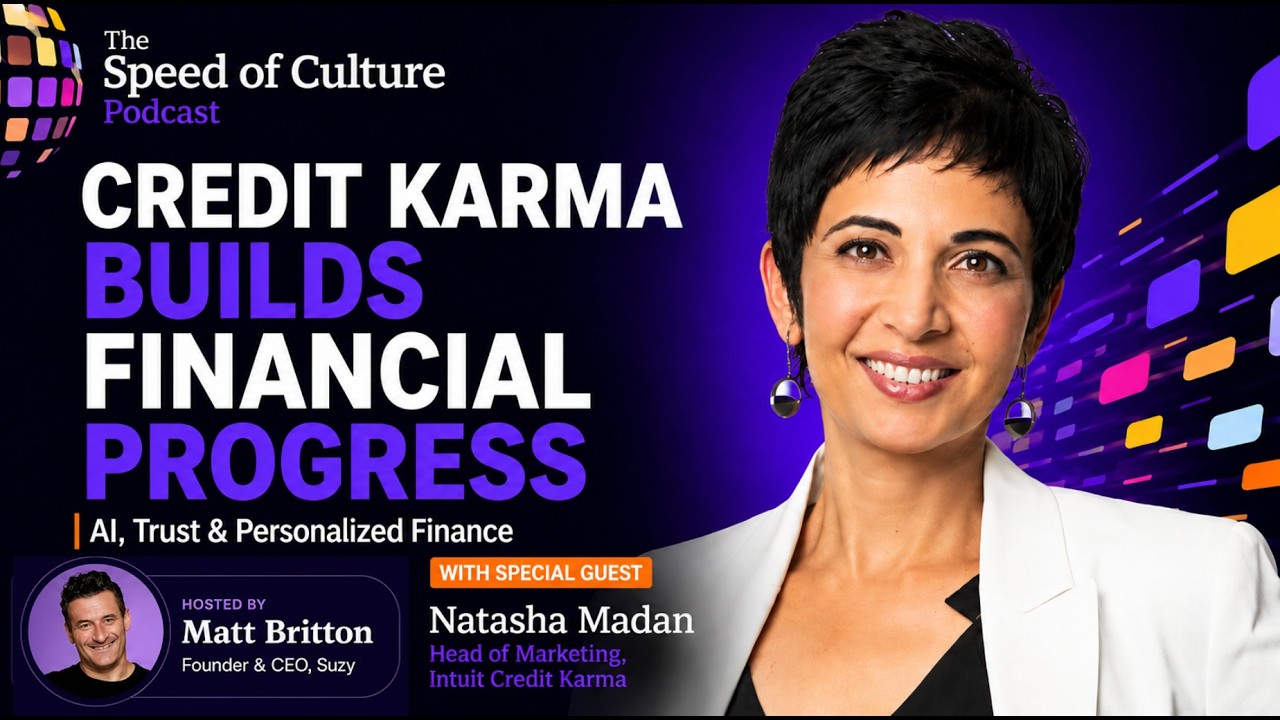
In a recent episode of The Speed of Culture podcast, recorded live at CES 2026 in Las Vegas, Matt Britton sits down with Natasha Madan, Head of Marketing at Intuit Credit Karma, to explore how the company is evolving from a credit monitoring tool into a personalized AI-powered financial assistant. The conversation reveals how the intersection of artificial intelligence, consumer empathy, and trust is redefining what financial services can look like at scale. For business leaders across industries, the lessons extend far beyond fintech. As Britton argues in his AI keynote presentations, the brands that combine data intelligence with emotional intelligence will define the next decade of consumer engagement.
Credit Karma operates with more than 70,000 data points per member, a staggering volume of financial information that spans credit histories, spending patterns, tax filings, debt positions, and savings behavior. That scale enables real-time personalization that goes far beyond generic product recommendations. If a member checks their credit score, the platform immediately shows them how to improve it. If they are shopping for a credit card, they receive pre-qualified recommendations tailored to their specific financial profile.
But as Madan makes clear on the podcast, data volume alone is not the competitive advantage. The real frontier is what she describes as long-term financial trajectory curation. Rather than simply recommending the next best action (pay down this debt, open this savings account) Credit Karma's ambition is to connect short-term financial behaviors to lifetime wealth-building trajectories.
This evolution mirrors a broader shift in how AI is being deployed across consumer-facing industries. The companies extracting the most value from artificial intelligence are the ones translating data into action that consumers can feel and trust, regardless of how much data they hold. Intuit has invested heavily in this direction, deploying over 22,000 machine learning models monthly across the Credit Karma platform and embedding generative AI through its Intuit Assist feature, which allows members to engage in personalized financial conversations powered by their own data.
For enterprise leaders, the principle is transferable. As Matt Britton explores in his national bestseller Generation AI, the brands that will thrive in the AI era are those that move beyond data collection and toward what he calls "intelligence delivery" turning information into personalized, actionable experiences that create measurable outcomes for consumers.
Credit scores have become commoditized. Dozens of apps and banks now offer free credit monitoring, making the service itself a commodity rather than a differentiator. Madan acknowledges this reality directly and frames Credit Karma's evolution as an expansion of the value proposition well beyond credit visibility.
The platform is positioning itself as a comprehensive financial dashboard, what Madan describes as "a financial assistant in your pocket." That dashboard now encompasses credit optimization, debt consolidation, tax filing automation, savings guidance, and investment recommendations. The recently announced Intuit Consumer Platform integrates Credit Karma with TurboTax, creating a unified experience where tax refunds, debt paydown strategies, and wealth-building plans all connect through a single interface.
Several new AI-powered features illustrate the ambition. Credit Karma's Debt Assistant analyzes a member's complete financial picture and automatically crafts a personalized debt paydown plan, including recommendations for consolidation and refinancing. The Tax Assistant transforms annual filing into year-round micro-steps, with members able to have up to 80% of their taxes prepared before filing season even begins. A forthcoming Refund Assistant will immediately direct tax refund dollars toward the highest-impact financial action for each individual member, whether that means building an emergency fund, paying off high-interest debt, or investing.
This consolidation strategy reflects a pattern Britton frequently highlights in his keynotes to financial services leaders: the winners in AI-transformed industries are platforms that aggregate fragmented experiences into unified, intelligent workflows. In financial services specifically, the shift from point solutions to comprehensive platforms is accelerating, and the companies that own the consumer's financial decision-making context will capture disproportionate value.
Younger consumers are increasingly turning to social platforms for financial education, a trend that has reshaped how an entire generation thinks about money. According to GWI research, 39% of Gen Z have learned financial concepts from social media platforms like TikTok and YouTube. The World Economic Forum reports that more than 50% of Gen Z individuals started learning about investing before even entering the workforce, double the rate of Baby Boomers.
But social-driven financial education comes with significant risks. Generic content from creators and influencers cannot replace personalized guidance tailored to an individual's actual financial situation. Exposure to financial concepts is frequently mistaken for genuine understanding, and confidence can outpace context. Research published in early 2026 found that fintech adoption is driven primarily by trust in AI rather than actual financial or technological literacy, a finding that highlights both the opportunity and the vulnerability of AI-powered financial guidance.
Madan sees this tension as both a risk and an opportunity for Credit Karma. Through products like Credit Spark, the platform focuses on building durable financial habits rather than delivering one-time advice. Credit Spark helps members, particularly those with thin or no credit history, build credit by sharing everyday payments like rent, utilities, and phone bills with credit bureaus. The feature can incorporate up to 24 months of past payments, giving younger consumers a practical on-ramp to the traditional credit system.
The focus, as Madan emphasizes, is not on once-and-done actions but on long-term financial sustainability. This philosophy aligns with what Britton describes in Generation AI as the defining characteristic of brands that succeed with younger consumers: they do not just provide access to information. They create systems that build capability and confidence over time.
For financial services marketers, the implication is clear. The battle for younger consumers is won through platforms that transform information into habitual behavior and earn trust through sustained, personalized value delivery, rather than through viral content or clever campaigns.
As AI democratizes both targeting and creative production, Madan argues that differentiation in financial services will increasingly come down to a single variable: trust. In a world where any brand can generate personalized content at scale, the brands that compound trust over time will outperform those that optimize only for short-term conversion.
This perspective is supported by the data. The World Economic Forum's research found that nearly 20% of Gen Z non-investors cite lack of trust in financial institutions as the primary reason they do not invest. At the same time, more than 40% of Gen Z report being comfortable having AI manage their investments, compared to just 14% of Baby Boomers. The trust is migrating, but it is migrating toward platforms and technologies that demonstrate competence, transparency, and consistent value.
Credit Karma is investing in this trust equation through several channels. On the acquisition side, the company is partnering with micro-influencers and creators who have genuine credibility within specific communities, recognizing that authenticity within a niche audience will outperform algorithmic reach alone. On the product side, features like the "See Why" explanation, which uses generative AI to contextualize why a specific credit card is being recommended based on a member's unique wallet composition, build confidence through transparency rather than persuasion.
Madan frames this as a structural advantage. Credit Karma's business model aligns incentives naturally: if the platform recommends a financial product that genuinely fits a member's needs, satisfaction and retention increase. If it recommends something that does not fit, members leave. That alignment between business outcomes and consumer outcomes is what makes trust scalable.
As Britton frequently notes in his keynotes to Fortune 500 audiences, the AI era will create two types of brands: those that use technology to extract value from consumers and those that use technology to create value for consumers. In financial services, where the stakes are personal and the consequences of poor advice are tangible, the distinction will be existential.
Madan closes the conversation with a personal leadership mantra that encapsulates the entire episode: "If I don't drive, I will be driven." In the AI-accelerated landscape, reactive marketing is obsolete.
The pace of change in financial services underscores the urgency. Credit Karma reported $616 million in quarterly revenue in Q2 2026, representing 23% year-over-year growth. Intuit's integration of agentic AI across its consumer platform, with AI agents that do not just recommend actions but execute them, signals a future where financial management happens increasingly in the background, automated and personalized at a level that was unimaginable five years ago.
For marketing leaders, Madan's philosophy translates into three operational imperatives. First, experimentation must become continuous rather than campaign-based. Second, teams must develop the capacity to look around corners, anticipating where consumer behavior is headed rather than reacting to where it has been. Third, leaders must push beyond permission, creating space for their organizations to take calculated risks before the competitive landscape forces their hand.
This proactive posture is particularly critical in financial services, where regulatory complexity and institutional caution can create a gravitational pull toward incrementalism. The companies that will define the next era of fintech are those whose leadership embraces the discomfort of moving faster than the category norm, while maintaining the trust that makes speed sustainable.
The conversation between Britton and Madan offers a blueprint that extends well beyond financial services. For any leader navigating the convergence of AI, consumer behavior, and trust, the formula is the same: combine the emotional intelligence to understand what consumers actually need with the data intelligence to deliver it personally, proactively, and at scale.
AI is shifting financial services from static product recommendations to dynamic, personalized financial management. Platforms like Credit Karma now deploy over 22,000 machine learning models monthly and generate 60 billion daily predictions to deliver tailored guidance across credit, debt, taxes, savings, and investing. Generative AI enables conversational financial advice personalized to each member's specific situation, turning what was once a credit score app into a comprehensive financial assistant.
As AI makes personalized targeting and content generation available to every brand, the ability to generate trust at scale becomes the primary competitive moat. Research from the World Economic Forum shows nearly 20% of Gen Z non-investors cite institutional distrust as their main barrier, while over 40% are comfortable having AI manage their investments. The brands that align business incentives with genuine consumer outcomes, and demonstrate that alignment transparently, will capture the loyalty of the next generation of financial consumers.
Gen Z is learning about money earlier and through fundamentally different channels than previous generations. Thirty-nine percent have learned financial concepts from social media, and more than half started exploring investing before entering the workforce. However, exposure does not equal expertise. Research shows fintech adoption is driven more by trust in AI than by actual financial literacy, which creates both opportunity for platforms that provide personalized education and risk for consumers who act on generic social media advice without individual context.
Credit Karma's evolution offers a transferable framework for any industry undergoing AI transformation. The key principles are consolidating fragmented experiences into a single intelligent platform, using AI to connect short-term actions to long-term outcomes, building trust through transparency and incentive alignment, and maintaining a proactive leadership posture that prioritizes experimentation over incrementalism. These principles apply whether the domain is financial services, healthcare, retail, or any consumer-facing category.
The conversation between Matt Britton and Natasha Madan reveals a future of financial services that is deeply personal, radically proactive, and powered by the intelligent application of AI to one of the most emotionally complex categories in consumer life.
For leaders across industries, the implications extend far beyond fintech. The principles that Credit Karma is applying, translating data into action, building trust as a compounding asset, and leading proactively in an accelerating landscape, represent a blueprint for any organization navigating the AI transformation.
Hear the full conversation on The Speed of Culture podcast, and for a comprehensive exploration of how AI is reshaping consumer behavior and business strategy across generations, explore Matt Britton's national bestseller Generation AI. To bring these insights to your next leadership event or industry conference, visit Matt Britton's speaking platform or connect with his team directly.