Opening
In the beauty industry, scale has traditionally required compromise, companies sacrifice personalization for breadth, or depth for speed. But what happens when a brand can deliver hyper-personalized experiences to 46 million loyalty members simultaneously? That's precisely what Ulta Beauty has accomplished by reimagining how artificial intelligence shapes modern retail marketing.
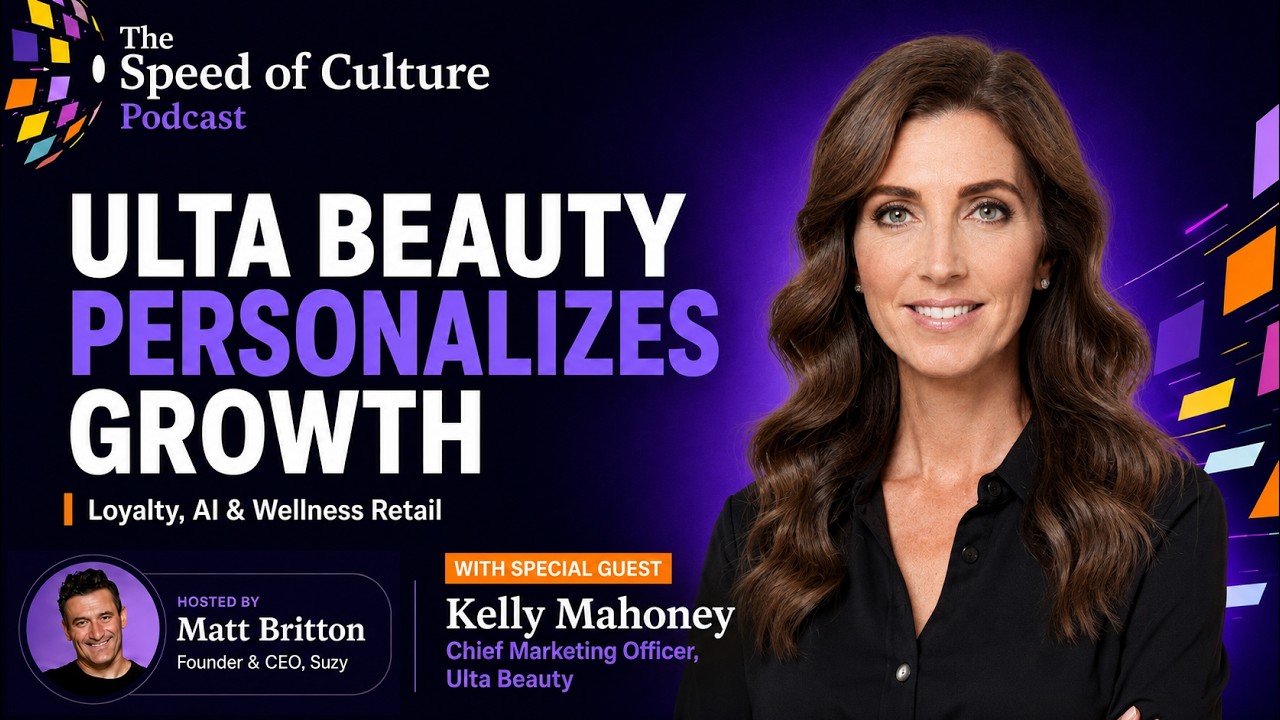
In Episode 236 of The Speed of Culture Podcast, recorded live from CES 2026, host Matt Britton, founder and CEO of Suzy, the AI-powered consumer intelligence platform, sat down with Kelly Mahoney, Chief Marketing Officer at Ulta Beauty, to unpack the strategic framework driving one of beauty retail's most impressive competitive advantages: a fully integrated AI personalization engine that powers nearly 95% of the company's sales.
The conversation reveals a fundamental shift in how leading beauty retailers think about customer relationships. Gone are the days when demographic segmentation sufficed. Ulta Beauty has moved beyond age and gender buckets toward motivation-based marketing, understanding not who customers are, but why they shop, where they discover products, what drives replenishment, and how their shopping patterns evolve.
This shift from static demographics to dynamic behavioral intelligence represents one of the most consequential marketing transformations in retail today.
For marketing leaders, this episode offers a masterclass in scaling relevance. Mahoney discusses how Ulta Beauty's 46+ million Rewards members generate approximately 95% of sales, a concentration of revenue that would overwhelm most organizations but instead fuels a powerful virtuous cycle.
First-party loyalty data feeds a connected Adobe CDP (Content Delivery Platform) infrastructure, which trains AI models to predict customer preferences, automate content creation through Adobe Firefly, and deliver seamless experiences across mobile, social, digital, and physical retail channels.
The stakes are higher than quarterly metrics. As consumers become increasingly discerning and fragmented across channels, the brands that win will be those capable of meeting customers with the right message, product, and experience at the precise moment of need.
Ulta Beauty's approach demonstrates that this capability, once considered a luxury, is now a necessity. This exploration of intelligent beauty personalization provides essential context for understanding how AI will reshape retail, marketing, and the customer experience for years to come.
The Architecture of Loyalty-Driven AI Personalization
Ulta Beauty's competitive advantage doesn't emerge from a single technology or tactic, it stems from an integrated architecture that treats the loyalty program as the foundational data engine for all downstream marketing decisions. This structural thinking represents a significant departure from how many retailers approach loyalty, where programs often function as discrete discount mechanisms rather than intelligence-gathering systems.
Kelly Mahoney's leadership has centered the Ulta Beauty Rewards program as what she calls "the heartbeat of the business." With 46+ million members, the program captures behavioral signals across the entire customer lifecycle: what products customers browse, which items they purchase, when they replenish, how they respond to personalized recommendations, and how they engage across digital and physical touchpoints.
This first-party data asset is extraordinarily valuable precisely because it reflects authentic customer intent rather than inferred preferences based on demographic assumptions.
The monetization of this insight is straightforward but profound: loyalty members generate approximately 95% of Ulta Beauty's sales. This extreme concentration of revenue around a specific customer subset creates powerful alignment within the organization.
Every decision, from merchandising to content creation to media allocation, can be informed by loyalty data and optimized for member lifetime value rather than spread thin across discount-driven acquisition channels.
Ulta Beauty capitalized on this advantage by centralizing customer data from multiple sources: emails, transaction history, in-store purchases, online behavior, social interactions, and mobile app engagement. The company stitched disparate data sources together to construct unified customer profiles that reveal preferences and transaction patterns across all channels.
This technical foundation, powered by Adobe Real-Time Customer Data Platform, creates a single source of truth for customer understanding across the organization.
The implementation speed itself reveals Ulta Beauty's operational discipline. The company deployed Adobe's Real-Time CDP in just four months, remarkable for a retail organization of Ulta's scale.
This accelerated timeline suggests mature data infrastructure, clear executive alignment, and a culture that prioritizes rapid experimentation. Speed matters in personalization; as customer preferences shift, the ability to recognize and respond to emerging patterns becomes a competitive asset in itself.
With unified customer profiles in place, Ulta Beauty deployed advanced AI and machine learning models designed to understand customers and predict their future behavior.
These models serve multiple functions: they identify customers most likely to repurchase specific product categories, recognize micro-preferences in shades and textures, detect when customers are likely to be in-market for new categories, and forecast optimal times for engagement across channels.
The business impact of this predictive capability is substantial. Ulta Beauty's AI-driven personalization has driven a 95% customer repurchase rate, a metric that reflects not just transactional behavior but fundamental brand affinity.
This exceptional retention rate means the company can invest in richer, more expensive customer experiences because the lifetime value of retained customers justifies the investment.
Motivation-Based Segmentation: Beyond Demographics in the AI Era
For decades, retail marketing has organized customers into segments based on demographic characteristics: age ranges, gender, income brackets, and geographic location. These demographic segments proved useful because they were observable, consistent, and easy to understand.
But they also proved increasingly inadequate because demographics don't actually predict behavior in meaningful ways. A 35-year-old woman in Boston may have entirely different shopping motivations, discovery preferences, and product needs compared to another 35-year-old woman in the same city.
Ulta Beauty's shift to motivation-based marketing represents a more sophisticated approach to segmentation, one enabled specifically by AI's capacity to process vast behavioral datasets and identify non-obvious patterns.
Rather than asking "who is this customer?" the company now asks "why does this customer shop, when do they shop, and what drives their replenishment cycles?"
These motivation-based questions yield dramatically different insights. Ulta Beauty discovered that discovery happens through distinct channels for different customer motivations: some customers research extensively through social media and influencer content, while others rely on in-store education and consultation.
Some customers shop out of habit and replenishment need, while others shop for occasional treats and exploration. Some view beauty as personal wellness, while others approach it primarily as self-expression.
Demographics tell none of these stories.
By training AI models on customer behavior data, Ulta Beauty can identify these motivation patterns at scale. The company can recognize when a customer begins showing interest signals in the wellness category, even before they've purchased from that section.
It can identify which customers are most influenced by peer recommendations versus expert guidance. It can detect seasonal and cyclical shopping patterns that reflect genuine customer needs rather than artificial calendar moments.
The personalization implications are profound. When a customer logs into the Ulta Beauty app or visits a store, the personalization engine can surface product recommendations that align with their specific motivations, not broad demographic assumptions.
A customer flagged as "wellness explorer" sees different homepage content than a customer identified as "targeted replenishment shopper." The messaging, creative execution, even the product assortment recommendations become individually tailored.
Adobe Firefly plays a critical role in making this scale possible. Creating millions of individually tailored promotional messages, email variations, and in-app experiences would require unlimited creative resources if done through traditional production methods.
Firefly's generative AI capabilities enable marketing teams to produce more content, more efficiently, without sacrificing quality or intent. The system can generate multiple creative variations against the same campaign concept, testing different messaging angles against different customer motivation segments, learning which approaches resonate with specific segments, and continuously optimizing.
This approach also surfaces an important truth about AI personalization: it is more focused human effort, and no less human.
The creative strategy still requires human insight about beauty, wellness, and the emotional drivers of customer choice. But instead of one human trying to create one message for millions of customers, humans can now architect systems where AI assists in scaling that focused insight across diverse audiences.
Omnichannel Integration: Seamless Experience Across Digital, Social, and Physical Retail
The true complexity of Ulta Beauty's AI personalization strategy reveals itself at the omnichannel intersection. The company doesn't operate separate marketing strategies for different channels; instead, it treats channels as extensions of a single, unified customer experience.
A customer's social media discovery behavior informs their app homepage experience, which influences the personalized recommendations they receive in-store, which shapes the email messages they receive next.
This omnichannel integration starts with data. The Adobe CDP collects behavioral signals from all channels: clicks and searches on the website, video watches on social platforms, in-store transactions, app engagement, email interactions, and mobile push notification responses.
These signals combine into comprehensive customer profiles that Adobe Journey Optimizer uses to orchestrate experiences across channels.
Journey Optimizer operates according to a principle of contextual relevance: delivering the right message through the right channel at the right moment in the customer's journey.
A customer who's researched a specific foundation formula on social media might receive an in-app notification reminding them they can try it in-store, with a real-time inventory check that confirms availability.
An in-store purchase of a new beauty category might trigger a personalized email sequence from Ulta Beauty's loyalty program, introducing complementary products and exclusive member offers timed to the typical replenishment cycle.
The mobile-first emphasis is particularly important in Ulta Beauty's strategy. Mobile devices serve as the primary discovery and engagement platform for many beauty consumers, especially younger demographics.
The personalization engine prioritizes mobile experience, ensuring that app users encounter highly tailored product recommendations, curated collections aligned to their demonstrated interests, and frictionless checkout flows based on their shopping preferences.
The company leverages this mobile-first approach to drive loyalty membership enrollment, as app users show higher engagement and retention than traditional digital channels.
Social discovery also plays a foundational role. Beauty consumers increasingly discover products through social platforms (TikTok, Instagram, YouTube) where influencers and creators drive trend adoption.
Ulta Beauty's personalization strategy recognizes this social discovery pattern, enabling customers to seamlessly transition from social inspiration to purchase through connected touchpoints.
A product spotted on social can be saved to an Ulta Beauty wishlist, receive personalized in-app recommendations based on similar products the customer has purchased, and trigger targeted messaging about availability or exclusive member pricing.
In-store experience becomes another critical personalization touchpoint. Rather than treating physical retail as separate from digital, Ulta Beauty enables store associates to access customer data, with appropriate privacy controls, that shows loyalty members' purchase history, preferences, and current interests.
An associate greeting a regular customer knows whether they're in-market for skincare replenishment, exploring a new color palette, or interested in the expanding wellness category.
This context enables more meaningful conversations and more effective product recommendations, elevating the in-store experience from transactional to consultative.
Adobe Customer Journey Analytics provides the measurement infrastructure that ties these experiences together.
The company can track how customers move through the omnichannel journey, which touchpoints drive conversion, which channels contribute to customer lifetime value, and where friction points exist in the experience.
This analytics capability enables continuous optimization: if data shows that app users who receive personalized recommendations within 24 hours of browsing show higher conversion, the system can prioritize that timing across customer segments.
The personalization engine's future evolution points toward fuller automation. Ulta Beauty's North Star, as Mahoney describes it, is to create a fully automated personalization engine that dynamically adjusts in real-time as users interact with the brand.
This vision means that no human must manually design thousands of customer journeys or message variations.
Instead, the system continuously learns which experiences drive desired outcomes for different customer segments and automatically optimizes the experiences delivered to new customers based on behavioral similarity to previous cohorts.
This approach represents the frontier of AI personalization: moving from programmatic optimization within human-defined frameworks to systems that can independently identify and act on emerging patterns.
The Data Foundation: Building Competitive Advantage Through First-Party Insights
In an era of increasing privacy regulation and declining third-party data availability, first-party data, information customers provide directly to brands through loyalty programs, purchases, and explicit engagement, has become the most valuable competitive asset in retail marketing.
Ulta Beauty's 46+ million loyalty members represent an extraordinarily rich first-party data asset, precisely because the company has designed its loyalty program to capture authentic customer intent across the entire journey.
The construction of this data advantage began years before AI personalization became mainstream. Ulta Beauty recognized that a loyalty program's value to the company should be proportional to its value to customers.
Members receive tangible benefits: exclusive pricing, early access to products, curated recommendations, and a differentiated shopping experience.
These benefits drive enrollment and continued engagement, which creates the behavioral data that powers personalization.
The scale of Ulta Beauty's first-party data advantage is difficult to overstate.
While many competitors operate with fragmentary customer understanding, perhaps knowing email subscribers in one system and in-store purchasers in another, Ulta Beauty has unified customer identity across all touchpoints.
The company knows that a customer who browsed a specific product on social, saved it to their wishlist in the app, visited a store location, asked an associate a question, and ultimately purchased is a single individual with a coherent set of preferences and needs.
This unified customer view enables a form of competitive moat.
As competitors attempt to build similar personalization capabilities, they must start from fragmented first-party data and third-party signals increasingly unavailable due to privacy regulations.
Ulta Beauty, with years of accumulated loyalty data, can train more sophisticated models, generate more accurate predictions, and deliver more relevant experiences.
New competitors building similar systems from scratch would require years to accumulate equivalent data depth.
The business case for Ulta Beauty's first-party data strategy also becomes clearer in financial terms.
The company invests in loyalty benefits (preferential pricing, member-exclusive offers, rewards) that reduce short-term margin but drive long-term customer value.
These investments are rational precisely because the loyalty program captures data that allows personalization at the scale Ulta Beauty has achieved.
The revenue concentration, 95% of sales from loyalty members, means these investments deliver outsized returns.
For competitors without equivalent loyalty data, similar investments would be speculative.
Privacy considerations also strengthen Ulta Beauty's position.
As regulations like GDPR and similar frameworks emerge globally, brands that rely heavily on third-party data face increasing compliance friction.
Ulta Beauty's emphasis on first-party data through its loyalty program positions the company to operate effectively in an increasingly privacy-constrained environment.
Customers understand they're providing data in exchange for personalized benefits; the arrangement is transparent and mutually beneficial.
The strategic implication extends beyond marketing efficiency.
Ulta Beauty's rich first-party data enables product development insights that competitors lack.
Merchandising teams can see which products generate the highest engagement, which categories show seasonal or cyclical demand patterns, and which product combinations appeal to specific customer motivations.
Retail operations can optimize store layouts and inventory distribution based on location-specific customer behavior.
Supply chain planning can anticipate demand with greater accuracy.
The data advantage, once established, cascades across the entire organization.
Marketing at Scale: How Adobe Tools Enable Personalization Without Sacrifice
One of the persistent challenges in personalization at scale is what might be called the creativity paradox: as you attempt to personalize more extensively (more customer segments, more channels, more message variations) the creative requirements expand exponentially.
Creating meaningful, on-brand, contextually relevant messaging for millions of individual personalization experiences would require creative resources that exceed any organization's capacity.
Adobe Firefly solves this challenge by functioning as a force-multiplier for creative teams.
Rather than asking creatives to personally design and execute thousands of message variations, teams can architect core creative concepts and campaign strategies, then use Firefly to generate multiple variations at scale.
A campaign promoting a new wellness product line might feature different imagery, messaging angles, and color palettes for different customer segments.
Instead of assigning these variations to multiple designers, a single designer can provide direction to Firefly: "Create 20 variations of this banner for our wellness-focused audience, emphasizing self-care and holistic health," and iterate on the system's output until it matches brand intent and messaging objectives.
This capability doesn't replace human creativity; rather, it removes tedious production work and enables human creatives to focus on strategy and concept-level decisions.
The outcome is often higher-quality work produced more efficiently.
Teams can test more creative variations, learn which approaches resonate with different segments, and continuously improve their messaging library.
Traditional production timelines compressed from weeks to days, enabling more agile response to market changes and customer preferences.
Adobe Journey Optimizer provides the orchestration layer that brings all these elements together.
The platform coordinates customer experiences across channels based on customer behavior and lifecycle stage.
If the CDP identifies that a customer is in the market for a specific product category, Journey Optimizer can automatically trigger a personalized email sequence with product recommendations, but only if the customer has demonstrated email engagement in the past.
If the customer's primary engagement channel is mobile app, the journey might instead begin with an in-app notification.
If the customer is a frequent in-store visitor, the system might prioritize a personalized promotional mailer.
The optimization extends beyond timing and channel to creative execution itself.
Journey Optimizer can direct different message variations to different audience segments based on their demonstrated motivations, purchase history, and engagement patterns.
A customer identified as "trendy explorer" might receive messaging emphasizing new, innovative products and trend-setting capabilities.
A customer flagged as "value-conscious" might see messaging emphasizing loyalty program rewards and exclusive member pricing.
The same underlying product receives different positioning based on what the CDP and AI models have learned about customer motivations.
Customer Journey Analytics completes the picture by providing comprehensive measurement across channels.
Rather than operating separate analytics dashboards for email, web, mobile, and social, Ulta Beauty can see the complete customer journey across all touchpoints.
The company can answer questions like: "What percentage of customers who receive personalized product recommendations via email ultimately purchase from mobile?" or "How does in-store brand consultation influence online repurchase rates?"
This holistic view enables optimization that would be impossible if channels were measured in isolation.
The competitive advantage of this integrated stack extends beyond personalization to operational efficiency.
Because campaigns are orchestrated across all channels based on unified customer profiles, the company avoids redundant messaging and channel conflict.
A customer doesn't receive the same offer through email and app on the same day; instead, the system intelligently spaces communications across customer preferences and engagement patterns.
This efficiency reduces marketing fatigue, improves customer experience, and often increases conversion despite lower overall message frequency.
Key Takeaways
- Loyalty as Core Architecture: Ulta Beauty's 46+ million loyalty members who generate 95% of sales represent the foundational data asset powering the entire personalization strategy, demonstrating that loyalty programs function as intelligence-gathering engines rather than discount mechanisms.
- Motivation-Based Over Demographics: Shifting from traditional demographic segmentation to motivation-based marketing, understanding why customers shop and what drives their behavior, enables dramatically more relevant personalization while leveraging AI's pattern-recognition capabilities at scale.
- First-Party Data as Competitive Moat: In an environment of increasing privacy regulation and declining third-party data, Ulta Beauty's accumulated first-party loyalty data represents a durable competitive advantage that competitors cannot quickly replicate.
- Omnichannel Integration Requires Unified Architecture: Seamless customer experiences across mobile, social, digital, and physical retail demand integrated data infrastructure and orchestration platforms that most retailers have not yet implemented at scale.
- AI Amplifies Human Creativity Rather Than Replacing It: Adobe Firefly and other creative automation tools enable marketing teams to execute more ambitious personalization strategies by removing production friction, allowing human creatives to focus on strategy and concept development.
Frequently Asked Questions
How does Ulta Beauty's loyalty program data inform AI personalization decisions?
Ulta Beauty's loyalty program captures behavioral signals across the entire customer lifecycle: product browsing, purchase history, engagement with email and app features, in-store visits, and interactions with content.
The company consolidates these signals into unified customer profiles through Adobe Real-Time CDP, then trains AI models to predict future behavior and preferences.
This continuous feedback loop enables increasingly accurate personalization as the company accumulates more behavioral data and models improve through experience.
What is motivation-based marketing segmentation and how does it differ from traditional demographic segmentation?
Traditional demographic segmentation groups customers by observable characteristics like age, gender, and location.
Motivation-based segmentation instead groups customers by their underlying reasons for shopping and demonstrated behavioral patterns, where they discover products, what drives replenishment, how they interact across channels, and which product categories align with their lifestyle philosophy.
AI enables motivation-based segmentation at scale by analyzing vast behavioral datasets to identify patterns that humans might not detect through direct observation alone.
How does Ulta Beauty measure the success of its AI personalization strategy?
Ulta Beauty uses Adobe Customer Journey Analytics to measure personalization success across multiple dimensions: customer lifetime value, repeat purchase rates, average order value, channel attribution, and customer satisfaction metrics.
The company can track how personalized recommendations influence conversion, how omnichannel journeys contribute to retention, and which creative variations drive engagement with different customer segments.
The headline metric, 95% customer repurchase rate among loyalty members, reflects both the effectiveness of personalization and the underlying strength of the loyalty program itself.
What role does Adobe Firefly play in Ulta Beauty's marketing execution?
Adobe Firefly generates content variations at scale, enabling marketing teams to maintain personalized messaging across millions of customer interactions without proportionally expanding creative resources.
Instead of manually designing unique creative assets for different segments, teams can provide direction to Firefly and iterate on the system's output.
This approach accelerates content production timelines, enables more experimentation with messaging approaches, and often improves creative quality by allowing human designers to focus on strategy rather than production tasks.
Looking Ahead
The intersection of AI, personalization, and loyalty represents one of the most consequential shifts in modern retail marketing.
Ulta Beauty's approach, treating loyalty programs as intelligence engines, motivation-based segmentation as the organizing principle for personalization, and first-party data as competitive moat, provides a template that resonates far beyond the beauty industry.
The broader implication is clear: the future of retail belongs to companies that can deliver increasingly relevant, personalized experiences at scale without sacrificing brand consistency or customer privacy.
Those capabilities require integrated technology infrastructure, mature data governance, and organizational cultures that prioritize experimentation and continuous optimization.
Ulta Beauty has demonstrated that these capabilities, once considered aspirational, are achievable with disciplined execution and the right technology partnerships.
For additional insights into AI-driven consumer intelligence and marketing transformation, explore these resources:
- Suzy - The AI-powered consumer intelligence platform providing real-time insights for marketing decisions
- The Speed of Culture Podcast - Where Matt Britton explores emerging trends and consumer behavior with industry leaders
- Generation AI: The Book - Matt Britton's national bestseller examining how AI reshapes business and society
- AI Keynote Speaker - Engaging presentations on AI's impact on consumer behavior and marketing strategy
- Speaker HQ - Complete speaker services and booking information

%20(400%20x%20100%20px)%20(300%20x%2050%20px)%20(150%20x%2050%20px).avif)