February 17, 2026
Hard Reset: How Lenovo is redefining AI PCs, edge computing, and trust

Milo Speranzo
Chief Marketing Officer
This is some text inside of a div block.
This is some text inside of a div block.
LISTEN ANYWHERE YOU FIND YOUR PODCASTS
%20(400%20x%20100%20px)%20(300%20x%2050%20px)%20(150%20x%2050%20px).avif)

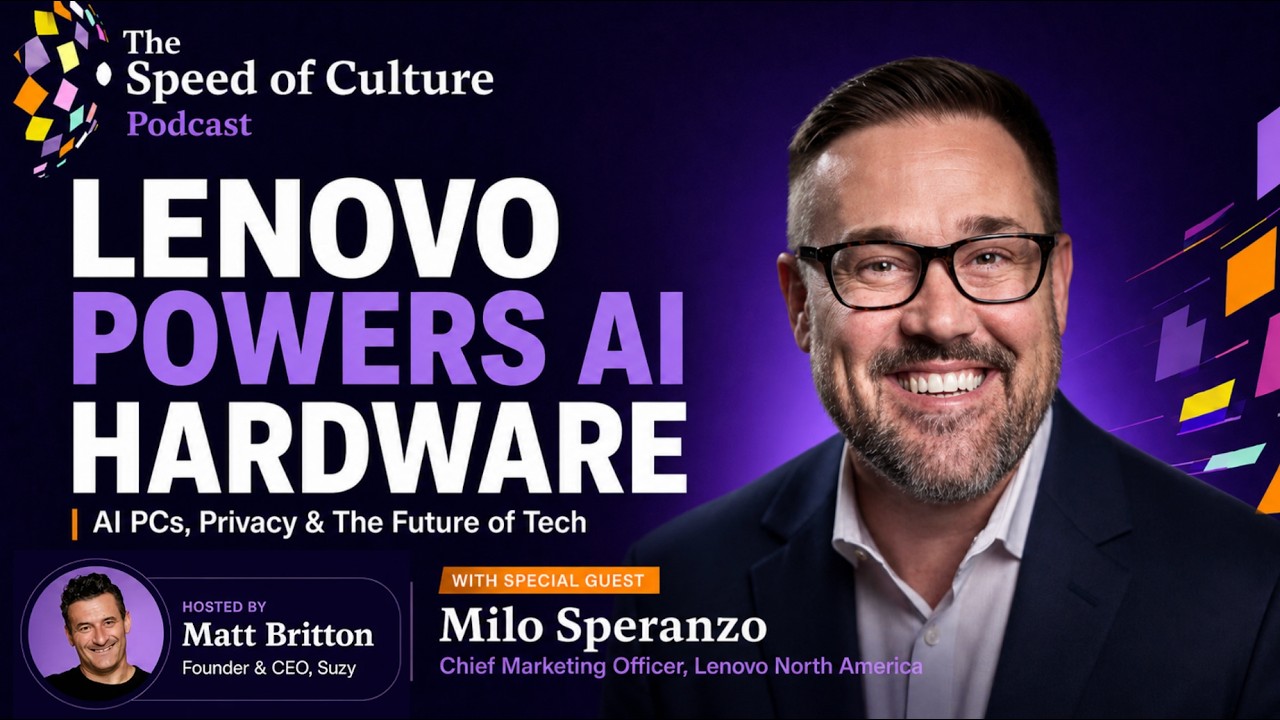
Artificial intelligence has moved from boardroom speculation to mainstream corporate strategy in a remarkably short timeframe. Yet the gap between technological capability and customer trust remains wide. At CES 2026, Lenovo articulated a vision that directly addresses this tension through an integrated approach to hardware, software, and ethical responsibility.
In the latest episode of The Speed of Culture Podcast, Matt Britton, founder and CEO of Suzy, the AI-powered consumer intelligence platform, sat down with Milo Speranzo, Chief Marketing Officer for Lenovo North America. Together, they explored how one of the world's largest technology companies is positioning itself not just as a device manufacturer, but as a systems integrator capable of delivering AI at scale.
The conversation, recorded live from Las Vegas during CES 2026, reveals a sophisticated strategic shift within Lenovo. After recognizing that small and medium businesses, alongside major enterprise accounts, wanted a clearer understanding of how AI fits into their operations rather than isolated device announcements, Lenovo made a calculated bet. It invested heavily in the Sphere, a sold-out venue, to demonstrate its end-to-end AI ecosystem spanning phones, wearables, personal computers, servers, and storage solutions.
This decision was about coherence rather than spectacle. It was about showing how integration creates value when customers are drowning in disconnected AI promises.
Milo brings 20+ years of experience to this challenge, having previously served as Senior Director of Marketing at Dell Technologies and begun his career with 13 years of service in the U.S. Air Force, including roles overseeing command and control operations. That background, both military discipline and enterprise sales perspective, informs Lenovo's approach to the trust problem.
Where others see AI as a technical achievement to be celebrated, Lenovo sees it as a responsibility to be managed. In 2026, as AI moves deeper into workplace and consumer workflows, the brands that succeed will be those that recognize that capability without trust is merely capability; trust without capability is marketing theater.
The episode explores five critical dimensions of this shift: the business case for major brand moments, the portfolio depth required to support AI at scale, how privacy becomes a purchase driver, the emerging AI PC refresh cycle, and the societal questions raised by always-on wearable intelligence. Across each dimension runs a common thread: Lenovo is betting that customers will choose complexity that works over simplicity that fails.
Traditional convention in tech marketing emphasizes controlled messaging in controlled environments. Lenovo rejected this playbook. Instead, it created an immersive environment designed to showcase how its portfolio works together in real-world contexts, a decision that emerged from data gathered during CES 2025.
The previous year revealed something unexpected: after a strategic pivot toward commercial and B2B audiences, Lenovo discovered that customers wanted education more than entertainment. Small and medium businesses with 50 to 500 employees weren't seeking another keynote. They needed hands-on time with actual products and direct access to experts who could explain the relationship between a ThinkSystem server, a ThinkPad laptop with AI capabilities, and a Motorola smartphone running a coordinated AI agent.
The Sphere event, held during CES 2026, became the physical manifestation of this insight. A sold-out venue provided the scale to accommodate thousands of attendees while creating intimate moments within breakout sessions. The investment was significant; the return was validation.
The fact that the event sold out immediately signaled that Lenovo's hypothesis was correct: customers showed up not for Lenovo's technology story, but for an understanding of how that story applied to their operations.
This approach carries three strategic implications:
Few companies operate across phones, wearables, personal computers, servers, and storage infrastructure within a single portfolio. That breadth creates both opportunity and responsibility. Lenovo's approach focuses on orchestration, the idea that tools work better when they understand one another.
This manifests concretely in the Lenovo Qira platform, a personal AI super agent unveiled at CES 2026. Unlike traditional AI tools that require users to open an application and explicitly request assistance, Qira operates as an ambient system-level intelligence. It works across devices, understands context, and moves work forward without forcing constant user intervention.
Initial implementations include real-time transcription, notification summarization, and coordination across applications and devices to handle tasks like travel bookings or document management. Crucially, Qira can operate entirely offline, addressing a fundamental concern that dominates actual usage patterns.
Enterprise customers face scenarios where cloud reliance introduces friction or risk. A personal AI agent that operates locally, retains control locally, and syncs to cloud systems only with explicit permission becomes a genuine differentiator.
The ecosystem architecture supporting Qira demonstrates the advantage of integration. Phone-to-PC coordination allows context to flow seamlessly. Wearable devices provide environmental context (location, calendar, recent communications) that inform prioritization. Storage systems maintain the knowledge base that personalizes the agent's behavior over time, while server infrastructure handles training and fine-tuning that doesn’t run on the device itself.
When companies build AI capabilities as bolt-on features rather than integrated systems, they create friction. Over time, friction fatigue limits adoption. Lenovo is betting that customers will accept the upfront complexity of an integrated ecosystem because that ecosystem works reliably across contexts without requiring constant manual intervention.
In 2026, privacy is a requirement. Yet most companies treat privacy as a feature to be bolted on after the fact rather than as a foundational principle.
Lenovo positions edge computing, the ability to run sophisticated AI inference directly on the device, as fundamentally a privacy solution. When your PC runs AI locally, even offline, you maintain control. Data doesn’t automatically flow to distant servers.
This shifts the conversation from trusting a privacy policy to trusting a technical architecture. Policies change. Regulatory environments evolve. But an architecture where user data stays on the device by default requires understanding, not blind trust.
In enterprise contexts, financial documents, healthcare records, and HR information remain local. Only aggregated, anonymized insights move to cloud systems for broader intelligence. In consumer contexts, edge-first design addresses anxiety about always-on devices and constant data collection.
This architecture also provides resilience against tightening regulation, including frameworks like the EU’s AI Act and California’s CCPA. Companies that build privacy into their technical foundation won’t need full redesigns as regulations evolve.
The AI PC market is at an inflection point, moving from pilot programs into mainstream adoption. The refresh cycle begins with engineers, architects, designers, and advanced content creators, professionals whose workflows directly benefit from local inference capability.
An architect running simulations with NPU acceleration sees meaningful performance gains. A video editor benefits from local AI upscaling without cloud delays. A data scientist iterates faster with tensor acceleration. For these users, AI PCs are productivity investments with measurable ROI.
Adoption then diffuses outward. Word-of-mouth and internal proof points lower switching barriers. Over time, the AI PC becomes the baseline for knowledge work.
Market timing amplifies this trend. Pandemic-era purchasing created a massive installed base of devices now three to five years old. These machines lack neural processing unit acceleration and memory bandwidth required for modern AI workloads.
The data supports the acceleration:
This refresh cycle is driven by real workflow friction, not speculative future-proofing. That distinction makes the upgrade durable.
Wearable AI devices raise questions that extend beyond technology into ethics and governance. Continuous biometric monitoring, environmental sensing, and contextual awareness can deliver extraordinary value, but also unprecedented surveillance risk.
Lenovo addresses this tension directly. In discussing CES 2026 wearable proof-of-concepts, Milo emphasized transparency, visible recording indicators, and governance structures with external validation rather than self-grading assurances.
Practical trust mechanisms may include clear UI indicators when recording, transparent documentation of data collection and storage, and regular external audits. Trust is earned institutionally, not declared in marketing copy.
The always-on device market will face headwinds unless companies demonstrate serious commitment to responsible practices. Those that proactively address governance will accelerate adoption. Those that minimize concerns will face barriers no marketing budget can overcome.
Lenovo’s role as technology partner for the FIFA World Cup 2026 and the FIFA Women’s World Cup 2027 extends beyond brand sponsorship. The partnership centers on AI-powered football analytics built on Lenovo infrastructure.
Football AI Pro, powered by Lenovo servers and inference systems, will provide advanced video analysis and real-time intelligence to participating nations. Smaller or underfunded teams gain access to capabilities previously reserved for elite programs.
This strategy achieves multiple objectives:
If national football programs gain competitive advantage through Lenovo AI infrastructure, CIOs and IT leaders take notice. Sports partnerships become visible validation of enterprise capability.
Milo’s leadership mantra for 2026 is simple: learn, iterate, and be a goldfish. Learning and iteration enable organizations to adapt faster than competitors. Being a goldfish, shedding setbacks quickly, ensures resilience during transformation.
Large-scale change inevitably produces missteps. The difference lies in whether organizations absorb lessons and move forward or become paralyzed. Lenovo’s coordination of 14,000 people across business units for CES 2026 required alignment without micromanagement and flexibility amid complexity.
The Sphere’s rapid sell-out validated the strategy. Yet the framing suggests Lenovo is already refining what to sustain and what to improve for future brand moments.
Edge computing refers to processing data on local devices rather than sending it to cloud servers. Lenovo emphasizes it because it enables sophisticated AI capability (local inference, real-time responsiveness, and context awareness) while preserving user privacy. Data stays on the device, and cloud processing is reserved only for tasks that genuinely benefit from centralized resources.
Lenovo Qira operates as an ambient system-level intelligence rather than an app-based assistant. It works across devices, understands context, coordinates actions across applications, and functions offline. Its key differentiator is reducing friction by operating invisibly in the background instead of requiring constant user prompts.
The AI PC refresh cycle has begun. Early adopters with intensive workflows will refresh within 6–12 months. Broader adoption will accelerate through 2026 and 2027, with significant penetration across installed bases within 24 months and fuller transitions over 36–48 months. Pilot programs among power users are a proven starting point.
Demand transparency regarding data collection, storage, and access. Verify external governance and audits. Conduct pilot programs before broad deployment. Establish clear policies around data retention and access. Privacy concerns are legitimate, and responsible vendors will accommodate reasonable transparency requirements.
The conversation between Matt Britton and Milo Speranzo highlights a broader shift in how technology companies position themselves. As AI becomes infrastructure, the winners will recognize three truths: capability without trust is theater, integration creates durable advantage, and sustainable growth comes from solving real problems.
Brand leaders should begin with customer workflows, not product features. Pilot with power users. Build governance structures that demonstrate responsible commitment rather than merely claiming it.
IT leaders should recognize that portfolio breadth enables consistent implementation across devices, applications, and cloud systems. Systematic privacy and security features earn user confidence faster than add-ons.
Organizational leaders should embrace learning, iteration, and resilience. In rapidly evolving environments, adaptability becomes the ultimate competitive advantage.
To explore these themes further, listen to The Speed of Culture Podcast Episode 235. For deeper insights into consumer trends and AI’s market impact, explore Generation AI, learn more about Matt’s AI keynote speaking, or connect through mattbritton.com.