Opening
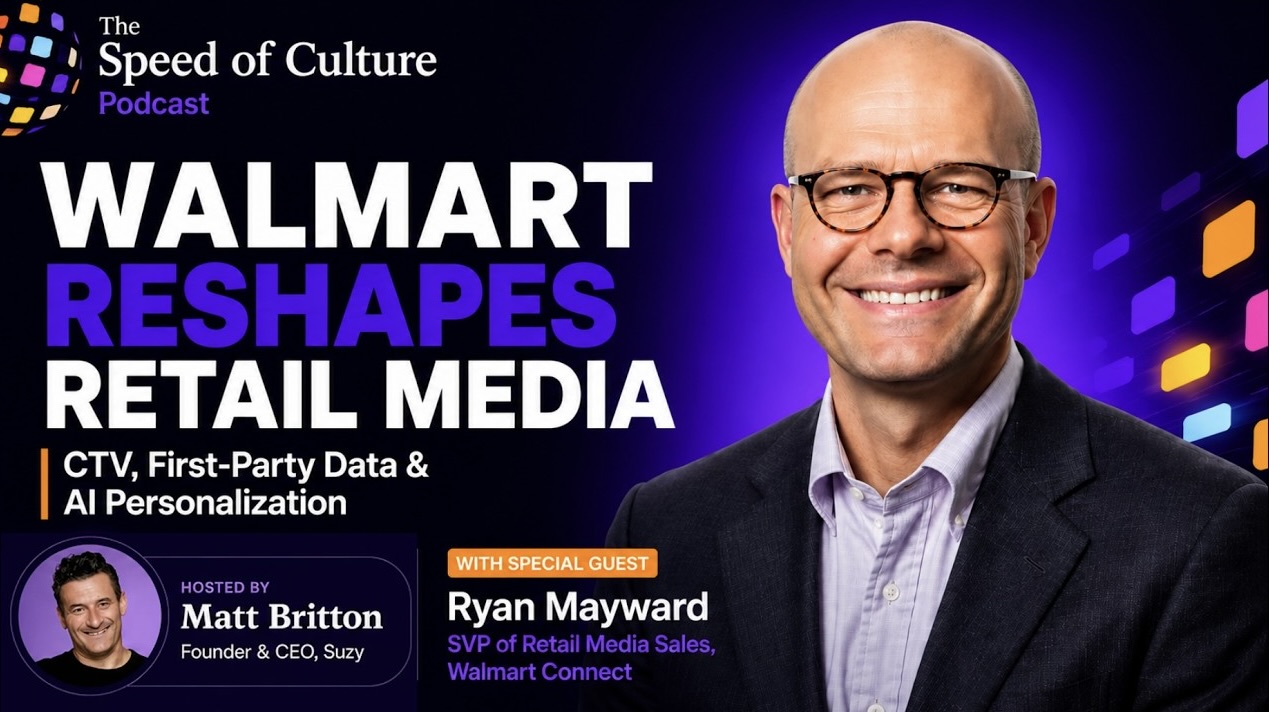
In Episode 194 of The Speed of Culture Podcast, Matt Britton, founder and CEO of Suzy, the AI-powered consumer intelligence platform, sits down with Ryan Mayward, Senior Vice President of Retail Media Sales at Walmart Connect, to explore how Walmart is fundamentally transforming retail advertising in 2025.
This conversation reveals a pivotal moment in the advertising industry: the shift from traditional promotional thinking to a sophisticated, data-driven ecosystem where first-party data, artificial intelligence, and omnichannel integration create unprecedented value for brands and retailers alike.
Ryan Mayward brings nearly two decades of experience at the intersection of ecommerce, retail, and advertising technology. His tenure at Amazon built his expertise in scaling advertising businesses, while his role at Instacart provided insights into the unique dynamics of the grocery and retail space.
Now, as he leads Walmart Connect's revenue organization, Mayward is overseeing one of the fastest-growing business units in the retail industry. The numbers speak for themselves: Walmart Connect delivered 31% year-over-year growth in Q1 FY26, outpacing the broader retail media market and contributing roughly one-third of Walmart's operating income alongside membership fees.
What makes this conversation particularly timely is the strategic inflection point Walmart Connect has reached. With the acquisition of Vizio in December 2024 and the integration of sophisticated AI-powered tools, the platform is no longer just another retail media network competing for advertiser dollars.
Instead, Walmart Connect is establishing itself as the connective tissue between online shopping, in-store experiences, and connected television, three channels that historically operated in silos but now form a cohesive ecosystem. For brands ranging from consumer packaged goods giants to emerging direct-to-consumer players, this evolution presents both an opportunity and a necessity to rethink their advertising strategies.
Mayward's insights in this episode provide a roadmap for understanding not just what Walmart Connect offers today, but where retail media is heading as an industry. Listen to the full conversation on The Speed of Culture Podcast.
The First-Party Data Advantage That's Reshaping Competitive Dynamics
At the heart of Walmart Connect's competitive moat lies something that took years to build but is increasingly difficult to replicate: access to first-party shopping data across 4,600+ physical stores and sophisticated digital channels.
Unlike traditional advertising platforms that rely on probabilistic audience modeling or cookies that are rapidly disappearing from the digital ecosystem, Walmart possesses actual purchase history, product browsing behavior, and customer preferences from real transactions. This is behavioral data grounded in real money spent and real products purchased.
The implications of this advantage extend far beyond simple audience targeting. Walmart Connect enables what industry experts call closed-loop attribution, meaning that brands can track not just whether an ad was clicked or viewed, but whether it actually drove a purchase.
This is a fundamental shift from awareness-based metrics that have historically dominated digital advertising. Instead, brands working with Walmart Connect can measure three distinct outcomes:
- Whether ads acquired entirely new customers
- Whether they re-engaged lapsed purchasers
- Whether they drove incremental sales from existing customers
This precision is revolutionary in an advertising landscape where CMOs are under constant pressure to prove ROI and demonstrate that marketing spending directly impacts the bottom line.
The competitive advantage extends internationally as well. While Amazon has historically dominated conversations about retail media in North America, Walmart's omnichannel footprint, combining physical retail presence with digital sophistication, provides a different value proposition.
Brands that previously viewed Walmart as solely a price-competitive channel now recognize it as a strategic platform for growth, especially as other retailers attempt to build their own media networks. The question is no longer whether brands should advertise on Walmart Connect, but rather how to allocate budgets across an increasingly crowded ecosystem of retail media networks.
Full-Funnel Strategy: Layering Media Channels for Maximum Impact
Traditional marketing thinking organizes campaigns along a funnel: awareness at the top, consideration in the middle, and conversion at the bottom. This mental model has shaped advertising strategy for decades, leading to siloed budgets for brand awareness versus performance marketing.
However, Ryan Mayward and Walmart Connect are advancing a more sophisticated framework: the "touchpoint strategy" that emphasizes layering multiple media channels across precisely defined audiences.
The distinction is subtle but consequential. Rather than assuming that different ad formats serve different parts of the funnel, Walmart Connect's approach involves coordinating search, display, video, and connected TV across the same audience with consistent messaging and sequencing.
For example, when Danone launched its Cold Foam Creamers at Walmart, the strategy coordinated full-funnel execution across brand, shopper, and agency teams. The result: nearly 45% of Danone's Walmart growth was directly attributable to this coordinated approach.
Similarly, Mondelez achieved a remarkable +53% ad-attributed sales growth and +29% incremental ROI improvement through optimized onsite strategies combined with seasonal campaigns.
This approach fundamentally changes how brands allocate budgets and measure success. Rather than A/B testing awareness campaigns in isolation from conversion campaigns, brands are now thinking about holistic customer journeys where each touchpoint reinforces previous messaging and moves customers closer to purchase.
What makes this strategy particularly powerful is that it operates within Walmart's owned ecosystem. Unlike efforts to coordinate across multiple platforms where brand safety and data sharing create friction, the full-funnel approach at Walmart Connect is entirely integrated.
This reduces complexity, improves attribution accuracy, and allows for faster optimization cycles. Brands are seeing the concrete results: higher conversion rates, improved customer acquisition efficiency, and greater customer lifetime value.
Connected Television: From Experimental to Essential
Among the most significant developments in the retail media landscape is the transformation of Connected TV (CTV) from an experimental channel into a performance marketing lever.
Historically, television advertising was primarily a brand awareness tool, expensive, difficult to target precisely, and nearly impossible to attribute to immediate sales. Connected TV promised to change this equation, but implementation proved challenging for most advertisers.
Walmart Connect, particularly following the Vizio acquisition, is solving this puzzle in a way that competitors have struggled to match. The company is taking premium video inventory and applying first-party audience data to it, creating what Mayward describes as a channel where brands can achieve measurable sales outcomes rather than just awareness metrics.
The results have been striking: CTV represented the fastest-growing segment of Walmart's advertising business, with Walmart's global ad business, including Vizio, exceeding 50% growth in the most recent quarter.
This development is reshaping how brands think about video advertising budgets. Historically, brands might split video spending between brand-building awareness campaigns and performance-driven YouTube or other programmatic video.
Walmart Connect is now offering a third option: premium video inventory where advertisers can track actual purchase attribution. For consumer packaged goods companies and direct-to-consumer brands operating on tight margins, this shifts video from a brand-building luxury to a direct-response channel worthy of serious budget allocation.
The competitive implications are significant. Major television networks and digital video platforms are increasingly pressured to integrate first-party retail data into their offering to remain competitive.
Amazon, Google, and other players are investing heavily in closed-loop measurement for video, but Walmart's integration of Vizio's streaming platform provides a unique advantage: direct access to millions of connected TV streams coupled with shopping data that remains unmatched across the industry.
For brands that depend on retail at scale, this convergence between premium video and measurable retail outcomes represents a genuine evolution in advertising capability.
Artificial Intelligence: The Next Frontier of Creative, Campaign Management, and Personalization
If first-party data is the foundation and full-funnel strategy is the architecture, then artificial intelligence is the operating system that will unlock unprecedented efficiency and personalization at scale.
Ryan Mayward emphasizes that AI holds "tremendous opportunity to unlock the value of creative," and Walmart Connect's roadmap reflects this conviction.
The practical applications are already emerging. In early beta testing, Walmart's GenAI-powered Automated Creative Generation (ACG) solution reduced median creative production time by 80%, allowing advertisers to launch display campaigns faster with significantly less creative overhead.
For smaller brands and emerging sellers with limited creative resources, this democratizes access to the sophistication that has historically been available only to large enterprises with dedicated creative teams.
Beyond creative production, Walmart is deploying agentic AI assistants like Marty, which helps brands of all expertise levels build, optimize, and troubleshoot campaigns through plain-language guidance.
Rather than requiring deep platform expertise, brands can now describe their campaign goals conversationally, and the AI assistant provides strategic recommendations and tactical execution support.
This represents a fundamental shift in how advertising platforms operate: moving from complex interfaces that require specialized training to AI-powered assistants that democratize expertise.
The broader vision extends to AI-powered insights. Walmart is developing end-of-campaign reports and path-to-conversion analyses powered by GenAI that transform raw omnichannel retail data into clear, actionable intelligence.
For CMOs overwhelmed by data and struggling to extract meaning from complex attribution models, this represents a significant quality-of-life improvement. Agency and brand teams can focus on strategy while AI handles the complexity of data synthesis and insight generation.
Advanced analytics and attribution modeling are not novel concepts, brands have invested heavily in these capabilities over the past decade.
However, what's new is the integration of generative AI to make these insights more accessible, more actionable, and delivered in real time rather than weeks after campaigns conclude. This speed advantage could compound significantly over time, as brands that can optimize faster will outpace competitors still working with legacy measurement and reporting systems.
The Broader Retail Media Landscape: Competition, Consolidation, and the Winner-Takes-Most Dynamics
While Walmart Connect's growth is impressive, it's important to understand the broader context of the retail media industry in 2025. The market is projected to reach $176.9 billion globally, representing 18.6% year-over-year growth.
This expansion is attracting competitors from every angle: Amazon, Target, Instacart, Kroger, and dozens of other retailers are all building or expanding media networks.
Additionally, traditional advertising platforms like Google and Meta are enhancing their retail integration capabilities, attempting to compete in this increasingly valuable market.
What separates Walmart Connect from competitors is a combination of scale, data sophistication, and now, technical infrastructure.
Amazon has larger advertising revenue, but Walmart has something Amazon lacks: a comprehensive physical retail footprint integrated with digital capabilities.
This omnichannel advantage is increasingly valuable as brands recognize that omnichannel campaigns simply perform better than online-only or in-store-only initiatives.
The integration of Vizio provides another layer of differentiation that Amazon and other competitors would struggle to replicate quickly.
The consolidation patterns are also telling. Walmart's acquisition of Vizio for $2.2 billion demonstrates a strategic commitment to building out end-to-end advertising capabilities.
This is not a defensive move, but an offensive one. Walmart is betting that the convergence of streaming video, retail data, and AI-powered optimization represents the future of advertising.
Other retailers are making comparable bets, but with less capital and often less technical sophistication. This could lead to a scenario where retail media consolidates around a few dominant platforms while mid-tier retail media networks struggle to justify continued investment.
Key Takeaways
- First-party data and closed-loop attribution are rewriting the advertising rulebook, allowing brands to measure actual sales impact rather than relying on probabilistic audience modeling or cookie-dependent solutions.
- Full-funnel strategy represents a paradigm shift from traditional funnel thinking, with brands now layering multiple channels (search, display, video, CTV) to reach the same audience segments with integrated messaging.
- Connected television is transitioning from awareness channel to performance channel, with Walmart's Vizio integration creating measurable, attributable video advertising at scale.
- Generative AI is democratizing campaign management and creative production, reducing barriers to entry for smaller brands while accelerating optimization cycles for enterprise advertisers.
- Walmart Connect's omnichannel footprint and technical infrastructure position it as a durable competitive advantage, creating potential winner-takes-most dynamics in the retail media landscape.
FAQ
What makes Walmart Connect different from Amazon Advertising?
While Amazon pioneered retail media and maintains the largest share of advertising revenue, Walmart Connect differentiates through its omnichannel footprint.
Walmart's integration of 4,600+ physical stores with digital channels, combined with the recent Vizio acquisition, enables coordinated advertising across in-store, online, and connected television, a capability that Amazon is actively building but had not yet fully integrated at the scale of Walmart Connect.
Additionally, Walmart's customer demographic and product assortment differs from Amazon, making it essential for brands with strong positions in traditional grocery and general merchandise retail.
How does closed-loop attribution actually work, and why does it matter?
Closed-loop attribution connects advertising exposure directly to actual purchases by matching customers who see ads with their subsequent shopping behavior.
This is possible at Walmart Connect because the platform has access to purchase data across stores and digital channels.
For advertisers, this means they can prove ROI with certainty rather than relying on probabilistic models or brand lift studies.
This certainty is transforming how CFOs and CMOs justify advertising budgets, moving away from soft metrics like brand awareness toward hard metrics like sales impact and customer acquisition cost.
Is retail media advertising only effective for consumer packaged goods brands?
While CPG brands have been early adopters, retail media has expanded significantly.
Walmart Connect is increasingly working with non-endemic advertisers from financial services, travel, quick-serve restaurants, and automotive sectors.
Any brand with products available at Walmart or through e-commerce channels can benefit from retail media advertising, though the strategic approach varies by category and brand positioning.
What happens as more retailers build competing media networks?
The proliferation of retail media networks creates challenges for brands trying to allocate budgets efficiently.
However, dominant networks with superior data, technology, and advertiser tools are likely to capture disproportionate share.
Walmart Connect's advantages in omnichannel integration, first-party data sophistication, and AI-powered tooling suggest it will remain a primary destination for advertiser budgets.
That said, brands will likely maintain presence across multiple networks as they seek both reach and efficiency.
The industry is moving toward a tiered structure where Walmart, Amazon, and a few other dominant players capture the majority of retail media budgets, while mid-tier networks compete for specialized use cases or specific retail channels.
Looking Ahead
The conversation between Matt Britton and Ryan Mayward in Episode 194 of The Speed of Culture Podcast captures retail media at an inflection point.
As first-party data becomes more valuable, artificial intelligence more sophisticated, and omnichannel integration more essential, the platforms that successfully combine all three will define the next era of advertising.
Walmart Connect's trajectory suggests that retail media is maturing from an experimental channel into a core pillar of digital advertising strategy.
For brands seeking consumer intelligence and market insights to inform their advertising strategy, Suzy offers AI-powered consumer intelligence that complements retail media optimization.
Explore the full episode and other insights on culture and commerce at The Speed of Culture Podcast.
For broader context on how AI is reshaping consumer behavior and marketing strategy, Matt Britton's book Generation AI provides essential reading.
Brands looking to integrate these insights into their leadership development can explore AI Keynote Speaker offerings or Speaker HQ for customized training programs.

%20(400%20x%20100%20px)%20(300%20x%2050%20px)%20(150%20x%2050%20px).avif)