April 24, 2025
Rising from the ashes: Marian Salzman on creating a tobacco-free future for Philip Morris

Marian Salzman
SVP
This is some text inside of a div block.
This is some text inside of a div block.
LISTEN ANYWHERE YOU FIND YOUR PODCASTS
%20(400%20x%20100%20px)%20(300%20x%2050%20px)%20(150%20x%2050%20px).avif)

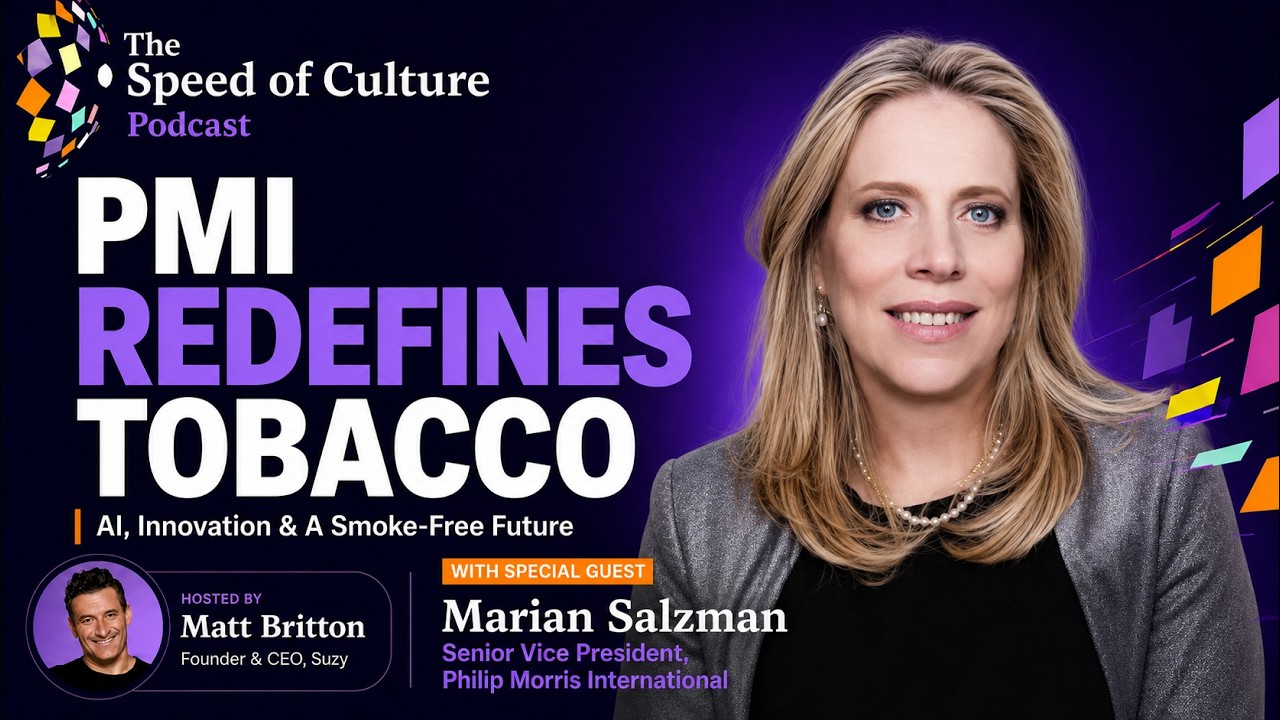
In an era where disruption defines competitive advantage, perhaps no industry transformation exemplifies bold reinvention quite like Philip Morris International's journey toward a smoke-free future. When most expected the Marlboro manufacturer to resist change, PMI instead committed $14 billion to fundamentally reimagining its business model.
On Speed of Culture Podcast Episode 183, Matt Britton, founder and CEO of Suzy, the AI-powered consumer intelligence platform, sat down with Marian Salzman, Senior Vice President at Philip Morris International, to explore how radical transparency, genuine commitment to innovation, and fearless leadership are transforming one of the world's most established industries.
Marian's journey to PMI offers a compelling case study in overcoming skepticism through authentic corporate transformation. Once a fierce critic of Big Tobacco, Marian found herself drawn to the company's unprecedented commitment to change. What emerged from their conversation was far more than a corporate rebrand, it revealed a fundamental shift in how established enterprises can pivot toward purpose while remaining competitive.
In an increasingly conscious marketplace where consumers demand authentic commitment to meaningful change, PMI's transformation serves as both inspiration and instructive blueprint for legacy brands confronting an uncertain future.
The Speed of Culture Podcast, presented in collaboration with Adweek and powered by Suzy's consumer intelligence platform, consistently explores how culture shapes business strategy and vice versa. Episode 183 proved no exception, diving deep into the intersection of innovation, AI-powered consumer insights, human connection, and corporate responsibility.
For executives and brand strategists wrestling with how to navigate massive industry shifts, Marian's insights offer actionable wisdom rooted in decades of global trendspotting and provocative thinking. This episode represents essential listening for anyone seeking to understand how legacy industries can not only survive disruption but lead it.
Perhaps no element of Episode 183 resonated more powerfully than Marian's candid admission: she was initially skeptical about joining a tobacco giant. As one of the world's most prominent trendspotters and communication strategists, her reputation had been built on identifying authentic cultural shifts and calling out corporate inauthenticity.
Joining PMI felt counterintuitive, even contradictory, to her brand and values.
Yet what changed her mind was PMI's genuine commitment to becoming a substantially smoke-free company by 2030. This is a fundamental pivot backed by unprecedented investment rather than corporate theater or greenwashing. Since 2008, Philip Morris has invested more than $14 billion in developing, scientifically validating, and commercializing innovative smoke-free products designed for adults who would otherwise continue smoking.
This scale of commitment matters in today's cynical marketplace. Consumers have become adept at detecting superficial corporate responsibility messaging. They've seen countless “sustainability” initiatives crumble under scrutiny, watched greenwashing campaigns backfire, and grown jaded about corporate pledges.
But when a company invests $14 billion, not in marketing, but in actual product innovation and scientific research, the signal penetrates the noise. For Marian, this fundamental inversion of the traditional Big Tobacco playbook proved compelling enough to overcome her initial hesitation.
The transformation extends far beyond cigarette alternatives. PMI's vision encompasses three distinct product categories: heated tobacco products like IQOS, nicotine pouches such as ZYN, and e-vapor offerings like VEEV. This portfolio diversification reflects sophisticated understanding of consumer preferences and harm reduction principles.
Rather than forcing all users into a single modality, PMI acknowledges that different adults have different needs and preferences.
The results have begun validating PMI's strategy. As of 2024, approximately 38.6 million adults worldwide use PMI's smoke-free products. In Japan, where IQOS was first launched in 2014, smoking prevalence among adults has plummeted from 19.6 percent to 10.6 percent by 2022, a decline that correlates directly with heated tobacco product adoption.
These are measurable outcomes in real markets demonstrating genuine public health impact.
Marian's transformation from skeptic to advocate illustrates a critical lesson for legacy industries: radical transparency and genuine commitment to meaningful change can overcome decades of institutional skepticism. When Marian encountered PMI's actual strategy and investment, not its marketing narrative, her perspective shifted entirely.
The company hadn't hired her to clean up its image; they'd hired her to help accelerate its transformation toward a genuinely different future. That distinction matters profoundly.
Beyond corporate transformation, Episode 183 explored a theme increasingly central to PMI's evolution: artificial intelligence. Marian articulated a perspective on AI that cuts through the hype and noise dominating contemporary business discourse.
Rather than viewing AI as a futuristic capability or distant possibility, Marian emphasized that AI is already reshaping competitive dynamics right now.
“AI is going to take us to a different plane and they're taking us there at a meteoric speed. And those who reject it are just going to be collecting data and data is valuable, but insights are more valuable.”
This distinction between data and insights proves crucial for understanding AI's true competitive value. Every company collects data, customer behavior, market trends, competitive intelligence, sentiment signals. Yet translating mountains of raw data into actionable strategic clarity has historically demanded enormous time and resources.
AI fundamentally transforms this equation. Advanced AI systems can ingest massive datasets, identify non-obvious patterns, and surface insights in hours or minutes that previously required months of manual analysis.
For PMI specifically, this capability directly supports the company's smoke-free transition. As they phase out traditional cigarettes and scale innovative alternatives, they need continuous insight into consumer preferences, market adoption patterns, regulatory landscapes, and competitive responses.
AI-powered analysis enables this real-time awareness and strategic agility at unprecedented speed. Rather than acting on quarterly data reviews, PMI can respond to weekly or daily trend signals.
Marian also illuminated a second dimension of AI's value that extends beyond data processing. She described how she personally doesn't particularly enjoy the mechanics of writing, the blank page, the revision cycles, the grinding editorial work. Yet with AI as a collaborative tool, her relationship to creative output transformed entirely.
AI helps her rapidly explore diverse perspectives, stress-test ideas, and transform nascent concepts into fully developed narratives without the drudgery of traditional writing.
This observation carries profound implications for how organizations should approach AI adoption. Rather than viewing AI as something that replaces human expertise, the most effective implementations treat AI as an amplifier of human capability.
Applied across organizations, this same principle suggests that companies embracing AI most effectively will be those that use it to enhance human judgment and creativity, not eliminate it.
For legacy brands navigating transformation, this insight proves particularly valuable. The anxiety that AI represents an existential threat proves less accurate than the reality that AI represents an asymmetric advantage for those who adopt it thoughtfully.
Companies that continue approaching strategy the way they did in 2015 will find themselves substantially disadvantaged relative to competitors leveraging AI-powered consumer intelligence, creative development, and strategic planning. The competitive window for adoption is closing rapidly.
Perhaps the episode's most thought-provoking segment extended beyond corporate strategy into territory increasingly relevant across all industries: the crisis of human disconnection and its implications for brand trust and customer loyalty.
Marian invoked Robert Putnam's seminal work Bowling Alone, which documented the steady erosion of civic participation, community involvement, and meaningful social connection across American society over recent decades.
The conditions Putnam documented in 2000 have only accelerated. Screens have increasingly replaced face-to-face interaction. Social media has created paradoxical experiences where we feel simultaneously connected to thousands and isolated from genuine community.
Today, loneliness represents one of the most significant public health challenges facing developed economies, correlating with depression, anxiety, cardiovascular disease, and premature mortality.
Marian's insight proved elegant yet powerful: brands must recognize their potential role in addressing this broader social fragmentation. Companies can't solve loneliness, but they can intentionally create experiences and interactions that foster genuine human connection rather than mere consumption.
This doesn't require abandoning digital channels or e-commerce. Rather, it demands intention about creating spaces where humans can interact meaningfully, trust can develop authentically, and community can take root.
For PMI specifically, this insight carries particular relevance as the company transforms its relationships with consumers. As PMI pivots toward smoke-free products and harm reduction, it has opportunity to cultivate fundamentally different relationships built on authenticity, transparency, and genuine concern for adult consumer welfare.
The broader message resonates powerfully for executives: the most successful brands of the coming decade will likely be those that explicitly acknowledge the connection crisis and position themselves as forces helping to rebuild human bonds in an increasingly fragmented world.
This positioning is strategically astute as well as philanthropic. Consumers increasingly support brands that align with their values and contribute to their wellbeing. By addressing the loneliness epidemic, brands can build profound emotional connection with customers while genuinely serving a crucial social need.
Throughout a distinguished career spanning decades, Marian has become renowned not merely for identifying emerging trends but for her willingness to articulate provocative perspectives that challenge conventional wisdom.
From coining the term “metrosexual” in the late 1990s to pioneering online market research when digital strategy remained nascent, she has consistently positioned herself at the intersection of cultural evolution and emerging consumer behavior.
Her career path offers instructive lessons for leaders navigating established organizations toward transformation.
For established organizations seeking to drive transformation, Marian's career demonstrates the value of recruiting leaders willing to think provocatively and challenge internal assumptions.
Legacy organizations often gravitate toward leaders who make them comfortable, who speak the organizational language, who work within existing mental models. Yet transformation requires the opposite, leaders who see current strategy from outside the institution's walls, who ask heretical questions, who refuse to accept “because we've always done it that way” as adequate justification.
This doesn't mean embracing chaos or dismissing institutional wisdom accumulated over decades. Rather, it means cultivating organizational cultures where smart, experienced outsider perspectives aren't just tolerated but actively valued.
Companies that can create psychological safety around challenging assumptions, that reward executives for asking tough questions about fundamentals, and that remain genuinely open to being wrong about important things, will prove far more adaptive as markets and consumers evolve.
Episode 183 resonates far beyond Philip Morris International. While PMI's specific context involves tobacco and smoke-free alternatives, the broader themes Marian articulated, how to drive authentic transformation in established organizations, how to leverage AI for competitive advantage, how to build trust with increasingly conscious consumers, and how to foster human connection in digital environments, apply across industries confronting disruption.
Energy companies transitioning toward renewable sources. Automotive manufacturers pivoting toward electric vehicles. Financial services firms adapting to fintech disruption. Healthcare organizations navigating precision medicine and biotechnology.
All these industries confront similar challenges: how to transform fundamental business models while maintaining competitive viability, how to invest in innovation at scale, and how to communicate authentically about change without appearing opportunistic.
Marian's example suggests several key principles for legacy enterprises:
PMI has invested over $14 billion since 2008 in developing, scientifically validating, and commercializing three distinct smoke-free product categories: IQOS, ZYN, and VEEV. As of 2024, approximately 38.6 million adults use PMI's smoke-free products globally, with the smoke-free business generating roughly 39 percent of total net revenues.
In Japan, where IQOS launched in 2014, smoking prevalence dropped from 19.6 percent to 10.6 percent by 2022, demonstrating measurable public health impact.
Rather than treating AI as purely an operational efficiency tool, organizations should view it as a capability amplifier. Identify processes and decisions where faster, more comprehensive analysis would deliver genuine strategic advantage.
Use AI to enhance human judgment, accelerate creative development, and explore possibilities more thoroughly. The most effective implementations are those where humans and AI work together.
It means creating intentional moments for authentic human connection within your brand experience. This might include designing retail spaces that encourage community gathering, developing digital platforms that facilitate genuine interaction, or building rituals around products that bring people together.
The key is authenticity, consumers detect manufactured community and resent it.
Marian's career has been defined by identifying emerging cultural shifts and translating them into business implications. This capability proved invaluable at PMI because she understands not just what consumers want, but why they want it and what deeper cultural values motivate those preferences.
Rather than merely executing the company's existing smoke-free strategy, she helped refine and accelerate it based on evolving consumer consciousness around health, responsibility, and authenticity.
The Speed of Culture Podcast continues exploring how cultural forces shape business strategy and corporate actions influence culture. For executives and brand strategists seeking to understand transformation dynamics, AI's emerging role in competitive advantage, and how legacy industries can remain relevant in rapidly evolving markets, Episode 183 with Marian Salzman offers essential insights grounded in real-world experience and proven success.
To access the full episode, connect with the hosts, and explore additional resources on innovation and culture:
The transformation of Philip Morris International represents more than a single company's evolution. It demonstrates that authentic commitment to meaningful change, amplified by AI-powered intelligence and driven by fearless leadership, can reimagine even the most established industries.
In an era of unprecedented disruption, that lesson proves invaluable.