Opening: The Science Behind Luxury Brand Transformation
The automotive industry stands at an unprecedented crossroads. As electric vehicles reshape consumer expectations and luxury consumers demand seamless omnichannel experiences, the brands that survive and thrive will be those that understand something fundamental: modern luxury is about the psychology, culture, and purpose that surrounds the product.
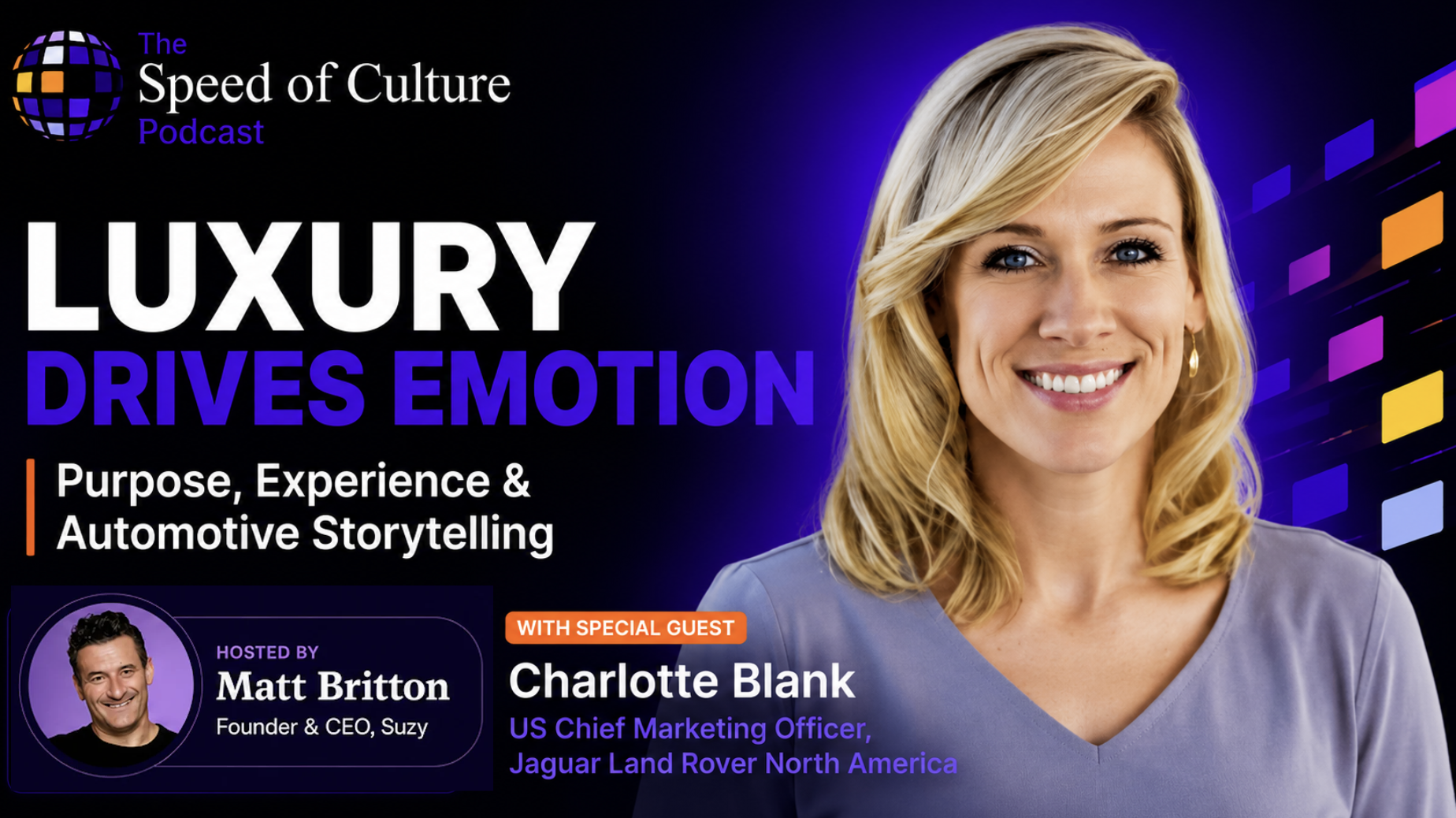
On Episode 190 of The Speed of Culture Podcast, Matt Britton, founder and CEO of Suzy, the AI-powered consumer intelligence platform, sat down with Charlotte Blank, US Chief Marketing Officer of Jaguar Land Rover North America, to discuss how two of the world's most iconic automotive brands are being reimagined for a new era. The conversation revealed a sophisticated approach to brand strategy that marries neuroscience, behavioral economics, and genuine cultural relevance.
Charlotte Blank doesn't fit the traditional automotive marketing profile. With a bachelor's degree in neuroscience and behavioral biology from Emory University and an MBA from Harvard Business School, she brings a unique perspective to one of the industry's most challenging transformation efforts.
Before her appointment as CMO USA at Jaguar Land Rover in October 2022, Blank served as director of transformation and analytics at the company. Prior to that, she was one of the world's first "Chief Behavioral Officers" at Maritz, where she designed reward, recognition, and incentive programs for automotive manufacturers and retailers.
This unconventional background (combining psychology, data science, and brand strategy) positions her at the intersection of how consumers actually think, decide, and connect with luxury brands.
The episode "Luxe Redux: Jaguar Land Rover's Charlotte Blank on reimagining iconic automotive brands" aired on May 20, 2025, and offers crucial insights into how legacy luxury automotive brands are navigating the greatest industry transformation in decades.
Released as a 26-minute conversation, the episode explores how behavioral science, curiosity, and creativity drive marketing forward in an industry at a cultural crossroads. From the bold relaunch of Jaguar to connecting Defender with grassroots causes, Blank reveals the methodology behind modern luxury marketing, one rooted in scientific rigor, cultural insight, and authentic storytelling rather than traditional automotive marketing playbooks.
The Psychology of Modern Luxury: Moving Beyond Products to Purpose
Understanding contemporary luxury consumers requires abandoning outdated assumptions about status signaling and exclusivity. Today's luxury market has fundamentally shifted. Where luxury once meant inaccessibility, it now means intentionality.
Where it once emphasized scarcity, it now emphasizes seamlessness. The customer who buys a Range Rover doesn't just want a vehicle; they want an integrated experience that flows effortlessly across digital configurators, mobile apps, dealership interactions, and ownership services.
Blank's neuroscience background proves invaluable in this context. She approaches marketing campaigns not as creative exercises but as experiments with measurable variables and causality tracking.
This scientific methodology represents a significant departure from traditional automotive marketing, which often relies on intuition, emotional appeals, and impression-based metrics. Instead, Blank's approach treats each campaign as a controlled study, complete with test groups, baseline measurements, and quantifiable outcome metrics.
The psychology of luxury car purchases reveals sophisticated motivations beyond the functional. Academic research confirms that luxury automotive consumption is driven by self-expression, social status enhancement, and the pursuit of exceptional craftsmanship.
But modern luxury consumers add another layer: they increasingly want brands that reflect their values. They want to know that the companies they support share their commitment to sustainability, social responsibility, and cultural relevance.
This is where behavioral economics enters the conversation. Luxury car buyers are willing to pay substantial premiums not just for superior engineering or materials, but for the psychological and social benefits that come with brand ownership.
A Range Rover signals something different than a Jaguar. Both are products of Jaguar Land Rover, yet they occupy distinct positions in consumer psychology. The challenge Blank faces is ensuring that each brand maintains its distinct identity while serving a modern audience with entirely new expectations and values.
The shift toward electric vehicles adds complexity to this psychological landscape. Traditional automotive status signaling relied heavily on the visceral experience of performance, the rumble of an engine, the power delivery, the mechanical feedback.
Electric vehicles require reimagining what performance and presence mean in the luxury automotive space. Blank's approach recognizes this fundamental shift and adapts messaging accordingly, using data and consumer research to understand how modern luxury buyers conceptualize an electric future.
Cultural Embedding Over Aggressive Marketing: The Range Rover Case Study
One of the most revealing insights from Blank's approach to brand strategy is her emphasis on cultural embedding, the idea that the strongest brands aren't those that shout loudest, but those that become woven into cultural fabric through subtle, sophisticated positioning.
Range Rover exemplifies this strategy. Rather than pursuing aggressive, interruptive advertising campaigns, the brand achieved iconic status through an "if you know, you know" approach.
This methodology relies on cultural relevance, aspirational identity, and organic cultural adoption rather than paid media saturation. The strategy recognizes that luxury consumers, particularly high-net-worth individuals and culturally influential audiences, actively resist obvious marketing.
Instead, they respond to brands that demonstrate understanding, exclusivity, and cultural cachet.
This approach has profound implications for how luxury automotive brands should allocate marketing budgets and creative resources. Instead of maximizing reach and frequency through traditional advertising, brands should focus on creating culturally relevant moments, associations, and experiences that resonate authentically with target audiences.
Range Rover's success demonstrates that status symbol status is earned through cultural positioning, not purchased through media spending.
The strategy also reflects a deeper understanding of consumer psychology. When consumers feel they've discovered a brand rather than being sold to by a brand, they develop stronger emotional connections and greater brand loyalty.
The "if you know, you know" approach creates an in-group feeling, a sense of belonging to an exclusive community of consumers who recognize and appreciate the brand's cultural significance. This psychological mechanism, the desire to be part of something exclusive and culturally aware, proves far more powerful than traditional motivational advertising.
Implementing this strategy requires discipline and sophistication. Marketing leaders must resist the pressure to maximize short-term metrics in favor of long-term cultural positioning.
They must also understand their audience deeply enough to recognize which cultural touchpoints and moments align authentically with brand values. Blank's background in behavioral psychology provides the framework for making these strategic decisions with conviction rather than intuition.
Purpose-Driven Marketing: The Defender Service Awards Model
While Range Rover demonstrates the power of subtle cultural positioning, Defender showcases how purpose-driven marketing can create authentic brand activation that serves genuine social needs while building brand equity.
The Defender Service Awards program spotlights nonprofits doing grassroots work, then provides them with resources and platforms to expand their impact.
This strategy combines several sophisticated marketing elements. First, it provides authentic content creation opportunities that showcase real stories of social impact rather than manufactured brand narratives.
Second, it aligns the Defender brand with genuine values and purpose, creating meaningful brand associations beyond the product itself. Third, it engages consumers in a cause-marketing effort that feels authentic because the social benefit is genuine and measurable, not a thin veneer over commercial objectives.
The effectiveness of purpose-driven marketing in the luxury space reflects broader consumer trends. Research on luxury consumption increasingly demonstrates that affluent consumers want their purchasing decisions to reflect their values.
The "cash rich, time poor" demographic that represents a significant portion of luxury automotive consumers prioritizes meaning and purpose alongside exclusivity and performance. They want to know that the brands they support contribute positively to society.
The Defender Service Awards model also demonstrates sophisticated understanding of modern nonprofit and advocacy communities. By providing resources and amplification to grassroots organizations, the brand positions itself as a supporter and enabler rather than an opportunistic advertiser.
This requires genuine commitment, not just performative gesture. The program must deliver real value to the organizations it highlights, which means it functions simultaneously as authentic social impact and brand marketing.
This dual-benefit approach reflects Blank's broader philosophy: effective brand marketing serves the consumer's deeper needs and values, not just commercial objectives.
When brands align with genuine social purposes and deliver authentic value, marketing becomes something more, it becomes a form of cultural contribution that consumers want to participate in rather than something they want to avoid or ignore.
Bridging Brand Storytelling and Performance Marketing: Data-Driven Attribution
One of the most significant challenges in automotive marketing is measuring the connection between brand-building activities and purchase intent. Traditional automotive marketing has long struggled with attribution, understanding which touchpoints, messages, and experiences actually drive consumers toward purchase decisions.
This challenge becomes more acute as consumer journeys become more complex, spanning digital and physical touchpoints, multiple decision stages, and increasingly sophisticated consumers.
Blank's approach to resolving this challenge integrates connected TV advertising and organic search data to create measurable attribution models that bridge brand storytelling with consumer intent.
Rather than treating brand marketing and performance marketing as separate silos with distinct objectives and measurement approaches, this integrated strategy recognizes that brand experiences and purchase intent exist on a continuum.
Connected TV represents a particularly valuable data source in this context. Unlike traditional television advertising, which offers limited audience data and no direct attribution pathways, connected TV provides information about which audiences see which messages, and increasingly, how those audiences behave afterward.
By analyzing connected TV exposure alongside search behavior, marketers can understand whether brand storytelling activities actually influence how consumers search for products and solutions.
This approach moves beyond impression metrics toward tracking actual consumer engagement and purchase consideration. A consumer who sees a Range Rover brand story on connected TV and then searches for "premium SUV with advanced off-road capability" has demonstrated a measurable connection between brand narrative and purchase intent.
Scaling this analysis across thousands or millions of consumers provides statistically significant evidence of brand marketing effectiveness.
The integration of organic search data proves particularly powerful. Search behavior reveals genuine consumer intent in ways that other digital signals cannot.
A consumer who searches for a specific vehicle model, searches for dealer locations, or searches for financing options has demonstrated active purchase consideration. By connecting this search behavior to prior brand exposure through connected TV, marketers can map the precise journey from brand awareness to purchase intent.
This data-driven approach also enables continuous optimization. As marketers understand which brand messages lead to search intent, they can adjust storytelling, messaging, and creative approaches to maximize the connection between brand building and purchase consideration.
The approach transforms automotive marketing from a largely intuitive discipline into a measurable science, which aligns perfectly with Blank's neuroscience and behavioral economics background.
The New Luxury Automotive Landscape: Lessons for a Transforming Industry
The conversation between Matt Britton and Charlotte Blank reveals a luxury automotive industry in profound transformation. The challenge facing Jaguar Land Rover, and the luxury automotive sector more broadly, extends beyond product engineering or design.
The fundamental challenge is conceptual: what does luxury mean in an era of electric vehicles, global consciousness about sustainability, and consumer expectations for seamless omnichannel experiences?
Blank's approach to this challenge provides a roadmap for automotive brands navigating disruption:
- Ground strategy in genuine understanding of consumer psychology and behavior, not in assumptions or tradition.
- Recognize that modern luxury is about purpose, culture, and seamless experience as much as it's about the product itself.
- Understand that cultural relevance must be earned through authentic alignment with consumer values, not purchased through advertising spending.
- Measure marketing effectiveness through genuine attribution to consumer intent, not vanity metrics like impressions or reach.
The luxury automotive industry has always positioned itself as the pinnacle of consumer goods, the most sophisticated, the most exclusive, the most aspirational.
The CMOs and marketing leaders who will succeed in this era of transformation will be those who combine this elevated positioning with genuine scientific rigor, cultural insight, and authentic purpose.
Charlotte Blank represents a new generation of automotive marketing leadership: scientifically trained, culturally literate, and committed to understanding why consumers actually choose luxury brands.
As the automotive industry accelerates toward electrification, sustainability requirements, and profound changes in consumer values and expectations, the brands that thrive will be those that adapt not just their products, but their entire approach to connecting with consumers.
The conversation in Episode 190 of The Speed of Culture Podcast provides crucial insights into how this transformation is happening at the strategic level, within one of the world's most iconic automotive companies.
Key Takeaways
- Behavioral Science Transforms Automotive Marketing: Treating marketing campaigns as controlled experiments with measurable causality, rather than intuitive creative exercises, enables automotive brands to optimize for genuine consumer psychology and measure real attribution to purchase intent.
- Cultural Positioning Trumps Advertising Spend: Modern luxury brands like Range Rover achieve iconic status through subtle cultural embedding and authentic relevance rather than aggressive, interruptive advertising, an approach that creates stronger emotional connections and greater consumer loyalty.
- Purpose-Driven Marketing Must Deliver Authentic Value: Programs like Defender Service Awards succeed because they create genuine social benefit alongside brand activation, aligning luxury brands with consumer values in ways that feel authentic rather than performative.
- Integrated Data Reveals True Brand Impact: Combining connected TV exposure data with organic search behavior enables marketers to bridge brand storytelling and purchase intent, moving beyond impressions toward measurable attribution and continuous optimization.
- Modern Luxury Requires Omnichannel Seamlessness: Today's luxury automotive consumers expect integrated experiences where digital configurators, mobile apps, dealership interactions, and ownership services function seamlessly together, demanding a fundamentally different approach to brand and customer experience strategy.
Frequently Asked Questions
How is Jaguar Land Rover approaching the transition to electric vehicles in its luxury marketing strategy?
Charlotte Blank recognizes that electric vehicles require fundamentally reimagining what performance, power, and presence mean in the luxury automotive space.
Rather than relying on traditional status signaling tied to engine performance and mechanical feedback, luxury EV marketing emphasizes technological sophistication, environmental consciousness, and design excellence.
The approach uses consumer research and behavioral data to understand how modern luxury buyers conceptualize an electric future, ensuring messaging and positioning align with evolved consumer expectations around sustainability and innovation.
Why does Charlotte Blank treat marketing campaigns like scientific experiments?
With a background in neuroscience and behavioral biology, Blank applies scientific methodology to marketing to move beyond intuition and assumptions.
By establishing control groups, baseline measurements, and quantifiable outcome metrics, she creates measurable causality between marketing activities and consumer behavior.
This approach enables continuous optimization based on data rather than creative instinct, and allows automotive brands to justify marketing investments through demonstrable returns rather than subjective assessments of creative quality.
What makes the "if you know, you know" approach to brand positioning more effective than traditional advertising?
This cultural embedding strategy recognizes that luxury consumers actively resist obvious marketing and respond more authentically to brands they feel they've discovered rather than been sold to.
When consumers feel part of an exclusive community that recognizes a brand's cultural significance, they develop stronger emotional connections and greater loyalty than they would through exposure to traditional advertising.
The approach also creates an in-group psychological effect where brand affinity becomes tied to cultural awareness and sophistication.
How does Defender's social impact program create authentic brand value?
The Defender Service Awards program succeeds because it provides genuine social benefit to real nonprofit organizations, creating authentic stories and impact measurement that consumers can verify and trust.
Rather than using nonprofits as props for brand storytelling, the program functions as genuine social contribution that aligns the Defender brand with real values.
This authenticity creates consumer trust and brand affinity that performative cause marketing cannot achieve, while also generating authentic content and community engagement opportunities.
Looking Ahead
The transformation of luxury automotive brands represents one of the most significant business challenges of the current era.
As consumer expectations evolve, technology disrupts traditional product categories, and younger audiences bring new values to purchasing decisions, automotive marketing must evolve from intuitive creative exercises to sophisticated, data-driven strategies grounded in behavioral science and cultural insight.
The insights shared by Charlotte Blank in Episode 190 of The Speed of Culture Podcast provide a framework for understanding this transformation.
They also offer valuable lessons for marketing leaders across industries navigating similar disruption: the brands that will thrive in eras of transformation are those that combine genuine consumer insight with authentic purpose, cultural relevance with measurable attribution, and creative excellence with scientific rigor.
For deeper insights into consumer behavior, market research, and AI-powered intelligence, visit Suzy, the leading consumer insights platform founded by Matt Britton.
To explore more conversations about culture, consumer trends, and business transformation, tune into The Speed of Culture Podcast.
For insights into how AI is reshaping business and society, read Generation AI or book Matt Britton as an AI Keynote Speaker for your organization.
For speaking inquiries and event planning, visit Speaker HQ.

%20(400%20x%20100%20px)%20(300%20x%2050%20px)%20(150%20x%2050%20px).avif)