Capturing Luxury Shoppers on TikTok: How David Yurman's CMO Carolyn Dawkins Is Revolutionizing Jewelry Marketing for Gen Z
Opening
The luxury jewelry market has undergone a fundamental transformation in recent years, driven by a demographic shift that challenges traditional industry assumptions. Younger consumers are entering the luxury jewelry space earlier than ever before, a phenomenon driven largely by digital exposure and accessible storytelling on social platforms like TikTok. This shift represents not just a marketing challenge but a significant opportunity for heritage brands willing to embrace innovation while maintaining their core identity.
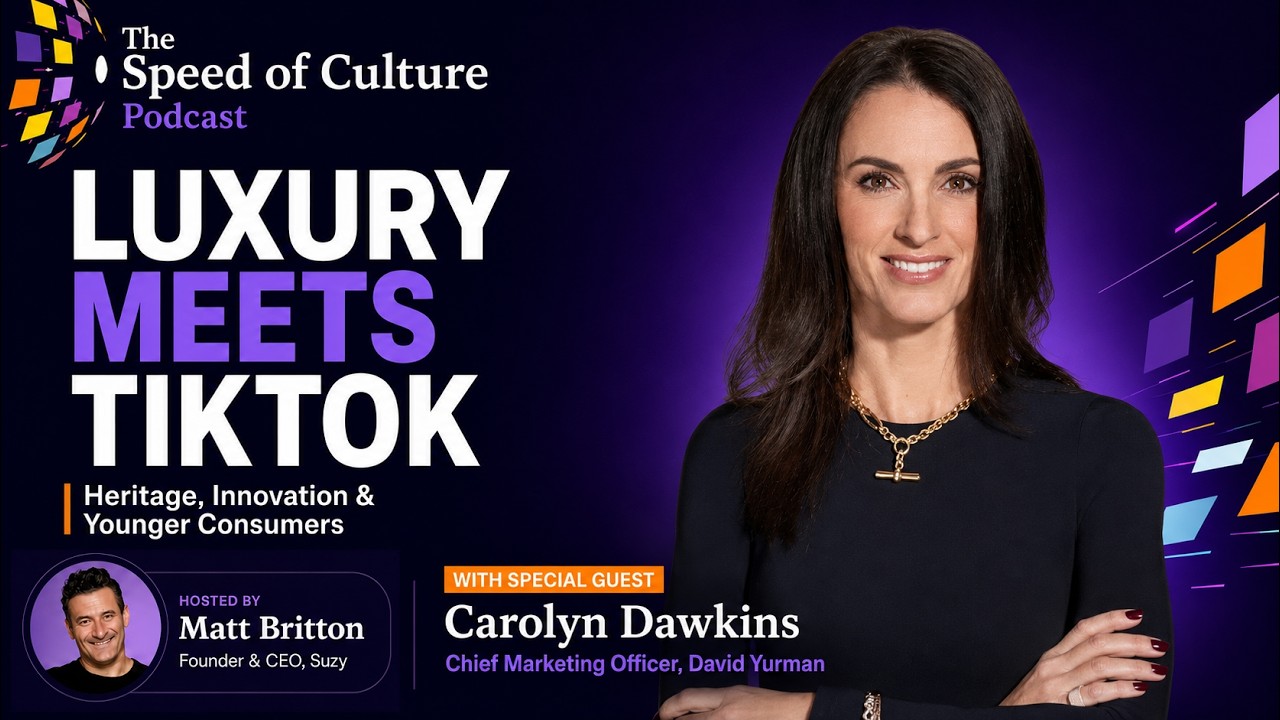
In Episode 191 of the Speed of Culture Podcast, Matt Britton, founder and CEO of Suzy, the AI-powered consumer intelligence platform, sits down with Carolyn Dawkins, Chief Marketing Officer of David Yurman, to explore how the iconic jewelry brand is navigating this evolving landscape. Carolyn brings a unique perspective shaped by her impressive career spanning leadership roles at beauty giants like L'Oréal and Estée Lauder, combined with significant experience at Google. This blend of creative instinct and data-driven expertise has proven essential in David Yurman's strategy to meet younger consumers where they are, literally and figuratively on TikTok.
The conversation reveals critical insights into how luxury brands can maintain heritage while embracing digital-first strategies, personalize experiences at scale through first-party data, and employ creator partnerships that go beyond traditional celebrity endorsements. For CMOs, brand strategists, and executives in the luxury space, this episode offers a masterclass in balancing what Carolyn describes as “heritage and heresy”, honoring a brand's legacy while surprising and delighting modern consumers on the platforms they inhabit daily.
The episode aired on May 22, 2025, and provides actionable frameworks for brands grappling with the challenge of staying relevant in an AI-driven, consumer-intelligence-powered era. Whether your brand is in jewelry, beauty, fashion, or another luxury category, the principles Carolyn shares demonstrate how to transform demographic shifts into competitive advantages.
The Gen Z Jewelry Renaissance: Understanding How Younger Consumers Are Reshaping Luxury
The traditional jewelry industry operated on an assumption that held for decades: luxury items were purchases for life milestones, engagements, anniversaries, significant birthdays. These were moments when consumers had reached a certain financial threshold and were ready to invest in heirloom pieces. However, this model has fundamentally shifted with the rise of Gen Z and their digital-native consumption patterns.
Carolyn Dawkins emphasizes that consumers are now entering the luxury jewelry category much earlier than historical patterns suggest. This acceleration is driven by several interconnected factors. First, social media platforms, particularly TikTok, have democratized access to luxury aesthetics and brand narratives.
A teenager in any city can watch styling content, see luxury pieces worn by influencers and creators, and develop aspirational familiarity with brands like David Yurman before they could have previously accessed such exposure.
Second, the rise of platforms like TikTok has created what might be called “digital window shopping” at scale. Younger consumers can discover, learn about, and develop emotional connections to luxury brands through short-form video content that feels authentic, relatable, and often educational. This stands in stark contrast to traditional advertising, which younger audiences often perceive as inauthentic or interruptive.
Third, changing economic models around jewelry have made luxury more accessible across demographics. While David Yurman pieces span a wide price range, from more accessible entry points to ultra-premium offerings, younger consumers can now invest in starter pieces that begin their luxury collection journey, rather than waiting for a single transformational purchase moment.
The strategic implication is profound: instead of viewing Gen Z as a future market to cultivate over years, luxury brands must recognize them as an active, present market making purchasing decisions today. For David Yurman, this meant rethinking content strategy, influencer partnerships, and even product accessibility without diluting brand prestige.
The podcast conversation makes clear that this is about meeting intelligence with intelligence rather than “dumbing down” luxury, using the same rigor and storytelling sophistication that appeals to established collectors while making it relatable to younger audiences discovering luxury for the first time.
Platform Strategy and Content Differentiation: Why TikTok and Instagram Aren't Interchangeable
A key insight from Carolyn Dawkins' discussion involves the often-overlooked reality that different social platforms demand fundamentally different content approaches, even when promoting identical products. Many brands make the mistake of posting the same content across multiple platforms, assuming that if something performs well on Instagram, it will automatically succeed on TikTok. David Yurman's approach demonstrates why this assumption is flawed.
The brand employs a sophisticated, platform-native strategy that acknowledges TikTok and Instagram as distinct ecosystems with different discovery mechanisms, user behaviors, and content expectations. While both platforms might feature the same jewelry collection, David Yurman tailors the editing style, the influencer collaborations, and the “hooks” that capture attention according to each platform's unique culture and algorithm.
On TikTok, where vertical video, rapid cuts, trending audio, and authentic-feeling content dominate, David Yurman creates content that feels native to the platform. This might include quick transformations showing how a piece upgrades an outfit, creators' unfiltered reactions to products, duets and stitches that feel like genuine conversation rather than branded content, or trending audio layered over product reveals.
The pacing is faster, the production aesthetic feels less polished, and the storytelling is often more personal and immediate.
Instagram, by contrast, operates differently. The platform's feed, Reels, and Stories each serve distinct purposes. Feed posts on Instagram often feature higher production values, more carefully composed imagery, and a curatorial aesthetic that aligns with Instagram's positioning as a visual design platform.
David Yurman's Instagram strategy can therefore lean more heavily on the artistry of the pieces themselves, the heritage of design, and aspirational lifestyle imagery that Instagram users expect.
This differentiation extends to influencer partnerships as well. A creator who performs exceptionally on TikTok might not be the optimal choice for Instagram, and vice versa. TikTok favors platform-native creators who have built communities through the platform's unique format, while Instagram influencers often bring a different aesthetic sensibility.
By recognizing these distinctions, David Yurman maximizes the return on creator partnerships and avoids the wasteful approach of forcing one-size-fits-all content across platforms.
The broader lesson for luxury brands extends beyond jewelry. As CMOs and marketing leaders allocate budgets across platforms, the assumption that repurposing content saves money often backfires by reducing performance across all channels.
Conversely, investing in platform-native strategies, even when it means creating multiple versions of campaigns, typically yields significantly better engagement, reach, and ultimately conversion. Carolyn's approach suggests that in the age of social commerce and algorithm-driven discovery, the cost of not differentiating often exceeds the investment required to do so effectively.
Heritage as a Universal Language: Why Brand Storytelling Transcends Generational Boundaries
One of the most surprising insights from Carolyn Dawkins in the Speed of Culture Podcast episode involves the performance of heritage-focused content. A conventional assumption in marketing suggests that older consumers care about brand heritage and history, while younger consumers prefer innovation and forward-thinking narratives. David Yurman's data tells a different story entirely.
The brand's campaigns exploring the origins and evolution of iconic collections (including Sculpted Cable, Madison, and Chevron for Men) have achieved record engagement across digital and social platforms with all age groups. This counterintuitive finding suggests that heritage storytelling, when executed with sophistication and authenticity, possesses universal appeal that transcends demographic boundaries.
Why does heritage resonate with Gen Z? Several factors emerge from Carolyn's discussion. First, heritage storytelling provides context and meaning that pure product features cannot.
A young consumer encountering a David Yurman piece might respond not just to its aesthetic but to understanding why the design matters, the innovation it represented when created, the craftsmanship it embodies, or the design philosophy that continues to influence the brand decades later.
This narrative depth satisfies the intellectual curiosity that Gen Z and younger millennials bring to consumption, moving beyond impulse purchasing toward intentional investment.
Second, heritage storytelling in the luxury space positions consumption as participation in something larger than oneself. Rather than simply buying a product, younger consumers are joining a legacy, becoming part of a narrative that extends backward through decades of design innovation and forward into their own personal style evolution.
This emotional positioning is particularly powerful for Gen Z consumers, who often express values around authenticity and meaningful consumption over materialistic accumulation for its own sake.
Third, well-executed heritage content feels earned rather than marketed. When David Yurman shares the story of how the Sculpted Cable design came to be, or explains the technical innovation behind the Madison collection, it's communicating expertise and confidence rather than pleading for attention.
This positions the brand as an authority and educator, roles that younger consumers respect more than traditional advertising.
The practical implication for luxury brands is significant. Instead of hiding or downplaying heritage when targeting younger demographics, they should reposition it as a contemporary asset: proof of expertise, consistency, and evolutionary thinking.
Brands should ask: What problems did our designs solve when they were created? How has our thinking evolved? What can our long history teach consumers about quality, craftsmanship, and value? By translating heritage into these terms, luxury brands can activate it as a powerful marketing tool across generational boundaries.
First-Party Data and Personalization: Building Competitive Advantage Through Consumer Intelligence
Throughout the Speed of Culture podcast conversation, Carolyn Dawkins emphasizes the critical role of first-party data in David Yurman's marketing strategy. In an era of increasing privacy regulations and the decline of third-party cookies, brands that have robust first-party data strategies will possess significant competitive advantages.
David Yurman's approach demonstrates this principle in action.
The brand collects rich behavioral and transactional data through both its e-commerce platform and retail experiences. This data provides a foundation for personalization that extends far beyond simple demographic targeting.
David Yurman uses this intelligence to fuel customized email journeys that adapt based on individual browsing history, purchase patterns, and collection interests. Homepage experiences can be tailored to reflect products most relevant to each visitor. Media targeting becomes more sophisticated, ensuring advertising dollars reach audiences most likely to convert based on actual behavioral signals rather than assumptions.
The power of this approach is multifaceted. At the most direct level, personalization drives conversion, customers who see products and experiences tailored to their interests are more likely to make purchases.
But the strategic value extends deeper. First-party data provides a feedback loop that informs creative execution across the entire marketing ecosystem.
When David Yurman's product team sees which collections generate the most interest, which design elements resonate most strongly, or which storytelling approaches engage consumers most deeply, they can use this intelligence to inform future product development and design decisions.
Additionally, first-party data enables the brand to test hypotheses and validate assumptions in real time. Instead of rolling out campaigns based on intuition or industry convention, David Yurman can collect consumer feedback, measure response, and optimize at the speed of culture.
This is precisely the value proposition of platforms like Suzy, which Matt Britton's company provides, the ability to bring the voice of real consumers directly to brand decision-makers at the speed and scale required for competitive advantage.
For CMOs considering how to allocate resources in 2025 and beyond, Carolyn's emphasis on first-party data strategy offers clear guidance. Investment in data infrastructure, consumer research platforms, and personalization technology may seem less flashy than large-scale advertising campaigns, but it often generates superior returns.
The brands that will dominate luxury categories in the coming years will be those that leverage consumer intelligence not as a marketing tactic but as a core strategic capability that informs product development, creative direction, and customer experience at every touchpoint.
Creator Partnerships as Cultural Interpretation: Moving Beyond Celebrity to Community
The final major theme from the Speed of Culture episode involves David Yurman's creator strategy, which extends well beyond traditional celebrity endorsements. Carolyn describes a tiered approach that recognizes different types of creators serve distinct functions in the marketing ecosystem, from high-profile celebrity talent to platform-native creators producing branded content independently.
Traditional celebrity endorsements operate on a simple logic: a well-known person wears a product, their audience sees it, some portion of that audience purchases the product.
While this approach can work: David Yurman's Sofia Richie Grainge campaign, for example, generated significant earned media value and engagement, it represents only one component of an effective creator strategy.
Platform-native creators operate differently and often more effectively in the context of younger audiences. These are creators who have built genuine communities on TikTok, Instagram, YouTube, or other platforms through consistent, authentic content production.
Their audiences follow them because they trust their taste, find them relatable, or value the communities they've built around specific interests. When these creators engage with a brand, the recommendation carries weight precisely because it comes from someone their audience already trusts.
What makes David Yurman's approach innovative is positioning creators not as amplifiers but as cultural translators or interpreters. Rather than simply featuring the brand's products in the same way any celebrity might, David Yurman's creator partners interpret brand narratives in ways that feel authentic to their own audience and personal aesthetic.
A fashion-forward TikTok creator might showcase how a David Yurman piece elevates a trend-focused outfit. A jewelry enthusiast might dive deep into the craftsmanship and design philosophy. An artist might explore how the brand's design language inspires their own creative work.
This approach offers several advantages. First, it increases content authenticity. When creators interpret brand narratives through their own lens, the content feels less like paid advertising and more like genuine enthusiasm or education.
This resonates far more powerfully with audiences than traditional branded content, which younger consumers have become expert at filtering out.
Second, it expands the brand's reach into micro-communities and interest groups that might not follow major celebrities but do follow specific creators within their niche.
A luxury jewelry enthusiast community on TikTok, for example, might include thousands of engaged, high-intent consumers who follow specific creators focused on jewelry but wouldn't necessarily follow celebrity talent with general audiences.
Third, it builds equity for creators themselves. When partners feel they're genuinely collaborating with a brand rather than simply being paid to pose with products, they're more likely to invest effort and creativity into the partnership.
This often results in better content, more frequent mentions, and longer-term relationships that generate sustained awareness rather than one-off campaign spikes.
For brands evaluating creator partnerships, Carolyn's framework suggests a need to move beyond measuring success by follower count alone. A creator with 50,000 hyper-engaged followers in a specific niche might generate far better returns than a celebrity with 2 million general followers.
The most effective creator strategies will be those that combine top-tier talent for reach with platform-native creators for depth, building a portfolio of partnerships that collectively address multiple audience segments and creative approaches.
Key Takeaways
- Gen Z enters luxury jewelry earlier than ever before, driven by TikTok and digital exposure, creating an active present-day market rather than a future audience to cultivate. Brands must recognize younger consumers as decision-makers making purchases today, not prospects to nurture for tomorrow.
- Platform-native content strategies are essential; identical products require fundamentally different approaches on TikTok versus Instagram, accounting for each platform's unique discovery mechanisms, user behaviors, and content expectations.
- Heritage storytelling possesses universal appeal transcending demographic boundaries when executed with sophistication, providing context and meaning that younger consumers find intellectually satisfying and authentic.
- First-party data represents a critical competitive advantage in privacy-focused environments, enabling personalization that drives conversion while simultaneously informing product development and creative strategy across the entire marketing ecosystem.
- Creator partnerships function most effectively when positioned as cultural translation rather than celebrity endorsement, combining top-tier talent for reach with platform-native creators for community penetration and authentic audience engagement.
FAQ
How is David Yurman attracting Gen Z consumers on TikTok without diluting the luxury brand positioning?
David Yurman maintains brand prestige while engaging younger audiences through sophisticated heritage storytelling, platform-native content creation, and a tiered product range that offers entry points without compromising design quality. The brand meets Gen Z consumers where they are with authentic, accessible storytelling rather than gatekeeping luxury behind traditional barriers. By positioning creators as cultural interpreters rather than product shills, and by using first-party data to understand what resonates with younger audiences, David Yurman builds genuine brand affinity rather than pursuing transactional awareness.
What specific metrics indicate that heritage-focused content performs well with Gen Z audiences?
According to Carolyn Dawkins' discussion in the Speed of Culture episode, campaigns exploring collection origins like Sculpted Cable, Madison, and Chevron for Men achieved record engagement across digital and social platforms with all age groups. The data demonstrates that when heritage is framed as design innovation, craftsmanship expertise, and evolutionary thinking, rather than simply as “we've been around a long time” younger consumers respond with high engagement rates. This suggests measuring performance not just by likes or shares but by deeper engagement metrics, time spent with content, and conversion behavior.
How can luxury brands without David Yurman's resources implement similar first-party data strategies?
First-party data strategies begin with fundamentals: understanding who visits your digital properties, what they browse, how they engage, and what they purchase. This requires starting with basic analytics, email capture, and customer segmentation. Platforms like Suzy offer solutions at various scales, and many smaller solutions exist for brands just beginning data infrastructure investments. The principle is that smaller brands should focus on depth rather than scale, building intimate knowledge of their actual customer base rather than pursuing broad demographic targeting.
What role does AI play in David Yurman's approach to luxury jewelry marketing as described in the podcast?
While not explicitly a focus of the episode, AI powers much of the intelligence discussed. Suzy, the platform Matt Britton founded, uses AI to bring consumer voice to brands at scale and speed. Personalization engines that customize homepages and email journeys rely on machine learning. Creator selection and performance measurement benefit from AI analysis of engagement patterns. The broader implication is that AI enables luxury brands to maintain human-centric, creative strategy while automating the data collection, analysis, and personalization infrastructure that makes that strategy effective.
Looking Ahead
The Speed of Culture Podcast Episode 191 featuring Carolyn Dawkins offers a roadmap for luxury brands navigating the intersection of heritage, innovation, and digital-first consumer engagement. As markets continue to evolve at accelerating speed, the frameworks Carolyn shares, balancing tradition with innovation, leveraging platform-specific strategies, building personalization through first-party data, and employing creators as cultural translators, represent not just tactical solutions but strategic imperatives.
For executives in luxury, beauty, fashion, and related industries, the episode demonstrates that success requires rejecting false choices between maintaining brand heritage and embracing digital transformation. Instead, the most effective leaders recognize these as complementary imperatives: heritage provides the foundation of authenticity and expertise that luxury consumers seek, while digital platforms and data-driven personalization enable authentic connection at the speed and scale modern markets demand.
To explore similar insights from industry leaders, visit The Speed of Culture Podcast, where Matt Britton regularly features CMOs from the world's leading brands discussing strategies for staying competitive in rapidly evolving markets. For deeper consumer intelligence capabilities that power strategy like David Yurman's, explore Suzy, the AI-powered consumer intelligence platform trusted by leading enterprises.
Additionally, Matt Britton's recently published book Generation AI explores how artificial intelligence is reshaping childhood, culture, and the future of work, providing broader context for the consumer and market shifts discussed throughout the podcast episode. For organizations looking to understand emerging consumer trends and leverage AI for strategic advantage, consider engaging with AI Keynote Speaker Matt Britton or exploring Speaker HQ for access to expert thought leadership on consumer intelligence, generational trends, and the future of marketing.

%20(400%20x%20100%20px)%20(300%20x%2050%20px)%20(150%20x%2050%20px).avif)