The Priceless Playbook: How Mastercard Is Using AI Personalization to Stay Relevant
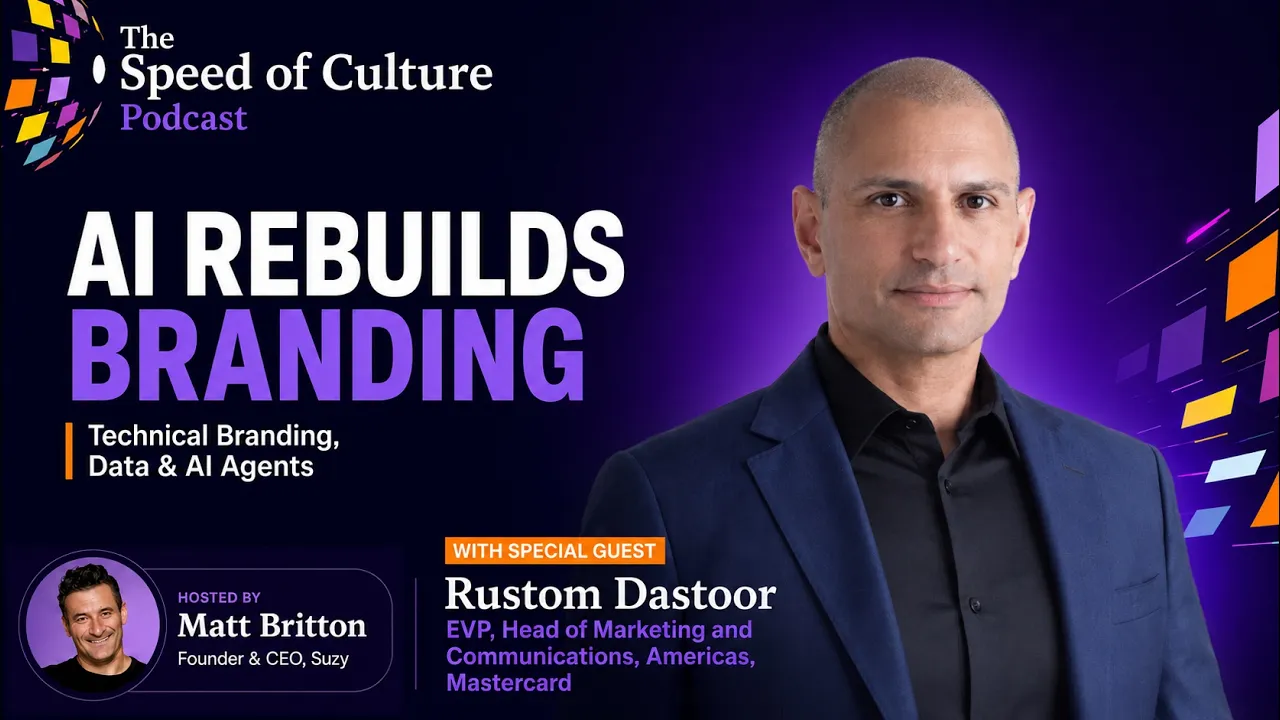
In an era where consumer attention is fragmented across countless platforms and digital experiences blur the line between commerce and culture, one of the world's most iconic payment brands is quietly reshaping how enterprises think about AI personalization marketing. The Speed of Culture Podcast Episode 188, featuring Rustom Dastoor, Executive Vice President of Marketing and Communications for the Americas at Mastercard, offers a masterclass in how established brands maintain relevance by embracing artificial intelligence not as a replacement for human creativity, but as a multiplier of it.
During the conversation with Matt Britton, founder and CEO of Suzy, the AI-powered consumer intelligence platform, Dastoor unpacks Mastercard's evolution from a transactional payment processor to an experience-driven brand that leverages AI to understand consumer behavior at scale. The discussion navigates the complexity of personalization in the modern marketing landscape, where data-driven insights must be balanced with emotional intelligence, where algorithmic optimization must serve human connection, and where the most successful brands are those asking the right questions rather than deploying the fanciest tools.
For more than two decades, Mastercard's "Priceless" campaign has captured a fundamental truth: people are emotionally invested in the moments that payments unlock, rather than in the payment methods themselves. Today, with AI as a strategic lever, Mastercard is taking that insight one step further, using advanced technology to identify, predict, and deliver those moments at scale.
This shift from mass reach to creator resonance, from generic personalization to empathetic connection, represents a pivotal moment in how enterprise marketing operates in the age of AI. The lesson for marketers, CMOs, and business leaders is clear: the winners won't be those with the most sophisticated algorithms, but those who combine technological capability with genuine curiosity about consumer intent and behavior.
The Evolution of "Priceless": From Campaigns to Experiences
Mastercard's "Priceless" campaign launched in 1997 and became one of the longest-running and most successful advertising campaigns in history. But under Rustom Dastoor's leadership, particularly in his current role as EVP of Marketing and Communications for the Americas, the brand has undergone a profound evolution, one that mirrors the broader shift in how companies must relate to consumers in a media-fragmented world.
The original campaign was built on a simple, powerful narrative structure: show the product purchase, then reveal the real value, the moment, the memory, the experience it enabled. A ticket to a baseball game costs X dollars, but seeing your son's face light up as the home run clears the fence? Priceless. This insight has remained the bedrock of Mastercard's brand identity for nearly three decades.
However, the evolution has shifted from one-way storytelling to collaborative story-making. Where once Mastercard broadcast messages about moments to consumers, the brand now co-authors narratives with creators, influencers, and communities. This strategic pivot reflects a fundamental change in consumer behavior: modern audiences trust peer recommendations and influencer perspectives more than traditional advertising.
Rather than commissioning a polished 30-second commercial about a concert experience, Mastercard partners with creators who embed the brand authentically within their content streams.
Club Mayhem exemplifies this new approach. The loyalty initiative offers consumers "money can't buy" moments. VIP experiences, exclusive access to cultural events, and once-in-a-lifetime opportunities. A Mastercard cardholder might win a trip to a Lady Gaga concert and exclusive after-party, not as a prize for reaching a spending threshold, but as validation of their cultural taste and status within a community.
This reframes loyalty from transactional accumulation to experiential belonging.
The deeper implication, according to Dastoor, is that personalization itself must evolve. Traditional personalization swaps content dynamically based on broad demographic or behavioral segments, showing blue sneakers to users flagged as "athletic" in a data model. But true personalization recognizes the individual beneath the data point. It understands that someone browsing luxury watches might be doing so for a special occasion, a professional milestone, or a deeply personal gift. The why matters as much as the what.
This is where AI enters not as a replacement for human judgment, but as an amplifier of human understanding. Machine learning models trained on millions of transactions and behavioral signals can identify patterns invisible to traditional analytics. They can surface the moments that matter most, the contextual cues that signal intent, and the precise emotional triggers that drive engagement.
But without human curiosity, without asking incisive questions about why consumers behave the way they do, this capability remains a highly sophisticated vending machine.
Personalization Without Empathy Is Just a Smarter Spreadsheet
One of the most striking insights from Rustom Dastoor's perspective on AI personalization is his distinction between data-driven optimization and empathetic understanding. In an age where machine learning engineers can build systems that predict customer behavior with uncanny accuracy, it's easy to assume that technology is the limiting factor. In reality, the limiting factor is often perspective.
Mastercard's approach to AI personalization is anchored in what Dastoor describes as blending powerful tech with emotional insight. This principle cuts against a prevailing assumption in modern marketing: that better data and faster algorithms will automatically drive better outcomes.
Without emotional intelligence informing how data is interpreted and applied, personalization becomes a high-resolution map of customer behavior with no compass to navigate it.
Consider Shopping Muse, Dynamic Yield by Mastercard's conversational AI shopping assistant. Rather than relying solely on traditional search algorithms that match keywords to product SKUs, Shopping Muse enables consumers to search using conversational language and personal context. A shopper can ask for "beach formal" attire and receive curated results that balance retailer inventory, trending aesthetics, the individual's past purchase history, and their expressed preferences.
The system understands intent through conversational context. That "beach formal" signals a specific occasion with social significance, not just a random combination of style descriptors.
The AI underlying Shopping Muse is sophisticated, but its design philosophy is rooted in empathy. Rather than forcing consumers to conform to the retailer's taxonomy of categories and filters, the tool meets them in their own language. The result: a 15–20% higher conversion rate than traditional search methods, but more importantly, a fundamentally different relationship between shopper and retailer.
The interaction feels less like using a vending machine and more like consulting a trusted personal stylist.
This principle extends across Mastercard's personalization infrastructure. The company's proprietary personalization technology uses machine learning and insights from permissioned first-party data to help financial institutions and merchants deliver more relevant offers to customers. But the variable that determines success is how well the organization has understood what "relevant" means in the specific context of each customer's life, more than the algorithm's sophistication.
Dastoor's perspective reflects a maturity in thinking about AI that many organizations are still developing. As adoption of generative AI and machine learning accelerates, many companies default to maximizing algorithmic optimization. But the organizations that will sustain competitive advantage are those that use AI to ask better questions about their customers: not just "what are they likely to buy?" but "what moment are they trying to create?"
Success depends on curiosity, not tool sophistication. The marketers who win will be those asking the best questions and experimenting continuously, viewing AI as a multiplier for human creativity rather than a replacement.
From Mass Reach to Creator Resonance: The New Marketing Paradigm
The marketing landscape has undergone a seismic shift over the past five years, and Mastercard's strategic response illuminates a broader transformation in how brands build relevance and loyalty. The broadcast era, when mass media and large-scale campaigns dominated, is over. The creator era is ascendant.
Rustom Dastoor articulates this shift clearly: "Today's consumer would rather follow a TikTok influencer than trust a banner ad." This is a fundamental change in how trust is built.
Mastercard has internalized this truth and built a strategy around it. Rather than commissioning ad agencies to create "culturally relevant" content, Mastercard partners directly with creators and cultural institutions. The brand doesn't tell people why moments matter; it collaborates with the creators, musicians, athletes, and influencers who are already embedded in those moments.
The partnership with Lady Gaga for Club Mayhem is exemplary. Rather than Mastercard buying an endorsement or sponsoring a tour, the brand created an exclusive experience, a dance party at her concerts, that rewarded loyal Mastercard holders. The value proposition was "use Mastercard and gain access to cultural moments you can't buy any other way," rather than "use Mastercard because Lady Gaga does."
This model creates authentic participation rather than transactional sponsorship. The experience becomes inherently shareable and amplifiable by the creator's existing audience, generating cultural momentum that traditional advertising cannot replicate.
For Mastercard, the competitive advantage lies not in any single partnership or activation, but in the systematic ability to identify, cultivate, and scale partnerships that feel authentic to creators and valuable to their audiences. The brand has become a curator of moments, leveraging AI to understand which moments matter most to which customers, and deploying creator relationships to bring those moments to life.
AI as a Multiplier: Technology in Service of Curiosity
Perhaps the most sophisticated insight Rustom Dastoor offers is the distinction between viewing AI as a replacement for human capability versus viewing it as a multiplier. This framing has profound implications for how organizations should approach AI adoption and integration.
Many organizations approach AI with a substitution mindset: Which human decisions can we automate? Which processes can we streamline? Which workflows can we replace? But Dastoor articulates a different vision, one where AI frees humans to ask better questions and pursue more meaningful forms of creativity.
Instead of asking "How can AI do what humans currently do, but faster and cheaper?" the question becomes "How can AI free humans to ask better questions and pursue more meaningful forms of creativity?"
Applied to segmentation and offer optimization, AI surfaces patterns, identifies customer segments, and predicts offer response. But the insight is the starting point for human curiosity. A data scientist might observe that a segment responds well to travel-related offers during specific seasons. The AI flagged the correlation; understanding the causation requires human investigation.
This multiplier mindset extends to personalization at scale. AI enables Mastercard to deliver different experiences to millions of customers simultaneously, but true personalization, the kind that builds loyalty and emotional connection, requires understanding the individual context behind aggregate patterns.
The bottleneck shifts from execution to insight, from what we can do to what we should do.
The Data-Empathy Advantage: Building a Competitive Moat
In a world where most enterprises have access to similar technology stacks (cloud infrastructure, machine learning frameworks, data warehousing solutions) the question of sustainable competitive advantage becomes more interesting. Mastercard's advantage doesn't lie in proprietary algorithms; it lies in proprietary understanding of customers, communities, and the moments that matter to them.
This understanding is built on three foundations: data, emotional intelligence, and institutional curiosity.
The data foundation is substantial. Mastercard processes billions of transactions annually across geographies, industries, and customer segments. This transactional data, when aggregated and analyzed, reveals patterns about how people actually spend money, what they value, and what moments they invest in.
But data alone isn't sufficient for competitive advantage. The differentiator is how that data is interpreted and applied. Mastercard's approach, personalizing without reducing individuals to data points, using AI to surface insights that prompt human curiosity rather than automate decisions, requires an organizational culture that prioritizes empathy alongside optimization.
Over time, this integrated approach builds a competitive moat that's difficult to replicate. Competitors might adopt similar AI tools, but they're unlikely to have invested in the organizational culture and research infrastructure required to use those tools in service of genuine customer understanding.
Key Takeaways
- Personalization without empathy is just a smarter spreadsheet. True personalization combines data-driven insights with emotional intelligence to treat customers as individuals, not segments.
- AI is a multiplier, not a replacement. The most successful marketers will use AI to ask better questions, experiment continuously, and free human teams to focus on creative and strategic insight.
- Creator partnerships require authenticity over sponsorship. Brands must move beyond transactional endorsements to collaborative relationships embedded in real cultural moments.
- Data at scale reveals what emotional insight explains. Transactional patterns surface opportunities, but understanding why they exist creates durable competitive advantage.
- Moments matter more than methods. People aren't emotionally invested in how they pay, but in what that payment unlocks, and AI personalization can now scale those moments across millions of customers.
Frequently Asked Questions
How is Mastercard using Shopping Muse to enhance customer experience?
Shopping Muse is an AI-powered conversational shopping assistant developed by Mastercard's Dynamic Yield technology that enables consumers to search retail inventories using natural language and personal context. Customers can use conversational phrases like "beach formal" or "cottagecore," and the system delivers personalized results based on preferences, past purchases, and behavioral patterns. In testing, Shopping Muse generated 15–20% higher conversion rates than traditional search methods.
What's the difference between traditional personalization and Mastercard's approach?
Traditional personalization often relies on demographic or broad behavioral segmentation. Mastercard's approach is more contextual and empathetic, using AI to understand the individual context behind behaviors. The company invests in understanding not just what customers buy, but why it matters to them, and uses AI to surface these insights at scale rather than replace human judgment.
How does Mastercard balance brand authenticity with AI personalization at scale?
Mastercard uses strategic partnerships with creators and cultural institutions rather than relying solely on algorithmic recommendations. Programs like Club Mayhem demonstrate that authentic moments (VIP experiences, exclusive access, cultural participation) can be personalized at scale without feeling artificial. AI identifies which moments matter most; creator partnerships bring those moments to life.
What role does curiosity play in Mastercard's AI strategy?
According to Rustom Dastoor, curiosity, not tool sophistication, is the competitive advantage. Mastercard uses AI to surface insights that prompt deeper questions about behavior, intent, and cultural resonance. Human teams treat algorithmic insights as starting points for investigation rather than final answers.
Looking Ahead
The convergence of artificial intelligence, creator culture, and consumer demand for authentic experiences creates both challenge and opportunity for enterprises. Mastercard's approach, combining sophisticated data infrastructure with emotional intelligence and deploying AI as a multiplier rather than a replacement, offers a template for how established brands can maintain relevance.
The key insight is that AI personalization is about understanding customers deeply enough to serve them in ways that feel thoughtful, authentic, and genuinely valuable.
For deeper insights into consumer intelligence, AI strategy, and the future of marketing, explore these resources:

%20(400%20x%20100%20px)%20(300%20x%2050%20px)%20(150%20x%2050%20px).avif)