Opening
The marketing landscape has undergone a seismic shift. Traditional advertising channels that once dominated brand strategies have given way to a more sophisticated, data-informed ecosystem where retail media, creator partnerships, and social listening converge.
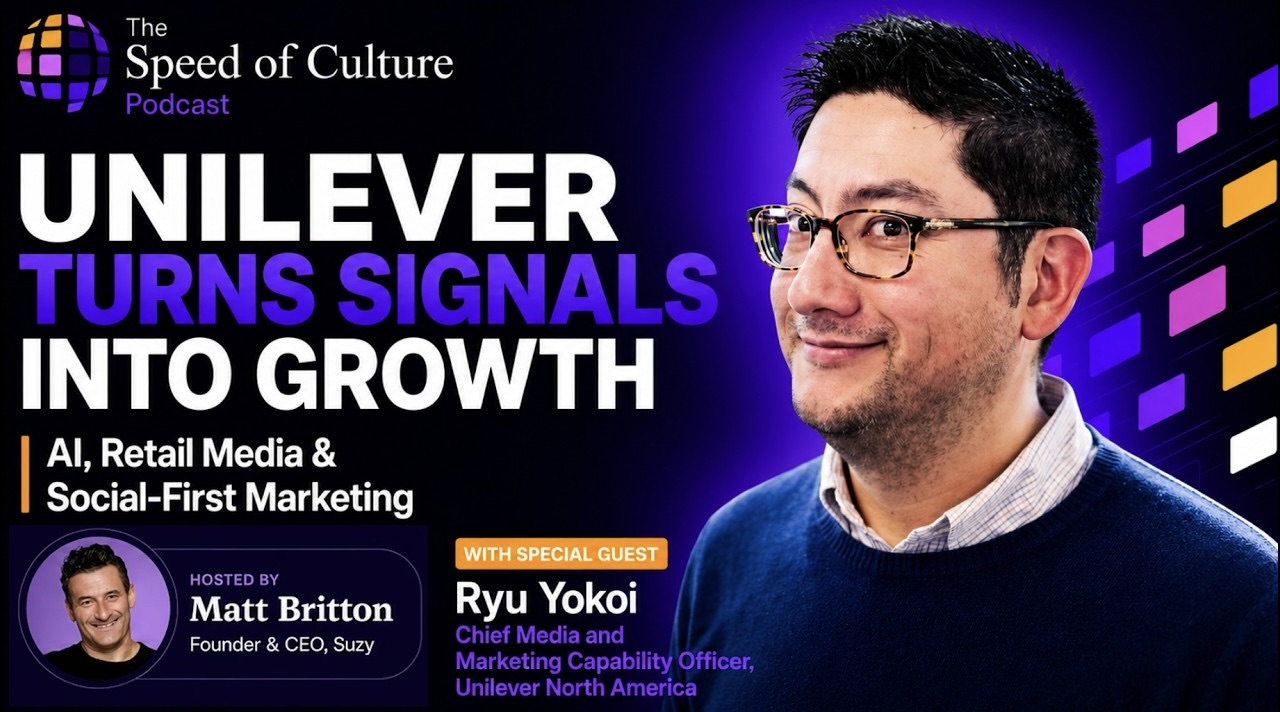
At the forefront of this transformation stands Ryu Yokoi, Chief Media and Marketing Capability Officer at Unilever North America, who is fundamentally reshaping how one of the world's largest consumer goods companies approaches brand building in the age of AI and real-time consumer intelligence.
In a recent episode of The Speed of Culture Podcast hosted by Matt Britton, founder and CEO of Suzy, the AI-powered consumer intelligence platform, Yokoi shared his vision for reimagining marketing as a data-powered, socially fluent discipline.
The conversation revealed how Unilever is leveraging first-party data, creator relationships, and retail media platforms to drive authentic connections with consumers, particularly Gen Z audiences skeptical of traditional advertising. With over 19 years at Unilever and a track record of digital transformation initiatives, Yokoi has positioned the company not just as a brand builder, but as a nimble, adaptive organization that treats marketing as both an art and a science.
His approach demonstrates that in a world where consumer preferences shift at the speed of culture, brands must be willing to pull the levers of data, commerce, and media in concert to remain relevant.
This article explores the key insights from that conversation, examining how Yokoi's strategic framework is redefining CPG marketing for the digital age and what other organizations can learn from Unilever's transformation.
1. From Campaign-Centric to Always-On: Restructuring Marketing for Modern Realities
Ryu Yokoi's first major structural insight addresses a fundamental problem facing legacy consumer brands: the traditional annual campaign cycle no longer aligns with how consumers engage with products and content.
Unilever's restructuring created a convergence between data, commerce, and media capabilities, a departure from siloed departments that once operated independently.
The old model treated media buying, creative development, and retail strategy as separate functions. Yokoi has reorganized these teams to work in concert, recognizing that meaningful brand signals emerge at the intersection of these domains.
When a consumer engages with a brand on social media, that interaction generates data that should immediately inform how the product appears on a retailer's digital shelf. When a trending moment emerges on TikTok or Instagram, Unilever's teams can now identify, analyze, and respond within hours rather than weeks.
This restructuring reflects a deeper philosophical shift: marketing is no longer about broadcasting campaigns at predetermined intervals. Instead, it's about creating an always-on presence that responds to real-time consumer sentiment, emerging trends, and cultural moments.
The speed of culture demands speed of response, and Yokoi has built organizational architecture to support that velocity.
The benefits are measurable. By aligning media insights with retail strategy, Unilever can optimize digital shelf presentation based on what's actually resonating in social channels.
Creative decisions are informed by data about which messages drive not just engagement, but actual purchase intent. Packaging decisions reflect cultural and contextual relevance rather than aesthetic preferences made in conference rooms removed from consumer behavior.
This model also enables more efficient budget allocation. Rather than splitting resources across disconnected initiatives, Unilever can invest in integrated campaigns where every touchpoint (social content, influencer partnerships, retail media, and traditional advertising) works toward the same outcome.
The result is higher ROI and clearer attribution for marketing investments.
2. Retail Media as Strategic Infrastructure, Not an Emerging Channel
One of Yokoi's most provocative insights involves reframing how brands should think about retail media platforms like Walmart and Amazon.
In many organizations, retail media is treated as a newer, secondary channel, something to experiment with while maintaining focus on traditional media buys. Yokoi argues this perspective is dangerously outdated.
Instead, he positions retail media as core infrastructure, a full-service media ecosystem that rivals traditional advertising channels in sophistication, reach, and targeting capability.
Platforms like Walmart.com and Amazon have evolved far beyond simple product placement. They now offer video capabilities, sophisticated audience segmentation, attribution modeling, and direct connections to purchase behavior.
They function as full-service media agencies in their own right.
This reframing has profound strategic implications. When retail media becomes infrastructure rather than a supplementary channel, budgets, talent, and strategic attention reallocate accordingly.
Unilever has committed 50% of its ad spend to influencer marketing and social media, up from 30% in previous years, recognizing that the convergence of social platforms and retail channels creates a new marketing funnel.
The advantage for CPG companies is direct: retailers now offer capabilities that enable unprecedented attribution.
A consumer can see a product advertised on Instagram, click through to a retailer's website, view the digital shelf, and complete the purchase, with each step tracked and measured. This closed-loop insight allows brands to understand what creative approaches actually drive sales, not just engagement metrics.
Yokoi emphasizes that forward-thinking brands should treat these retail media platforms not as competitors to traditional agencies, but as primary partners.
The data generated by consumer interactions on these platforms (search queries, browsing behavior, purchase history) represents an invaluable asset for understanding what drives consumer decision-making in real time.
3. Creator Partnerships as Authentic Relationships, Not Programmatic Transactions
While many brands approach influencer marketing through automation platforms and programmatic buying tools, Yokoi advocates for a fundamentally different philosophy: creator partnerships should be built on genuine human relationships and authentic cultural understanding.
This distinction matters profoundly, especially when reaching Gen Z consumers. This demographic has been exposed to advertising their entire lives and has developed sophisticated filters for detecting inauthenticity.
They trust creators they perceive as genuine; they dismiss brands that feel like corporate entities attempting to co-opt their culture.
Programmatic influencer buying, where algorithms match brands to creators based on audience overlap, often produces hollow partnerships that feel transactional rather than authentic.
Unilever's creator strategy inverts this model. Instead of buying reach through automated platforms, the company builds relationships with creators who genuinely align with brand values and understand their audiences' cultural context.
This approach treats creators as what they truly are: tastemakers and cultural arbiters who can guide consumer preferences through authentic endorsement.
The results validate this philosophy. Creators offer both reach and resonance. They introduce products to large audiences while simultaneously adding cultural credibility that traditional advertising cannot achieve.
A Gen Z consumer is far more likely to trust a product recommendation from a creator they follow than from a banner ad. The human relationship between creator and audience amplifies brand messaging far more effectively than programmatic delivery.
Moreover, this approach aligns with Unilever's broader commitment to authenticity. By prioritizing genuine relationships over transaction volume, the company signals that it respects creator audiences and won't exploit cultural moments for superficial marketing purposes.
This builds long-term brand equity that transcends individual campaigns.
Yokoi notes that as Unilever scales this approach, the company plans to work with 20 times more influencers globally, maintaining authentic relationships across thousands of creator partnerships requires new organizational capabilities.
It demands marketing teams with genuine curiosity about culture, collaboration skills, and the ability to empower creators rather than control them.
4. First-Party Data Without Direct-to-Consumer Operations
A common assumption among consumer brands is that building first-party data capabilities requires direct-to-consumer operations.
Yokoi challenges this premise, demonstrating that sophisticated first-party data collection is achievable even without owning the customer relationship directly.
Unilever captures consumer insights through multiple channels despite not operating major DTC platforms.
Media tagging systems allow the company to understand which consumers engaged with specific campaigns across digital channels. Real-world activations (product sampling, experiential marketing, pop-up events) generate direct consumer interactions and feedback.
Publisher partnerships enable data collection through content platforms and media relationships.
The philosophical foundation underlying this approach is trust-building through value creation.
Rather than aggressively collecting data through owned channels, Unilever emphasizes earning consumer trust by creating genuinely valuable content and experiences.
Recipes, skincare advice, beauty tutorials, and lifestyle content address consumer needs while simultaneously generating behavioral signals about what resonates.
This strategy sidesteps the privacy concerns and first-party deprecation challenges that plague companies relying solely on DTC models.
As third-party cookies disappear and privacy regulations tighten, brands that have built trust-based relationships with consumers, rather than relying on invasive tracking, will maintain competitive advantages.
The data generated through these trust-based channels proves particularly valuable because it reflects genuine consumer interest.
A consumer who voluntarily engages with a Dove skincare tutorial is expressing authentic interest in that category; they're not just a tracked data point.
This distinction translates to higher-quality insights and more effective targeting.
5. Marketing Talent Evolution: From Campaign Managers to Adaptive Problem-Solvers
Underlying all these strategic shifts is a fundamental insight about organizational capability: the traditional marketing skillset is insufficient for the modern environment.
Yokoi emphasizes that success requires a new breed of marketing professional, someone who embraces curiosity, collaboration, and iterative thinking rather than relying on established annual campaign cycles.
The traditional marketing trajectory, where professionals develop expertise in specific disciplines, doesn't adequately prepare teams for an always-on, data-driven, culturally responsive environment.
Modern marketing demands professionals who can synthesize insights across disciplines, adapt strategies based on real-time feedback, and embrace the complexity of an interconnected marketing ecosystem.
Yokoi prioritizes hiring for curiosity and adaptability. Does the candidate genuinely want to understand consumer behavior? Are they collaborative, or do they guard functional territory? Can they thrive in ambiguity, or do they need clear playbooks?
These qualities matter more than whether they've previously managed a specific marketing function.
This talent evolution extends beyond individual hiring to team composition.
Unilever is building marketing teams that include data analysts, cultural researchers, platform strategists, and creative generalists working alongside specialists.
The goal is cross-functional understanding, enabling media buyers to grasp creative implications, creative teams to understand data constraints, and all disciplines to speak a common language around consumer insights.
The practical implication is that traditional marketing organizational charts no longer function.
Instead, successful companies organize around consumer journeys and key platforms with fluid team structures that shift as market conditions change.
This requires different kinds of managers, people who can lead without rigid hierarchical authority, who can facilitate collaboration across functions, and who can help teams embrace constant iteration rather than defending fixed strategies.
Key Takeaways
- Restructure for Convergence: Align media, data, and commerce capabilities across organizational silos to create an integrated marketing ecosystem responsive to real-time consumer behavior and cultural moments.
- Retail Media Is Infrastructure: Treat retail media platforms like Walmart and Amazon not as supplementary channels but as primary strategic partners offering sophisticated targeting, attribution, and direct-purchase connections.
- Authenticity Over Automation: Build creator partnerships based on genuine relationships and cultural alignment rather than programmatic buying, especially when reaching Gen Z audiences skeptical of traditional corporate messaging.
- Earn Trust Through Value: Generate first-party consumer data by creating genuinely valuable content and experiences that address consumer needs, building relationships that are more resilient to privacy regulation and third-party deprecation.
- Hire for Adaptability: Prioritize marketing talent with curiosity, collaboration skills, and iterative thinking over functional specialization, recognizing that the always-on environment demands professionals who can synthesize insights across disciplines.
Frequently Asked Questions
How can established CPG brands restructure marketing teams to embrace data-driven, always-on operations?
Start by mapping your current customer journey across all touchpoints, social media, retail platforms, owned channels, and traditional media.
Identify where information silos prevent alignment. Then reorganize teams around customer touchpoints rather than functional specialties.
Create daily or weekly cadences where media, retail, and creative teams review performance data and adjust strategies.
The restructuring should be gradual; trying to transform everything simultaneously creates organizational chaos.
Instead, pilot the integrated approach with one brand category, measure results, and expand based on learnings.
What specific tools and platforms enable the kind of real-time social listening and response that Yokoi describes?
Unilever leverages AI-powered platforms like Suzy for consumer intelligence, combined with native analytics from social platforms and retail partners.
The platforms are less important than the processes around them, daily social listening reviews, rapid response protocols, and permission structures that empower teams to act on insights without bureaucratic delays.
Many organizations already own these tools but fail to use them for real-time response because organizational processes require weeks of approvals before content can launch.
How should brands measure success in an always-on, integrated marketing model?
Traditional metrics like cost-per-acquisition and return-on-ad-spend remain important but prove insufficient.
Add metrics around cultural resonance, speed of response, and long-term brand equity.
Attribution modeling becomes critical, understanding not just which channel drove a sale, but how multiple touchpoints contributed to purchase decisions.
Companies should move away from channel-specific reporting toward integrated dashboards showing how different marketing elements reinforce each other.
What organizational barriers most commonly prevent brands from implementing this strategy, and how can leaders overcome them?
The primary barrier is functional specialization, deep expertise in individual disciplines creates territorial silos.
Leaders must redefine success metrics to reward collaboration rather than individual function performance.
A second barrier is approval processes designed for slower campaign cycles; real-time response requires empowering teams with decision-making authority.
Third is talent, finding professionals comfortable with ambiguity and rapid iteration rather than those who prefer stable annual plans.
Address this through explicit hiring criteria and professional development programs emphasizing cross-functional learning.
Looking Ahead
The conversation between Matt Britton and Ryu Yokoi on The Speed of Culture Podcast illuminates a critical inflection point in marketing evolution.
The companies that will dominate the next decade won't be those with the largest budgets, but those that can move at the speed of culture, identifying moments when consumers care, delivering authentic messages through trusted creators, and connecting desire to purchase through frictionless retail experiences.
For marketing leaders seeking to build adaptive, data-driven organizations, Yokoi's framework provides a actionable roadmap.
Start by examining your organizational structure: Does it enable real-time collaboration across media, creative, and retail functions?
Continue by reassessing your creator strategy: Are you building authentic relationships, or relying on transactional influencer platforms?
Then evaluate your data approach: Are you earning consumer trust through valuable content, or attempting to extract data through invasive tracking?
The future of marketing belongs to organizations willing to fundamentally rethink what marketing is, not campaigns designed in isolation, but integrated experiences emerging from the convergence of data, creativity, culture, and commerce.
For deeper insights into how consumer intelligence and AI are reshaping marketing strategy, explore Suzy's AI-powered platform, listen to more episodes of The Speed of Culture Podcast, or dive into Matt Britton's latest book Generation AI: Why Generation Alpha and the Age of AI Will Change Everything.
For organizations seeking to bring these insights to their leadership teams, explore Matt Britton's AI Keynote Speaker services and Speaker HQ platform, or contact the team directly.

%20(400%20x%20100%20px)%20(300%20x%2050%20px)%20(150%20x%2050%20px).avif)