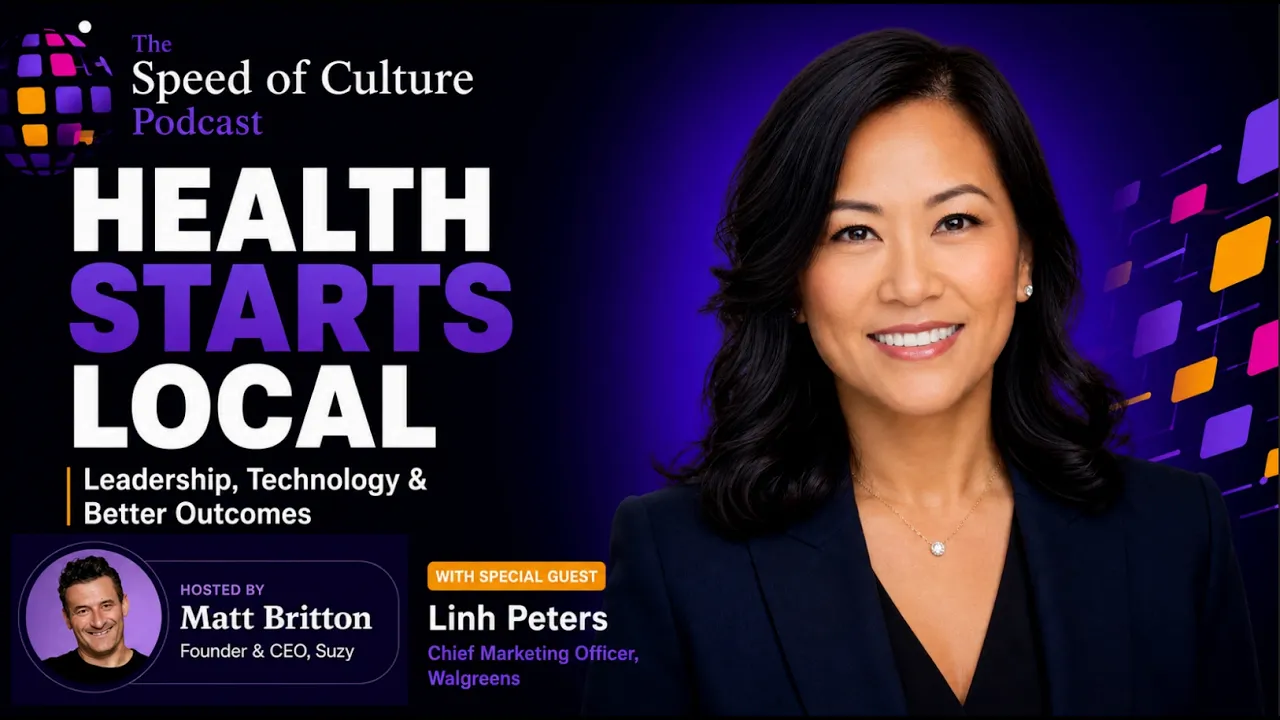
Driving Healthcare with Purpose and Empathy with Linh Peters, CMO at Walgreens
In episode 32 of the Speed of Culture podcast, Matt Britton, founder and CEO of Suzy, the AI-powered consumer intelligence platform, sits down with Linh Peters, Chief Marketing Officer at Walgreens, to explore how personal leadership experiences shape organizational strategy and drive meaningful healthcare transformation.
Peters, a refugee who fled Vietnam with her family in the 1980s, brings an authentic commitment to purpose-driven marketing that extends far beyond traditional retail positioning. This conversation reveals the intersection of empathy, data-driven marketing, and healthcare innovation in one of America’s largest pharmacy networks.
As consumer expectations shift toward brands that prioritize genuine community impact, Peters’ approach to leveraging Walgreens’ 9,000 community-based stores as neighborhood health destinations offers critical insights for executives navigating the retail healthcare revolution.
The episode, recorded on January 31, 2023, demonstrates how authentic leadership grounded in personal values creates competitive advantages in an increasingly purpose-conscious marketplace where consumers demand transparency, accessibility, and genuine commitment to underserved populations.
From Refugee to Healthcare Leader: The Power of Personal Mission Alignment
Linh Peters’ journey to becoming CMO of one of America’s largest pharmacy chains is inseparable from her personal story as a refugee and immigrant. Born in Vietnam, Peters’ family escaped the post-war chaos in 1980 aboard an overcrowded cargo ship with thousands of other families seeking refuge.
After spending five months in Hong Kong Harbor, the family was resettled in Minnesota through the support of a Lutheran church, a transformative experience that fundamentally shaped her understanding of vulnerability, community support, and human dignity. This lived experience directly informs her leadership philosophy at Walgreens, where she emphasizes building a healthcare ecosystem grounded in empathy and accessibility for underserved populations.
During the podcast conversation, Peters articulates how her formative experiences translate into professional action:
“I learned very early on in life about empathy, about community, about giving, about being vulnerable.”
This philosophy stands in stark contrast to traditional retail marketing approaches that prioritize transactional relationships over authentic human connection. Rather than positioning Walgreens simply as a convenient pharmacy chain, Peters leverages her CMO platform to reposition the organization as a neighborhood health partner committed to closing healthcare access gaps.
This strategic reframing requires moving beyond conventional marketing metrics (revenue per customer, foot traffic conversion) to measuring impact in terms of health outcomes, accessibility improvements, and community trust.
Peters’ background as a former Target, Starbucks, Ulta Beauty, and Calvin Klein marketer demonstrates her proven ability to build meaningful brand experiences across diverse industries. However, her transition to Walgreens represents a deliberate choice to align her career with her personal mission to serve vulnerable and underserved populations, illustrating how values-aligned leadership drives authentic brand transformation.
The Healthcare Evolution: From Pharmacy to Primary Care Destination
When Linh Peters assumed the CMO role at Walgreens in May 2022, the company was already piloting a strategic shift from traditional pharmacy operations toward comprehensive healthcare delivery.
The flagship initiative, Walgreens Health Corners, represents a fundamental reimagining of retail pharmacy’s role in the American healthcare system. These dedicated spaces, now installed in select Walgreens locations across California, Ohio, New Jersey, and other markets, combine clinical expertise with accessible community-based infrastructure to address critical healthcare deserts where primary care access remains limited.
Health Corners operate as mini health clinics embedded within pharmacy environments, featuring approximately 3,000 square feet of state-of-the-art clinical space staffed by health advisors with clinical backgrounds, including pharmacists, nurse practitioners, and other qualified healthcare professionals.
Rather than simply dispensing prescriptions, these spaces facilitate preventive screenings, chronic disease management, wellness consultations, and patient education. Peters’ marketing strategy positions Health Corners not as revenue-generating centers but as trust-building community assets.
The clinical environment design, patient communication messaging, and partnership structures all reflect Peters’ core insight: healthcare transformation requires centering consumer needs and community accessibility over pure profit maximization.
The Walgreens Health Corners initiative directly addresses a critical national challenge: the healthcare access crisis affecting low-income and underserved communities. According to industry analysis, retail pharmacies increasingly recognize that consumer expectations have fundamentally shifted.
More than half of Gen Z and Millennials report visiting local pharmacies for non-emergency care in the past year, demonstrating consumers’ readiness to accept pharmacy-based healthcare services when trust and quality are demonstrated.
Peters recognized that Walgreens’ nearly 9,000 stores represent an unparalleled opportunity to deliver healthcare at the neighborhood level, where most Americans already access pharmaceutical services. By strategically positioning these locations as primary healthcare touchpoints rather than convenience retailers, Peters’ marketing initiatives help consumers understand how Walgreens can address their comprehensive wellness needs, not merely fill prescriptions.
Data, Technology, and Human Connection: The Marketing Infrastructure for Purpose-Driven Healthcare
Peters emphasizes that purpose-driven marketing requires sophisticated integration of data analytics, consumer experience design, and authentic human connection. During the podcast conversation, she highlights how Walgreens leverages “data, technology and the customer experience to create meaningful messaging” that resonates with health-conscious consumers while maintaining accessibility for vulnerable populations.
This human-centric approach distinguishes Walgreens from competitors attempting healthcare expansion through purely transactional digital channels.
The strategic challenge Peters navigates involves maintaining authentic empathy while operating at enterprise scale. Walgreens serves millions of customers across geographically and demographically diverse communities, each with distinct healthcare needs, cultural contexts, and trust relationships with healthcare providers.
Rather than deploying one-size-fits-all marketing campaigns, Peters champions hyper-localized approaches that honor community-specific health priorities and cultural identities. This requires sophisticated data infrastructure capable of analyzing neighborhood-level health trends, cultural demographics, healthcare access patterns, and consumer communication preferences, then translating these insights into locally relevant messaging that reflects genuine commitment to community health, not exploitative targeting.
Technology enables this precision without replacing authentic human relationships. Peters’ marketing strategy encourages Walgreens team members (pharmacists, store associates, health advisors) to function as trusted community health guides rather than product-focused sales staff.
Training programs, internal communications, and performance incentives all reflect Peters’ philosophy that healthcare access fundamentally requires human relationships built on trust, competence, and demonstrated commitment to patient wellbeing.
This distinction proves critical in underserved communities where historical healthcare inequities and institutional distrust run deep. Digital marketing campaigns can drive awareness and initial consideration, but trust, and therefore sustainable healthcare transformation, emerges from consistent in-person interactions demonstrating genuine care for community health outcomes.
Peters’ approach recognizes that premium targeting and personalization technology, while valuable, function best when supporting rather than replacing authentic human connection at the point of care.
Purpose-Driven Leadership: Maximizing Impact Through Strategic Voice and Operational Involvement
Peters brings sophisticated insights about executive leadership effectiveness in purpose-driven organizations. She emphasizes the importance of maximizing one’s voice strategically, understanding when to advocate directly for mission-aligned decisions versus when to build consensus through relationship-based influence.
This nuanced leadership approach proves essential in large organizations where alignment across multiple functions (merchandising, supply chain, store operations, clinical quality) becomes necessary to execute integrated healthcare strategies.
Peters advocates for what she describes as “getting into operational details when needed” a departure from siloed executive structures where marketing leadership remains isolated from store-level realities.
By spending time in Health Corner locations, observing patient interactions, gathering frontline feedback, and understanding operational constraints, Peters ensures that marketing strategies reflect authentic store realities rather than disconnected corporate theory.
This hands-on approach builds credibility with store associates and clinical staff while generating consumer insights that inform more effective marketing positioning.
Additionally, Peters emphasizes “assuming positive intent” when navigating cross-functional tensions, recognizing that colleagues in operations, supply chain, and clinical leadership share commitment to Walgreens’ mission, even when functional priorities create apparent conflicts.
This collaborative rather than adversarial approach accelerates healthcare innovation by reducing organizational friction and building cooperative coalitions across previously siloed departments.
The podcast conversation reveals Peters’ sophisticated understanding of leadership leverage within large organizations. Whereas traditional CMO narratives focus narrowly on campaign development and brand building, Peters conceptualizes the CMO role as a strategic bridge connecting consumer insights, organizational capabilities, and purpose-driven mission execution.
Her emphasis on relationships “rooted in trust” acknowledges that sustainable healthcare transformation requires alignment among executives, employees, partners, and communities, trust-based relationships that marketing alone cannot manufacture.
Instead, authentic leadership communication and visible commitment to articulated values build organizational credibility. When employees observe executives like Peters actively involving themselves in understanding store realities and patient needs, and when customers experience consistent messaging aligned with actual operational priorities, trust accumulates, creating the social license necessary for fundamental healthcare model innovation.
The Competitive Advantage of Authenticity in Purpose-Driven Marketing
As consumers increasingly align purchasing decisions with brand values, Peters’ approach to purpose-driven marketing offers competitive advantages beyond traditional brand metrics.
Research from 2023 indicates that 56% of Gen Z and 54% of Millennials have visited local pharmacies for non-emergency care, suggesting fundamental shifts in how younger generations access healthcare.
This demographic transition creates opportunities for pharmacy retailers demonstrating authentic commitment to accessibility and community health over pure profit maximization. Competitors attempting to replicate purpose-driven positioning without underlying organizational commitment risk perceived inauthenticity that damages trust more severely than traditional positioning ever could.
Peters’ strategy recognizes that in healthcare markets, authenticity becomes a premium competitive attribute. Patients and families navigating healthcare decisions, particularly in underserved communities where institutional distrust runs deep, evaluate whether organizations genuinely prioritize health outcomes or merely exploit healthcare access gaps for profit expansion.
Walgreens’ commitment to Health Corners represents visible, costly investment in underserved communities that competitors cannot easily replicate. The clinical staff, physical infrastructure, partnership investments with community health plans, and organizational commitment to accessible services create credible signals of authentic mission alignment.
Furthermore, Peters understands that purpose-driven positioning attracts and retains high-performing employees motivated by mission alignment rather than compensation alone.
Healthcare professionals (pharmacists, nurse practitioners, health advisors) increasingly select employers based on organizational values and alignment with personal professional missions.
Marketing campaigns articulating Walgreens’ commitment to healthcare access help attract mission-driven talent while supporting recruitment narratives that emphasize professional fulfillment alongside compensation. This talent advantage becomes particularly critical as Walgreens expands Health Corners and other advanced healthcare services requiring clinical expertise in competitive labor markets.
Key Takeaways for Business Leaders
- Authenticity Matters: Leadership credibility and organizational authenticity become premium competitive advantages in purpose-driven markets. When executives genuinely align personal values with organizational mission, that authentic commitment cascades throughout organizational culture, employee engagement, customer relationships, and community perception. Peters’ personal refugee background informs credible healthcare equity commitments that competitors cannot replicate through marketing campaigns alone.
- Purpose Requires Operational Investment, Not Just Messaging: Purpose-driven positioning demands substantive organizational change and resource commitment beyond marketing communications. Health Corners, clinical partnerships, workforce training, and process redesign represent costly investments that validate marketing claims about healthcare accessibility and community commitment, creating credible differentiation in increasingly skeptical markets.
- Hyper-Local Strategy Honors Community Diversity: Different neighborhoods face distinct healthcare access challenges, cultural healthcare preferences, and trust relationships with healthcare institutions. Sophisticated purpose-driven strategy requires data infrastructure and marketing flexibility to adapt messaging, partnerships, and service approaches to community-specific contexts rather than deploying standardized campaigns across geographically diverse markets.
- Human Connection Scales Through Trusted Employees: Digital marketing enables reach and targeting sophistication, but healthcare trust ultimately emerges from consistent positive relationships with frontline employees, pharmacists, health advisors, store associates. Marketing strategies that position frontline employees as trusted community health guides rather than product-focused sales staff create sustainable competitive advantages through relationship-based competitive moats.
- Values-Aligned Leadership Attracts Mission-Driven Talent: Healthcare and other purpose-driven industries compete for talent motivated by professional mission and values alignment alongside compensation. Marketing that authentically articulates organizational commitment to healthcare equity and community health helps attract and retain high-performing healthcare professionals who increasingly select employers based on mission alignment.
Frequently Asked Questions
How does Walgreens’ Health Corners initiative differ from traditional pharmacy operations?
Traditional pharmacy operations focus narrowly on prescription dispensing, customers present prescriptions and exchange them for medications, often with minimal patient education or health assessment.
Health Corners fundamentally expand Walgreens’ role to comprehensive primary care delivery, where clinical staff provide preventive screenings, chronic disease management, wellness consultations, and medication therapy management.
This transformation positions Walgreens as a neighborhood health destination rather than a convenience pharmacy, enabling the organization to address healthcare access gaps while deepening customer relationships and capturing expanded revenue opportunities in underserved markets lacking adequate primary care capacity.
Why does Linh Peters emphasize personal refugee background in her healthcare leadership approach?
Peters’ lived experience navigating vulnerability, displacement, and community dependence creates authentic empathy for underserved populations lacking reliable healthcare access.
Rather than positioning healthcare equity as corporate social responsibility or brand differentiation strategy, Peters grounds these commitments in personal values and professional mission alignment.
This authenticity proves particularly important in healthcare markets where institutional distrust runs deep among populations historically marginalized by healthcare systems. Customers recognize when organizational leaders genuinely prioritize population health outcomes versus exploiting healthcare access gaps for profit maximization, making authentic values alignment a critical competitive advantage.
How does data analytics support purpose-driven marketing at Walgreens?
Data infrastructure enables hyper-localized marketing that honors community-specific health needs, cultural contexts, and communication preferences.
Neighborhood-level analysis of health outcomes, demographic profiles, healthcare access patterns, and existing provider relationships allows Walgreens to tailor Health Corners positioning and partnership strategies to community contexts rather than deploying standardized messaging.
This precision prevents purpose-driven positioning from appearing tone-deaf or exploitative, authentic community-responsive strategy requires understanding specific health challenges and cultural contexts that shape how different communities access and relate to healthcare services.
What competitive advantages emerge from values-aligned leadership in healthcare markets?
Authenticity becomes a premium competitive attribute in healthcare where consumers evaluate whether organizations prioritize health outcomes or merely exploit access gaps.
Substantive organizational commitments to underserved populations, visible through Health Corners infrastructure, clinical partnerships, workforce training, and process redesign, create credible differentiation that competitors cannot easily replicate through marketing campaigns alone.
Additionally, mission-aligned positioning attracts and retains healthcare professionals motivated by professional purpose alongside compensation, creating talent advantages in competitive healthcare labor markets.
Looking Ahead
Linh Peters’ approach to healthcare leadership reflects broader evolution in consumer expectations and business purpose. As stakeholders increasingly expect organizations to demonstrate authentic commitment to social impact alongside profit generation, leaders like Peters who align personal values with organizational mission create meaningful competitive advantages.
For business executives across industries, the Speed of Culture podcast conversation illuminates critical insights about purpose-driven strategy, authentic leadership communication, and the organizational transformation required to validate purpose-driven positioning.
Walgreens’ Health Corners initiative and the broader healthcare retail transformation represent just one example of how consumer expectations are reshaping traditional business models.
Organizations in retail, technology, financial services, and other industries face similar pressures to demonstrate authentic commitment to stakeholder wellbeing beyond shareholder returns. Peters’ leadership model, grounded in personal values, supported by data-driven insights, and validated through substantive organizational investment, offers a replicable framework for executives navigating this values-driven business evolution.
For deeper exploration of consumer trends, emerging market opportunities, and how organizations build authentic purpose-driven positioning, explore Suzy’s consumer intelligence platform or visit the Speed of Culture podcast for additional episodes with leading marketing executives.
For presentations on generational consumer trends, AI strategy, and purpose-driven business transformation, discover Matt Britton’s work as an AI keynote speaker and explore resources including Generation AI and Speaker HQ.

%20(400%20x%20100%20px)%20(300%20x%2050%20px)%20(150%20x%2050%20px).avif)