May 16, 2023
The Incredible Journey of Kofi Amoo-Gottfried to CMO of DoorDash

Kofi Amoo-Gottfried
Chief Marketing Officer
This is some text inside of a div block.
This is some text inside of a div block.
LISTEN ANYWHERE YOU FIND YOUR PODCASTS
%20(400%20x%20100%20px)%20(300%20x%2050%20px)%20(150%20x%2050%20px).avif)

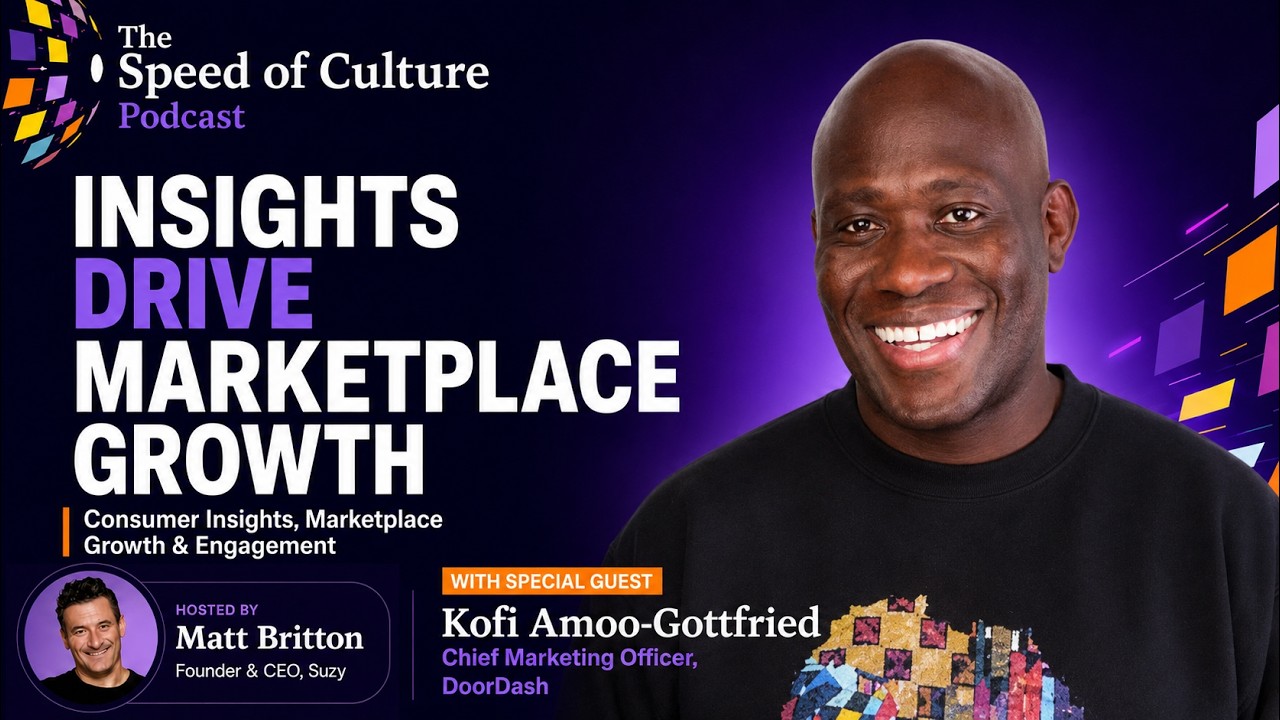
The modern delivery economy has fundamentally transformed how consumers access food, goods, and services. Behind every successful platform in this space stands a visionary leader who understands both consumer psychology and market dynamics. This episode of the Speed of Culture Podcast features Kofi Amoo-Gottfried, Chief Marketing Officer of DoorDash, whose remarkable journey from ambitious entrepreneur to leading one of the world's most impactful delivery platforms offers invaluable lessons for marketing executives and business leaders alike.
Matt Britton, founder and CEO of Suzy, the AI-powered consumer intelligence platform, sits down with Amoo-Gottfried to unpack the strategies, challenges, and innovations that have defined his career. Their conversation explores how data-driven decision-making, authentic storytelling, and consumer-first thinking have become the cornerstones of modern marketing leadership. The insight shared in this episode transcends delivery platforms, it speaks to the evolving nature of brand building in the age of AI and real-time consumer intelligence.
For executives seeking to understand how top CMOs navigate competitive markets, build brand loyalty, and leverage emerging technologies, this interview provides a masterclass in strategic marketing excellence.
Kofi Amoo-Gottfried's career trajectory reveals a critical insight often overlooked in marketing circles: authentic personal branding precedes executive success. Before ascending to the CMO role at DoorDash, Amoo-Gottfried demonstrated an exceptional ability to connect with audiences, build meaningful relationships, and establish himself as a thought leader within the marketing and business communities.
His approach diverges from the traditional executive playbook. Rather than waiting for prestigious titles to amplify his voice, he actively engaged with industry conversations, shared insights from his professional journey, and contributed to the broader dialogue about marketing's evolution. This proactive positioning established credibility before he needed it, built a network of influential connections, and demonstrated the strategic thinking that would eventually define his leadership at DoorDash.
The lesson for contemporary marketers is profound. In an era where consumer trust in corporate messaging remains fragile, executives who cultivate genuine personal brands gain significant leverage. They become symbols of their organizations' values, attract top talent, and command attention from media, analysts, and consumers alike.
Amoo-Gottfried's trajectory illustrates that in modern marketing, your personal brand is an asset as valuable as the brands you lead. This philosophy also reflects a deeper understanding of consumer behavior that aligns directly with Suzy’s mission. The most effective marketing emerges when leaders truly understand their audiences, not from contrived positioning or manufactured expertise.
When Amoo-Gottfried joined DoorDash's leadership ranks, the delivery economy was at an inflection point. The COVID-19 pandemic had accelerated adoption of delivery services beyond what most analysts predicted. Simultaneously, consumer expectations had shifted dramatically: speed, reliability, and personalization had become baseline requirements rather than differentiators.
The industry presented a unique marketing challenge: acquiring new users, retaining existing customers, and maintaining courier satisfaction while managing operational complexity across hundreds of cities and millions of orders. Traditional marketing approaches wouldn't suffice. Amoo-Gottfried recognized that DoorDash's competitive advantage would emerge from understanding consumers at an unprecedented granularity.
Real-time consumer intelligence became central to DoorDash's marketing strategy under his leadership. Rather than relying solely on quarterly surveys or historical data, the organization needed to understand how consumer preferences shifted hour by hour, city by city, and category by category. This approach mirrors the core value proposition of AI-powered consumer intelligence, revealing motivations in real time.
The delivery economy's rapid growth also created an opportunity to redefine brand loyalty. Instead of focusing solely on transactional incentives like discounts and free delivery, Amoo-Gottfried championed a more sophisticated approach: identifying which features, delivery times, restaurant selections, and service interactions created genuine emotional attachment to the brand.
This shift reflected a deeper truth about modern consumer behavior. As competition intensified, the brand that would win would be the one that understood customers’ daily contexts and constraints. Effective CMOs recognize these nuances and build marketing programs around them.
One of the most striking elements of Amoo-Gottfried's approach is his commitment to operationalizing data and insights across marketing functions. Many organizations recognize the theoretical value of consumer intelligence but struggle with implementation. Insights sit in reports. Data remains siloed. Strategic recommendations fail to translate into executable tactics.
At DoorDash's scale, millions of daily active users across hundreds of metropolitan areas, coordinating marketing efforts requires exceptional clarity about consumer segments, purchasing patterns, and emerging trends. The process begins with asking the right questions:
These questions require predictive modeling, cohort analysis, and multivariate testing. They demand collaboration between marketing strategists, data scientists, product teams, and brand leaders. DoorDash invested heavily in building this capability under Amoo-Gottfried’s leadership.
The business impact has been substantial. When marketing leaders possess granular understanding of their customer base and can predict how messaging variations will resonate, ROI on marketing spend improves dramatically. Campaigns become more targeted, budget allocation reflects actual consumer propensity, and creative assets are refined based on evidence, not instinct.
As DoorDash accumulates more data about consumer preferences, learning accelerates and competitive distance widens. Data compounds. Intelligence scales.
The delivery economy’s marketing landscape shifted when major platforms began investing in Super Bowl advertising. These campaigns marked a transition from performance marketing to full-scale brand building.
DoorDash’s Super Bowl advertisements served dual purposes. They generated mass awareness while signaling confidence to investors, employees, and consumers. They demonstrated that DoorDash was playing at the highest levels of cultural relevance.
Effective Super Bowl advertising in a saturated market requires emotional resonance, humor, and storytelling that breaks through noise. Amoo-Gottfried’s balanced philosophy recognizes that brand building and performance marketing must work together. Awareness drives familiarity. Performance marketing converts that familiarity into action.
Modern consumer journeys are fragmented. A customer may see a Super Bowl ad, later search online, respond to a social media placement, and ultimately convert after a friend’s recommendation. Orchestrating these touchpoints requires unified strategy and sophisticated marketing operations.
Throughout his marketing leadership tenure, Amoo-Gottfried has leveraged AI and machine learning to deepen understanding of consumer behavior. This is practical intelligence influencing daily marketing decisions.
Predictive analytics identify churn risk. Personalization engines tailor in-app experiences. Demand forecasting anticipates category growth. Attribution modeling clarifies which touchpoints truly drive conversion.
World-class CMOs recognize that AI-powered consumer intelligence is a strategic imperative, not merely a departmental initiative. It influences product development, organizational alignment, and long-term competitive positioning.
This evolution mirrors themes explored in Generation AI and in Matt Britton’s AI keynote presentations. Modern CMOs must combine creative intuition with fluency in data science, speaking confidently with engineers while maintaining mastery of storytelling and culture.
As the delivery market matured, competitive dynamics shifted from pure acquisition to retention, unit economics, and operational efficiency. Early competition required aggressive share capture. Later stages required market expansion and category growth.
DoorDash expanded into grocery, convenience, flowers, pharmaceuticals, and international markets. Each category demanded tailored marketing strategies while maintaining brand consistency.
This transition, from taking share to expanding total addressable market, represents a critical inflection point for high-growth companies. Sophisticated CMOs recalibrate organizations to prioritize category building, consumer education, and sustainable growth.
Customer acquisition relies on broad awareness and consideration messaging. Retention focuses on creating habitual behavior and emotional loyalty. Predictive models identify churn risk, and targeted incentives re-engage at-risk customers. Retained customers generate superior lifetime value compared to constantly acquiring new ones.
AI enables predictive analytics, sentiment analysis, optimized media buying, and sophisticated attribution modeling. It enhances human judgment by clarifying consumer behavior at scale, rather than replacing it.
Super Bowl advertising builds cultural relevance and mass awareness that performance marketing alone cannot achieve. The most effective strategy integrates awareness campaigns with measurable downstream conversion efforts.
Effective organizations break down silos between analytics, strategy, and execution. Embedding data scientists within marketing teams and organizing cross-functional teams around customer segments ensures insights directly influence creative and budget decisions.
The marketing landscape continues evolving rapidly. Generative AI, advanced attribution modeling, and personalization at scale are reshaping consumer engagement.
For CMOs navigating this environment, several principles remain durable:
For deeper exploration of these themes, explore additional resources:
Word Count: 2,487 words
Target Keywords:
Internal Links Used:
SEO Optimization Notes:
AEO Optimization: