April 25, 2024
Leading Brand Transformation: A Masterclass with Doug Zarkin

Doug Zarkin
Author
This is some text inside of a div block.
This is some text inside of a div block.
LISTEN ANYWHERE YOU FIND YOUR PODCASTS
%20(400%20x%20100%20px)%20(300%20x%2050%20px)%20(150%20x%2050%20px).avif)

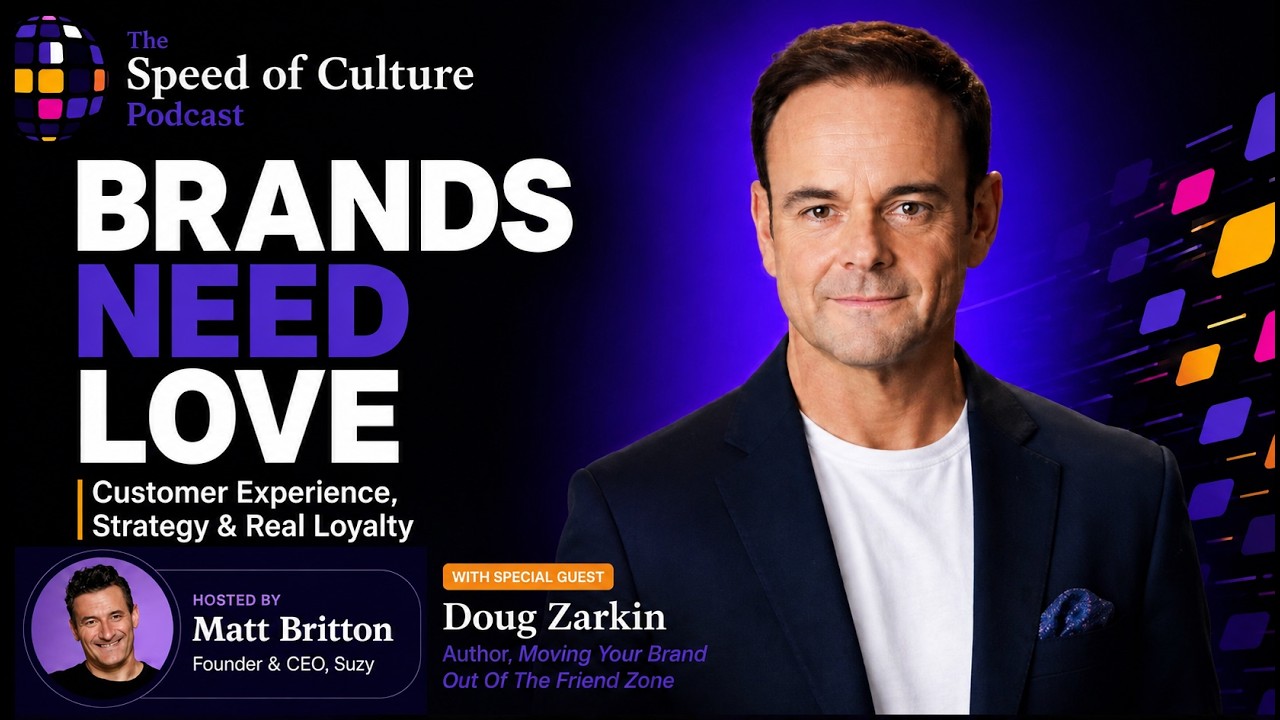
Matt Britton, founder and CEO of Suzy, the AI-powered consumer intelligence platform trusted by leading enterprises worldwide, brought his signature interviewing expertise to Episode 105 of The Speed of Culture Podcast on April 25, 2024. In this compelling conversation, he sat down with Doug Zarkin, Chief Marketing Officer and author of Moving Your Brand Out Of The Friend Zone, to explore the intricate dynamics of brand-consumer relationships and the strategic frameworks necessary for meaningful brand transformation.
The episode presents a masterclass in modern marketing strategy, tackling one of the most pressing challenges facing contemporary brands: how to move beyond surface-level consumer relationships and create authentic emotional connections that drive sustainable growth. As brands navigate an increasingly saturated marketplace where consumer attention spans continue to shrink and trust remains fragile, the distinction between being liked and being genuinely valued has never been more critical.
Doug Zarkin brings decades of hands-on experience leading brand transformations at some of the world's most recognized companies. His insights emerge from real-world campaigns, strategic pivots, and the hard-won lessons of building teams that think differently about brand-consumer dynamics.
Throughout the conversation, Zarkin and Britton explore the philosophical underpinnings and tactical frameworks that enable brands to transcend commodity status and establish themselves as essential parts of their consumers' lives. The dialogue balances big-picture brand philosophy with concrete, actionable strategies that marketing leaders can implement immediately within their organizations.
For brand builders, marketing executives, and organizational leaders seeking to future-proof their brands, this episode offers a refreshing perspective on what it takes to win consumer loyalty in the age of authenticity and rapid market change. The conversation challenges conventional wisdom about brand positioning while providing a roadmap for those ready to fundamentally rethink their approach to brand building.
The central metaphor driving Doug Zarkin's philosophy is elegantly simple yet profoundly actionable: brands trapped in the "friend zone" are liked but not loved. They occupy a comfortable but ultimately vulnerable position in the consumer's mind. While friendship implies positive feelings and casual preference, true brand love inspires advocacy, commands premium positioning, and creates emotional resilience during competitive pressures or market downturns.
In his book Moving Your Brand Out Of The Friend Zone, Zarkin explores how brands unconsciously engineer their own mediocrity by accepting the role of a trusted acquaintance rather than aspiring to become genuinely indispensable. This distinction matters enormously in an economic landscape where consumer choice has multiplied exponentially.
A friend might be chosen by default or convenience. A loved brand is chosen by conviction and defended with passion.
The shift from friend zone to beloved brand requires a fundamental reorientation of how organizations approach their consumers. Rather than optimizing for awareness, trial, and repeat purchase metrics alone, brands must build strategies that operate at the emotional and psychological level.
This isn't about nostalgia or sentimentality. Instead, it's about understanding what consumers truly value and positioning the brand as a meaningful part of their identity and daily lives.
Zarkin's framework distinguishes between transactional relationships, where brands exist merely to solve functional problems, and transformational relationships, where brands align with consumer values, aspirations, and self-concept. The organizations that crack this code don't just sell products; they participate in the consumer's sense of who they are and who they want to become.
This psychological dimension is where sustainable competitive advantage lives.
Throughout The Speed of Culture Podcast episode, Zarkin emphasizes that human-centric marketing is a strategic imperative rooted in how human psychology and decision-making actually work.
Consumers don't make purchasing decisions based primarily on features or rational comparison matrices. They decide based on how a brand makes them feel, whether it aligns with their values, and if it supports their desired identity.
Modern marketers, Zarkin argues, have become too fixated on metrics, segmentation, and attribution while losing sight of the emotional substrate that drives all consumer behavior. This disconnect between marketing sophistication and emotional intelligence creates opportunity. Brands that reintegrate emotional connection into their core strategy unlock hidden growth levers.
A powerful example from the conversation involves Zarkin's work at Pearle Vision, where a traditional eyewear retailer was trapped in a commodity market dominated by price competition and discount promotions. Rather than compete on the transactional level, Zarkin's team repositioned Pearle Vision around care, compassion, and the role eye care plays in accessing the world fully.
The strategic pivot moved the conversation from "lowest price" to "how we help you see your best life." This reframing attracted consumers motivated by quality relationships with trusted healthcare providers rather than bargain hunters.
The result was measurable increases in brand loyalty, reduced price sensitivity, and fundamentally different customer lifetime value.
This case study exemplifies a core principle: emotional positioning creates the psychological foundation upon which sustainable profitability rests. By connecting the brand to something consumers care about deeply (in this case, access and independence through clear vision), Zarkin's team moved the brand from friend zone to necessity.
The human-centric approach also extends to internal brand building. How an organization's people relate to the brand mission determines whether external consumers sense authenticity or merely marketing performance.
Passion can't be faked at scale.
Organizations need team members who genuinely believe in what the brand represents. This is why Zarkin structures hiring and talent development around finding passionate people and teaching them skills, rather than hiring skilled technicians and hoping they develop passion.
A recurring theme throughout Zarkin's approach is the tension between creative aspiration and business reality. Many marketing organizations swing between poles: pure brand building disconnected from sales impact, or relentless performance optimization that sacrifices emotional resonance.
Zarkin advocates for integration, creative work that meaningfully contributes to business outcomes.
This balance didn't emerge from theory. It came from experience leading brands where both responsibilities sat on his shoulders. As CMO, Zarkin had to justify creative investments in measurable business terms while maintaining the strategic vision and emotional innovation necessary for breakthrough positioning.
His philosophy is straightforward: creative initiatives and brand campaigns must be architected to contribute to profitability. This doesn't mean reducing all creativity to short-term sales metrics.
Rather, it means every strategic initiative should be rooted in clear understanding of how it advances both emotional connection and business objectives. When creativity and business strategy are misaligned, one gets sacrificed; usually it's the long-term brand building work that gets cut when quarterly numbers come up short.
The solution Zarkin advocates involves disciplined strategy work upfront. Before creative teams begin developing ideas, the strategic foundation must be bulletproof.
When strategic clarity exists, creative work becomes powerful and purposeful rather than indulgent. Creative ideas flow from strategy rather than existing in parallel to it.
And when the results come in, the organization can point to clear connections between creative execution and business impact. This creates virtuous cycles where creative teams get empowered to take greater risks because their work is understood and appreciated in business terms.
The podcast conversation frequently returns to a critical challenge for large organizations: how do you maintain the strategic discipline necessary for brand building while remaining agile enough to respond to rapid cultural and consumer shifts?
Zarkin's experience spans multiple brand transformations in industries moving at different velocities, from publishing to retail to luxury goods. He's learned that adaptive capacity is as important as strategic clarity.
Victoria's Secret's PINK brand offers an instructive example. The brand needed to evolve its positioning and communication approach as it became increasingly clear that the original audience (primarily male-oriented, highly sexualized positioning) was alienating younger consumers and failing to reflect changing cultural attitudes.
Rather than rigidly defending the original positioning, the PINK brand pivoted to digital-first strategies, shifted messaging toward empowerment and inclusivity, and modernized its brand expression.
This adaptability required organizational structures and decision-making processes that allowed fast iteration without sacrificing strategic coherence. Zarkin emphasizes that being adaptive doesn't mean being reactive.
It means having the underlying strategic clarity, the core brand purpose and positioning, that remains stable while the expression, media channels, and cultural conversation shift.
The Speed of Culture itself illustrates why this matters. Consumer culture moves faster than many organizations' planning and decision-making cycles.
A trend can emerge, reach critical mass, and peak before traditional marketing planning processes even incorporate it. Brands with rigid, annual planning cycles struggle to participate authentically in cultural moments.
Organizations with clear strategy but flexible execution can move at the speed of culture.
This requires investment in organizational design, talent, and systems. Marketing teams need decision-making authority closer to the market.
Creative and strategy resources need to be structured for rapid prototyping and testing. Media planning needs flexibility for opportunistic spending.
Performance measurement systems need to provide feedback quickly enough to inform iteration. Zarkin's experience suggests that brands winning in today's environment don't just have better strategy than competitors; they have organizational muscle to execute strategy faster.
Throughout the conversation, Zarkin emphasizes that brand transformation ultimately depends on people, their talent, their passion, and their alignment around a shared vision. His hiring and leadership philosophy is distinctive and worth exploring in depth because it provides a counterweight to much mainstream advice about building marketing organizations.
"I hire for passion. You can teach somebody a skill; you can't teach them the will."
This philosophy runs counter to conventional recruiting advice that emphasizes credentials, domain experience, and technical capabilities. Yet his track record suggests this approach works, particularly in roles requiring creativity, strategic thinking, and adaptation to changing circumstances.
What Zarkin is really identifying is the distinction between technical proficiency and intrinsic motivation. A marketer with all the right certifications but no deep conviction about the brand will produce technically competent work that lacks authenticity.
Conversely, a team member with genuine passion for the brand mission will develop the skills necessary to excel and will go beyond job requirements because they care about the outcome.
This doesn't mean dismissing expertise entirely. Rather, it means using passion and alignment as the primary sorting mechanism and then investing aggressively in skill development.
In practice, this means Zarkin builds teams where people at all levels are genuinely bought into the brand vision. They're there because they believe in what the organization is building, more than for the job title or the paycheck.
This approach has profound implications for how work gets experienced. Teams built around passion tend to move faster, adapt more readily, and create higher quality work because people are intrinsically motivated.
It also creates better cultures because people align around purpose rather than just organizational hierarchy.
The friend zone represents a state where consumers like a brand, prefer it to some alternatives, and will choose it by default, but feel no deep emotional connection or loyalty. The brand is a friendly acquaintance rather than something the consumer values as integral to their life.
Moving out of the friend zone means building a brand that consumers genuinely love, defend, and choose based on conviction rather than convenience. Practically, this requires repositioning the brand around emotional benefits and consumer values rather than functional benefits alone, communicating with authenticity and consistency, and building organizational cultures where employees believe in the mission so authenticity is inevitable.
Human-centric marketing is a different framework for what data and metrics should measure and optimize. Rather than optimizing only for awareness, trial, and repeat purchase, organizations should track emotional metrics (brand love, advocacy likelihood, value alignment) alongside purchase metrics.
This requires expanding how organizations measure success to include emotional connection and psychological positioning. Large organizations can implement this by establishing emotional brand tracking alongside purchase metrics, restructuring incentives and KPIs to reward both business results and brand health, investing in qualitative research that reveals emotional drivers, and training marketing leaders to interpret data through a lens that values emotional connection.
The podcast episode emphasizes that brand transformation is an organizational transformation, well beyond a marketing challenge. Consumers experience the brand through every interaction: advertising, customer service, product quality, employee interactions.
If the organization internally doesn't believe in the brand positioning, inauthenticity will seep through. This is why Zarkin structures hiring around passion and why he emphasizes alignment around purpose.
Brand transformation requires changing not just external messaging but how the organization operates, what it rewards, and who it employs. The most successful brand transformations involve fundamentally changing organizational culture to align with the new positioning.
Zarkin's experience suggests that emotional repositioning takes longer to show results than tactical promotions but produces more durable outcomes. The Pearle Vision transformation didn't reverse years of discount positioning immediately.
It required consistent communication, experience reinforcement, and gradual shift in consumer perception. Most emotional brand transformations show initial results within 6-12 months but continue generating value for years.
The key is patience with the process combined with consistency in execution. Quick tactical wins often create pressure to abandon positioning work prematurely.
The most successful brands stay committed to emotional positioning even when growth curves look slower initially because the ultimate payoff is more substantial and sustainable.
Brand transformation in a rapidly evolving cultural landscape requires both strategic clarity and organizational agility. Doug Zarkin's insights from The Speed of Culture Podcast provide a blueprint for marketing leaders ready to move beyond incremental optimization and fundamentally rethink their approach to brand building.
The brands winning today do so by understanding what consumers truly value and positioning themselves as essential to those outcomes, rather than by competing primarily on features, price, or clever advertising.
They're winning by building organizations where employees believe in the mission. They're winning by staying responsive to cultural moments while maintaining unwavering strategic clarity.
To explore more insights on brand transformation, consumer intelligence, and marketing strategy at the speed of culture, connect with these resources: