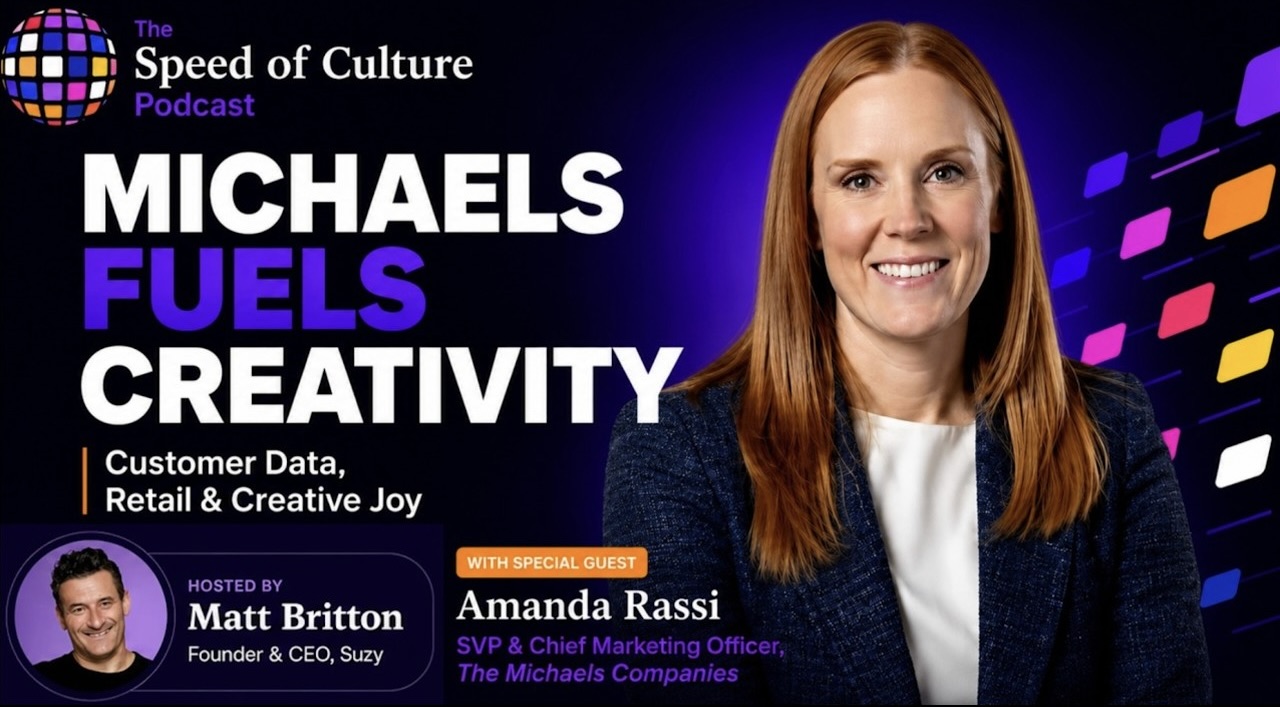
The ART of Marketing: How The Michaels Companies is Redefining Creative Consumer Engagement
In the rapidly evolving retail landscape, successful marketing demands both strategic precision and creative authenticity. Amanda Rassi, Senior Vice President and Chief Marketing Officer at The Michaels Companies, exemplifies this duality in her approach to building meaningful connections with creative consumers.
In a recent episode of The Speed of Culture Podcast, Rassi shared invaluable insights into how data-driven marketing, retail evolution, and purpose-driven strategies are reshaping the arts and crafts industry. Matt Britton, founder and CEO of Suzy, the AI-powered consumer intelligence platform, led an engaging conversation that delved into the transformational journey of one of America's largest specialty retailers.
The conversation highlighted critical trends in retail marketing, the power of consumer data in personalization, and how Michaels has positioned itself as more than just a supply store. It's a beacon for creative expression and joyful exploration.
For marketing leaders and brand strategists seeking to understand how to thrive in today's competitive retail environment, this episode offers a masterclass in balancing brand purpose with consumer-centric marketing innovation. Whether you're managing a retail brand, developing customer loyalty programs, or exploring the intersection of creativity and commerce, the insights from this discussion provide actionable strategies for modern consumer engagement.
Building a Legacy Through Retail Mastery: Amanda Rassi's Career Transformation
Amanda Rassi's career trajectory offers a compelling case study in how diverse retail experiences translate into visionary leadership. Her professional journey began at Procter & Gamble (P&G), where she invested 14 years developing deep expertise in consumer and market knowledge.
"I joined P&G right out of undergrad, having studied psychology and women's studies. I thought I'd spend a couple of years there and then go back to grad school, but I fell in love with the company and the work."
Her tenure at P&G spanned multiple critical roles, from global brand management on iconic products like Tide and Ariel to collaborations with major retailers including Kroger and Safeway. This diverse portfolio experience equipped Rassi with a comprehensive understanding of both brand management and the intricate dynamics of retail partnerships.
The transition from P&G to Kroger marked a significant inflection point in her career.
"Retail moves incredibly fast. At Kroger, we were watching sales on a daily basis and reacting to them in real-time."
This shift from the measured pace of consumer goods marketing to the immediate responsiveness required in retail necessitated a fundamental reimagining of her marketing approach. At Kroger, Rassi spearheaded initiatives that leveraged first-party consumer data to drive personalized marketing strategies, a capability that would become central to her philosophy of customer engagement.
She emphasized the transformative power of this data:
"We stood up what is now the marketing and retail media ecosystem at Kroger, emphasizing the transformative power of data in understanding and serving customers better."
This experience established the foundation for her current strategic direction at Michaels, where data-informed creativity drives every marketing decision.
The Revolution in Retail Media: Transparency, Attribution, and Strategic Evolution
One of the most compelling dimensions of the conversation focused on the evolution of retail media and its implications for brand strategy. As retailers have developed sophisticated media networks, the marketing landscape has fundamentally transformed.
Rassi highlighted the central advantages of retail media:
"Retail media offers unparalleled transparency and the ability to close the loop on a media activation and a purchase. This transparency is a significant advantage for brands looking to measure the effectiveness of their marketing efforts."
This direct attribution from advertising exposure to actual purchase behavior represents a paradigm shift from traditional media measurement, where causality often remains speculative.
However, Rassi also acknowledged the complexities inherent in managing multiple retail media partnerships. With every major retailer developing proprietary media networks, brands must navigate an increasingly fragmented landscape.
"As every retailer spins up retail media, it can become part of the relationship you have to have, not just with the big retailers but all retailers. This proliferation of retail media networks poses both opportunities and challenges for brands seeking to optimize their marketing spend."
The challenge lies in balancing the benefits of direct measurement and close retailer partnerships with the operational burden and strategic complexity of managing numerous platforms and partnership nuances. For marketing leaders, this evolution underscores the importance of developing flexible, scalable approaches to retail media that can adapt as the ecosystem continues to mature.
Fueling the Joy of Creativity: Purpose-Driven Marketing in the Arts and Crafts Sector
Michaels' marketing strategy transcends traditional retail promotion, grounded instead in a powerful corporate purpose: fueling the joy of creativity. This philosophy fundamentally shapes how the company engages with its diverse customer base.
Rassi articulated the brand's evolved mission:
"We recently adopted a new purpose: to fuel the joy of creativity. Creativity is joyful. We want to be that partner for all creative people, wherever they are in their creative journey."
This purpose-centric approach resonates profoundly with Michaels' core customer demographic, people who view creative activities as essential to their well-being and personal expression.
The effectiveness of this purpose-driven strategy became particularly evident in the post-pandemic retail environment. The COVID-19 pandemic triggered an unprecedented surge in creative activities as consumers sought meaningful ways to occupy their time at home.
Rassi observed:
"There are people who picked up creative pursuits and have continued them, but others who were 'COVID crafters' have moved on."
Despite this normalization, Michaels continues to witness robust engagement from customers who recognize creative activities as therapeutic and stress-relieving. The company emphasizes the critical role of mindfulness and mental well-being in today's fast-paced world.
For Michaels, marketing is about positioning the brand as a champion of self-expression, community, and the authentic joy that creative pursuits provide.
This positioning has profound implications for customer loyalty and lifetime value. When brands align marketing messaging with genuine purpose, they move beyond transactional relationships to create emotional connections that sustain engagement across market cycles.
Michaels' ability to evolve its brand narrative from "the place to buy supplies" to "the partner in creative joy" demonstrates sophisticated understanding of consumer psychology and shifting cultural values around wellness and authenticity.
Customer Data, Personalization, and the Future of Retail Marketing
Throughout the discussion, the critical role of consumer data in modern retail marketing emerged as a consistent theme. Rassi emphasized how first-party consumer data enables retailers and brands to deliver increasingly personalized experiences.
At Michaels, data informs decisions across the entire customer journey, from understanding customer preferences and behavior patterns to predicting future creative needs and personalizing promotional messaging.
This data-driven personalization extends beyond simple email marketing; it encompasses product recommendations, dynamic pricing, inventory management, and even in-store experience design.
The shift toward data-driven personalization reflects broader consumer expectations. Today's shoppers anticipate that retailers understand their preferences and deliver relevant recommendations without unnecessary friction.
For specialty retailers like Michaels, serving a diverse customer base, from professional artists and crafters to casual hobbyists and parents looking for educational activities, requires sophisticated segmentation and personalization capabilities.
Rassi's experience at Kroger, where she helped establish pioneering retail media and personalization systems, directly informs Michaels' approach to leveraging customer intelligence.
Looking forward, the integration of artificial intelligence and machine learning into retail marketing will further accelerate personalization capabilities. The convergence of rich consumer data, advanced analytics, and real-time decision-making systems enables retailers to deliver increasingly relevant and timely marketing experiences.
For Michaels, this evolution presents opportunities to deepen customer relationships by understanding not just current creative projects, but anticipated future needs and emerging creative interests.
The competitive advantage belongs to organizations that can translate data into meaningful, non-intrusive personalization that genuinely enhances the customer experience.
Strategic Lessons for Modern Retail Marketers
The insights from Amanda Rassi's conversation with Matt Britton offer several critical takeaways for marketing leaders navigating today's retail landscape.
First, successful retail marketing requires balancing analytical rigor with creative authenticity. The most effective approaches neither abandon data-driven decision-making nor sacrifice brand purpose and human connection for algorithmic optimization.
Second, the evolution of retail media represents a fundamental shift in how brands measure marketing effectiveness and build retailer partnerships. Leaders must develop sophisticated capabilities to navigate multiple retail media platforms while maintaining clarity of strategy and optimal allocation of resources.
Third, purpose-driven marketing that genuinely connects with consumer values creates sustainable competitive advantages. As commoditization increases across most retail categories, differentiation increasingly flows from authentic brand purpose and community building.
Michaels' positioning around creative joy and community participation provides a defensible brand identity that transcends product-level competition.
Finally, the successful retail marketer recognizes that personalization, when executed with customer respect and transparency, enhances rather than diminishes the customer experience. The brands that leverage consumer data most effectively are those that use it to remove friction and create genuine value rather than to manipulate or surveil.
Key Takeaways
- Data-Informed Creativity Drives Engagement: The most effective modern retail marketing strategies combine robust consumer data analysis with authentic creative storytelling, enabling brands to connect with customers on both rational and emotional levels.
- Retail Media Evolution Requires Strategic Navigation: As retailers develop proprietary media networks, brands must develop flexible approaches that balance the measurement advantages and partnership opportunities of retail media with operational complexity management.
- Purpose-Centric Marketing Builds Sustainable Loyalty: Brands that ground marketing strategies in genuine corporate purpose, like Michaels' focus on fueling creative joy, create emotional connections that drive long-term customer value beyond transactional relationships.
- First-Party Data and Personalization Differentiate in Competitive Markets: In specialty retail, sophisticated consumer segmentation and personalized marketing enable brands to serve diverse customer bases effectively while delivering relevant, timely customer experiences.
- Retail Transformation Demands Adaptive Leadership: Successful retail marketing leaders balance the measured, strategic thinking developed in consumer goods companies with the real-time responsiveness required in fast-moving retail environments.
Frequently Asked Questions
How is Michaels positioning itself differently in the competitive retail landscape?
Michaels has evolved from being perceived primarily as a supply retailer to positioning itself as a champion of creative joy and self-expression. The company's adoption of the purpose statement "fuel the joy of creativity" guides all marketing and business decisions.
This purpose-centric positioning resonates with consumers who view creative activities as essential to wellness, community, and personal fulfillment. By anchoring brand identity in this authentic purpose rather than competing solely on product selection or price, Michaels creates an emotional connection that drives customer loyalty and community engagement beyond traditional retail metrics.
What role does consumer data play in Michaels' marketing strategy?
Consumer data enables Michaels to deliver increasingly personalized experiences across touchpoints. First-party data informs product recommendations, targeted promotions, inventory decisions, and dynamic customer experiences both online and in-store.
By understanding customer behavior patterns, creative preferences, and anticipated future needs, Michaels can allocate marketing resources more efficiently while delivering more relevant, helpful experiences to customers. This data-driven approach enables the company to serve its diverse customer base, from professional artists to casual hobbyists, with appropriate products, messaging, and community initiatives tailored to specific segments.
How has the post-pandemic creative economy affected Michaels' business and marketing approach?
The COVID-19 pandemic initially drove unprecedented demand for creative supplies as consumers sought meaningful home activities. While some of this surge came from temporary "COVID crafters" who have since shifted interests, Michaels has observed that meaningful segments of customers have sustained and deepened their creative engagement.
The company has also recognized the broader cultural shift toward wellness and mindfulness, positioning creative pursuits as valuable stress-relief and mental well-being activities. This cultural validation of creativity has enabled Michaels to reinforce its purpose-driven positioning and attract customers seeking authentic ways to disconnect from digital life and engage in restorative creative activities.
What strategic insights can other retail brands apply from Michaels' marketing approach?
Michaels demonstrates that specialty retailers can build defensible competitive positions through authentic purpose alignment rather than competing solely on operational efficiency. The company's success illustrates the value of understanding customer psychology and cultural trends deeply, leveraging data to enable personalization while maintaining brand authenticity.
Additionally, Michaels' evolution from supply-focused positioning to purpose-centric branding shows how retail brands can expand category definition and customer lifetime value by expanding the emotional and cultural meaning associated with their products. For retail leaders, the lesson centers on combining rigor (data-driven decision-making) with authenticity (genuine purpose) to create marketing that informs and resonates simultaneously.
Looking Ahead
The Speed of Culture Podcast continues to explore the intersection of business, culture, and consumer behavior with thought leaders reshaping their industries. Amanda Rassi's insights into retail marketing, consumer data strategy, and purpose-driven brand building represent just one of many conversations examining how organizations build meaning and value in rapidly evolving markets.
For those interested in exploring more about consumer intelligence, marketing strategy, and the future of retail:
- Suzy - The AI-powered consumer intelligence platform enabling marketers to understand and connect with customers
- The Speed of Culture Podcast - Weekly conversations with CMOs, cultural leaders, and brand strategists shaping the future of business and culture
- Generation AI - Comprehensive insights into AI's impact on consumer behavior and business strategy
- AI Keynote Speaker - Transform your organization's understanding of consumer trends and AI applications
- Speaker HQ - Connect with leading voices on consumer trends, marketing innovation, and business transformation

%20(400%20x%20100%20px)%20(300%20x%2050%20px)%20(150%20x%2050%20px).avif)