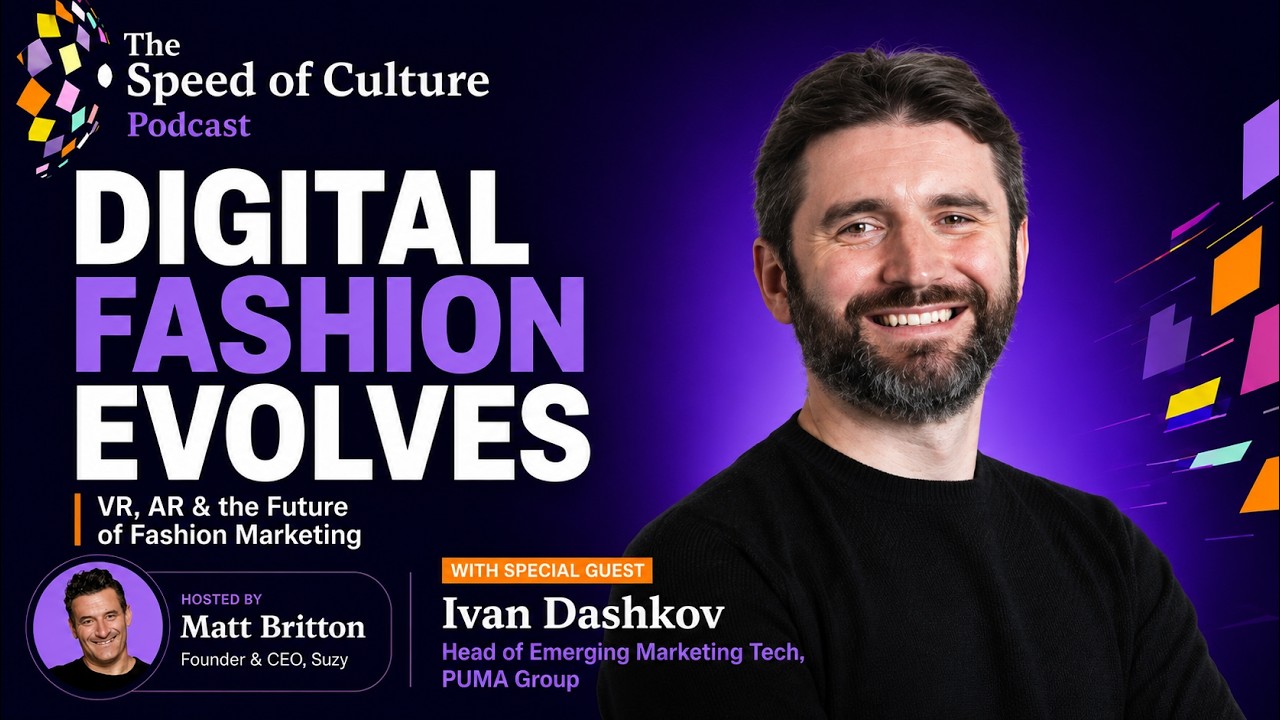
The fashion and sportswear industry stands at an inflection point. While legacy brands struggle to adapt to rapidly evolving consumer expectations and technological capabilities, PUMA is charting a different course, one defined by strategic innovation, calculated risk-taking, and a deep commitment to digital transformation.
In Episode 107 of the Speed of Culture Podcast, Matt Britton, founder and CEO of Suzy, the AI-powered consumer intelligence platform, sits down with Ivan Dashkov, Head of Emerging Marketing Tech at PUMA Group, to explore how the 75-year-old athletic brand is positioning itself as a frontrunner in digital assets, virtual reality, and the metaverse, areas that many traditional companies dismiss as speculative or immaterial to their core business.
The conversation reveals something profound: digital transformation for forward-thinking brands isn’t about chasing trends for their own sake. Rather, it’s about recognizing where culture is actually happening and ensuring your brand shows up meaningfully in those spaces.
Ivan Dashkov’s work at PUMA exemplifies this philosophy. His previous tenure at the NBA, where he pioneered digital and social initiatives across then-nascent platforms like Reddit, Vine, and Snapchat, positioned him perfectly to recognize patterns. What seemed experimental a decade ago has become mainstream. What seems experimental today (VR fitness experiences, AI-designed digital fashion, avatar-based shopping) represents tomorrow’s competitive battleground.
This episode offers essential insights for marketing executives, brand leaders, and digital strategists navigating the intersection of technology and consumer engagement. It’s a masterclass in how to think about emerging marketing technology not as a sidelined experimental division, but as central to brand relevance and growth.
Understanding PUMA’s Digital Transformation Philosophy
PUMA’s approach to digital transformation differs markedly from many of its competitors. The brand hasn’t treated emerging technologies as optional experiments confined to a small innovation lab. Instead, Ivan Dashkov has championed a philosophy where emerging marketing technology serves as a core strategic driver of brand evolution and consumer engagement.
The concept animating this approach is captured in PUMA’s mantra: “forever faster.” This isn’t merely about speed of execution, though that certainly matters. It reflects a fundamental commitment to continuous evolution and cultural adaptation.
In an industry where product cycles once measured in seasons now unfold in months, and where consumer preferences shift based on viral trends rather than traditional marketing campaigns, the ability to innovate faster than competitors becomes a true competitive advantage.
Dashkov’s career trajectory reveals the strategic thinking behind this commitment. Before joining PUMA, he spent time at the NBA leading groundbreaking digital and social initiatives. That experience taught him something invaluable: the platforms and technologies that seem niche and experimental today often become the dominant channels for cultural expression and commerce tomorrow.
When he was exploring Reddit, Vine, and Snapchat at the NBA, many traditional marketers dismissed these platforms as immaterial to brand building. Yet all three fundamentally changed how audiences consume media and interact with brands.
This historical pattern directly informs PUMA’s current strategy. The brand recognizes that virtual reality, augmented reality, digital fashion, and gaming platforms represent not future-gazing experiments, but emerging arenas where culture (and by extension, meaningful brand engagement) is actively happening right now.
The Meta Partnership and VR as Brand Experience
One of PUMA’s most tangible demonstrations of this commitment is its partnership with Meta, exemplified by the “world’s smallest gym” campaign. This isn’t a traditional digital marketing campaign that exists only in the virtual world. Instead, it represents a sophisticated blending of physical and digital brand experiences that brings consumers into the world of virtual reality in a memorable, embodied way.
The campaign works as follows: PUMA established workout pods in its Berlin flagship store that function as VR fitness experiences. Consumers can physically enter these pods and engage in a virtual fitness experience, merging the tactile reality of walking into a PUMA store with the immersive potential of VR technology.
For PUMA, the “world’s smallest gym” serves multiple strategic purposes simultaneously.
- Technological proof of concept: It demonstrates to leadership, stakeholders, and consumers that VR technology is sufficiently mature and engaging to warrant meaningful marketing investment.
- Brand positioning: It places PUMA at the forefront of innovation in an industry often dominated by heritage and incremental change.
- Shareable cultural moments: The experience is inherently Instagram-worthy, TikTok-friendly, and newsworthy, generating organic reach that traditional advertising struggles to achieve.
Rather than describing VR experiences in abstract terms, PUMA allows consumers to experience them firsthand, building tangible evidence of the technology’s value.
Looking ahead, Dashkov emphasizes the even greater potential of augmented reality.
“When you have a lightweight pair of glasses that can overlay your real-world environment with different apps,” he notes in the podcast, the possibilities fundamentally expand.
AR glasses represent a technological transition point, the moment when virtual experiences become seamlessly integrated into daily life rather than requiring dedicated hardware or physical spaces. PUMA’s early experimentation positions the brand to capitalize on this transition when it reaches mainstream adoption.
Digital Fashion, Gaming, and the Metaverse Economy
While VR experiences grab headlines, PUMA’s most significant long-term initiative may be its establishment of a genuine digital goods and gaming strategy. The brand has moved beyond treating gaming platforms and metaverse environments as curiosities, instead recognizing them as legitimate spaces where consumer culture is crystallizing and where revenue generation is increasingly possible.
PUMA’s presence on Roblox illustrates this shift. The platform has achieved remarkable adoption metrics: over four million digital goods claimed by users. To put this in perspective, that represents millions of consumers engaging with PUMA’s digital assets, selecting them, customizing their avatars with PUMA gear, and integrating PUMA into their gaming and virtual social experiences.
This matters because it reflects a genuine behavioral shift in how audiences, particularly younger consumers, construct identity and express affiliation with brands. A teenager wearing a PUMA digital outfit in Roblox isn’t fundamentally different from wearing a PUMA t-shirt in physical space, it’s an expression of brand preference, style alignment, and cultural positioning.
The difference is that the digital environment offers new possibilities for PUMA: limited editions, seasonal drops, exclusive collaborations, and dynamic pricing models that would be impractical in physical retail.
PUMA has also explored NFTs and other Web3 innovations, participating in broader experimentation with blockchain-based digital goods. While the NFT market experienced significant volatility and skepticism, PUMA’s willingness to experiment, rather than fully committing or entirely dismissing, reflects appropriate strategic positioning.
Some experiments generate valuable learnings; others don’t. The key is maintaining the flexibility to test, learn, and adapt.
Perhaps most notably, PUMA has invested in augmented reality capabilities that extend beyond gaming. The brand is working with 3D digital transformation partners to create product visualizations that enhance e-commerce experiences.
According to research, 3D content achieves higher click-through rates than traditional 2D imagery, meaning that PUMA’s investment in digital transformation directly translates to improved conversion rates and e-commerce performance.
The Technology Stack Behind PUMA’s Digital Innovation
PUMA’s digital transformation extends beyond marketing into the core infrastructure that supports both digital and physical commerce. The brand has invested significantly in generative AI and advanced data analytics to accelerate product development, personalization, and campaign effectiveness.
Working with Google Cloud, PUMA implemented generative AI tools that dramatically improve marketing campaign development. Specifically, PUMA uses Imagen 2 on Vertex AI to create dynamic, personalized product imagery that boosts click-through rates.
In India, geographically personalized images improved CTRs by 10%, a meaningful improvement that compounds across millions of digital impressions.
This implementation reflects a sophisticated understanding of how emerging technology actually creates business value. It’s not about the technology itself; it’s about translating technological capabilities into measurable improvements in consumer engagement and conversion.
Generative AI doesn’t matter unless it demonstrably improves marketing performance. For PUMA, it does.
Additionally, PUMA migrated its e-commerce ecosystem, including PUMA.com, to Google Cloud infrastructure in 2024, enabling better personalization, faster time-to-market for campaigns, and improved average order value. The cloud migration represents the unglamorous but essential backbone of PUMA’s digital strategy.
Behind these visible initiatives lies a critical investment in talent and organizational culture. Dashkov emphasizes in the podcast that PUMA has been deliberate about assembling a team of skilled professionals genuinely interested in exploring emerging technologies.
This organizational approach matters profoundly. Technology adoption fails not because the technology isn’t capable, but because organizations don’t have people who understand it, believe in its potential, and have the authority and resources to implement it thoughtfully.
Building a Culture of Innovation Amid Organizational Scale
One of the most compelling insights from the episode is Dashkov’s emphasis on organizational and cultural challenges. PUMA is not a startup; it’s a 75-year-old global brand with established product lines, retail networks, supply chains, and stakeholder expectations.
Introducing meaningful digital innovation in an organization of this scale presents enormous challenges that technological sophistication alone cannot solve.
Dashkov’s experience navigating these challenges offers valuable lessons.
- Assemble the right team: People must understand emerging technologies and possess the political and interpersonal skills to navigate large organizational structures.
- Practice strategic patience: Digital initiatives won’t generate immediate revenue that justifies their costs; organizations must invest in long-term positioning.
- Maintain clarity of purpose: Innovation works best when guided by clear principles rather than reactive trend-chasing.
“Forever faster” works as a unifying mantra because it provides clear direction without being prescriptive about which specific technologies to pursue. It tells the organization: we’re committed to continuous evolution, but not everything we experiment with will succeed.
Some initiatives will be learning experiences; others will become core to the business. This approach contrasts sharply with organizations that either dismiss emerging technologies entirely or chase every trend with equal intensity.
PUMA has found a middle path: strategic experimentation guided by clear principles and organizational commitment.
Key Takeaways
- Digital transformation extends beyond marketing into core business infrastructure: PUMA’s investment in generative AI, cloud migration, and 3D product visualization drives measurable improvements in conversion rates and time-to-market.
- Culture happens where consumers spend time: From Roblox to Meta to VR experiences, PUMA recognizes that brand relevance requires active participation in digital environments.
- VR and AR represent near-term opportunities: Initiatives like the “world’s smallest gym” position PUMA to capitalize on shifts in consumer interaction with digital content.
- Team composition determines innovation success: Organizational culture and talent matter more than technology capabilities alone.
- “Forever faster” enables strategic flexibility: The mantra provides clarity while allowing experimentation across emerging platforms.
FAQ
How is PUMA using AI to improve marketing performance?
PUMA uses generative AI tools from Google Cloud, specifically Imagen 2 on Vertex AI, to create dynamic and personalized product imagery. This approach has improved click-through rates by 10% in some markets and accelerates campaign asset development, enabling faster response to market opportunities and seasonal demand.
What is PUMA’s strategy for digital goods and gaming platforms?
Rather than treating gaming platforms and metaverse environments as experimental sidelines, PUMA has established a meaningful presence on platforms like Roblox, where over four million digital goods have been claimed by users. The brand recognizes these environments as legitimate spaces for identity expression, brand affiliation, and new revenue models.
Why does PUMA emphasize augmented reality as more important than current VR experiences?
While PUMA invests in VR experiences like the “world’s smallest gym,” Ivan Dashkov emphasizes that lightweight AR glasses represent the more transformative technology. AR glasses that seamlessly overlay digital content onto the physical environment will fundamentally change consumer engagement without requiring dedicated hardware or activation spaces.
How does “forever faster” guide PUMA’s emerging technology strategy?
“Forever faster” functions as both a brand mantra and organizational principle. It commits PUMA to continuous innovation and cultural evolution without prescribing specific technologies or tactics, enabling flexibility to experiment, learn, and adapt based on market response and technological development.
Looking Ahead
Ivan Dashkov’s conversation with Matt Britton on the Speed of Culture Podcast reveals a brand comfortable with complexity, confident in its strategic vision, and willing to make meaningful investments in technologies that may not deliver immediate returns.
For marketing executives and brand leaders navigating their own digital transformation journeys, PUMA’s approach offers a compelling blueprint: stay grounded in clear strategic principles, assemble the right team, invest in infrastructure, experiment thoughtfully, and maintain unwavering focus on where consumer culture is actually happening.
To dive deeper into consumer intelligence, emerging marketing trends, and AI-powered decision making, visit Suzy. To explore more conversations about culture, innovation, and consumer behavior, visit The Speed of Culture Podcast.
For additional insights on AI’s impact on business and consumer behavior, check out Matt Britton’s Generation AI or explore his AI keynote speaker services. For agencies and organizations looking to amplify their thought leadership, explore Speaker HQ.

%20(400%20x%20100%20px)%20(300%20x%2050%20px)%20(150%20x%2050%20px).avif)