April 23, 2024
Beyond the Flight: CMO Alicia Tillman on Reinventing Delta’s Brand Experience

Alicia Tillman
CMO
This is some text inside of a div block.
This is some text inside of a div block.
LISTEN ANYWHERE YOU FIND YOUR PODCASTS
%20(400%20x%20100%20px)%20(300%20x%2050%20px)%20(150%20x%2050%20px).avif)

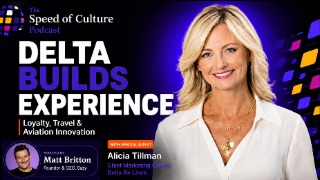
In the hyper-competitive landscape of modern aviation, where safety and timeliness have become table-stakes expectations rather than differentiators, Delta Air Lines is carving out a bold new identity. Under the visionary leadership of Chief Marketing Officer Alicia Tillman, Delta is transcending its traditional role as a transportation provider to become a lifestyle brand that touches every aspect of the customer journey.
Recognized by Forbes as one of the world's most influential CMOs, Tillman brings over two decades of marketing expertise, previously honing her craft at American Express and SAP, where she developed an intimate understanding of premium experiences, membership value, and emotional brand connections.
In Episode 104 of the Speed of Culture Podcast, Matt Britton, founder and CEO of Suzy, the AI-powered consumer intelligence platform, sits down with Tillman to explore how Delta continues to lead and innovate within the competitive airline industry.
The conversation delves into core consumer expectations, the evolution of experiential marketing, and the strategic imperatives that define next-generation brand building in the travel sector. As Tillman herself articulates:
“Every company is complicated… and I think for marketers, we are at the forefront of being able to distill that complexity into something really meaningful, really relevant, really purpose-filled.”
The episode, released on April 23, 2024, reveals critical insights into how Delta's marketing strategy is reshaping industry standards. Rather than relying solely on traditional advertising, Delta is investing in holistic brand experiences that resonate with diverse generational cohorts, from Gen Z digital natives to established frequent flyers.
Through initiatives like the Window Seat Shop, free Wi-Fi integration, premium lounge experiences, and partnerships with cultural events, Delta demonstrates that modern consumers want more than a flight: they want to belong to a brand that understands and anticipates their evolving needs.
This exploration of Delta's transformation is particularly relevant as brands across industries grapple with similar challenges: How do you maintain operational excellence while simultaneously innovating the customer experience? How do you balance the fundamental expectations customers hold with aspirational brand positioning? How do you leverage technology without losing the human connection that drives loyalty?
The conversation between Britton and Tillman provides a masterclass in executive-level brand strategy, offering valuable lessons for CMOs and marketing leaders navigating the complexities of consumer expectations in an era where experience has become the ultimate product differentiator.
Alicia Tillman's approach to brand marketing begins with a fundamental principle that often gets overlooked in pursuit of innovation: customer expectations must be satisfied in hierarchical order, with foundational needs taking absolute precedence.
For an airline, this means safe, on-time flights that fully accommodate passenger needs form the bedrock upon which all other brand experiences are constructed. Without excellence in core operational metrics, no amount of experiential marketing, digital innovation, or lifestyle positioning can overcome customer dissatisfaction.
This hierarchy reflects insights drawn from her transformative years at American Express, where Tillman learned to appreciate the profound value of membership, access, and premium experiences. At Amex, she witnessed firsthand how brands can build unparalleled loyalty by first delivering exceptional baseline service, then layering premium experiences on top of that foundation.
The lesson is straightforward yet profound: customer loyalty isn't generated through gimmicks or superficial engagement tactics, it emerges from consistently delivering on promises and then thoughtfully exceeding expectations.
Delta's operational excellence has been hard-won. The airline has invested billions in fleet modernization, airport infrastructure, operational technology, and employee training to ensure that passengers experience reliable, comfortable flights.
Only after establishing this operational foundation does Delta venture into the experiential territories that define contemporary brand strategy. When the SkyMiles loyalty program offers value, it's because Delta flights are dependable. When premium lounges feel luxurious, it's because the entire brand experience reflects commitment to passenger wellbeing.
When the Window Seat Shop curates travel-inspired products, customers appreciate it because they know the airline has already taken care of their fundamental travel needs.
This sequencing matters enormously in the CMO's strategic arsenal. According to research on airline loyalty programs, a striking 92 percent of loyalty providers believe their programs deliver on traveler needs, while only approximately 50 percent of travelers share that assessment.
This perception gap emerges partly because airlines attempt to layer sophisticated loyalty mechanics onto platforms that don't adequately address baseline consumer expectations. Tillman's approach inverts this logic: establish operational excellence first, then layer brand experiences that genuinely enhance customer value.
The hierarchy also explains Delta's cautious approach to digital innovation. Rather than rushing to adopt the latest technology trends, Delta integrates digital solutions specifically where they solve real customer problems.
Free Wi-Fi on all domestic flights, for instance, directly addresses generational expectations, particularly among Gen Z and younger millennials, for connectivity. In-flight streaming of premium content services doesn't distract from the core flight experience; rather, it respects passenger time and preferences during hours aloft.
Digital ID and biometrics trials in select hubs streamline security processes, reducing friction in the travel experience. Each innovation maps directly to demonstrated customer needs, not to hypothetical engagement opportunities.
The transformation of Delta from an airline into a lifestyle brand represents one of the most sophisticated brand repositioning strategies in contemporary marketing. This evolution requires fundamentally rethinking what the brand represents, how it interacts with customers across touchpoints, and where it creates value in customers' lives beyond the immediate travel moment.
Under Tillman's leadership, Delta has moved beyond the transactional relationship to develop a deeply integrated presence in customers' broader lifestyle choices and aspirations.
The Window Seat Shop exemplifies this philosophy. Rather than viewing the flight window as mere transportation infrastructure, Delta recognized that the window view represents one of aviation's most transcendent experiences, a perspective on the world that fundamentally changes how passengers think about travel, geography, and possibility.
By creating a retail environment centered on window-seat inspired products and experiences, Delta extends that emotional resonance into the ground-based world, allowing customers to maintain their connection to the Delta brand during moments when they're not flying.
This initiative signals a profound shift in brand strategy: Delta is no longer merely selling flights; it's selling an aspirational identity centered on exploration, possibility, and the transformative power of experiencing the world from new perspectives.
This lifestyle positioning aligns seamlessly with contemporary consumer behavior, particularly among younger generations. Research from the State of Experiential Marketing indicates that 9 out of 10 marketers recognize experiential marketing as central to their strategy, driven by consumer demand for authentic, immersive brand encounters.
For Delta, this means thinking beyond in-flight service to consider where and how the brand shows up in customers' lives. The airline's inaugural appearance at the 2024 Essence Festival of Culture in New Orleans, featuring brand ambassadors, musical performances, and an interactive "Fly Girl Travel Confessional" booth, demonstrates Delta's commitment to meeting customers in culturally relevant spaces.
Premium lounge experiences illustrate how lifestyle branding extends beyond novelty into structural brand differentiation. Modern premium lounges are sanctuary spaces where high-value customers experience consistent excellence across comfort, amenities, food and beverage, technology access, and service quality.
By designing lounges that reflect the Delta brand identity while anticipating the needs of sophisticated travelers, the airline creates environments where business travelers can prepare for important meetings, families can relax during layovers, and frequent flyers experience recognition for their loyalty.
The lifestyle brand positioning also influences Delta's partnership strategy. Serving as the Official Airline Partner to Team USA for the Olympics transforms Delta from a service provider into a co-creator of national pride, athletic excellence, and Olympic achievement.
Such partnerships create brand love at levels that traditional advertising cannot achieve, because they align customer identity with brand identity in emotionally meaningful ways.
The role of digital transformation in contemporary brand marketing cannot be overstated, yet the manner in which brands implement technology determines whether digital initiatives enhance or diminish customer relationships.
Alicia Tillman's perspective on Delta's digital evolution reflects mature sophistication: technology should be invisible in its effectiveness, present only insofar as it solves real customer problems or creates meaningful value.
Younger demographics including Gen Z and Gen Alpha hold fundamentally different expectations regarding digital engagement. Having grown up with internet connectivity, mobile-first experiences, and algorithm-driven personalization, these cohorts expect brands to understand their preferences, anticipate their needs, and deliver seamless digital interactions.
Delta's commitment to free Wi-Fi across all domestic flights represents more than a convenience feature. It's a recognition that modern travelers refuse to disconnect voluntarily.
In-flight streaming services including Paramount Plus for international passengers further illustrate intentional digital strategy. Travelers can choose whether to work, stream content, read digital publications, or simply disconnect if they prefer, but the infrastructure supporting all these options is available.
The Delta Sync platform demonstrates how digital personalization can extend the brand relationship beyond the flight itself. By providing customized content, partner offers, and travel recommendations based on individual customer preferences and travel history, Delta creates an ongoing dialogue with customers rather than a transactional interaction.
Emerging technologies including digital ID, biometrics trials, and RFID baggage tracking promise to revolutionize the travel experience by removing friction from security processes and physical movement through airports.
The digital evolution also encompasses how Delta gathers and interprets consumer insights to inform marketing strategy. Using platforms like Suzy's AI-powered research capabilities, forward-thinking airlines can conduct rapid consumer research, test messaging before major campaign launches, understand competitive positioning from the customer perspective, and identify emerging trends in traveler expectations.
Experiential marketing represents perhaps the most sophisticated evolution in contemporary brand strategy, moving beyond traditional advertising to create immersive, multisensory brand encounters that generate authentic emotional connections.
The future of experiential marketing increasingly emphasizes three core dimensions: technology integration, personalization, and sustainability.
Leading brands are investigating how augmented reality, virtual reality, and immersive technologies can enhance physical experiences without overwhelming them. Emirates' virtual reality experience and Hainan Airlines' augmented reality system illustrate how in-flight experiences are evolving beyond passive consumption toward interactive engagement.
For Delta specifically, experiential marketing manifests across multiple dimensions. The Window Seat Shop extends the window experience into retail environments, creating spaces where travel enthusiasts can curate products that enhance their personal travel narratives.
Premium lounge spaces function as experiential theaters where customers witness Delta's commitment to excellence firsthand. Cultural partnerships and festival appearances position Delta within the communities where customers live.
The rise of sustainability as a central theme in experiential marketing reflects evolving consumer values. Delta's recognition as one of Fast Company's Most Innovative Companies in 2024 for scaling sustainable aviation fuel initiatives demonstrates how operational innovation can become central to brand storytelling.
Data-driven decision-making increasingly shapes experiential marketing effectiveness. Rather than creating activations based on assumptions, sophisticated brands gather real-time feedback and continuously refine experiences based on demonstrated customer preferences.
The emotional intelligence embedded in contemporary experiential marketing deserves particular emphasis. Effective experiential marketing acknowledges traveler emotional realities and creates moments that address underlying emotional needs rather than adding another layer of commercial messaging.
The role of the Chief Marketing Officer has fundamentally transformed in recent years, evolving from a position focused primarily on advertising and promotions toward a strategic leadership role responsible for overall brand health and customer experience orchestration.
Alicia Tillman's leadership at Delta exemplifies this evolved CMO function, positioning marketing as central to corporate strategy rather than peripheral to it.
Contemporary CMOs face distinctive challenges rooted in rapidly evolving consumer expectations, technological complexity, and heightened pressure for demonstrable business impact.
Consumer expectations for personalization have escalated dramatically, yet this expectation must coexist with genuine concern for privacy, creating a delicate balance.
Generational diversity compounds this complexity. Enrollment among Gen Z and Millennials in traditional airline loyalty programs lags significantly compared to older demographics, even as these cohorts represent the future of aviation.
The tension between operational excellence and experiential innovation represents another key CMO imperative. Brands cannot build sustainable loyalty through experiences alone. They must first deliver on fundamental operational promises.
CMOs increasingly require comfort with marketing technology and data science, as evidenced by platforms like Suzy that democratize access to consumer research and insights.
The expansion of the CMO's mandate to encompass corporate purpose and values alignment represents perhaps the most significant evolution in the role. Modern consumers demonstrate strong preference for brands that align with their personal values regarding social responsibility, environmental sustainability, and ethical business practices.
Delta's brand experience strategy prioritizes customer needs in hierarchical order, establishing operational excellence in safety and reliability as the foundation, then layering experiential innovations and digital enhancements as customer value-adds.
"Keep Climbing" represents a rallying cry emerging from Delta's operational evolution, symbolizing commitment to continuous improvement and entrepreneurial adaptation beyond functional airline benefits.
Technology integration at Delta is deliberate and customer-centric. Investments in free Wi-Fi, streaming, digital ID trials, RFID baggage tracking, and the Delta Sync platform target demonstrated customer needs.
Brands can adopt a hierarchical approach by first auditing whether they deliver on fundamental customer expectations, then layering experiences that exceed those expectations using consumer insights platforms like Suzy.
The conversation between Matt Britton and Alicia Tillman in Episode 104 of the Speed of Culture Podcast illuminates critical imperatives for modern marketing leaders navigating an experience-driven economy.
As consumer expectations continue to evolve, the CMOs who will drive organizational success are those who can balance data-driven decision-making with authentic customer empathy, maintain operational excellence while innovating experiences, and position brands as participants in customers' lives rather than simply providers of services.
For marketing leaders seeking to understand the future of consumer behavior, experiential marketing strategy, and CMO leadership in an AI-driven era, the Speed of Culture Podcast provides invaluable perspective from practitioners at the forefront of industry innovation.
Discover more about consumer insights and marketing innovation: