Opening Section
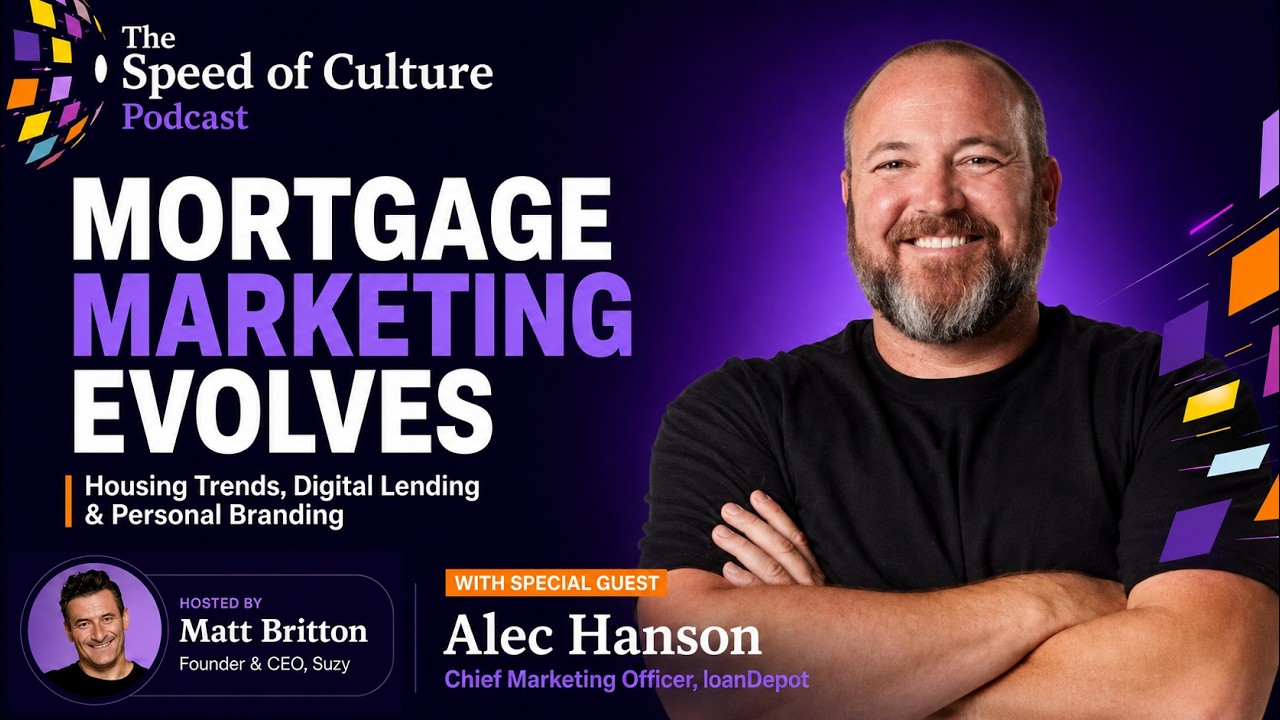
The mortgage industry stands at a critical inflection point. As interest rates fluctuate, consumer expectations evolve rapidly, and digital-first experiences become non-negotiable, financial services leaders must fundamentally rethink their marketing strategies. Few executives understand this reality better than Alec Hanson, Chief Marketing Officer at LoanDepot, who brings a rare blend of frontline sales experience and strategic leadership to one of the nation's largest mortgage lenders.
In Episode 110 of the Speed of Culture Podcast, hosted by Matt Britton, founder and CEO of Suzy, an AI-powered consumer intelligence platform, Alec Hanson shares invaluable insights into how LoanDepot adapts its marketing strategies to navigate economic fluctuations, capitalize on digital transformation, and reach next-generation consumers. This conversation represents more than a single company's story, it encapsulates the broader evolution of financial services marketing in an era defined by volatility, technological disruption, and shifting consumer behaviors.
Alec's journey to the CMO role is noteworthy. He began his career as a top 1% loan originator, spending two decades in the mortgage industry learning the operational intricacies of lending from the ground level. This hands-on experience distinguishes him from traditional marketing executives who may lack deep industry understanding.
By transitioning from sales leadership to the CMO position, Alec brings a customer-centric perspective that fundamentally shapes LoanDepot's strategic approach to brand building, digital engagement, and market penetration. The episode explores how market adaptation, multi-channel strategies, AI integration, social media leverage, strategic sponsorships, and personal branding collectively position LoanDepot not just to survive economic cycles, but to thrive during periods of uncertainty.
As the mortgage industry experiences the post-pandemic normalization, from explosive pandemic-era growth to sustainable market levels, understanding these strategic shifts becomes essential for marketing leaders across financial services sectors. For brands navigating uncertainty, this conversation offers a masterclass in agility, customer-centricity, and data-driven decision-making.
Matt Britton's probing questions uncover how leading CMOs think about competition, innovation, and consumer psychology in sectors where trust and expertise drive business outcomes.
The Mortgage Industry in Flux: Understanding Market Cyclicality
Economic cycles fundamentally shape mortgage lending. The housing market experienced unprecedented disruption following the COVID-19 pandemic, creating a unique case study in market dynamics. During the low-interest-rate period that followed, the mortgage market reached extraordinary proportions, expanding to approximately $4 trillion in annual volume.
This explosive growth created opportunity but also masked underlying vulnerabilities that would manifest when economic conditions shifted. Alec Hanson's perspective on these dynamics reflects his deep industry experience. He articulates how the mortgage lending sector operates in fundamentally different market conditions depending on broader economic circumstances.
When interest rates are historically low, consumer demand skyrockets, refinancing activity accelerates, and lenders experience abundant deal flow. Marketing during these periods emphasizes scale, volume management, and brand awareness. Lenders focus on capacity building, technology infrastructure, and process optimization to handle unprecedented transaction volume.
Conversely, when interest rates rise, as they did in 2023 and beyond, market dynamics invert. Refinancing activity evaporates, purchase-originated demand declines, competition intensifies, and profit margins compress. Lenders must contract operations, rightsize teams, and recalibrate their marketing strategies entirely.
Rather than emphasizing volume, marketing pivots toward differentiation, value proposition communication, and customer retention. Brands must articulate why borrowers should choose them during periods of constrained demand.
This cyclicality presents both challenges and opportunities. Brands lacking preparedness find themselves caught flat-footed, unable to adjust cost structures quickly or pivot messaging appropriately. However, organizations like LoanDepot that invest in market intelligence, maintain strategic flexibility, and retain leadership deeply familiar with industry cycles can anticipate shifts and position themselves advantageously.
For marketing leaders across industries facing economic uncertainty, this principle applies universally: understanding your market's cyclical nature and maintaining strategic optionality proves more valuable than pursuing growth at all costs. Sustainable competitive advantage accrues to organizations that can navigate uncertainty with agility, maintaining profitability across multiple economic scenarios.
Multi-Channel Strategy: Serving Diverse Customer Segments
One of Alec's most compelling insights concerns how LoanDepot serves fundamentally different customer segments through completely distinct channels, each optimized for specific borrower profiles and preferences. This multi-channel approach reflects sophisticated market segmentation and customer psychology.
LoanDepot's channel strategy includes direct consumer contact centers, partnerships with homebuilders as joint ventures, wholesale relationships with mortgage brokers, and increasingly, digital-native consumer touchpoints. Each channel serves different purposes and attracts different customer demographics.
A young, tech-savvy homebuyer discovering mortgage information through social media represents a completely different customer than a 55-year-old homeowner refinancing through an established relationship with a local mortgage broker. This segmentation has profound implications for marketing strategy.
Attempting to reach all customer segments through identical channels wastes marketing resources and dilutes messaging effectiveness. Alternatively, tailored approaches that recognize distinct customer preferences, decision-making processes, and media consumption habits yield significantly higher engagement and conversion rates.
The joint venture model with homebuilders exemplifies this principle. Homebuilders maintain direct relationships with purchasers during the property selection and purchase process. By partnering with builders, LoanDepot positions mortgage financing as an integrated element of the home purchase experience rather than a separate, intimidating process.
Conversely, wholesale relationships with mortgage brokers appeal to a different borrower segment, typically more sophisticated, price-sensitive customers who shop multiple lenders and demand specialized expertise. LoanDepot's wholesale channel must emphasize competitive rates, fast loan decisioning, robust technology platforms for brokers, and responsive customer service rather than consumer-facing brand awareness.
This multi-channel sophistication demonstrates advanced marketing maturity. Rather than pursuing a one-size-fits-all approach, Alec's strategy recognizes that different customers require different value propositions, delivered through different channels, supported by different marketing investments.
Digital Transformation and the Internet-First Consumer
Perhaps Alec's most quotable insight addresses the fundamental shift in consumer behavior and the unprecedented marketing opportunities this creates:
“Now you have this internet-first generation of people who are staring at their phones and social platforms all day. That, to me, is like the guerilla warfare opportunity of our time.”
This observation captures a critical inflection point in financial services marketing. Traditional mortgage lenders built brands through television advertising, direct mail, local relationships, and regional sponsorships. While these channels maintain some value, they increasingly miss the consumer segment that actively researches mortgages, compares rates, reads reviews, and makes preliminary decisions entirely through digital channels before ever contacting a lender.
The internet-first consumer represents both an opportunity and a challenge. Opportunity emerges from the fact that many traditional financial institutions have not yet fully adapted to reaching consumers through social media, digital content platforms, search marketing, and influencer partnerships.
LoanDepot's approach emphasizes social media penetration, content creation, and strategic digital engagement. Rather than waiting for consumers to discover the brand through traditional channels, LoanDepot proactively intercepts consumers in the digital spaces where they spend time.
For CMOs in regulated industries like financial services, this presents particular challenges. Regulatory compliance, messaging approval processes, and risk management requirements can constrain marketing agility. Yet leading marketers like Alec find ways to navigate these constraints while still maintaining authentic engagement.
Artificial Intelligence: The Great Accelerant in Mortgage Lending
Alec's perspective on artificial intelligence in mortgage lending deserves particular attention. He predicts that AI will fundamentally transform both customer service and operational efficiency within mortgage lending, with implications extending beyond marketing to the entire customer experience.
In mortgage lending, AI's most immediate applications center on document processing and underwriting acceleration. Historically, mortgage underwriting involves time-consuming manual document review, verification processes, and decision-making that can extend loan timelines significantly.
By deploying AI to automate routine document processing, flag exceptions requiring human review, and accelerate decision-making timelines, lenders can reduce loan processing time from weeks to days while simultaneously reducing operational costs. These operational improvements translate directly into customer experience enhancements.
AI's customer service applications similarly transform the mortgage experience. AI-powered chatbots can answer common questions immediately, qualify borrowers, and route complex requests to human specialists efficiently.
From a marketing perspective, AI enables personalization at scale. Lenders can analyze borrower profiles, financial situations, and preferences to deliver highly customized rate offerings, product recommendations, and educational content.
Social Media, Sponsorships, and Personal Branding
Traditional financial services marketing emphasized trust-building through institutional messaging, professional testimonials, and authority-based positioning. While these elements retain value, Alec's insights reveal how social media has become a primary consumer engagement channel.
LoanDepot's social media strategy emphasizes authentic engagement, educational content, and thought leadership. Rather than hard-sell advertising, social channels showcase employee expertise, share borrower success stories, provide mortgage education, and address common questions.
LoanDepot's sponsorship of the Miami Marlins baseball stadium represents strategic investment in brand visibility and consumer recall. Aligning with major sports teams provides platforms reaching diverse, engaged audiences during moments of emotional connection.
Alec Hanson's emphasis on personal branding reflects broader recognition that CMO visibility and credibility enhance company brands. By sharing his experiences, insights, and perspectives through podcasts, speaking engagements, content creation, and industry participation, Alec builds personal credibility that transfers to LoanDepot's brand.
Key Takeaways
- Cyclical market understanding drives strategic agility. Organizations that recognize their industry's natural cycles and maintain flexibility across economic conditions outperform competitors caught unprepared during downturns.
- Multi-channel customer-centric strategies outperform one-size-fits-all approaches. Deep customer segmentation and tailored channel strategies yield significantly higher conversion rates and satisfaction.
- Internet-first consumers require new engagement models. Brands embracing social media and authentic digital engagement reach consumers where they spend time.
- Artificial intelligence transforms both operations and customer experience. AI integration creates operational advantages while improving speed, accuracy, and personalization.
- Thought leadership and personal branding enhance corporate brands. Visible, credible CMOs transfer trust and authority to their organizations.
Frequently Asked Questions
How does interest rate environment affect mortgage marketing strategy?
Interest rate cycles fundamentally reshape lending markets. During low-rate environments, marketing emphasizes volume, scale, and speed-to-close. When rates rise, marketing pivots toward differentiation, value proposition articulation, and customer retention.
Why do mortgage lenders need multi-channel strategies?
Different borrower segments prefer different channels. Effective mortgage marketing tailors channel strategies, messaging, and operations to serve these distinct segments optimally.
What role does social media play in mortgage industry marketing?
Social media reaches internet-first consumers through channels where traditional mortgage institutions maintain minimal presence. For mortgage companies, social strategies emphasize education, transparency, and peer validation rather than hard-sell advertising.
How will artificial intelligence change mortgage lending?
AI will accelerate document processing, reduce underwriting timelines, automate customer service, and enable personalization at scale. From the customer perspective, faster decisions and customized products represent meaningful experience improvements.
Looking Ahead
The Speed of Culture Podcast, hosted by Matt Britton and powered by Suzy, continues exploring how leading brands navigate digital transformation, economic cycles, and evolving consumer expectations.
For executives seeking deeper insights into consumer behavior, market trends, and marketing innovation, explore the podcast and related resources. To deepen your understanding of emerging consumer trends and generational shifts, consider Generation AI by Matt Britton.
For organizations seeking to engage Matt Britton as a speaker at your conference or company event, visit AI Keynote Speaker. Marketing professionals interested in optimizing their strategies through consumer intelligence and AI-powered insights should explore Suzy's research platform.
For freelance and in-house marketing teams seeking additional resources, tools, and strategic support, visit Speaker HQ. To inquire about booking or collaboration opportunities, visit the contact page.

%20(400%20x%20100%20px)%20(300%20x%2050%20px)%20(150%20x%2050%20px).avif)