When iconic brands face the challenge of staying relevant in an increasingly competitive consumer landscape, the stakes are high. Legacy brands must balance preserving their heritage while embracing innovation, a delicate equilibrium that separates thriving companies from those left behind by market shifts.
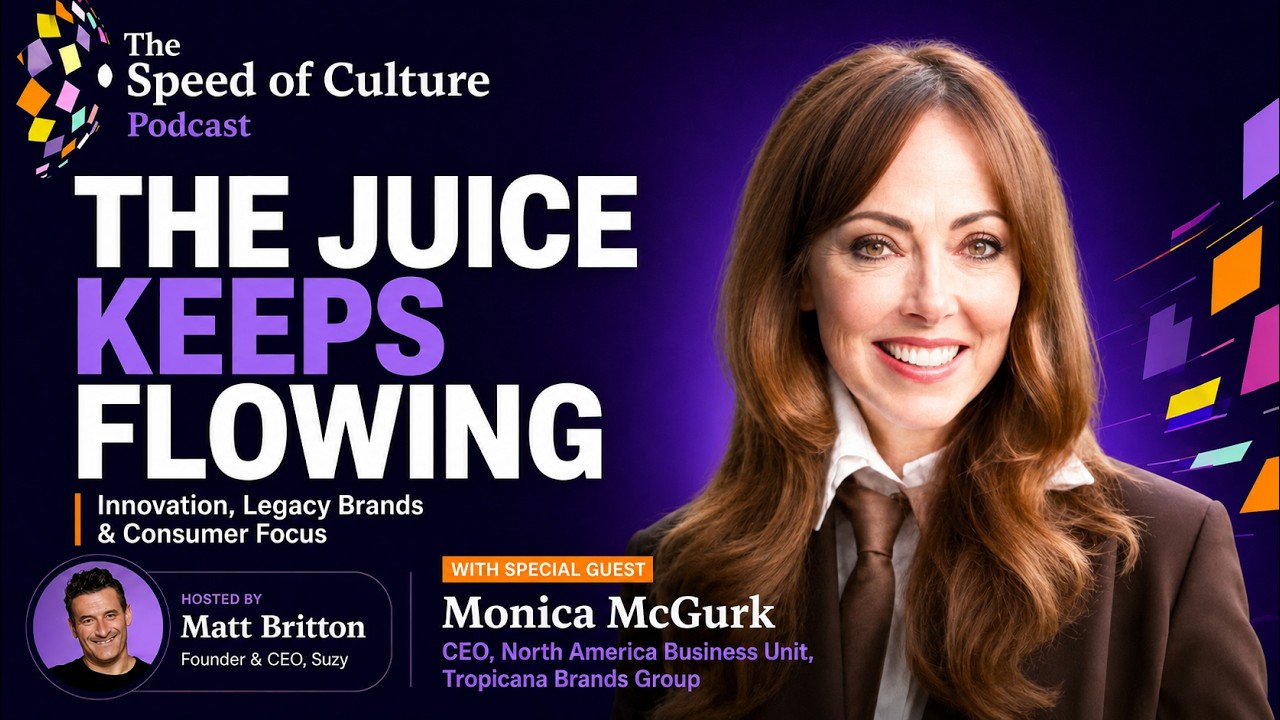
In Episode 103 of The Speed of Culture Podcast, Matt Britton, founder and CEO of Suzy, the AI-powered consumer intelligence platform, sits down with Monica McGurk, CEO of the North America Business Unit at Tropicana Brands Group, to explore how the iconic juice brand is squeezing innovation into nearly 100 years of heritage. Their conversation reveals critical insights into CPG strategy, sustaining innovation within established brands, and the mindset required to modernize while maintaining consumer trust.
Tropicana represents an interesting study in organizational transformation. After PepsiCo's 2021 divestment to private equity firm PAI Partners, the brand positioned itself as a "$3 billion startup", leveraging entrepreneurial agility while retaining the operational sophistication of an established market leader.
This positioning has become central to Tropicana's strategy under McGurk's leadership. Rather than resting on decades of brand equity, McGurk has championed a philosophy of continuous evolution, cultural relevance, and consumer-centricity that speaks directly to how legacy brands must operate in 2024 and beyond.
The interview surfaces several critical themes that resonate across the CPG industry: how to identify innovation opportunities without diluting brand identity, the importance of authentic consumer connection, and the role of leadership in fostering organizational creativity.
McGurk's background, spanning roles at Coca-Cola, Tyson Foods, and Kellogg Company, combined with her identity as a published fiction writer, provides a unique lens on how diverse experiences inform business strategy. Her approach emphasizes clarity of purpose, cross-functional collaboration, and the courage to pursue unconventional ideas that emerge from genuine consumer insights.
For brand leaders, marketing executives, and innovation strategists, McGurk's insights offer a masterclass in navigating the intersection of tradition and transformation. The episode demonstrates that sustained innovation doesn't require abandoning heritage; it requires reimagining how that heritage serves evolving consumer needs.
Whether Tropicana is launching low-sugar product options, capitalizing on viral consumer moments with Tropicana Crunch, or implementing industry-leading sustainability initiatives, each decision reflects a deliberate strategy to keep the brand culturally relevant and consumer-focused. This blog post explores the key lessons from that conversation and what they mean for brands seeking to remain competitive in an era of rapid change.
Understanding the Heritage Brand Challenge: Innovation Without Abandonment
The central paradox facing legacy brands like Tropicana is straightforward yet profound: how do you innovate aggressively without undermining the very heritage that built consumer loyalty?
McGurk addresses this challenge head-on, framing it not as a choice between tradition and innovation, but as a strategic integration of both.
Heritage brands possess an enormous advantage that younger competitors cannot replicate: decades of consumer trust and emotional connection. Tropicana has been part of American breakfast culture since the 1950s.
That heritage is valuable, but it can also become a constraint if leadership views it as a museum piece to be preserved rather than a foundation to build upon. McGurk's approach reverses this logic. She sees Tropicana's heritage as a platform for innovation, a trusted space where consumers are willing to try new products and brand extensions because of existing brand equity.
The launch of Tropicana's low-sugar options exemplifies this strategy. Instead of creating a separate sub-brand or distancing these products from the core Tropicana identity, the company positioned them as natural extensions that acknowledge changing consumer preferences around health and wellness.
This move respected the brand's heritage while responding to a measurable market trend: consumers increasingly seek beverages that taste great without the sugar content. By introducing low-sugar options under the established Tropicana umbrella, the brand retained customer loyalty while capturing new consumer segments concerned about sugar intake.
Similarly, the sustainability initiative, becoming the first national juice brand to bring 100% recycled PET bottles to scale, demonstrates how innovation can align with both consumer values and brand purpose.
This was innovation that addressed a genuine consumer concern (environmental impact) while reinforcing Tropicana's positioning as a responsible, forward-thinking brand. The recyclable bottle initiative felt like an evolution of Tropicana's heritage rather than a betrayal of it.
The deeper insight here is about organizational clarity. McGurk emphasizes the importance of knowing Tropicana's core purpose and strategic boundaries. Innovation within those boundaries generates excitement and drives growth. Innovation that contradicts core brand values or confuses consumer perception typically fails.
By maintaining clarity about what Tropicana is and stands for, McGurk creates space for bold innovations that actually resonate with consumers. This clarity becomes the guardrail that allows creative risk-taking without recklessness.
Capturing Cultural Moments: Authenticity and Responsiveness in Brand Building
One of the most revealing stories from McGurk's interview involves a moment of pure consumer insight that became a successful product launch: Tropicana Crunch.
The origin story is delightful and instructive. Tropicana's social media team discovered that consumers were posting about pouring Tropicana Pure Premium orange juice over their breakfast cereal, using juice instead of milk. Rather than dismissing this as an outlier behavior, McGurk and her team recognized it as a signal of consumer creativity and engagement.
This observation triggered a critical question: What if Tropicana created a product specifically designed for this use case? The result was Tropicana Crunch, a cereal formulated to pair with orange juice.
The campaign that launched the product capitalized on the viral nature of this discovery, positioning Tropicana as a brand that listens to consumers and responds in ways that feel authentic and playful. This approach generated significant media attention and consumer interest, demonstrating that legacy brands can participate in contemporary culture in ways that feel organic rather than forced.
The Tropicana Crunch example illustrates several principles of modern brand building:
- Listen across all channels, social media, customer interactions, market research, and consumer intelligence platforms like Suzy.
- Treat unexpected consumer behaviors as innovation signals rather than anomalies.
- Prioritize authenticity in brand communication so initiatives feel genuine rather than manufactured.
Tropicana Crunch worked because it was a genuine response to real consumer behavior, not a manufactured attempt to seem trendy.
This cultural responsiveness aligns with the broader positioning of Tropicana as a "$3 billion startup." Startups are characteristically agile, willing to test hypotheses quickly, and responsive to market feedback.
By adopting this mindset, Tropicana created organizational structures and decision-making processes that allow the brand to move faster than traditional legacy companies while maintaining the operational sophistication of an established player.
The Crunch campaign demonstrates this in action: the insight was identified, the product was conceptualized and developed, and the marketing campaign was launched, all relatively quickly compared to how such decisions might have been made in a more bureaucratic structure.
For brands looking to stay culturally relevant, the lesson is clear: invest in understanding what consumers are actually doing, not just what they say they want. Create organizational processes that allow market insights to flow quickly into product and marketing decisions. Trust your brand's heritage enough to take risks on unexpected opportunities.
The brands that win in 2024 are those that can move with culture while remaining authentically aligned with brand purpose.
Data, Creativity, and Organizational Transformation: Building the Modern CPG Company
Beyond product innovation and marketing, McGurk's leadership has involved a fundamental transformation of Tropicana's operational and technological infrastructure. This transformation reflects a crucial insight: modern CPG companies require a different relationship with data and analytics than their predecessors.
Tropicana Brands Group has embarked on a comprehensive digital transformation aimed at modernizing backend operations across supply chain, finance, and accounting. More importantly, the company has adopted what McGurk describes as a "data-forward, streamlined approach" to strategy, characterized by live dashboarding and democratic access to data across the organization.
This shift is significant because it challenges the traditional corporate model where data analysis happened in specialized departments and insights flowed vertically through hierarchies.
The new model at Tropicana treats data as a shared organizational resource that empowers teams at all levels to make more informed decisions. When marketing teams have immediate access to consumer insights, supply chain managers can see demand forecasts in real-time, and financial planners understand profitability metrics across product lines, the entire organization becomes more responsive and strategic.
This approach aligns with the "$3 billion startup" positioning because startups have always operated with transparent access to key metrics and a culture where data-driven decision-making is normalized.
Artificial intelligence plays an important role in this transformation. Tropicana is leveraging AI technology to streamline processes, identify patterns in consumer data, and automate routine operational tasks.
However, McGurk's approach to AI reflects an important maturity: AI is not treated as a replacement for human creativity and judgment, but as an enabler of it. By automating routine analytical work, AI frees teams to focus on strategic thinking, consumer insights, and creative problem-solving, the areas where human expertise remains irreplaceable.
This integration of data and creativity represents a fundamental shift in how legacy brands must operate to compete. McGurk herself embodies this integration: she is simultaneously a data-driven executive who understands supply chain optimization and a fiction writer who understands narrative, character, and emotional resonance.
Data tells you what consumers are doing. Creativity helps you understand why and imagine how your brand can connect with their deeper aspirations and values.
For CPG companies seeking to modernize, the implication is clear: the future belongs to organizations that can integrate analytical sophistication with creative excellence. This requires recruiting talent across both dimensions, creating collaboration structures that bring data scientists and creative teams together, and building a leadership culture that values both types of thinking.
Tropicana's transformation demonstrates that this integration is possible and that it drives competitive advantage.
Sustainability, Scale, and Stakeholder Alignment: The Business Case for Responsible Innovation
One of the more compelling aspects of McGurk's leadership at Tropicana involves the brand's commitment to sustainability and how that commitment translates into competitive advantage.
The initiative to bring 100% recycled PET bottles to scale across the Naked juice line represents a significant undertaking, scaling sustainable practices is infinitely harder than implementing them in limited contexts.
Bringing recycled bottles to scale required innovation at multiple levels: sourcing sufficient quantities of recycled material, modifying manufacturing processes, managing costs, and building consumer awareness of the initiative. It also required aligning stakeholders across the supply chain, from suppliers to bottling facilities to retailers.
This is precisely the kind of complex, multi-stakeholder initiative that legacy companies should excel at, given their established relationships and operational sophistication. However, it requires a leadership commitment to treat sustainability not as a marketing claim but as a fundamental operational priority.
What makes this initiative strategically interesting is that it addresses genuine consumer concerns about environmental impact while also creating operational efficiencies. Recycled material is increasingly cost-competitive with virgin plastic, especially as scale increases.
By committing to recycled PET at scale, Tropicana simultaneously addressed consumer values, managed input costs, and positioned itself as an environmental leader in the beverage industry. This is the ideal outcome: sustainability initiatives that improve the business economics while improving environmental outcomes.
The Tropicana approach also reflects sophisticated stakeholder management. Consumers increasingly care about environmental impact, particularly younger consumers who drive category growth. Retailers recognize that sustainability-positioned brands often perform better in the marketplace.
Suppliers understand that large-scale commitments to recycled materials benefit their business by creating guaranteed demand. Government and environmental organizations appreciate corporate commitments to reducing plastic waste.
By aligning these stakeholders around a clear sustainability commitment, McGurk created momentum that made the initiative feasible at scale.
This lesson extends beyond sustainability initiatives. It applies to any significant organizational change or strategic pivot: the most successful initiatives are those that create clear benefits for multiple stakeholders, not just shareholders.
When consumers care about it, retailers want to sell it, employees feel proud to work on it, and suppliers can build viable businesses around it, the initiative becomes part of organizational DNA rather than a temporary effort that loses support when leadership attention shifts.
Leadership Authenticity and Organizational Culture: The Human Element of Brand Innovation
Perhaps the most unexpected element of McGurk's approach to leadership is her openness about her identity as a published fiction writer and her belief that personal passions and interests directly enhance organizational creativity and effectiveness.
This might seem tangential to a business case, but McGurk treats it as integral.
Fiction writing requires deep understanding of human motivation, emotional complexity, and narrative coherence. These capabilities translate directly into business problem-solving.
When McGurk approaches an organizational challenge, she brings not just analytical frameworks and industry experience, but also the storyteller's instinct for understanding what will resonate with people, how to communicate complex ideas compellingly, and how to recognize the narrative patterns that explain market behavior.
More importantly, McGurk's willingness to integrate her fictional writing practice with her CEO role models a leadership philosophy that values whole human beings rather than compartmentalized professional personas.
This approach has implications for organizational culture. When the CEO openly acknowledges that her best business insights sometimes come from fiction writing, it sends a message throughout the organization that diverse interests and experiences are valuable, that creativity is encouraged, and that the best thinking often comes from unexpected sources.
This connects directly to the innovation challenge McGurk addresses throughout her career. Sustainable innovation requires an organizational culture where people feel safe proposing unconventional ideas, where diverse perspectives are actively solicited, and where the evaluation of ideas is based on merit rather than organizational politics or conformity to established thinking.
McGurk's personal approach to leadership, integrating fiction writing with business strategy, bringing emotional intelligence alongside analytical capability, creates permission for this kind of creative organizational culture.
The implication for CPG leaders is significant: the companies that will innovate most effectively are those with leaders who model intellectual curiosity, celebrate diverse perspectives, and demonstrate that business excellence doesn't require abandoning the parts of yourself that make you interesting and creative.
This is particularly important for attracting and retaining top talent, especially among younger cohorts of employees who increasingly seek alignment between their personal values and organizational values, and who expect leaders to embody authenticity rather than perform a professional persona.
Key Takeaways
- Heritage as Platform: Legacy brands create competitive advantage not by preserving heritage unchanged but by using it as a trusted foundation for innovation that addresses evolving consumer needs and values.
- Consumer Insights Drive Innovation: The most successful product innovations emerge from deep understanding of actual consumer behavior and cultural moments, not from internal assumptions about what consumers want.
- Data and Creativity Are Complementary: Modern CPG companies require organizational structures and leadership capabilities that integrate analytical sophistication with creative excellence, treating data insights as fuel for human creativity rather than as substitutes for it.
- Sustainability Creates Stakeholder Alignment: Strategic sustainability initiatives that address genuine consumer concerns while creating operational efficiencies generate support across stakeholders and become embedded in organizational practice.
- Authentic Leadership Drives Culture: Leaders who integrate their whole selves into their work, bringing personal passions, diverse experiences, and emotional intelligence alongside analytical capability, create organizational cultures where innovation thrives.
Frequently Asked Questions
How can legacy brands compete with younger, more agile competitors?
Legacy brands possess substantial advantages if they reorganize for agility: deep consumer trust, established distribution networks, operational sophistication, and substantial resources. The "$3 billion startup" positioning that Tropicana adopted captures this insight, legacy brands can adopt startup mentality and decision-making processes while leveraging their operational strengths.
This requires flattening hierarchies, accelerating decision-making, and creating cross-functional teams that move at startup speed. Companies like Tropicana demonstrate that this organizational transformation is feasible.
What makes a product innovation successful for an established brand?
Successful innovations for legacy brands remain authentically aligned with brand purpose and identity while addressing genuine consumer needs or desires. Tropicana's low-sugar products succeeded because they responded to real consumer concerns about health and wellness while remaining true to Tropicana's identity as a juice brand.
Tropicana Crunch worked because it responded to actual consumer behavior rather than manufactured trends. The key is ensuring that innovations flow from genuine consumer insights rather than internal brainstorming sessions disconnected from market reality.
How important is organizational transparency and data access to innovation?
Organizational transparency around data and metrics proves essential for innovation at scale. When teams across the organization have access to consumer insights, sales data, and profitability metrics, they make better decisions and identify opportunities faster.
Legacy companies often concentrated this information in specialized departments, which slowed decision-making and prevented frontline teams from contributing insights. Modern CPG companies increasingly adopt "democratic access to data" models that empower teams at all levels to understand market reality and contribute to strategic decisions.
Can sustainability initiatives actually improve business economics?
Yes, when sustainability initiatives are strategic rather than compliance-focused. Initiatives that address genuine consumer concerns while also improving operational efficiency or managing input costs create win-win scenarios.
Tropicana's recycled PET bottle initiative addressed environmental concerns while becoming cost-competitive with virgin plastic at scale. The key is identifying sustainability initiatives where consumer values, operational efficiency, and business economics align, rather than treating sustainability as a cost to bear for marketing purposes.
Looking Ahead
The insights from Monica McGurk's conversation with Matt Britton on The Speed of Culture Podcast offer a blueprint for how legacy brands can thrive in an era of rapid change.
Tropicana's transformation demonstrates that heritage and innovation are not opposing forces but complementary strengths when leadership creates organizational structures and cultures that honor both.
For brand leaders, marketing executives, and innovation strategists seeking to understand how established companies remain competitive, this episode is essential listening. The conversation spans CPG strategy, organizational transformation, sustainability, and the human dimensions of leadership, all topics that will determine competitive success in the coming years.
Explore more insights about consumer intelligence and brand strategy through these resources:

%20(400%20x%20100%20px)%20(300%20x%2050%20px)%20(150%20x%2050%20px).avif)