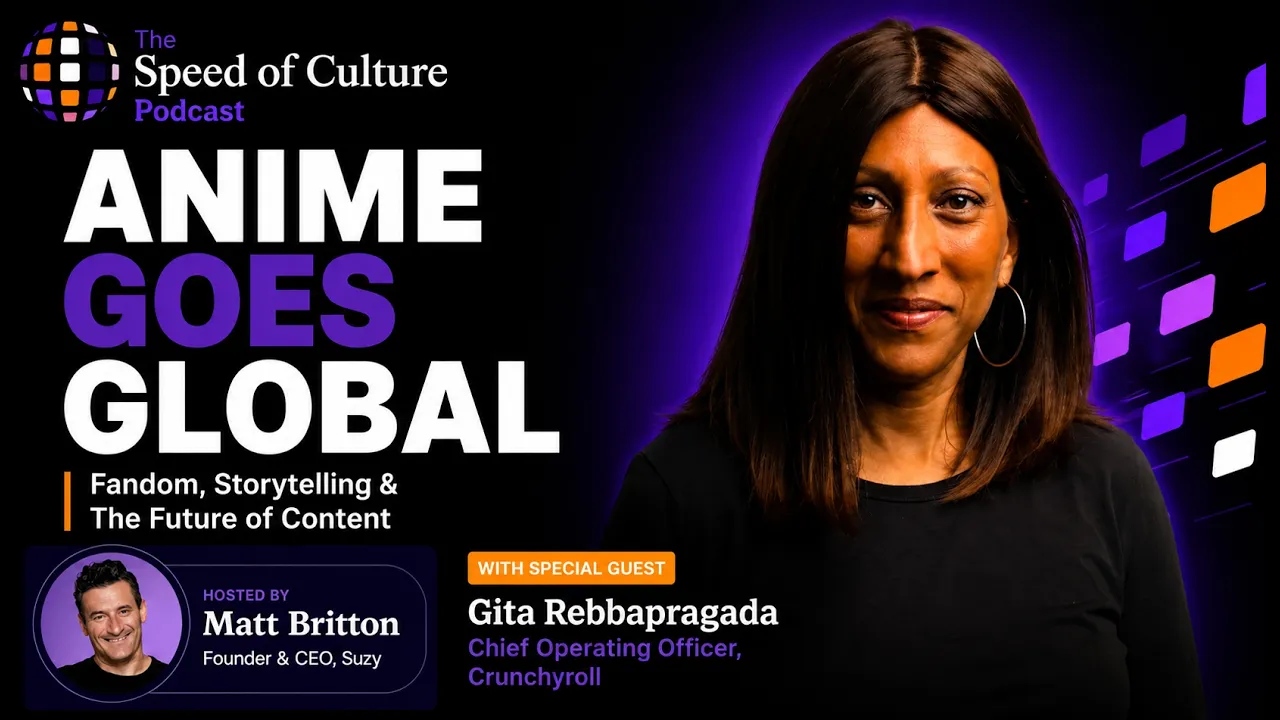
Breaking Storytelling Boundaries with Gita Rebbapragada: How Crunchyroll Is Reshaping the Global Anime Industry
In May 2024, Matt Britton, founder and CEO of Suzy, the AI-powered consumer intelligence platform, sat down with Gita Rebbapragada, Chief Operating Officer of Crunchyroll, to explore how anime is transforming entertainment globally. The conversation revealed critical insights into storytelling innovation, business strategy, and the unprecedented growth of the anime industry.
Rebbapragada, who pivoted from Chief Marketing Officer to COO in September 2023, brings extensive experience scaling high-growth ventures including Fabletics at TechStyle Fashion Group and Zipcar's revolutionary car-sharing service.
The episode of The Speed of Culture Podcast illuminates a pivotal moment in entertainment history. The global anime streaming market, valued at USD 7.50 billion in 2024, is projected to reach USD 14.65 billion by 2030, a compound annual growth rate of 11.8% that vastly outpaces traditional streaming sectors.
Crunchyroll and Netflix together dominate over 80% of the international anime streaming market, with Crunchyroll's subscriber base tripling from 5 million in August 2021 to more than 15 million by August 2024. What's particularly remarkable is that Crunchyroll has already achieved profitability while continuing aggressive expansion, with projections showing the platform will generate 40% of Sony Pictures' operating profit within two years.
This conversation goes beyond industry metrics. Rebbapragada discusses the fundamental nature of anime as a storytelling medium, how it pushes traditional narrative boundaries in ways that resonate with Gen Z and global audiences.
Unlike Western animation traditionally targeting younger viewers, anime explores complex themes with visual sophistication and emotional depth. The discussion touches on how streaming platforms have democratized access to this content, enabling simultaneous international releases with localized subtitles and dubbing that transform regional stories into global phenomena.
For business leaders, marketing executives, and consumer strategists, this episode offers essential context for understanding one of entertainment's fastest-growing segments. Rebbapragada's insights reveal how niche content can become mainstream through strategic platform positioning, community engagement, and ecosystem development.
The anime industry expansion demonstrates broader shifts in consumer preferences toward authentic, boundary-pushing storytelling that reflects diverse perspectives and cultural narratives. As traditional media companies compete for streaming dominance, understanding Crunchyroll's approach to content curation, global localization, and fan-forward strategy becomes crucial for anyone navigating digital entertainment markets.
The Anime Renaissance: Why Storytelling Matters More Than Ever
The anime industry's explosive growth represents more than just entertainment trends, it reflects fundamental changes in how audiences consume stories and what content resonates globally.
Gita Rebbapragada emphasizes that anime's strength lies in its willingness to tackle complex narratives and mature themes with visual innovation that transcends cultural boundaries. Unlike many Western animation formats that historically confined themselves to specific age demographics, anime creators embrace storytelling that mirrors the emotional complexity of their audiences' lives.
The streaming era accelerated this transformation. Before platforms like Crunchyroll existed, anime fans faced significant barriers accessing content.
International releases lagged months or years behind Japanese broadcasts. Licensing fragmentation meant different episodes appeared on different services across regions. Subtitles were often amateur-quality, and dubbing was inconsistent.
Crunchyroll solved these infrastructure problems by pioneering simultaneous global releases with professional localization.
This infrastructure innovation enabled narrative innovation. When episodes reach global audiences on the same day as their Japanese premiere, creators can engage worldwide fan communities in real-time.
This creates appointment viewing, the antithesis of passive background watching. Gen Z audiences, who grew up with the internet and sophisticated visual media, gravitated toward anime's complex character development and thematic depth.
The result: anime titles increasingly compete with traditional television for cultural relevance.
Rebbapragada's strategic positioning of Crunchyroll reflects this shift. Rather than viewing anime as a niche category, she treats it as a complete entertainment ecosystem.
The platform expanded beyond streaming into Game Vault, collectibles, anime music videos, and live events. Each franchise becomes a monetizable universe, creating multiple touchpoints for audience engagement.
This ecosystem approach transforms casual viewers into invested community members, increasing lifetime value and platform stickiness.
The global market data supports this expansion strategy. The anime streaming market's projected 11.8% CAGR significantly exceeds the broader SVOD market growth.
Asia-Pacific regions drive substantial demand, but North American and European audiences have grown dramatically. This geographic diversification reduces risk and creates sustainable growth trajectories that traditional entertainment platforms rarely achieve.
Crunchyroll's Operational Excellence: Building a Streaming Powerhouse
Gita Rebbapragada's elevation from CMO to COO reflects Crunchyroll's maturation as an operating business. Her previous experience at Fabletics and Zipcar taught her how subscription models scale and how to integrate diverse functional teams around growth objectives.
At Crunchyroll, her operational purview encompasses strategy and planning, business and content operations, localization and dubbing, curation and programming, enterprise technology, and all marketing functions.
This integrated approach differs fundamentally from traditional entertainment structures where marketing operates in silos from content operations. Rebbapragada's leadership model ensures content strategy aligns with audience development, global localization happens simultaneously with acquisition campaigns, and technology investments directly support viewer experience.
The result is a company that thinks operationally about every aspect of the customer journey.
Localization and dubbing represent particularly important operational considerations in the anime business. While subtitles are faster and cheaper to produce, dubbing drives significantly higher engagement in Western markets.
Crunchyroll invests heavily in dubbing quality, recognizing that American and European audiences often prefer dubbed versions, especially for younger viewers. This requires maintaining dubbing operations across multiple languages, managing voice actor networks, and ensuring cultural adaptation that respects source material while resonating with target audiences.
Crunchyroll's profitability is remarkable given the high-growth streaming environment. The platform achieved an estimated profit margin of 8% in Q3 2024, projected to more than double by 2027.
This profitability reflects operational excellence, efficient content acquisition, optimized marketing spend, technology infrastructure that scales with subscriber growth, and subscription pricing that reflects premium positioning.
Most SVOD services hemorrhage cash during growth phases; Crunchyroll's ability to scale profitably while tripling subscribers demonstrates sophisticated operational management.
The Sony Pictures merger with Funimation in 2022 accelerated this trajectory. By consolidating competing anime streaming services, Crunchyroll eliminated redundancy while expanding content libraries.
Rather than splitting subscriber attention across two platforms, Sony unified the anime audience under Crunchyroll's brand, creating stronger negotiating positions with content creators and more efficient marketing investments. This consolidation represents a masterclass in strategic M&A within the streaming context.
Enterprise technology investments underpin operational scaling. Content management systems must handle simultaneous releases across regions, manage rights workflows that vary by territory, optimize streaming delivery for diverse network conditions, and provide analytics that inform acquisition and retention strategies.
Rebbapragada's operational responsibility includes ensuring these technical foundations support business objectives.
Global Expansion and the International Anime Phenomenon
The anime industry's global expansion extends far beyond Western markets. While North America and Europe attract significant attention, Asia-Pacific regions represent both massive opportunity and intense competition.
Japan, South Korea, and China have homegrown streaming services competing for anime audiences, while India and Southeast Asia represent emerging markets with minimal anime penetration.
Rebbapragada discusses Crunchyroll's global strategy with nuance that reflects regional differences. The platform's July 2024 brand identity refresh, including new logo and graphics, accompanied an Indonesian market expansion with official launches, localized subtitles, and region-specific dubbing.
This pattern repeats across emerging markets: Crunchyroll identifies growth opportunities, invests in local language content, and positions itself as the premium anime destination.
The global anime market's USD 32–39 billion valuation in 2024 masks significant regional variation. Streaming represents one segment; merchandise represents nearly 48% of total market value.
This merchandise emphasis reflects anime's transmedia potential. Successful series spawn manga, light novels, collectible figures, apparel, games, and live-action adaptations.
The best-performing franchises treat anime as story content that anchors broader merchandise ecosystems.
Rebbapragada's background in subscription scaling becomes particularly relevant in this context. Fabletics grew by treating subscription not as a transactional purchase but as a lifestyle service.
Similarly, Crunchyroll positions itself as the central hub for anime fandom, where subscribers access streaming content, community features, merchandise opportunities, and exclusive experiences. This ecosystem orientation creates defensible competitive advantages.
International content creators view Crunchyroll's infrastructure and global reach as transformative opportunities. A series that might have limited domestic appeal gains international exposure through simultaneous releases and professional localization.
This dramatically expands addressable markets for content creators, justifying larger production budgets and attracting top talent. The virtuous cycle strengthens Crunchyroll's content library while enabling creators to pursue more ambitious narratives.
Cultural localization goes beyond translation. Crunchyroll recognizes that audiences in India, Brazil, and Nigeria have distinct preferences that differ from Western markets.
Regional content teams curate libraries, inform acquisition decisions, and maintain cultural authenticity in dubbing. This localized approach prevents the homogenization that plagued earlier globalization efforts, instead celebrating anime's cultural specificity while building worldwide audiences.
The Future of Boundary-Pushing Storytelling
Anime's storytelling evolution reflects broader entertainment trends toward authenticity, complexity, and cultural specificity. Rather than pursuing universal narratives that appeal to lowest-common-denominator audiences, anime creators embrace stories that reflect specific cultural perspectives and complex emotional realities.
This counterintuitive approach, targeting niche audiences with authentic content rather than mass audiences with diluted content, has proven remarkably effective.
Rebbapragada emphasizes that streaming enables creators to pursue stories that traditional broadcast television would have rejected. Network television requires advertisers, which demands large, predictable audiences.
Streaming subscription models create different incentives. A series that attracts one million intensely engaged subscribers generates more valuable data and stronger retention than ten million passive viewers.
This shift enables creators to pursue challenging narratives, complex characters, and innovative visual techniques.
The anime industry's diversity of storytelling approaches, from avant-garde experimental narratives to traditional adventure stories, provides audiences with genuine choice.
Some anime embraces visual innovation that breaks conventional animation rules. Others prioritize character development and psychological complexity. Still others explore philosophical themes through narrative structures.
This diversity reflects the medium's maturity and confidence.
Technology innovations will continue reshaping anime's potential. Virtual production techniques, AI-assisted animation, and dynamic dubbing technologies promise to reduce production timelines and costs while expanding creative possibilities.
Crunchyroll's technology investments position the company to leverage these innovations ahead of competitors.
The globalization of anime also represents a victory for cultural pluralism in entertainment. For decades, American entertainment companies assumed global audiences would consume American content if it was available.
Anime's success demonstrates that global audiences prefer diverse, culturally-specific storytelling. This realization reshapes how major studios approach content strategy, forcing recognition that authentic local perspectives often outperform homogenized global content.
Community and Fandom as Business Strategy
One often-overlooked element of Crunchyroll's success is its explicit embrace of fan communities. Rather than viewing fans as consumers to be exploited, Rebbapragada describes how Crunchyroll positions itself as a platform that serves fan needs.
This fan-forward orientation manifests in numerous ways: community features within the app, fan convention sponsorships, exclusive merchandise access, and involvement in fan governance decisions.
This community orientation reflects generational differences. Gen Z audiences expect brands to participate authentically in fan communities rather than attempting to co-opt fandom for marketing purposes.
Crunchyroll's community-centric approach feels organic rather than manufactured, building trust and loyalty that traditional marketing campaigns cannot achieve.
The anime fan community's global nature creates network effects that strengthen Crunchyroll's competitive position. When American fans engage with Japanese communities through Crunchyroll's platforms, they encounter diverse perspectives and cultural contexts that deepen engagement.
This cross-cultural community interaction becomes a product feature, fans value the global community as much as the content itself.
Key Takeaways
- Anime's Boundary-Pushing Narratives Drive Engagement: Unlike traditional Western animation, anime explores complex themes and mature storytelling that resonates with Gen Z audiences seeking authentic, culturally-specific narratives that reflect emotional complexity.
- Streaming Infrastructure Enables Content Globalization: Crunchyroll's simultaneous international releases with professional localization transformed anime from regional content to global phenomenon, demonstrating that infrastructure innovation drives creative possibility.
- Operational Excellence Generates Profitability During Growth: Crunchyroll's achievement of 8% profit margins while tripling subscribers showcases how integrated operational strategy (aligning content, technology, localization, and marketing) creates sustainable growth even in competitive streaming markets.
- Ecosystem Expansion Multiplies Revenue Beyond Streaming: By developing Game Vault, collectibles, music videos, and live events alongside streaming, Crunchyroll transforms casual viewers into invested community members, increasing lifetime value across multiple monetization vectors.
- Community-Centric Strategy Builds Defensible Competitive Advantages: Positioning Crunchyroll as a platform that authentically serves fan communities, rather than exploiting them, creates loyalty and network effects that traditional marketing cannot replicate, particularly among globally-connected Gen Z audiences.
FAQ
What makes anime's storytelling different from Western animation?
Anime differentiates itself through willingness to tackle complex narratives, mature themes, and psychological depth traditionally reserved for live-action television. Rather than assuming animation targets specific age demographics, anime creators treat the medium as capable of exploring sophisticated character development, philosophical themes, and visual innovation. This approach resonates with audiences seeking authentic, culturally-specific storytelling that mirrors real emotional complexity.
How did Crunchyroll achieve profitability while scaling rapidly?
Crunchyroll achieved profitability through integrated operational strategy that aligns content acquisition, localization, technology infrastructure, and marketing around sustainable unit economics. The platform prioritizes viewer lifetime value over subscriber acquisition volume, leveraging ecosystem expansion into games and merchandise to diversify revenue streams. Additionally, consolidating competing anime services under the Crunchyroll brand eliminated redundancy while strengthening negotiating positions with content creators.
What is the global anime market's growth trajectory?
The global anime streaming market, valued at USD 7.50 billion in 2024, is projected to reach USD 14.65 billion by 2030, a compound annual growth rate of 11.8%. The broader anime market (including merchandise, merchandise, and gaming) is valued at USD 32-39 billion in 2024, with merchandise representing nearly 48% of total value. This growth significantly exceeds traditional streaming market growth rates, driven by increasing North American and European adoption alongside strong Asian demand.
How does Crunchyroll's community strategy differ from traditional media companies?
Rather than viewing fans as consumers to extract value from, Crunchyroll positions itself as a platform that serves fan community needs. This manifests through community features, convention sponsorships, exclusive merchandise access, and genuine engagement with fan perspectives. This fan-forward orientation feels authentic rather than manufactured, building trust particularly among Gen Z audiences who expect brands to participate authentically in communities rather than attempting to co-opt fandom for marketing purposes.
Looking Ahead
The Speed of Culture Podcast episode with Gita Rebbapragada offers essential insights for anyone seeking to understand how entertainment industries evolve in digital-first environments. Rebbapragada's leadership demonstrates that operational excellence, community authenticity, and strategic ecosystem thinking create defensible competitive advantages even in consolidated markets.
For organizations navigating streaming economics, anime's trajectory provides valuable lessons about profitability in high-growth environments. For marketers seeking to engage Gen Z audiences, anime fandom demonstrates that authentic cultural specificity outperforms homogenized global content.
For content creators, Crunchyroll's platform infrastructure shows how to leverage distribution scale while maintaining creative integrity.
Learn more about consumer intelligence and AI-driven insights at Suzy, explore additional episodes of The Speed of Culture Podcast, and discover more from Matt Britton on Generation AI: The Book, AI Keynote Speaking, and Speaker HQ.

%20(400%20x%20100%20px)%20(300%20x%2050%20px)%20(150%20x%2050%20px).avif)