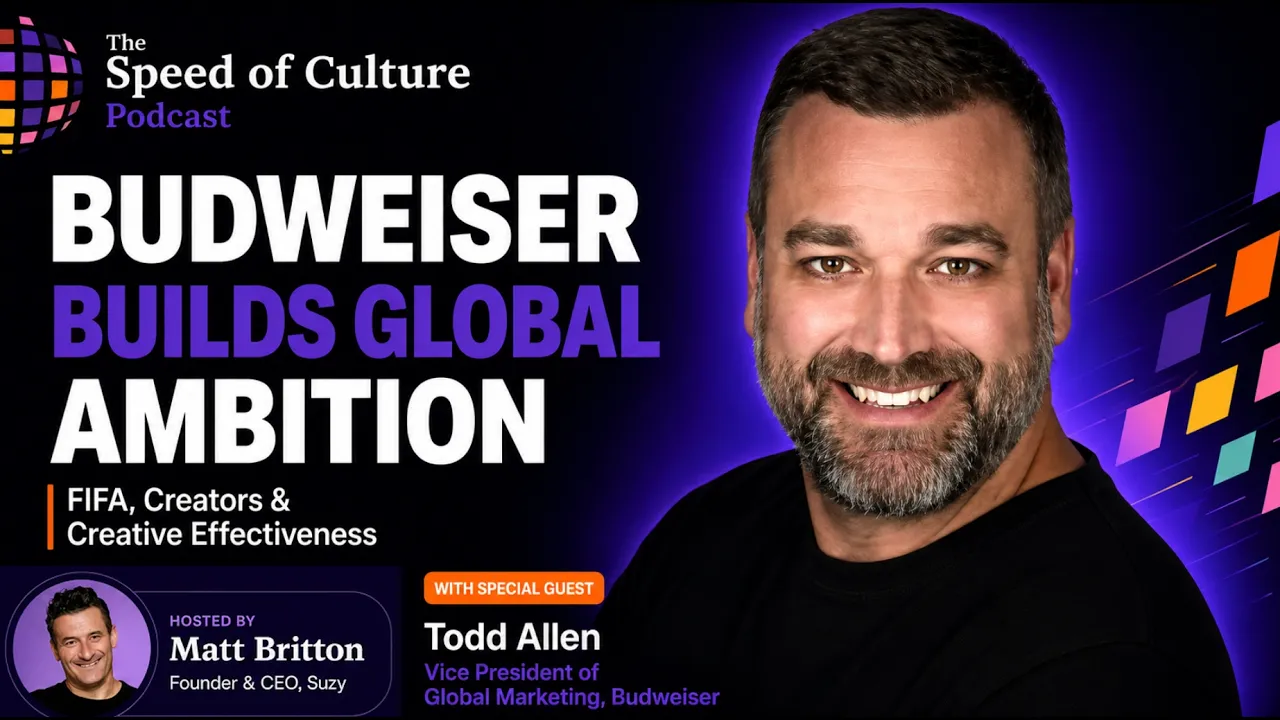
The 2022 FIFA World Cup presented unprecedented challenges for global brands. When Qatar announced a last-minute ban on alcohol sales at stadiums, most sponsors would have scrambled for damage control. Instead, Todd Allen, Vice President of Global Marketing at Budweiser, saw an opportunity to demonstrate the agility and strategic thinking that separates category leaders from competitors.
In a conversation on The Speed of Culture podcast, Allen discussed how Budweiser leveraged this obstacle to launch their most ambitious global campaign in the brand's 146-year history.
Matt Britton, founder and CEO of Suzy, the AI-powered consumer intelligence platform, sat down with Allen to explore the deeper story behind "The World is Yours to Take" campaign. The conversation revealed how enterprise-level marketing decisions are made when real-time consumer insights meet strategic agility.
Rather than treating the stadium alcohol ban as a setback, Budweiser's marketing team repositioned the narrative entirely. The campaign pivoted from traditional stadium activation to a celebration of fans, passion, and the pursuit of greatness on a global stage. This strategic evolution offers critical lessons for chief marketing officers, brand leaders, and marketing teams navigating rapid market shifts in an increasingly unpredictable business environment.
Allen's approach to solving complex marketing challenges demonstrates what it means to operate at the highest levels of brand stewardship. With over 20 years of experience across major multinational brands including Unilever, Stella Artois, and Labatt Breweries of Canada, Allen brought a sophisticated understanding of how to build consumer relevance across different markets and cultures.
His appointment as VP of Global Marketing positioned him to lead one of the most visible brand initiatives in sports marketing. The World Cup campaign would test every element of his strategic philosophy, consumer insight, creative partnership, digital transformation, and real-time decision-making.
The Strategic Imperative: Building Community Over Transactions
Budweiser's position as an official FIFA World Cup partner for more than three decades provides structural advantages, but it also creates expectations. Consumers expect innovation, authenticity, and cultural relevance. Allen emphasized that the foundation of any successful campaign rests on a single principle: continuous relevance to the consumer.
"The first and foremost thing is to continue to be relevant to the consumer and offer them the right product, at the right time, in the right format."
This statement, while seemingly straightforward, represents a fundamental shift in how enterprise brands approach marketing strategy.
For decades, Budweiser's World Cup activations focused on stadium presence, exclusive experiences, and broadcast dominance. By 2022, the marketing landscape had fundamentally transformed. Consumers increasingly discover brands through social media, creator partnerships, and peer recommendations rather than traditional advertising channels.
The shift toward direct-to-consumer marketing required Budweiser to rebuild its relationship with fans at a more granular level. Rather than a top-down broadcast message, the campaign needed to facilitate community conversations where fans felt seen, celebrated, and part of something larger than themselves.
This philosophy directly shaped the campaign's creative execution. Budweiser recruited over 100 global influencers and creators to amplify the message across different cultural contexts. By partnering with creators who had authentic relationships with their audiences, Budweiser could extend its reach beyond traditional media buying.
Each creator brought their unique perspective to the campaign narrative, resulting in a more diverse, culturally responsive activation than a single creative direction could achieve. The campaign didn't tell consumers what greatness looked like; instead, it invited communities to define it for themselves.
The Agile Response: When Real-Time Insights Drive Strategic Pivots
The alcohol sales ban at Qatar stadiums represented a critical test of whether Budweiser's marketing infrastructure could adapt in real-time. Traditional marketing organizations operate on annual cycles, with quarterly reviews and multi-month lead times for creative development and media buying. Allen's team needed to make major strategic decisions in a matter of days.
This required not just creative flexibility but also a fundamentally different approach to consumer research and validation.
According to Allen, Budweiser didn't retreat from the market opportunity. Instead, the team conducted rapid consumer research to understand where fans would gather, how they wanted to experience the World Cup, and what role alcohol brands could authentically play in those moments.
The insights revealed that most fans cared less about consuming beer at the stadium and more about feeling connected to the global spectacle. Budweiser could facilitate those connections through digital experiences, creator partnerships, and localized activations outside stadiums.
This pivot demonstrates how real-time consumer intelligence reshapes strategy. Rather than following predetermined plans, Allen's approach relied on continuous feedback loops: What are consumers discussing on social media? Which content formats generate engagement? Where do conversations about World Cup excitement originate?
By treating consumer data as a strategic asset rather than a post-campaign measurement tool, Budweiser could adjust messaging, influencer partnerships, and media allocation throughout the tournament. The campaign operated with what Allen described as "market conviction", the confidence that data-driven insights, not assumptions, should guide major decisions.
The practical implications extend far beyond one brand or campaign. Any organization in fast-moving consumer goods, technology, entertainment, or retail faces similar pressures to deliver results in shorter timeframes while working with incomplete information.
Marketing teams increasingly need to build infrastructure for rapid hypothesis testing, real-time analytics, and decision-making under uncertainty. Budweiser's ability to execute against these demands offers a blueprint for how enterprise organizations should structure their marketing operations.
The Creator Economy and Authentic Brand Partnership
One of the most significant evolutions in modern marketing involves the relationship between established brands and digital creators. Historically, brands viewed influencers as media channels, vehicles for distributing messages to their audiences. This transactional mindset limited effectiveness and created obvious inauthenticity that consumers increasingly reject.
Allen's approach to creator partnerships reflected a different philosophy: treat creators as strategic partners with unique insights into their communities.
When Budweiser recruited over 100 creators for the World Cup campaign, the brand didn't hand down a single message or strict content requirements. Instead, Budweiser provided the campaign platform and creative framework, then empowered creators to develop content authentic to their audiences.
A creator focused on women's football brought different perspectives than one centered on club football or emerging markets. By encouraging this diversity, Budweiser accessed market insights it couldn't generate internally. The creators understood local contexts, cultural nuances, and audience preferences in ways that a centralized marketing team never could.
This approach also addressed a core credibility challenge. Consumers inherently distrust advertising. They trust people they already follow and respect.
By having creators champion the World Cup message through their own voices and perspectives, Budweiser gained the credibility that paid advertising cannot purchase. The campaign benefited from what sociologists call "weak tie" effects, people are more influenced by recommendations from acquaintances than by authority figures or close friends.
The creator economy lesson runs deeper than execution tactics. It reveals how successful brands must become genuine community partners rather than just message broadcasters.
Budweiser asked: what do football fans care about beyond beer? How can we facilitate those conversations and moments? What platforms and formats do creators already excel at producing? The answers suggested that brand value would emerge from enablement and partnership rather than from asserting control over the narrative.
Global Scale and Cultural Relevance: Executing in Over 70 Countries
Budweiser's campaign reached more countries than any previous World Cup activation by the brand. This unprecedented scale required new approaches to localization and cultural adaptation. The central campaign message, "The World is Yours to Take", needed to resonate across vastly different cultural contexts.
In soccer-obsessed Latin America, the message might emphasize player excellence and athletic achievement. In emerging Asian markets, the focus might shift toward community celebration and family moments. In Europe, the message could highlight tradition, legacy, and continental pride.
To execute this level of localization, Allen's team deployed regional leadership empowered to make creative decisions. Rather than enforcing a single global template, Budweiser provided strategic guardrails and core brand positioning while allowing regional teams to develop culturally specific creative expressions.
This balance between consistency and flexibility represents best practices in global marketing. The brand ensures visual and message continuity across markets while trusting regional experts to navigate local market dynamics.
The campaign also featured a global anthem, the Budweiser-backed single "The World Is Yours to Take" featuring Lil Baby, which sampled the iconic Tears for Fears track "Everybody Wants to Rule the World." This creative element provided unifying cultural touchstones that resonated globally while allowing localization through international remixes and regional versions.
By combining a globally recognizable music platform with locally relevant artist partnerships, Budweiser achieved scale without sacrificing authenticity or cultural sensitivity.
This global coordination required sophisticated marketing technology and insight infrastructure. Budweiser needed real-time dashboards showing campaign performance across regions, enabling rapid reallocation of resources to high-performing activations.
Executing at this scale demands that marketing organizations invest in technology, talent, and processes specifically designed for global coordination and rapid decision-making. Many enterprises underestimate these requirements, leading to campaigns that sacrifice performance for simplicity or spend excessively to achieve necessary sophistication.
The Future of Global Brand Marketing in Uncertain Times
Allen's World Cup campaign and the broader principles it embodied point toward how global marketing will function over the next decade. First, real-time consumer insights will increasingly drive strategy rather than follow it. Organizations that can transform consumer data into actionable strategic decisions in hours rather than months will consistently outperform competitors.
Second, creator partnerships and community engagement will continue displacing traditional advertising as the primary driver of brand relevance. Successful brands will increasingly operate as platform creators and community facilitators rather than message broadcasters.
Third, global marketing success requires balancing centralized strategy with distributed execution. Organizations that develop clear strategic frameworks while empowering regional teams to execute within those frameworks outperform those that impose rigid central control.
As business environments grow more unpredictable, marketing agility becomes a competitive advantage comparable to product innovation or operational efficiency. Budweiser's World Cup campaign serves as a case study in how enterprises at the highest levels of brand stewardship approach these challenges.
For deeper insights into how top marketing leaders navigate culture and strategy, explore The Speed of Culture podcast where Matt Britton discusses innovation, consumer trends, and leadership with CMOs and brand executives across industries.
Those interested in consumer intelligence methodologies and real-time market insights can explore how Suzy's AI platform enables organizations to access consumer perspectives instantly. Additionally, Matt Britton's Generation AI book offers comprehensive analysis of how artificial intelligence reshapes consumer behavior and marketing effectiveness, while his AI keynote speaker services bring these insights directly to enterprise audiences.
Organizations seeking guidance on building high-impact marketing presentations and strategies can also benefit from Speaker HQ, which connects brands with thought leadership expertise.
Key Takeaways for Business Leaders
- Consumer relevance is the foundation of all marketing strategy. Organizations must continuously research, understand, and respond to evolving consumer preferences rather than relying on static assumptions about audience behavior.
- Real-time agility creates competitive advantage. When circumstances change, organizations that can make rapid strategic decisions based on consumer data outperform those locked into predetermined plans.
- Creators and influencers function best as strategic partners, not media channels. Empowering creators to develop authentic content within brand frameworks generates more credible outcomes than enforcing standardized messages.
- Global scale doesn't require global uniformity. Successful international campaigns balance centralized strategy with distributed execution, providing frameworks while trusting regional teams to adapt for local markets.
- Marketing infrastructure must support decision-making speed. Modern marketing organizations require technology, processes, and talent specifically designed to transform consumer insights into strategy in hours rather than weeks or months.
Frequently Asked Questions
How did Budweiser respond to the Qatar stadium alcohol sales ban?
Rather than treating the stadium ban as a setback, Budweiser conducted rapid consumer research to understand how fans wanted to experience the World Cup. The team discovered that fan engagement centered more on connection to the global spectacle than on stadium consumption. This insight led to a strategic pivot toward digital experiences, creator partnerships, and localized activations outside stadiums, which ultimately expanded the campaign's reach and authenticity.
What makes the creator partnership model more effective than traditional influencer marketing?
The creator partnership approach treats creators as strategic collaborators with deep community insights rather than as distribution channels for standardized messages. By empowering creators to develop content authentic to their audiences while working within brand frameworks, Budweiser accessed localized perspectives and gained credibility that comes from trusted community voices. Consumers inherently distrust advertising but trust recommendations from creators they follow.
How did Budweiser execute a campaign across 70+ countries with consistent messaging?
The campaign balanced centralized strategy with distributed execution. Budweiser developed clear brand positioning and campaign frameworks, then empowered regional leadership to develop culturally specific creative expressions. A global anthem and visual identity provided consistency while local partnerships and regional creative teams ensured cultural relevance in each market.
What role did consumer insights play in Budweiser's decision-making process?
Consumer intelligence directly shaped strategy rather than simply measuring results after execution. Budweiser conducted rapid research to understand where fans gathered, how they wanted to engage with the World Cup, and which content formats and platforms drove conversation. These insights enabled real-time adjustments to messaging, influencer partnerships, and media allocation throughout the tournament.
Looking Ahead
The marketing landscape continues to evolve at an accelerating pace. Consumer expectations for authenticity, cultural relevance, and brand transparency grow more demanding. Technologies like artificial intelligence and real-time analytics create new possibilities for understanding audiences, while social media and streaming platforms fragment attention across infinite alternatives.
In this environment, the principles Todd Allen demonstrated at Budweiser, deep consumer understanding, strategic agility, authentic creator partnerships, and global coordination, represent the future of marketing excellence.
Business leaders across industries can learn from how enterprise-scale brands approach these challenges. Whether you're building marketing strategy for a startup or leading global initiatives at a multinational corporation, the fundamental principles remain consistent: understand your consumers deeply, create infrastructure for rapid decision-making, partner authentically with voices that reach your audiences, and balance centralized strategy with distributed execution.
For ongoing insights into how the world's leading marketing executives navigate culture, innovation, and strategy, The Speed of Culture podcast features conversations with CMOs and brand leaders across industries. The podcast explores how organizations stay culturally relevant in rapidly changing markets, how technology reshapes consumer relationships, and how leadership approaches the intersection of creativity and commerce.

%20(400%20x%20100%20px)%20(300%20x%2050%20px)%20(150%20x%2050%20px).avif)