Opening: The Future of Brand Connection in the Streaming Era
The advertising landscape has undergone a seismic shift. The days of one-size-fits-all 30-second television spots are rapidly fading into history, replaced by a complex ecosystem of streaming platforms, real-time engagement opportunities, and hyper-targeted audience connections.
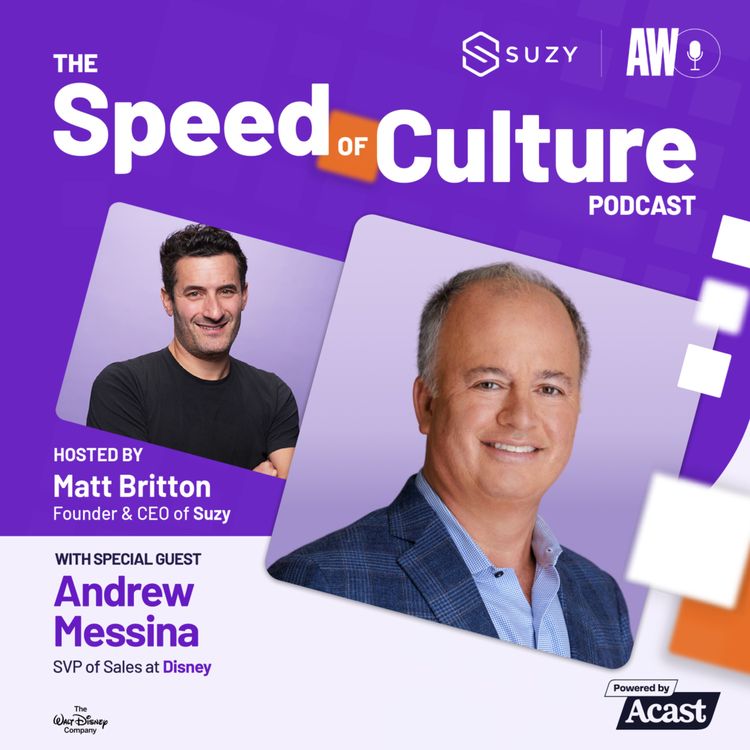
In Episode 161 of The Speed of Culture Podcast, hosted by Matt Britton, founder and CEO of Suzy, the AI-powered consumer intelligence platform, this transformation comes into sharp focus through a candid conversation with Andrew Messina, Senior Vice President of Sales at Disney Advertising.
Messina brings decades of experience overseeing Disney's expansive portfolio—including ESPN, Hulu, ABC, and Disney+—positioning him as one of the most influential voices in modern advertising strategy. The episode, published February 6, 2025, explores how Disney Advertising is leveraging live sports, streaming innovation, and personalized advertising to create unforgettable brand moments that resonate with audiences in a fractured media environment.
For marketing executives, brand strategists, and media buyers navigating the complexity of contemporary advertising, this conversation offers actionable insights that challenge conventional thinking and illuminate a path forward.
“Live sports is huge for us. We continue to invest in the content there, so we just have a lot to offer our clients.”
This philosophy underscores Disney's commitment to meeting advertisers where their audiences actually are—not where legacy media metrics suggest they should be.
The Unmatched Power of Live Sports in Real-Time Engagement
Live sports have emerged as the singular most valuable content category for advertisers in the streaming age. While pre-recorded content allows viewers to skip ads and consume content on their own timeline, live sporting events demand real-time attention and engagement.
Andrew Messina emphasizes this critical distinction: live sports create a rare psychological contract between broadcaster, advertiser, and viewer—one that cannot be replicated through any other content format.
The data supporting this assertion is compelling. According to recent engagement metrics, 64% of respondents actively tuned into advertisements during live sports, with 80% demonstrating strong ad recall. Compare this to standard digital advertising, where attention spans fragment and ad fatigue sets in rapidly.
For Thursday Night Football on streaming platforms, audience demographics skew seven years younger than traditional linear NFL broadcasts, while achieving nearly 20% incremental reach and nearly 50% higher engagement rates. These figures represent not merely marginal improvements but fundamental shifts in how brands can connect with desired audience segments.
Disney's infrastructure places it in an optimal position to capitalize on this advantage. Thursday Night Football, the Super Bowl 2027, Monday Night Football, and emerging women's sports events create a calendar of high-impact opportunities unavailable to competitors.
But Messina's strategic vision extends beyond simply acquiring sports rights. Instead, Disney integrates social media, streaming platforms like Hulu and Disney+, and real-time data analytics to amplify sports moments beyond the game itself. When a quarterback throws a touchdown pass or a record-breaking athlete achieves a milestone, the moment becomes a touchpoint for multiple advertiser activations across platforms simultaneously.
The engagement differential is substantial. Live game viewing sessions average 2.5 to 3 hours compared to 45 to 60 minutes for other connected television content. This extended viewing window provides multiple opportunities for brand exposure, message reinforcement, and audience interaction throughout the entire experience.
More broadly, streaming sports advertising performs 66% better than cable and broadcast placements. Netflix's NFL Christmas Day games generated 84% higher ad effectiveness for entertainment brands, while Peacock's soccer coverage delivered a 116% lift over standard television advertising.
More than three-quarters of major advertisers running connected television campaigns now include live sports as an essential component of their strategies, reflecting industry recognition that live sports have become a cornerstone of effective media investment.
Addressable Advertising and Hyper-Personalization: Moving Beyond Broad-Based Reach
Traditional advertising operated on a fundamental assumption: reach the largest possible audience with consistent messaging, then measure performance through aggregate metrics. This model produced tremendous waste.
Streaming and addressable advertising have inverted this paradigm.
Disney's addressable advertising capabilities represent one of the most sophisticated implementations of precision targeting in the media industry. Messina describes Disney's ability to deliver hyper-specific audience segments using first-party data—individuals whose auto leases are ending, for example, or consumers demonstrating clear purchase intent signals across multiple touchpoints.
This precision allows brands to maximize return on investment while simultaneously blending broad reach with targeted messaging, creating campaigns that deliver measurable results across both streaming and linear platforms.
Disney's proprietary Audience Graph, now expanded to select international markets, enables brands to identify and reach specific consumer cohorts with unprecedented accuracy. Rather than buying time slots or demographic approximations, advertisers can define their ideal customer profile and reach individuals matching that profile across Disney's entire ecosystem.
This capability extends to dynamic ad insertion in live programming. During live events on Disney+, viewers see personalized advertisements based on their profiles, viewing history, and demonstrated interests.
The efficiency gains are substantial. Rather than reaching 1 million viewers at a cost where only 50,000 meet target audience criteria, brands can reach 50,000 precisely-matched consumers at a fraction of the cost.
Hyper-personalized advertising, when executed ethically and transparently, improves consumer experience by delivering relevant messages rather than intrusive interruptions.
Disney's integration of machine learning and data-driven personalization creates a feedback loop where campaigns improve continuously. This virtuous cycle positions Disney not as a traditional media company but as an advertising technology and data platform that happens to own tremendous content assets.
Women's Sports: Unlocking an Undermonetized Market Segment
For decades, women's sports operated in the shadow of male-dominated sports leagues, constrained by lower media rights valuations, reduced sponsorship investment, and limited advertising attention. This dynamic is changing with remarkable speed.
Andrew Messina specifically highlights women's sports as a rising opportunity for Disney and its advertising partners.
Televised games from the WNBA, NCAA women's basketball, and the National Women's Soccer League reached approximately 370 million viewer hours in 2024—a 430% increase from 2021. Women's sports now account for 20% of all sports coverage in 2025, up from less than 6% in 2019.
Advertising spending reflects and reinforces these trends. In the United States, $244 million was spent on women's sports in 2024, a 139% year-over-year increase. Sponsorship investments grow 50% faster than in men's leagues.
The WNBA's new media rights deal beginning in 2026 delivers $200 million in annual average value, more than triple the previous $60 million deal and a growth rate outpacing the NBA's renewal by 2.6 times.
Commercials featuring WNBA players airing during WNBA games demonstrated 103% greater effectiveness than advertisements without athlete representation. National Women's Soccer League players in ads shown during NWSL matches achieved 39% higher effectiveness.
For brands, women's sports represent an opportunity to reach passionate, engaged audiences while aligning with inclusion-focused brand values. Disney's ecosystem—encompassing ESPN, ABC, Hulu, and Disney+—provides unmatched inventory and distribution for women's sports content and advertising.
Building Authentic Relationships in an Automated Era
In an era of programmatic buying and automated marketing workflows, Andrew Messina emphasizes a thesis that might seem counterintuitive: genuine human relationships remain the foundation of successful advertising partnerships.
The episode includes discussion of what Messina describes as “paying it forward”—the practice of investing time in mentoring young professionals, nurturing client relationships, and prioritizing face-to-face interaction.
“Show up, be real, and invest in relationships that matter.”
While Disney continues building proprietary algorithms and machine learning systems that optimize campaign performance, Messina maintains that relationship quality ultimately determines partnership success.
As advertising becomes increasingly programmatic and data-driven, competitive differentiation increasingly derives from human elements: reliability, trustworthiness, creative partnership, and genuine commitment to advertiser success.
Custom Partnerships and Collaborative Campaign Development
Rather than selling standardized media packages, Disney Advertising emphasizes custom partnerships that integrate creative storytelling with strategic product innovation.
Messina highlights the Hyundai and Disney 100 collaboration as exemplary—a campaign that extended far beyond traditional media buying to create integrated brand experiences.
This approach transforms the advertiser-media company relationship from transactional to collaborative. Disney's infrastructure—encompassing creative services, data analytics, audience insights, and distribution across multiple platforms—enables campaigns of genuine creative sophistication and strategic depth.
By focusing on delivery and long-term partnership value rather than short-term transaction volume, Disney builds client loyalty and generates referral business.
Key Takeaways
- Live sports deliver unmatched engagement: 64% of viewers actively watch ads during live sports with 80% demonstrating recall, while live sports advertising performs 66% better than cable or broadcast.
- Addressable advertising enables precision targeting at scale: Disney's hyper-specific audience segmentation allows brands to reach ideal customers with relevant messaging across streaming and linear platforms.
- Women's sports represent explosive growth opportunity: $244 million in 2024 ad spending (up 139% year-over-year) and emerging WNBA/NWSL media rights exceeding previous valuations by 2.6–3x signal substantial upside.
- Human relationships remain competitive differentiation: Trustworthiness, mentorship, and genuine partnership commitment create durable advantages.
- Custom partnerships drive measurable business impact: Collaborative campaign development creates integrated brand experiences that generate customer acquisition and long-term brand equity.
Frequently Asked Questions
How does live sports advertising differ from traditional broadcast advertising?
Live sports create psychological engagement that pre-recorded content cannot replicate. Viewers cannot skip advertisements during live events, and the real-time nature of sports creates moments of heightened attention. Research demonstrates that audiences achieve 80% recall of advertisements during live sports, compared to significantly lower recall rates for on-demand content.
The extended viewing session length—2.5 to 3 hours—provides multiple exposures and reinforcement opportunities. Disney's ability to deliver addressable advertisements even during live broadcasting enables hyper-personalization that traditional broadcast advertising cannot achieve.
What makes Disney Advertising's addressable capabilities distinctive compared to other streaming platforms?
Disney's portfolio breadth is virtually unmatched, spanning ESPN, ABC, Hulu, and Disney+. This integrated ecosystem enables advertisers to reach specific audiences across multiple contexts and touchpoints.
Disney's investment in proprietary technology—including the Audience Graph, biddable technology platforms, and dynamic ad insertion—allows for technical sophistication competitors struggle to match. The combination of content assets and technology investment creates genuine competitive moat.
How should brands approach women's sports advertising given current market dynamics?
The evidence suggests treating women's sports not as experimental niche programming but as mainstream growth opportunity. Advertising featuring athletes during women's sports broadcasts demonstrates 39–103% greater effectiveness than advertising without athlete representation.
Forward-thinking advertisers should increase women's sports media investment now, before competitive saturation increases costs. Disney's expanded women's sports coverage provides premium inventory across multiple platforms.
What role do data and measurement play in modern advertising partnerships?
Data informs every element of contemporary advertising strategy—from audience targeting to creative optimization to performance attribution. Disney Compass integrates planning, data collaboration, and measurement into unified experience, providing brands visibility into campaign performance across platforms.
However, data represents only one element of successful partnerships. Brands should demand both sophisticated measurement capabilities and genuine partnership commitment to optimization.
Looking Ahead
The advertising landscape continues evolving at accelerating pace. Brands navigating this transformation should closely monitor the expanding role of artificial intelligence in campaign optimization, the ongoing fragmentation of audience attention, and the shift from broad-based reach to precision targeting and personalization.
For deeper insights into consumer behavior, emerging media trends, and strategic innovation in marketing, explore the following resources:
- Suzy offers AI-powered consumer intelligence platforms enabling brands to understand evolving audience preferences and behaviors.
- The Speed of Culture Podcast features conversations with leading marketing innovators exploring cultural trends and their business implications.
- Generation AI by Matt Britton provides a comprehensive exploration of artificial intelligence's impact on consumer behavior and marketing strategy.
- AI Keynote Speaker Services from Matt Britton bring forward-thinking perspective to organizations navigating AI's role in marketing and consumer connection.
- Speaker HQ connects brands with leading voices in marketing, culture, and technology innovation.
Meta Elements
Meta Title: Beyond the 30-Second Spot: Disney's Andrew Messina on Creating Unforgettable Brand Moments | Episode 161
Meta Description: Explore Episode 161 of The Speed of Culture Podcast featuring Disney SVP Andrew Messina discussing live sports advertising, personalized marketing, and women's sports opportunities in 2025. Learn how addressable advertising transforms brand connection.
Focus Keywords: live sports advertising, Disney advertising strategy, addressable advertising, personalized marketing, women's sports marketing, streaming advertising, brand moments, audience engagement, marketing innovation
Long-tail Keywords: how Disney uses live sports for advertising, personalized advertising strategy 2025, women's sports sponsorship opportunities, addressable advertising explained, streaming platform advertising trends, real-time audience engagement advertising
Featured Image Alt Text: Andrew Messina, SVP of Sales at Disney Advertising, discusses creating unforgettable brand moments through live sports, streaming, and personalized advertising on The Speed of Culture Podcast Episode 161.

%20(400%20x%20100%20px)%20(300%20x%2050%20px)%20(150%20x%2050%20px).avif)



.jpeg)
.jpeg)