Opening
Weather has always been the great equalizer of human experience, no one can escape it, and no business can ignore it. Yet for decades, weather data remained a peripheral concern, relegated to farmer's almanacs and weekend planning. Today, that narrative has fundamentally shifted.
At the intersection of artificial intelligence, enterprise data science, and strategic business planning, weather has emerged as a critical intelligence asset capable of unlocking billions in value across industries.
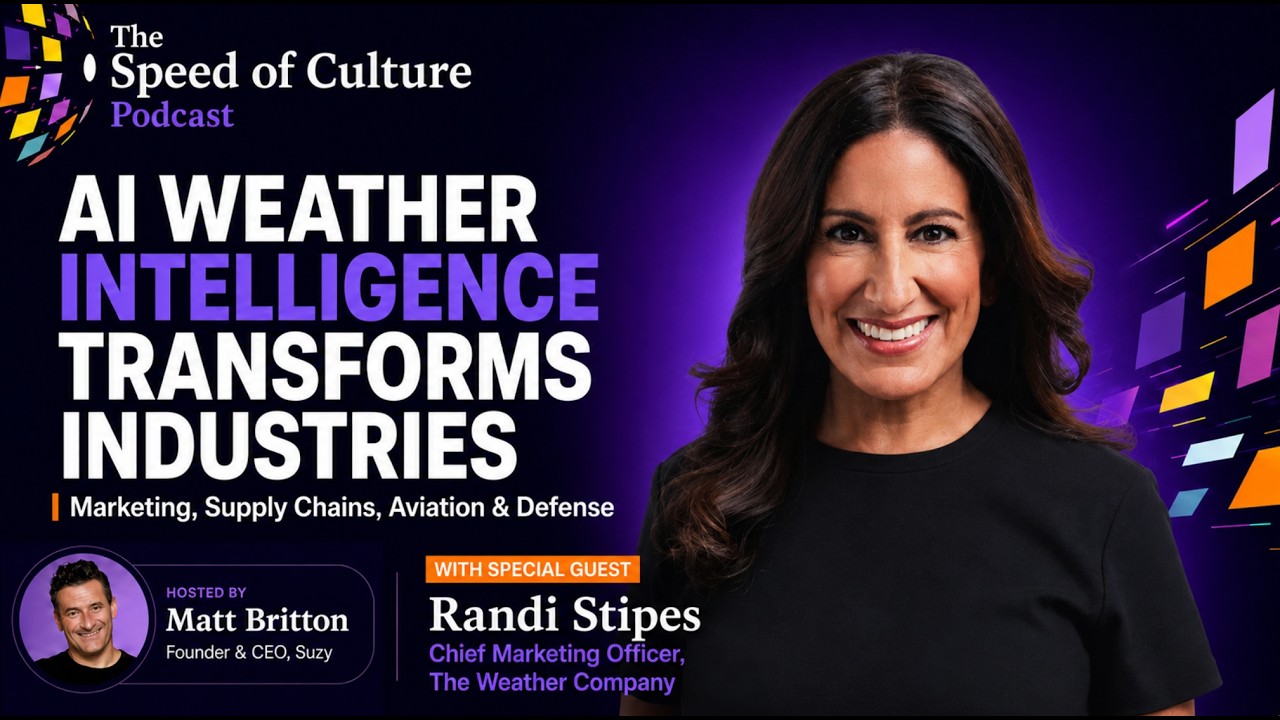
On February 25, 2025, Matt Britton, founder and CEO of Suzy, the AI-powered consumer intelligence platform, hosted a conversation with Randi Stipes, Chief Marketing Officer of The Weather Company, on the Speed of Culture Podcast. The episode, titled “The Billion-Dollar Forecast: CMO Randi Stipes on How The Weather Company Shapes Business Decisions”, explores the seismic shift happening at the intersection of weather science, artificial intelligence, and business strategy.
This discussion reveals not just how weather intelligence is transforming individual industries, but how it represents one of the most underutilized competitive advantages available to enterprise organizations today.
Randi Stipes brings nearly two decades of leadership to this conversation, having evolved The Weather Company from a consumer-facing forecast service into an AI-driven intelligence ecosystem that now powers decisions for some of the world's largest enterprises.
Her insights reveal a fundamental truth: in an era of hyperlocal personalization, supply chain volatility, and climate unpredictability, businesses that harness weather intelligence gain not just operational efficiency, but a strategic moat against competitors who treat weather as mere meteorological trivia.
The episode delves into concrete applications, from retail demand forecasting to supply chain optimization, from marketing personalization to aviation safety. It explores how The Weather Company's partnership with NVIDIA is poised to unlock kilometer-scale weather predictions, breaking down forecasts to 1-kilometer radius precision.
Most importantly, it articulates why weather intelligence has evolved from a nice-to-have curiosity into a mission-critical business asset that separates market leaders from laggards.
The Evolution of Weather as a Business Intelligence Asset
The transformation of weather data from meteorological curiosity to enterprise intelligence platform represents one of the most significant, yet underappreciated, evolutions in the business technology landscape. Randi Stipes and The Weather Company have been instrumental architects of this transformation.
Historically, weather forecasts served a single purpose: telling people whether to bring an umbrella. The Weather Channel was built on this consumer-facing premise, becoming one of the world's most trusted sources for local forecasts.
However, the company recognized a deeper opportunity within its data infrastructure. The Weather Channel's app boasts over 360 million users globally, generating an unprecedented volume of real-world behavioral data tied to specific weather conditions, geographic locations, and temporal patterns.
This data goldmine represented something far more valuable than forecast accuracy, it represented the ability to understand and predict human behavior at scale.
The rise of AI and machine learning accelerated this transformation. It became possible to correlate weather conditions with consumer purchasing patterns, supply chain disruptions, energy consumption, demand fluctuations, and financial market movements.
The Weather Company invested heavily in building Weather Engine™, a proprietary AI/ML insights platform and API designed to unlock precision and scalability for business process optimization.
This technology doesn't just predict whether it will rain; it predicts what consumers will buy when it rains, where delivery trucks will be delayed, and which retailers will face inventory challenges.
This evolution reflects a broader recognition in the C-suite: weather is an internal lever to optimize rather than an external variable to tolerate.
For Chief Marketing Officers, Chief Supply Chain Officers, Chief Financial Officers, and other enterprise leaders, weather intelligence has become a data signal as fundamental as consumer demographics or transaction history.
In an economy characterized by just-in-time supply chains, real-time personalization, and climate volatility, organizations that ignore weather intelligence are essentially flying blind, making demand forecasts without understanding seasonal patterns and optimizing logistics without anticipating weather-related disruptions.
AI-Powered Hyper-Local Predictions: The NVIDIA Partnership and the Future of Weather Intelligence
One of the most significant developments discussed in Episode 166 involves The Weather Company's expanded collaboration with NVIDIA to advance AI-based weather forecasting capabilities.
This partnership represents not merely a technical upgrade, but a fundamental leap in the precision and applicability of weather intelligence for business decision-making.
Historically, traditional AI weather models generated predictions at approximately 25-kilometer grid resolution, roughly the size of a small city. For many enterprise applications, this granularity is too coarse.
The Weather Company and NVIDIA are solving this by developing the first kilometer-scale, AI-based numerical weather prediction model. This represents a reduction from 25 kilometers to 1 kilometer, a 625x increase in geographic precision.
Rather than knowing “it will rain in the city,” businesses will know “it will rain in the shopping district three blocks from our flagship store.”
NVIDIA's Earth-2 digital twin platform provides the computational substrate for generating high-resolution forecasts at scale and speed, while The Weather Company contributes one of the world's largest collections of global weather data through its GRAF system.
The result is a virtuous cycle: more precise predictions generate more business value, which drives adoption, which generates more behavioral and operational data, which improves model accuracy.
The business applications are profound across retail, logistics, agriculture, energy, and advertising. Kilometer-scale forecasting enables store-level inventory decisions, hyperlocal route optimization, field-level irrigation planning, grid management precision, and neighborhood-specific marketing offers.
The NVIDIA partnership signals The Weather Company's commitment to remaining at the forefront of AI weather forecasting, ensuring it continues delivering cutting-edge intelligence to its enterprise customers.
Weather Intelligence and Marketing: Reshaping Customer Engagement and Campaign ROI
Perhaps no enterprise function has more to gain from weather intelligence than marketing. Weather represents one of the most powerful, yet underutilized, behavioral signals available.
Neuroscience research conducted by The Weather Company reveals that weather literally rewires human brains, affecting emotion, memory, and decision-making at a subconscious level where 90% of purchasing decisions are made.
When brands use weather as a contextual signal to predict consumer mindsets, ROI improves by nearly 20%, with campaign engagement increases of 20–30% and conversion rate uplift of 15–25%.
Randi Stipes has pioneered the concept of “mindset marketing”, using weather intelligence to deliver the right psychological message at the right moment.
This approach goes far beyond product recommendations. It recognizes that weather influences not only what consumers buy, but how they want to be communicated with and what emotional appeals resonate.
Applications range from apparel brands promoting summer collections during warm forecasts to automotive brands highlighting all-wheel-drive vehicles during snowy conditions.
The Weather Company operationalizes this through Weather Targeting, enabling real-time, hyperlocal weather-based personalization across digital channels.
Enterprise B2B marketers are adopting similar approaches, recognizing that weather influences buyer behavior and timing in business contexts as well.
Enterprise Supply Chain and Operational Optimization: Weather as a Strategic Lever
Beyond marketing, the most economically significant applications of weather intelligence lie in supply chain management and operational optimization.
Every component of the supply chain is weather-vulnerable, from procurement and manufacturing to transportation and last-mile delivery.
Advanced weather intelligence enables proactive management rather than reactive mitigation. Real-time data identifies emerging disruptions, enabling rerouting, inventory repositioning, and operational adjustments before disruptions occur.
Research shows weather influences daily sales by up to 23.1% by store location and 40.7% by sales category.
Retailers integrating weather forecasts into demand models prevent stockouts and reduce excess inventory, while logistics companies leverage hyperlocal forecasts to reduce fuel consumption, improve delivery speed, and minimize accidents.
The Weather Company quantifies the impact: enterprises leveraging weather intelligence achieve 5–10% revenue increases and substantial operating cost reductions.
With 79% of executives contemplating integrating weather into their business strategy, weather intelligence is rapidly becoming a core strategic capability.
The Broader Strategic Opportunity
Weather intelligence has become an essential strategic differentiator in an era of supply chain volatility, climate unpredictability, and rising consumer expectations for personalization.
It enables competitive advantage through operational efficiency, customer experience differentiation, proactive risk mitigation, and revenue growth optimization.
The Weather Company represents recognition that intelligence about natural systems is as valuable as intelligence about markets and consumers.
The episode also highlights The Weather Channel's integration into TikTok and other consumer platforms, bringing personalized weather intelligence to where attention already lives.
This reflects the same principles Matt Britton explores in Generation AI and across his work as an AI keynote speaker: intelligence embedded at the point of decision drives exponential business impact.
Key Takeaways
- Weather Intelligence Is Business-Critical: Weather data now directly impacts supply chain optimization, marketing ROI, demand forecasting, and financial performance.
- Hyper-Local AI Forecasting Drives Precision: Kilometer-scale predictions (up from 25-kilometer resolution) enable block-level business optimization.
- Weather-Based Marketing Boosts ROI: Brands leveraging weather intelligence achieve nearly 20% ROI improvement and significant engagement gains.
- Supply Chain Leaders See Measurable Gains: Enterprises integrating weather intelligence achieve 5–10% revenue lift and meaningful cost reductions.
- Climate Volatility Makes Intelligence Essential: Weather has shifted from a background variable to a mission-critical competitive advantage.
Frequently Asked Questions
How does weather data improve marketing campaign performance?
Weather data reveals how atmospheric conditions influence human psychology at a subconscious level, enabling marketers to align messaging with weather-influenced consumer mindsets. When brands use weather as a contextual signal, ROI improves by nearly 20%, with measurable conversion uplift and engagement gains.
What is the business impact of hyper-local weather forecasting?
Moving from 25-kilometer to 1-kilometer precision enables store-specific inventory planning, hyperlocal route optimization, field-level agricultural decisions, and neighborhood-targeted marketing. This precision translates directly into improved revenue performance and operational efficiency.
How do supply chain leaders use weather intelligence for demand forecasting?
Supply chain professionals integrate weather forecasts into demand models, anticipating demand shifts driven by temperature, precipitation, and seasonal volatility. This prevents stockouts and excess inventory, contributing to 5–10% revenue increases and substantial cost reductions.
Why is weather intelligence becoming more important for enterprise strategy?
Climate volatility, supply chain disruption, and rising personalization expectations have elevated weather intelligence from a nice-to-have to a strategic necessity. With 79% of executives considering integration into business strategy, weather intelligence is now central to competitive differentiation.
Looking Ahead
The conversation on the Speed of Culture Podcast represents a pivotal moment in enterprise technology evolution, where weather intelligence transitions from emerging opportunity to strategic necessity.
As AI capabilities advance and kilometer-scale precision becomes mainstream, weather intelligence will become as fundamental to enterprise decision-making as customer data and financial analysis.
To explore related insights:
Published: February 27, 2025
Episode Air Date: February 25, 2025
Episode Length: 23 minutes
Featured Resources: The Speed of Culture Podcast | Suzy | The Weather Company

%20(400%20x%20100%20px)%20(300%20x%2050%20px)%20(150%20x%2050%20px).avif)