Opening: The Convergence of AI and Consumer Intelligence
The telecommunications industry stands at a critical inflection point. As consumer expectations evolve and competition intensifies, enterprises must fundamentally reimagine how they engage their customers.
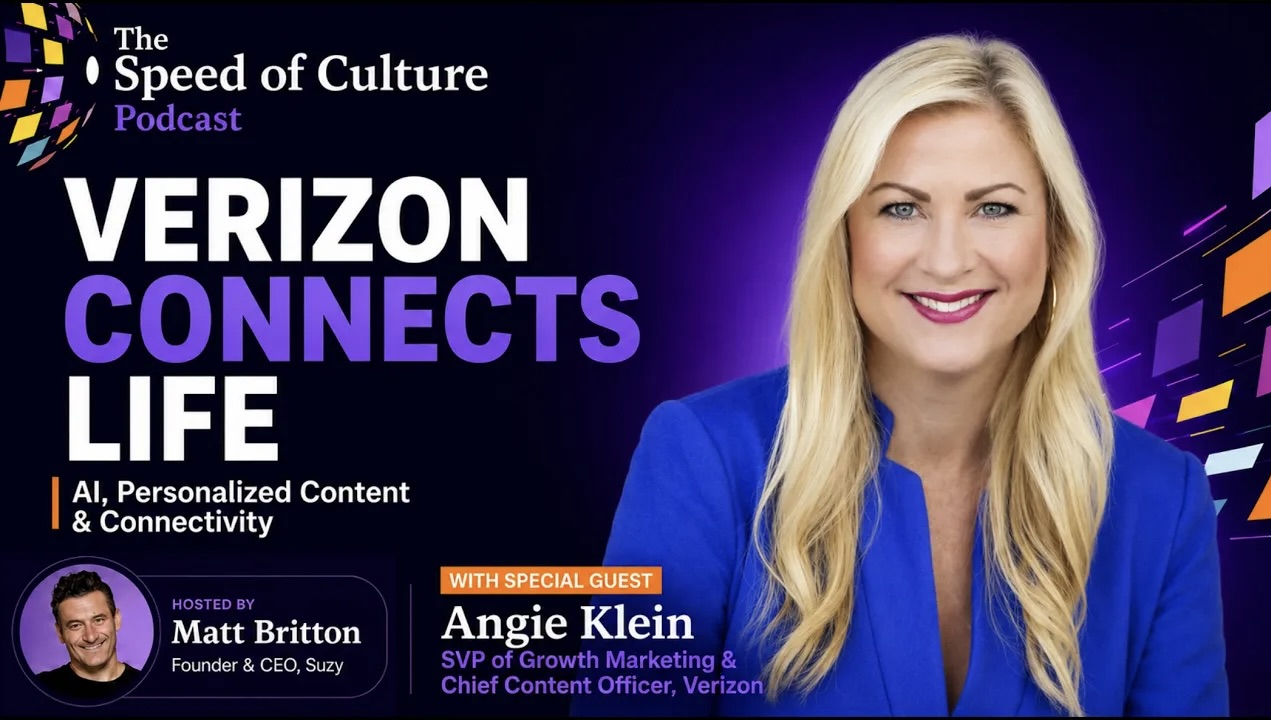
In Episode 165 of The Speed of Culture Podcast, Matt Britton, founder and CEO of Suzy, the AI-powered consumer intelligence platform, sits down with Angie Klein, Senior Vice President of Growth Marketing and Chief Content Officer at Verizon, to explore how leading brands are leveraging artificial intelligence to transform customer engagement strategies.
The conversation reveals a compelling narrative: organizations that successfully integrate AI into their marketing infrastructure while remaining deeply attuned to consumer needs are establishing sustainable competitive advantages. Verizon, as one of the world's largest telecommunications companies, exemplifies this approach.
Under Klein's leadership in growth marketing and content strategy, the company has developed a sophisticated framework that treats every customer interaction as an opportunity for personalization at scale. Rather than viewing AI as a replacement for human insight, Verizon has positioned technology as an enabler of deeper, more meaningful consumer connections.
This episode, released on February 20, 2025, captures a pivotal moment in marketing evolution. The discussion moves beyond theoretical applications of artificial intelligence to examine real-world implementation strategies that drive measurable business results.
For marketing executives, content strategists, and business leaders navigating the AI transformation, Klein's insights into Verizon's approach provide actionable intelligence on how to balance technological innovation with authentic consumer engagement. The episode underscores a fundamental truth: the future of marketing belongs to organizations that can synthesize consumer data, harness AI capabilities, and deliver genuinely valuable, personalized experiences at every touchpoint.
From Hyper-Personalization to Category-of-One Marketing
Angie Klein's role at Verizon encompasses both growth marketing and content leadership, positioning her at the intersection of two critical business functions. This dual responsibility reflects a broader industry shift: leading companies recognize that marketing success in 2025 requires seamless integration between data-driven growth strategies and compelling content creation.
Verizon's approach moves beyond traditional segmentation models toward what Klein describes as "category of one" marketing, treating each customer as a unique segment deserving personalized attention.
The telecommunications industry has historically relied on demographic and behavioral segmentation to target customer audiences. Verizon's evolution toward AI-powered personalization represents a fundamental departure from this model.
By leveraging advanced analytics and machine learning algorithms, the company can now identify nuanced patterns in customer preferences, usage behaviors, and lifecycle stages. This granular understanding enables marketing teams to craft messages, offers, and content that resonate on a deeply personal level, regardless of the channel through which customers engage.
The content strategy component of Klein's role becomes particularly crucial in this context. As customers expect increasingly personalized interactions, the volume of content required to deliver these experiences expands exponentially.
Traditional approaches to content creation, where centralized teams develop content for broad segments, cannot scale to meet the demands of true personalization. Instead, Verizon has invested in systems and processes that combine AI-generated insights with human creativity and editorial judgment.
Content is developed with specific customer journeys in mind, dynamically delivered based on real-time signals about individual customer interests and behaviors.
This shift to category-of-one marketing also reflects a response to broader consumer expectations. Modern consumers resist one-size-fits-all messaging. They expect brands to understand their individual needs, preferences, and contexts.
When a telecommunications company can demonstrate that it recognizes a customer's specific usage patterns, business needs, or life circumstances, and tailors its communications accordingly, it creates a meaningful competitive advantage. The customer perceives the brand as attentive and relevant, rather than impersonal and transactional.
AI as an Enabler of Authentic Consumer Engagement
The conversation between Britton and Klein addresses a critical misconception: that AI-powered marketing diminishes the human element or creates sterile, robotic customer experiences. Verizon's implementation demonstrates the opposite.
When properly integrated, AI serves as a force multiplier for human creativity and strategic thinking.
Consider the challenge that every large enterprise faces: how to deliver personalized experiences to millions of customers across multiple channels. Manual segmentation, message development, and campaign optimization become logistically impossible at scale.
AI addresses this constraint by automating the routine analytical work that would otherwise consume enormous human resources. Machine learning models can analyze vast datasets to identify patterns, predict customer behaviors, and recommend optimal messaging strategies in real-time.
This automation frees marketing professionals to focus on higher-order strategic work: developing authentic narratives, understanding emerging consumer trends, and making nuanced judgments about brand positioning and voice.
Verizon's content strategy exemplifies this complementary relationship between AI and human expertise. AI tools assist in identifying which content topics will resonate with specific customer segments, optimizing content distribution, and personalizing delivery.
But the actual creative work, developing content that genuinely addresses customer concerns, tells compelling brand stories, and differentiates Verizon from competitors, remains fundamentally human. The most effective AI-enabled content strategies are those where technology handles the optimization and personalization infrastructure, allowing skilled content creators to focus on substance and authenticity.
The consumer intelligence perspective adds another dimension to this discussion. AI-powered consumer intelligence platforms like Suzy enable marketers to move beyond reliance on historical data or educated guesses about customer needs.
Instead, companies can directly access real-time insights about what consumers are thinking, discussing, and prioritizing. This intelligence feeds the personalization engines that power customer engagement.
When Verizon uses AI to deliver personalized communications, those communications are grounded in genuine understanding of consumer needs and preferences, not mere algorithmic assumptions.
This distinction becomes critical when examining how consumers respond to AI-driven marketing. Research consistently shows that consumers appreciate personalization when it feels relevant and helpful, but strongly reject marketing that feels intrusive or creepy.
The difference often comes down to whether the personalization is based on genuine understanding of consumer intent and need. Verizon's approach, grounded in both AI infrastructure and consumer intelligence, helps ensure that its hyper-personalization efforts generate positive rather than negative consumer sentiment.
Content Strategy as a Competitive Differentiator in Telecommunications
The telecommunications industry presents unique challenges for content strategy and customer engagement. The sector deals with inherently complex products, constantly evolving technology landscapes, and intense competitive pressure around pricing and service quality.
Customers often view telecommunications services as commodities, undifferentiated offerings where decision-making focuses primarily on cost and network performance. This perception creates both a challenge and an opportunity for forward-thinking companies like Verizon.
Klein's role as Chief Content Officer reflects Verizon's recognition that content strategy has moved from a support function for marketing to a primary mechanism for competitive differentiation.
In a market where technical specifications and pricing have become increasingly transparent, content becomes the tool through which brands can educate, inspire, and build emotional connections with customers. Verizon uses content to position itself not merely as a connectivity provider, but as a partner in customers' digital transformation journey.
This positioning is particularly relevant given the rapid evolution of AI and its implications for different customer segments. Verizon serves a remarkably diverse customer base: individuals navigating personal technology decisions, small business owners seeking efficient communications infrastructure, enterprise executives managing large-scale digital transformation, and government agencies with specific security and compliance requirements.
Each of these segments faces distinct questions about how AI will affect their work, what new capabilities become possible, and what risks they must mitigate. Content becomes the mechanism through which Verizon educates these diverse audiences, demonstrating expertise and building trust.
The challenge of content at scale becomes particularly acute in the context of personalization. If Verizon commits to delivering genuinely personalized experiences, the library of content required expands dramatically.
A single piece of generic content cannot serve all customer segments; instead, multiple variations must be developed for different personas, use cases, and stages of the customer journey. Klein's content strategy addresses this scale challenge through several mechanisms: identifying core themes and narratives that transcend specific segments, developing modular content components that can be combined in different ways, and using AI to dynamically adapt existing content for different contexts.
The strategic advantage of this approach becomes apparent when considering customer engagement across the full journey. In the awareness stage, Verizon content educates potential customers about the business impact of telecommunications infrastructure and data connectivity.
In the consideration stage, content becomes more specific, addressing particular use cases relevant to different industries or customer segments. Throughout the decision and implementation stages, content builds confidence and addresses specific technical or contractual concerns.
Post-purchase, content transforms into ongoing value delivery, helping customers maximize the return on their investment in Verizon services.
Building Organizational Capability for AI-Driven Marketing
Perhaps the most valuable insight from Klein's discussion is the organizational dimension of AI transformation. Many companies acquire AI tools and platforms but fail to generate meaningful business impact because they lack the organizational structures, talent, and processes to effectively deploy these capabilities.
Verizon's approach to building organizational capability for AI-driven marketing provides important lessons for companies at earlier stages of their transformation journey.
First, Verizon has invested in talent acquisition and development. Successful AI-enabled marketing requires teams that combine marketing expertise with technical literacy.
These professionals need to understand enough about AI capabilities and limitations to ask informed questions, interpret algorithm outputs, and recognize when human judgment should override algorithmic recommendations. Klein's dual responsibility for growth marketing and content strategy reflects this integrated approach.
Second, Verizon has created organizational structures that facilitate collaboration between marketing teams and data science/engineering teams. This is not simply a matter of having these functions report to the same executive.
Effective integration requires regular communication, shared success metrics, and feedback loops that allow marketing teams to learn from what the data is revealing while helping data teams understand what questions marketers are trying to answer.
Third, Verizon has established governance frameworks that clarify how AI-driven insights and recommendations are used in practice. This is particularly important when algorithms may surface insights that conflict with existing marketing strategies or organizational beliefs.
The governance process should create space for genuine debate about whether the algorithm is revealing something important that the organization should act on, or whether the specific recommendation is flawed for reasons the human team understands better than the machine learning model.
Finally, Verizon has maintained flexibility and learning orientation as it implements AI across marketing functions. AI capabilities are improving rapidly; what seemed like the right technical solution eighteen months ago may have been superseded by significantly more capable tools.
Verizon's approach instead emphasizes building fundamentals: understanding customer needs and behaviors, developing content and messaging frameworks that resonate, and creating analytical disciplines that can evaluate whether personalization and optimization efforts are generating genuine business value.
Consumer Expectations in the Age of AI-Powered Marketing
Understanding how consumers perceive and respond to AI-powered marketing requires moving beyond simplistic narratives about consumers either embracing or rejecting AI. In reality, consumer attitudes toward AI-driven personalization are nuanced and often depend on whether customers perceive the personalization as valuable or invasive.
Research from consumer intelligence platforms like Suzy reveals that consumers increasingly expect personalization as a baseline for customer experience. When organizations fail to personalize, sending irrelevant offers or communications that ignore the customer's known context and preferences, consumers experience this as poor service.
Simultaneously, when personalization crosses from helpful to intrusive (communicating that the company knows too much or using data in ways the customer did not anticipate), consumers respond with privacy concerns and brand resentment.
Verizon's approach navigates this challenge through emphasis on transparency and genuine value exchange. When customers understand that Verizon is using data and AI to provide more relevant offers, better customer service, or more helpful information, they generally embrace the personalization.
The key is ensuring that the personalization genuinely serves customer interests, not merely company sales objectives.
This distinction between personalization that serves mutual value exchange versus personalization that simply enables more effective selling is critical for long-term marketing success.
The content strategy dimension becomes crucial here. Through educational content, Verizon helps customers make better-informed decisions about how to use its services to achieve their goals.
This content-driven approach to building customer intelligence and trust creates a positive foundation for AI-powered personalization.
Key Takeaways
- AI-powered personalization represents a fundamental shift from traditional segmentation: Category-of-one marketing treats each customer as a unique segment, requiring organizations to combine advanced analytics, machine learning, and human insight to deliver genuinely personalized experiences at scale.
- Content strategy is a primary competitive differentiator in increasingly commoditized markets: Verizon's dual investment in AI-powered marketing and world-class content creation reflects recognition that brands differentiate through the value and insight they provide to customers, not merely through product specifications or pricing.
- Successful AI implementation requires integrated organizational structures and collaborative talent: Achieving business impact from AI tools requires teams that combine marketing expertise with technical literacy, structures that facilitate collaboration between marketing and data science functions, and governance processes that balance algorithmic recommendations with human judgment.
- Consumer trust is built through transparent value exchange, not algorithmic sophistication: The most effective AI-driven marketing programs are those where personalization and optimization genuinely serve customer interests, supported by content and communications that demonstrate the company's commitment to customer success.
- Technology is an enabler of human creativity, not a replacement for it: AI automates routine analytical work and optimizes delivery, freeing skilled marketing professionals to focus on developing authentic narratives, understanding emerging consumer trends, and making strategic decisions about brand positioning that require human judgment.
Frequently Asked Questions
How can organizations begin implementing AI-powered personalization without overwhelming their marketing teams?
Start by identifying the highest-impact customer journeys or segments where personalization will generate significant business value. Rather than attempting to personalize all customer interactions simultaneously, establish proof-of-concept programs that demonstrate the potential impact of AI-driven personalization in specific contexts.
Use the insights from these pilots to build organizational capability and expand to broader implementation. Ensure that investment in AI infrastructure is matched by investment in talent development and organizational redesign to effectively deploy these capabilities.
What is the relationship between consumer intelligence and AI-powered marketing?
Consumer intelligence platforms provide the input data that makes AI-powered personalization effective. Rather than relying on historical transaction data or algorithmic assumptions about customer needs, consumer intelligence tools enable organizations to understand what customers are actually thinking, discussing, and prioritizing in real-time.
This direct understanding of consumer intent becomes the foundation for more accurate personalization. When AI systems are trained on consumer intelligence rather than merely on transactional patterns, the resulting personalization feels more relevant and valuable to customers.
How do content strategy and marketing technology work together in AI-driven organizations?
Content strategy defines what messages, narratives, and value propositions the organization will deploy to different customers. Marketing technology, including AI-powered personalization and optimization tools, determines how those messages are delivered to achieve maximum relevance and impact.
Technology handles the optimization and personalization infrastructure, while content strategy provides the substance and authenticity that make personalization genuinely valuable. The integration between these functions is critical, technology without substantive content becomes intrusive manipulation, while content without personalization infrastructure fails to reach the customers who would most benefit from it.
What metrics should organizations use to evaluate whether AI-powered marketing programs are creating genuine value?
Beyond standard marketing metrics like click-through rates or conversion rates, measure consumer sentiment and trust. Are customers perceiving the brand as more helpful and relevant as a result of personalization? Are they more likely to recommend the brand to others?
Additionally, examine whether personalization is increasing customer lifetime value, not merely extracting maximum value from individual transactions. Organizations that implement AI purely for short-term conversion optimization often find that improved conversion metrics come at the cost of reduced customer loyalty and increased defection over time.
Looking Ahead
The future of marketing belongs to organizations that can simultaneously master technological innovation and deepen human understanding of consumer needs. Angie Klein and Verizon's approach demonstrates that artificial intelligence is not a threat to authentic customer relationships but rather an enabler of deeper, more meaningful connections when deployed with appropriate strategy and governance.
For marketing leaders and business executives seeking to understand how AI can strengthen their customer engagement strategies, Episode 165 of The Speed of Culture Podcast provides valuable insight into real-world implementation approaches.
Matt Britton, through his work with Suzy and his broader expertise in consumer trends and business evolution, continues to provide essential perspective on how companies can navigate rapid technological change while maintaining focus on authentic consumer needs.
Additional resources for deepening expertise in this area include:
- The Speed of Culture Podcast: A comprehensive resource for insights on how leading brands are adapting to changing consumer preferences and technological capabilities
- Suzy: The AI-powered consumer intelligence platform that enables organizations to understand what consumers are thinking in real-time
- Generation AI: Matt Britton's comprehensive exploration of how artificial intelligence is reshaping business and consumer behavior
- AI Keynote Speaker: For organizations seeking expert perspective on AI strategy and implementation, Matt Britton's keynote presentations explore the business implications of artificial intelligence and the emerging consumer expectations that accompany it
- Speaker HQ: A resource for connecting with thought leaders and experts who can help organizations navigate rapid technological and cultural change

%20(400%20x%20100%20px)%20(300%20x%2050%20px)%20(150%20x%2050%20px).avif)