January 28, 2025
Hands-Free Living: Shachar Scott on the Rise of Smart Wearables and AI

Shachar Scott
VP of Global Marketing
This is some text inside of a div block.
This is some text inside of a div block.
LISTEN ANYWHERE YOU FIND YOUR PODCASTS
%20(400%20x%20100%20px)%20(300%20x%2050%20px)%20(150%20x%2050%20px).avif)

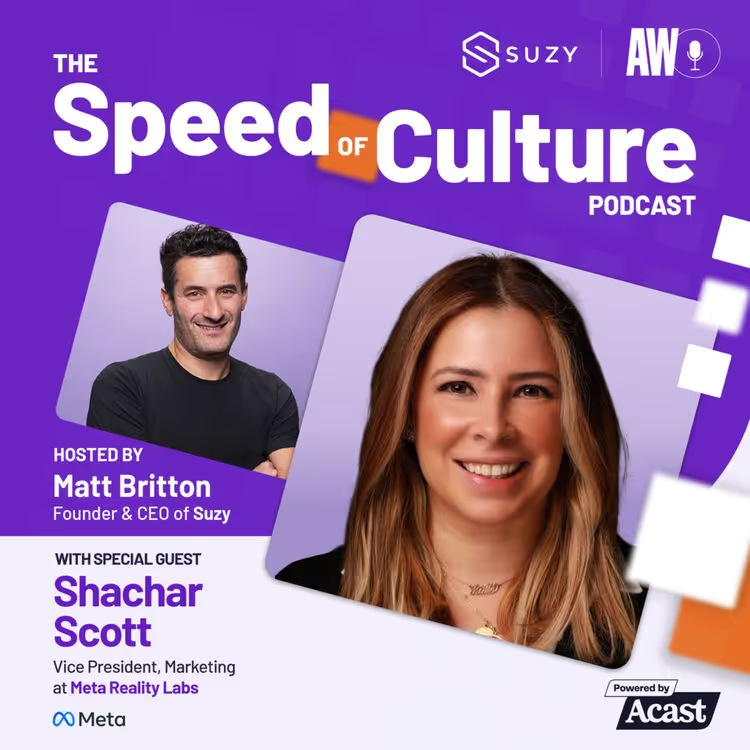
In an era where convenience reigns supreme, smart wearables represent the next frontier of human-technology interaction. Ray-Ban Meta smart glasses have emerged as a watershed moment in the wearables space, demonstrating that sophisticated artificial intelligence can be delivered through devices so seamless they become invisible to everyday life.
During a recent episode of the Speed of Culture Podcast, Shachar Scott, VP of Global Marketing at Meta Reality Labs, unpacked the remarkable trajectory of AI-powered wearables, the strategic marketing innovations reshaping the category, and how mixed reality is fundamentally altering consumer expectations.
The conversation underscored a pivotal shift in technology adoption: consumers no longer view wearables as experimental gadgets, but as essential tools for productivity, entertainment, and social connection. Meta's investment in Ray-Ban Meta glasses has validated what industry analysts predicted. That eyewear would become the dominant form factor for AI and augmented reality experiences.
With over 2 million Ray-Ban Meta units sold since launch and shipments projected to exceed 5 million units globally in 2025, the wearables revolution is no longer theoretical.
Scott's insights, captured in dialogue with Matt Britton, founder and CEO of Suzy, the AI-powered consumer intelligence platform, reveal the sophisticated strategies required to move emerging technology from niche innovation to mass-market adoption. Suzy's real-time consumer data provides the intelligence brands need to understand how wearables are being adopted, what features drive consumer engagement, and how marketing narratives must evolve to reflect shifting expectations.
This episode serves as an essential primer for executives seeking to understand the intersection of artificial intelligence, wearable technology, and cultural momentum that defines 2025's technology landscape.
The transformation of Ray-Ban Meta from luxury accessory to essential consumer technology represents one of the most successful product launches in recent memory. The smart glasses category, which barely existed five years ago, now commands meaningful market attention and consumer mindshare.
According to Shachar Scott, the shift was catalyzed by delivering tangible utility wrapped in culturally familiar form factors.
Meta's Ray-Ban Meta glasses succeeded where previous augmented reality wearables faltered because they didn't feel alien to consumers. Unlike bulky headsets or specialized devices, Ray-Ban Meta sunglasses leverage the existing eyewear market, a category with deep cultural significance and established retail infrastructure.
By partnering with Ray-Ban, a brand synonymous with style and status, Meta transformed what could have been purely utilitarian technology into an object of desire.
The growth trajectory tells a compelling story. Since launching in October 2023, Ray-Ban Meta has sold more than 2 million units, with sales tripling in the second quarter of 2025 alone. Mark Zuckerberg has set an ambitious target of 5 million sales for 2025, a figure that seemed audacious until market momentum became undeniable.
Industry forecasts suggest the AI glasses market will experience 158% shipment growth in 2025, reaching 5.1 million units globally. By 2026, Omdia forecasts that AI glasses shipments will hit 10 million units.
What distinguishes Ray-Ban Meta from previous wearable failures is the integration of AI capabilities that matter to everyday users. The glasses employ real-time object recognition, live translation across 100+ languages, and voice-activated commands that feel natural rather than gimmicky.
Unlike earlier augmented reality attempts that required users to adopt entirely new behaviors, Ray-Ban Meta supplements existing activities, capturing photos and videos from the user's perspective, translating conversation in real time, and providing contextual information through Llama 2 AI integration.
The global smart glasses market is projected to expand from $2.46 billion in 2025 to $14.38 billion by 2033, representing a 24.2% compound annual growth rate. AI smart glasses specifically are valued at $2.9 billion in 2025 and forecast to reach $8.4 billion by 2035.
Meta Ray-Ban Display AI Glasses, which feature built-in displays, sold out in just two days, suggesting pent-up demand has barely been tapped.
The success of Ray-Ban Meta fundamentally reshaped how technology executives and marketing strategists think about wearables. Rather than asking “Can we make glasses smart?” the conversation shifted to “What problems do consumers want glasses to solve?”
The answer, staying connected while present, capturing moments without interruption, understanding the world in real time, positioned smart glasses not as futuristic novelties but as contemporary necessities.
Shachar Scott's expertise in global marketing became evident through Meta's sophisticated approach to reaching consumers across demographics and geographies. The company deployed multiple marketing strategies simultaneously, each designed to appeal to distinct audience segments and reinforce the narrative that smart glasses represent inevitable technological progress.
Meta's Super Bowl advertising strategy exemplified the shift from tech-vertical marketing toward mainstream cultural engagement. The “Gallery” advertisement, which aired during Super Bowl LIX on February 9, 2025, featured celebrities including Chris Hemsworth, Chris Pratt, and Kris Jenner demonstrating Ray-Ban Meta in authentic scenarios.
The spot wasn't primarily about technical specifications; rather, it communicated cultural relevance and aspirational lifestyle integration. By positioning Ray-Ban Meta alongside A-list celebrities, Meta signaled that smart glasses weren't products for early adopters, but tools for everyone.
Meta's most innovative marketing strategy capitalized on creative artists demonstrating organic use cases. Tyla, the Grammy-winning artist, filmed her entire “Water” music video using Ray-Ban Meta glasses, providing authentic creative expression that technology advertising rarely captures.
Busta Rhymes hosted a phone-free concert where attendees were encouraged to experience music through presence rather than device distraction, positioning smart glasses as tools for deepening human connection rather than fragmenting attention.
Meta's retail strategy proved equally sophisticated. Rather than relying exclusively on direct-to-consumer channels, Meta leveraged existing eyewear retail infrastructure through Sunglass Hut, LensCrafters, and dedicated Ray-Ban stores.
This decision acknowledged that purchasing eyewear remains a category where consumers value expert guidance and physical trial. By positioning Ray-Ban Meta within traditional retail ecosystems, Meta normalized the product and reduced purchase friction.
The company further invested in experiential retail, including an LA pop-up running through the end of 2025 and broader market availability planned for early 2026.
Ray-Ban Meta pricing ranges from $299–$379 for standard models to $799 for the premium Ray-Ban Display variant with built-in display technology. By offering multiple price points, Meta created entry ramps for different consumer segments.
The Oakley Meta line, positioning smart glasses within sports and lifestyle contexts, further expanded addressable markets. This tiered approach mirrors successful strategies from consumer electronics, providing options for early adopters willing to pay premium prices while establishing volume pathways for price-sensitive segments.
Scott's insights revealed that successful technology marketing requires translating abstract capability into concrete consumer benefit. Consumers don't purchase technology; they purchase solutions to problems and expressions of identity.
Ray-Ban Meta marketing consistently communicated how smart glasses solve real problems, capturing memories without interruption, understanding the world through real-time translation, staying connected while remaining present.
Artificial intelligence emerged as the critical component that transformed smart glasses from interesting experiments into essential consumer devices. Earlier smart glasses, including Google Glass and other augmented reality ventures, failed because they offered capability without compelling use cases.
Ray-Ban Meta succeeded because it integrated large language models and on-device AI in ways that addressed genuine consumer needs.
The glasses utilize Llama 2, Meta's large language model, to deliver AI-powered assistance directly through wearables. Users can ask questions about their surroundings, receive real-time translation, identify objects, and access contextual information without opening their phones.
This represents a fundamental shift in how artificial intelligence reaches consumers, not through applications and interfaces, but through ambient assistance embedded in devices people already wear.
Real-time translation supports live translation across 100+ languages, enabling seamless cross-cultural communication. Rather than speaking with a phone between faces, users can have natural conversations with real-time translation occurring discreetly through their glasses.
Object recognition and contextual intelligence add additional utility layers, identifying items in users' visual fields and providing relevant information. For professionals in healthcare, manufacturing, and field service, this capability streamlines workflows.
Global shipments of smart glasses rose 110 percent year-on-year in the first half of 2025, with AI-enabled models representing 78 percent of total shipments. This suggests that consumer preference has decisively shifted toward AI-powered devices.
In North America, the smart glasses industry dominated with over 36% of global market share in 2025, with the U.S. representing over 88% of the North American market.
Mixed reality represents the ultimate destination for wearable technology, seamlessly blending digital and physical worlds so thoroughly that the distinction becomes meaningless. Ray-Ban Meta currently functions as an augmented reality device with AI assistance, but the trajectory toward true mixed reality displays is inevitable.
Meta's Ray-Ban Display, which features built-in display technology, represents the progression toward genuine mixed reality experiences embedded in everyday eyewear.
The global mixed reality market is projected to expand from $2.9 billion in 2025 to $25.8 billion by 2032. The spatial computing market is projected to surge from $20.43 billion in 2025 to $85.56 billion by 2030.
Consumer preferences are increasingly shifting toward wireless MR headsets, which now represent 72.3% of market share, indicating that freedom of movement and convenience drive adoption decisions.
Retail and e-commerce businesses are leveraging MR capabilities to enable virtual try-ons and product demonstrations, with research indicating that augmented reality integration increases consumer purchase intention by 17 percent.
Healthcare, education, and manufacturing are also incorporating MR interfaces to enhance learning, assist in complex procedures, and provide worker guidance.
Analysts project the smart eyewear category will exceed $30 billion by 2030, representing an extraordinary value creation opportunity.
Understanding why consumers adopt, or reject, new technologies remains crucial for companies navigating wearable innovation. This is where platforms like Suzy, which provide real-time consumer intelligence, become essential infrastructure for technology companies.
Consumer preferences for wearables are nuanced, driven by perceived utility, social signaling, privacy considerations, and brand affinity.
Ray-Ban Meta's success reflects deep consumer insights driving strategic decisions. The choice to launch through Ray-Ban rather than Meta-branded eyewear responded to consumer research indicating that brand trust in eyewear operates differently than technology brand trust.
Rather than marketing Ray-Ban Meta as augmented reality or metaverse devices, categories associated with hype and unfulfilled promises, Meta positioned the glasses as practical tools for capturing, translating, and understanding.
Real-time consumer intelligence platforms also track sentiment evolution as products mature. Ray-Ban Meta's net sentiment has remained positive through its growth phase, indicating consistent satisfaction among adopters.
Ray-Ban Meta integrates practical AI capabilities that address genuine consumer needs, real-time translation, object recognition, and voice-activated assistance. By partnering with Ray-Ban rather than launching under Meta's brand, the product benefited from existing brand equity in eyewear and incorporated privacy-conscious design with some on-device processing.
The global smart glasses market is projected to expand from $2.46 billion in 2025 to $14.38 billion by 2033, representing a 24.2% compound annual growth rate. Analysts project the broader smart eyewear category will exceed $30 billion by 2030 as mixed reality capabilities mature.
Artificial intelligence enables real-time translation across 100+ languages, object recognition, contextual information, and voice-activated assistance. AI delivers ambient intelligence without requiring explicit user requests or phone interaction.
Market projections suggest mainstream adoption will accelerate as display technology improves, battery life extends, and content ecosystems expand. Within a decade, wearing AR/MR smart glasses is likely to be as common as carrying smartphones today.
The conversation between Shachar Scott and Matt Britton illuminates a transformative moment in technology adoption. Smart wearables, powered by AI and delivered through culturally familiar form factors, are reshaping how humans interact with information and each other.
For executives and marketing professionals, the implications are profound. Organizations that understand the intersection of artificial intelligence, wearable form factors, and consumer behavior will capture outsized value in the emerging extended reality economy.