March 4, 2025
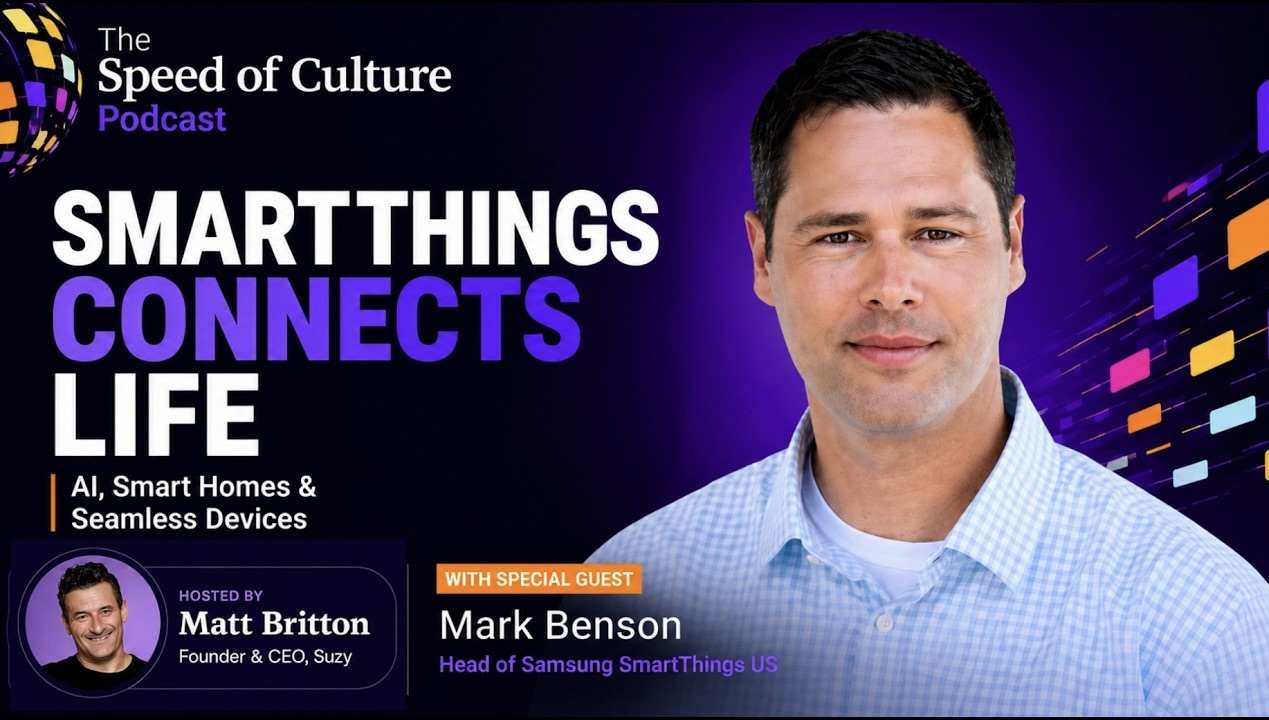
Welcome to the AI Home: Mark Benson on Samsung’s Vision for the Future

Mark Benson
Head of SmartThings US
This is some text inside of a div block.
This is some text inside of a div block.
LISTEN ANYWHERE YOU FIND YOUR PODCASTS
%20(400%20x%20100%20px)%20(300%20x%2050%20px)%20(150%20x%2050%20px).avif)

The modern home is undergoing a fundamental transformation. No longer are smart homes mere collections of connected gadgets requiring constant manual input and troubleshooting. Instead, they are evolving into intelligent ecosystems that learn, adapt, and anticipate the needs of their inhabitants.
This shift represents one of the most significant technological movements of the mid-2020s, reshaping not just how people live, but fundamentally changing the relationship between humans and their domestic spaces.
In Episode 168 of the Speed of Culture Podcast, hosted by Matt Britton, founder and CEO of Suzy, the AI-powered consumer intelligence platform, the conversation centers on this transformative moment. The guest, Mark Benson, Head of Samsung SmartThings US, provides an insider's perspective on how Samsung is pioneering the AI home revolution.
With over a decade of experience in the intersection of IoT, artificial intelligence, and consumer technology, Benson offers critical insights into a future where homes understand and serve their residents proactively, beyond responding to commands.
Matt Britton, who has spent two decades consulting with Fortune 500 companies on consumer behavior trends, brings his expertise in understanding how new technologies shape human behavior and cultural shifts. Through Suzy's AI-powered platform, which serves Netflix, Coca-Cola, P&G, and other global leaders, Britton has gained unparalleled insight into consumer expectations for emerging technologies.
His interview with Benson explores not just the technology behind Samsung's AI home vision, but what it means for how people will live, work, and interact with their environments in the coming years.
The discussion touches on several critical themes: the role of artificial intelligence in automating domestic routines, the importance of interoperability in a fragmented smart home market, the security and privacy implications of always-connected homes, and Samsung's strategic vision for becoming the central platform in AI-powered living.
As smart home adoption accelerates, with industry projections suggesting the market will exceed $300 billion by 2028, understanding these developments is essential for consumers, technologists, and business leaders alike.
The Speed of Culture Podcast, which examines how consumer behavior, technology, and culture intersect, is the ideal venue for this conversation. By exploring Samsung's approach to the AI home, Benson and Britton discuss not just product features, but the deeper cultural and behavioral shifts that will define the next era of domestic life.
This episode serves as a valuable resource for anyone seeking to understand where smart home technology is heading and what consumers should expect from their homes in 2025 and beyond.
For the past fifteen years, the smart home industry has operated under a command-and-control model. Consumers purchase individual devices (smart thermostats, connected lighting systems, intelligent security cameras) and then manually integrate them into their homes.
This approach, while innovative for its time, has created fragmentation, complexity, and frustration. Users often find themselves managing multiple apps, learning different interfaces, and dealing with devices that don't communicate seamlessly with one another.
Mark Benson's tenure at Samsung SmartThings has coincided with a radical reimagining of this paradigm. Rather than viewing the smart home as a collection of individual connected devices, Samsung positions the AI home as an integrated ecosystem where artificial intelligence serves as the connective tissue.
The shift is profound: instead of users commanding their homes, homes increasingly anticipate and serve their inhabitants.
The distinction between a “smart home” and an “AI home” lies primarily in autonomy and prediction. A smart home responds to explicit user input, a voice command, a button press, an app notification. An AI home learns patterns, understands context, and takes action without intervention.
Samsung's vision centers on this fundamental difference. Rather than requiring users to remember to adjust their thermostat before bed, an AI home learns sleep patterns and automatically optimizes temperature and lighting.
Instead of manually scheduling the washing machine, the AI home recognizes laundry accumulation and energy usage patterns, then initiates optimal wash cycles at times when energy costs are lowest.
This evolution reflects broader trends in consumer expectations. Younger demographics, particularly Gen Z and Generation Alpha, audiences that Britton has extensively researched through Suzy's consumer intelligence platform, expect technology to anticipate their needs rather than simply respond to commands.
They view friction-free, intuitive experiences not as luxuries but as baseline requirements. Samsung's AI home strategy directly addresses this expectation, positioning the company to capture market share among demographics that will make up the majority of homebuyers and renters over the next two decades.
Samsung's SmartThings platform serves as the foundational layer enabling this transformation. With 33 million appliances connected as of 2025, a 30% increase from the previous year, and integration with 4,500 device models from 380 partners, SmartThings has achieved scale that competitors struggle to match.
This network effect creates substantial competitive advantages. As more devices connect to the SmartThings ecosystem, the platform accumulates more data, enabling increasingly sophisticated AI capabilities.
This virtuous cycle positions Samsung not merely as an appliance manufacturer, but as the operating system for connected domestic life.
The business implications are equally significant. Rather than competing primarily on hardware specifications and price, competitive arenas where margins compress continuously, Samsung increasingly competes on the intelligence embedded in its platform.
An AI home that reduces washing machine energy consumption by up to 70%, as Samsung's technology demonstrates, creates tangible value that justifies premium pricing. Consumers choose not the cheapest washing machine, but the one that learns their habits, optimizes performance, and reduces their environmental footprint and utility bills.
Understanding Samsung's AI home vision requires examining the technical architecture that makes it possible. The company approaches this challenge through three integrated layers: the device layer (the physical appliances and sensors), the platform layer (SmartThings, which coordinates devices and learns patterns), and the intelligence layer (AI and machine learning systems that predict needs and optimize performance).
At the device layer, Samsung has invested heavily in modernizing its appliance portfolio. The Bespoke AI line represents a deliberate move beyond traditional appliances toward connected companions.
These devices incorporate cameras, microphones, and screens, enabling them to perceive their environments and interact with inhabitants. A Bespoke AI refrigerator can recognize 37 different food items, suggest recipes based on available ingredients, and anticipate future shopping needs.
A Bespoke AI washer and dryer set automatically adjusts cycles based on fabric type, weight, and desired outcomes while optimizing energy consumption.
Critically, Samsung recognizes that not every connected device must be a Samsung product. The SmartThings platform integrates devices from 380 different manufacturers, enabling a truly heterogeneous smart home.
This interoperability strategy is philosophically and commercially important. Philosophically, it acknowledges that consumer preferences are diverse, some prefer Google Home hubs, others Alexa, still others HomeKit.
Rather than forcing customers into Samsung-exclusive ecosystems, the company enables integration across brands. Commercially, this approach maximizes the size of the SmartThings network effect, making it the most valuable platform to connect to, regardless of the device manufacturer.
The platform layer, SmartThings itself, is where Samsung's competitive advantage becomes most apparent. Modern smart home platforms must solve several interrelated challenges simultaneously: they must connect disparate devices using different communication protocols (WiFi, Bluetooth, Zigbee, Thread, Matter), they must learn user patterns and preferences, they must ensure security and privacy, and they must deliver the intelligence that drives automated routines.
Samsung's approach leverages machine learning to analyze vast patterns of home data. When a user establishes routines, turning off lights at bedtime, adjusting temperature to energy-saving mode during work hours, running the washing machine during off-peak energy periods. SmartThings captures and analyzes these patterns.
Over time, the system identifies regularities and automates them. The user, who initially had to manually initiate actions, eventually experiences a home that operates almost autonomously, aligned with their preferences and constraints.
Energy management exemplifies this capability. SmartThings Energy, Samsung's integrated energy monitoring system, provides granular visibility into household power consumption.
Combined with AI, the system identifies optimization opportunities across connected appliances. When utility companies offer time-of-use pricing (where electricity costs less during off-peak hours), the AI home can shift flexible loads like dishwashing, laundry, and EV charging to those windows.
The result: consumers reduce their energy consumption and costs, while utilities better balance load demands across the grid.
Security and privacy form the foundation of this architecture. Samsung achieved a significant milestone in 2024 when SmartThings became the first consumer electronics platform to receive UL Solutions' highest security rating: Diamond.
This achievement reflects Samsung's commitment to protecting the vast amount of personal data flowing through the platform. As homes become more connected, the potential attack surface expands.
A compromised smart home is not merely an inconvenience, it threatens security (a hacked door lock), privacy (a compromised camera), and essential services (a manipulated climate control system).
Samsung's Knox security framework provides defense-in-depth protection at the device, platform, and network levels. Knox applies its experience protecting mobile devices to the smart home context, exemplifying how incumbents with strong security traditions can maintain competitive advantages in new markets.
Looking forward, Samsung's technical roadmap continues to expand SmartThings capabilities. Integration with Samsung Health enables the platform to contextualize home automation within broader wellness patterns.
A home that knows your sleep data can optimize bedroom conditions during sleep hours. A home that understands your exercise patterns can automatically adjust climate and entertainment systems when you return from workouts.
These integrations represent the deepening of the home's understanding of its inhabitants, moving toward the home companion concept that Samsung articulated in its 2026 vision.
The emergence of the Matter standard, which promises interoperability across brands, creates additional opportunities for Samsung. Rather than threatening SmartThings, the standard strengthens it by reducing the technical barriers to connecting diverse devices.
Samsung's broad partnerships and integration experience position it to become the platform of choice for managing Matter-based networks.
At the heart of Samsung's AI home vision lies a fundamental insight about consumer behavior: the most convenient technology is technology that requires no conscious engagement. This insight, which Matt Britton has documented extensively through Suzy's research, represents a significant shift in how people evaluate new technologies.
For decades, consumer research focused on feature adoption and user satisfaction metrics tied to specific product interactions. These remain important questions, but they miss a larger behavioral shift occurring across demographics.
Younger consumers, particularly Gen Z and Generation Alpha, demonstrate distinctly different expectations regarding technology's role in daily life. Rather than viewing technology as something to learn and master, they expect it to work invisibly and intuitively.
They grew up with touchscreens, voice interfaces, and AI assistants as environmental constants. They view interactions with technology that require learning curves or conscious effort as poorly designed.
Samsung's AI home strategy directly addresses this behavioral shift. Rather than requiring users to learn complex home automation systems, the AI home makes automation transparent and automatic.
The thermostat adjusts temperature without user instruction. The lighting adjusts brightness based on time of day and activity. The appliances coordinate their energy consumption to take advantage of favorable utility pricing.
Crucially, these automations are not presented as impressive technical achievements but as expected baseline functionality.
This shift from feature-oriented thinking to behavior-outcome thinking changes how consumers evaluate products and services. Rather than asking “What smart features does this home have?” consumers increasingly ask “Does this home make my life better?”
A washing machine with AI that reduces energy consumption by up to 70% succeeds because it delivers a tangible outcome that matters: lower utility bills and reduced environmental impact.
Britton's research through Suzy has documented that this outcome-oriented thinking has spread beyond early adopters to mainstream demographics. Majority responses focus on convenience, cost savings, and time reclamation, not the underlying AI technology.
This consumer mindset creates powerful strategic implications for Samsung. The competitive differentiator isn't primarily technical sophistication but practical results.
If Samsung can consistently deliver real-world performance improvements, consumer adoption accelerates regardless of whether competitors have marginally more sophisticated AI models.
The interview between Britton and Benson explores how this understanding of consumer behavior shapes product development, marketing, and strategic partnerships at Samsung.
Rather than emphasizing AI as a feature, Samsung positions it as a means to practical ends. To consumers, what matters is that their homes work better, more efficiently, more conveniently, more aligned with their values and constraints.
As homes become more connected and intelligent, security and privacy transitions from a technical concern to a fundamental trust issue. Consumers will only adopt increasingly intimate levels of home automation if they trust that their data is protected and that compromised systems cannot harm them.
The attack surface of a connected home expands with each new device and integration. A camera that monitors occupancy patterns becomes a security vulnerability if compromised.
A door lock that operates remotely becomes dangerous if an attacker gains control. A heating system that understands household occupancy reveals intimate behavioral data if exposed.
Samsung's Diamond certification from UL Solutions represents not merely a technical achievement but a market signal. By achieving the highest rating available, Samsung communicates that security is engineered into SmartThings from the foundation upward.
The privacy dimension proves equally important. Modern smart homes generate tremendous volumes of data: movement patterns, appliance usage, energy consumption, climate preferences, content consumption, sleeping and waking times, cooking habits, and cleaning patterns.
This data is valuable for personalization, but it is also intensely personal. Samsung's SmartThings privacy architecture reflects this understanding.
Data remains on local devices and hubs whenever possible. When data must be transmitted, it is encrypted in transit and at rest.
Users retain granular control over data sharing permissions. Importantly, Samsung's business model doesn't depend on selling user data to third parties.
Unlike platforms that monetize behavioral data for advertising, Samsung monetizes through device sales, services subscriptions, and platform integrations. This alignment of incentives creates more trustworthy privacy practices.
The regulatory environment increasingly enforces privacy expectations, from GDPR in Europe to emerging state-level privacy laws in the US. Samsung's proactive approach exceeds regulatory minimums.
Trust also extends to behavioral reliability. Consumers will only permit homes to operate autonomously if they trust that automations serve their interests and respect their values.
Samsung's approach ensures that the AI home automates routine decisions within parameters that individuals set explicitly, while always preserving override mechanisms.
Looking beyond 2025, Samsung's AI home vision expands dramatically. The company has articulated ambitious plans that extend smart home concepts into modular homes, integrated HVAC systems, and even insurance models that use smart home data to reduce risk and adjust pricing.
Samsung's Smart Modular Home, unveiled at IFA 2025, exemplifies this ambition. Rather than retrofitting intelligence into existing structures, Samsung designs homes from the foundation upward with AI as an integrated feature.
The modular approach enables customization while maintaining system cohesion through the SmartThings platform.
Expansion into HVAC systems signals broader intentions. Heating, ventilation, and air conditioning represent one of the largest energy consumers in most homes.
A truly intelligent home integrates climate control with occupancy patterns, weather forecasting, energy pricing, and individual comfort preferences.
The concept of Home Companion may be the most intriguing element of Samsung's future vision. Unlike voice assistants that respond to explicit requests, Home Companion uses accumulated understanding of routines, preferences, and goals to proactively enhance quality of life.
It might suggest bedroom climate adjustments to improve sleep quality. It might recommend meal planning assistance or recognize stress indicators and recommend relaxation features.
This vision raises profound questions about the role of technology in domestic life. How much should homes understand about their inhabitants? What are the ethical boundaries around AI systems that predict and influence behavior?
Industry analysts project that AI-powered smart home capabilities will grow 45% annually through the end of the decade. Early adopters report satisfaction with reduced energy costs, simplified routines, and enhanced home security.
From a business perspective, Samsung's strategy is a long-term bet on becoming the primary platform for domestic technology. Just as smartphone ecosystems reshaped consumer technology markets, Samsung seeks to establish SmartThings as the operating system for connected homes.
Success would fundamentally reposition Samsung's business model, from selling individual products to delivering a comprehensive home experience.
Previous smart home systems operated on a command-and-control model where users manually programmed automations or controlled devices through voice commands and apps.
Samsung's AI home learns patterns over time and automates routines without explicit user instruction. The key difference is autonomy, users establish preferences once, and the system handles optimization continuously and invisibly.
Samsung prioritizes privacy through local data processing, encryption, granular sharing controls, and independent verification through UL Solutions' Diamond certification.
Importantly, Samsung's business model does not depend on selling user data to third parties, aligning its incentives with consumer privacy protection.
SmartThings is Samsung's platform integrating devices from 380 manufacturers into a cohesive ecosystem.
With 33 million connected appliances and integration with 4,500 device models, SmartThings provides the intelligence layer that collects data, identifies patterns, and coordinates automation at scale.
Practical benefits include energy savings of up to 70%, simplified daily routines, enhanced security, and cost reductions through optimized utility usage.
These outcomes translate to lower bills, more time for valued activities, and greater peace of mind.
The transition to AI-powered homes is not a distant future scenario but an emerging reality shaping how people live today. Mark Benson's insights from Episode 168 of the Speed of Culture Podcast illuminate both the technical capabilities Samsung is developing and the consumer behavior shifts driving adoption.
For deeper exploration of how AI is reshaping consumer behavior and culture, explore Suzy for data-driven consumer intelligence.
Additional resources: