The Intersection of AI, Authenticity, and Commerce: What Every Brand Leader Needs to Know
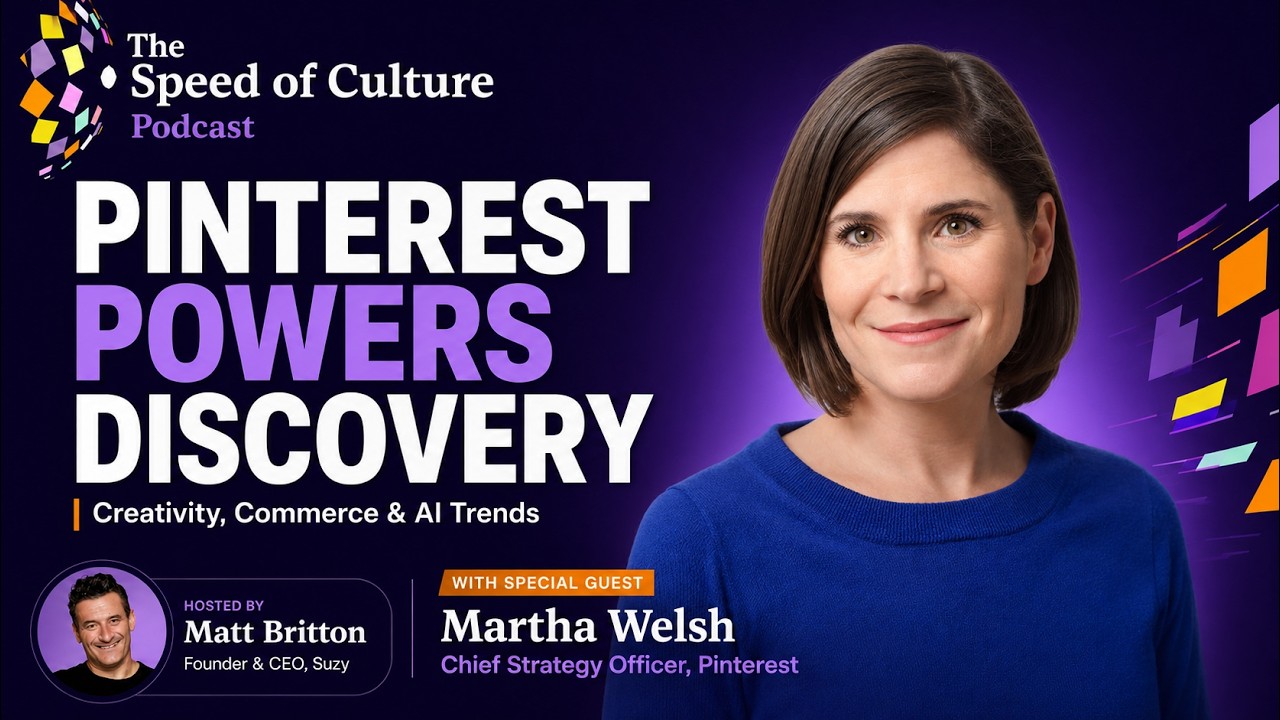
Pinterest has quietly become one of the most powerful platforms reshaping how consumers discover, create, and purchase, and Martha Welsh, Pinterest's Chief Strategy Officer, is leading the charge. In Episode 160 of the Speed of Culture Podcast, hosted by Matt Britton, founder and CEO of Suzy, the AI-powered consumer intelligence platform, Welsh shares the strategic vision powering Pinterest's evolution from a passive inspiration tool to an active commerce and creativity engine.
The conversation unveils a nuanced understanding of how artificial intelligence can enhance rather than replace human creativity, why authenticity matters more than performance on social platforms, and how brands can leverage Pinterest's unique consumer insights to stay ahead of emerging trends. For marketing leaders, CMOs, and strategists navigating an increasingly AI-driven landscape, this episode offers actionable intelligence on consumer behavior, trend forecasting, and the future of digital commerce.
The core insight: Pinterest is leading the AI revolution by centering human creativity and authentic self-expression while deploying sophisticated AI systems to amplify both. This is the consumer intelligence era, and Martha Welsh is the architect of it at one of the world's most influential visual platforms.
The podcast episode, which aired on February 4, 2025, represents a critical moment in the evolution of digital commerce and consumer engagement. Welsh's perspective on AI's role in creativity, consumer authenticity, and predictive insights challenges conventional wisdom in the industry.
She emphasizes that true innovation doesn't come from replacing human creativity with algorithms, it comes from using AI to understand, amplify, and enable human creativity at scale.
For organizations seeking to understand where consumer behavior is heading, how AI will reshape their marketing strategies, and why authenticity remains the ultimate currency in digital engagement, this episode delivers comprehensive, data-driven perspectives grounded in Pinterest's position as a platform serving over 600 million monthly active users globally.
Understanding Pinterest's Dual Identity: Creativity Platform and Commerce Engine
Pinterest operates at a fascinating intersection that most social platforms struggle to balance: it serves as both a hub for personal creative expression and a direct commerce channel. This duality is the foundation of Martha Welsh's strategic vision for the platform.
Unlike Instagram or TikTok, which prioritize social performance and viral moments, Pinterest users arrive with intent: they're planning, designing, and creating their futures rather than performing for an audience.
Martha Welsh brings over 15 years of experience in finance, technology, and strategy to this role, having previously led global product strategy and go-to-market initiatives at Google Commerce and Payments, and held strategic roles at Goldman Sachs. Her background positions her uniquely to understand how platforms can bridge inspiration and commerce while maintaining user trust and authenticity.
The platform's evolution reflects this strategic positioning. Welsh explains that Pinterest transformed from a passive discovery tool into what she describes as:
"a place where you get to be authentic. You're not trying to be on display for others."
This messaging resonates powerfully with Gen Z users, who comprise over 40% of Pinterest's user base and are increasingly skeptical of performative social media. These users are drawn to Pinterest specifically because it offers a judgment-free space for exploring identity, taste, and personal aesthetics without the performative pressure of traditional social networks.
The business implications are significant. Pinterest achieved nine consecutive quarters of record-high user growth, reaching 600 million global monthly active users in Q3 2025. This growth directly correlates with the platform's repositioning as an authenticity-first platform where creativity drives commerce.
Welsh's strategic oversight encompasses enterprise strategy, global partnerships, user support, and in-house incubation teams, ensuring that every initiative aligns with this core philosophy. The Performance Plus suite exemplifies this approach, it automates creative optimization for advertisers while maintaining the native, organic feel of the platform.
These ads don't interrupt; they inspire. This subtle distinction has enabled Pinterest to double its year-over-year ad clicks while maintaining user satisfaction and trust.
The geographical distribution of Pinterest's user base further supports this positioning. While the platform maintains strong presences in established markets like the US and UK, it's experiencing explosive growth in emerging markets where visual inspiration and commerce intersect in particularly powerful ways.
AI as an Enabler of Creativity: The Pinterest Approach to Artificial Intelligence
The conversation between Matt Britton and Martha Welsh addresses one of the most pressing questions facing brands and platform operators in 2025: How can artificial intelligence enhance rather than homogenize creativity?
Welsh emphasizes that Pinterest's approach centers on what some in the industry call "additive AI", systems designed to expand human creative possibilities rather than constrain them through excessive prescription.
The Performance Plus automation suite demonstrates this philosophy in action. Rather than replacing creative decision-making, it handles the mechanical aspects of campaign optimization, testing variations, adjusting performance elements, identifying high-performing creative combinations, while leaving strategic and aesthetic decisions to human marketers.
The "collages" feature mentioned in the discussion exemplifies Pinterest's commitment to user-facing AI innovation. This feature allows users to build personalized, shoppable boards by combining saved pins into new aesthetic combinations.
Welsh notes that Pinterest's AI effectiveness hinges on curating high-quality, inclusive training data rooted in human judgment, and designing AI models to prioritize positivity, relevance, and diversity.
The responsible AI measures Pinterest has implemented reveal the sophistication of this approach. The platform added AI-generated content labels, implemented a "show fewer AI Pins" toggle, and offers an opt-out for users who don't want their activity used to train models.
The predictive capabilities that Welsh discusses also reveal the platform's AI sophistication. Pinterest Predicts, the platform's annual trend forecasting report, maintains an 80% accuracy rate in identifying emerging trends before they hit mainstream consciousness.
This predictive power helps brands avoid both being too late to capitalize on trends and being too early (and thus appearing inauthentic) in their trend adoption.
Gen Z's Creative Renaissance: Why Authenticity Trumps Performance
One of the most compelling aspects of Martha Welsh's conversation with Matt Britton addresses the fundamental shift in how Gen Z approaches creativity, self-expression, and consumption.
Welsh notes that over 40% of Pinterest's current user base comprises Gen Z users, making the platform a critical window into this demographic's behavior, preferences, and values.
Nearly four in 10 Gen Z Pinterest users say that trends make them feel creative, using the platform to design spaces and aesthetics that reflect their identity rather than copying what's popular.
Searches for "coordinating outfits for friends" increased 60%, while searches for aesthetics like "doll-like makeup" and "goddess core" gained significant traction.
This year's Pinterest Predicts research found that 91% of Gen Z says "the mainstream" is officially over, signaling a fundamental rejection of mass-market trends and a shift toward niche, personalized aesthetics.
Brands that try to manufacture authenticity or ride trends inorganically will be immediately rejected by Gen Z consumers. Instead, successful brands will position themselves as tools that enable authentic self-expression, much like Pinterest does by offering shoppable inspiration that translates desire into reality without judgment.
Pinterest Predicts and the Future of Trend Forecasting: Data-Driven Consumer Intelligence
Pinterest Predicts represents the most sophisticated application of consumer intelligence at the platform's disposal. Using behavioral data from over 500 million users, the annual report identifies 20 emerging trends expected to gain consumer traction before they achieve mainstream recognition.
The 80% accuracy rate reflects the quality of Pinterest's underlying data and analytical capabilities. This is based on measurable behavior: what users are searching for, what they're saving, and what they're buying.
The "Cherry Coded" trend perfectly illustrates how Pinterest Predicts works in practice. Searches for "dark cherry red" increased 235%, while searches for "cherry vibe" jumped 325%.
"Peak Travel" tells a different story. Searches for "skiing outfits" rose 255%, and the Dolomites saw 45% increased interest.
These insights position Pinterest not just as a media platform but as a business intelligence tool, a significant expansion of its competitive moat.
Performance Plus, Commerce Integration, and the Future of Platform Strategy
The Performance Plus automation suite exemplifies how Pinterest is evolving to serve advertisers while maintaining the native, authentic experience that makes it unique.
Pinterest doubled its year-over-year ad clicks while maintaining strong user satisfaction metrics, expanding advertiser results without degrading user experience.
Commerce integration features, including shoppable boards and the ability to turn saved pins into direct purchase paths, embed commerce directly into the creative exploration process.
The "styled for you" feature generates AI-powered fashion collages from saved pins, providing both creative inspiration and a clear path to purchase.
This reframes Pinterest's value proposition from an inspiration platform with advertising to a conversion engine rooted in authentic creativity.
Key Takeaways: Strategic Insights for Brand Leaders and Marketing Teams
- AI enhances creativity when designed with human judgment at the center. Pinterest's approach demonstrates that artificial intelligence generates the most valuable outcomes when it amplifies human creativity rather than replacing it.
- Authenticity is now the primary differentiator in social platforms. Gen Z's migration to Pinterest reflects broader consumer exhaustion with performative social media.
- Trend forecasting based on behavioral data outperforms intuition-based approaches. Pinterest's 80% accuracy rate demonstrates the power of analyzing actual consumer behavior.
- Commerce success requires removing friction from the inspiration-to-purchase journey. Seamless integration drives conversion while enhancing creativity.
- Consumer segmentation by aesthetic and identity will replace demographic segmentation. Micro-trends reflect Gen Z's embrace of aesthetic identity over demographic categories.
FAQ: Common Questions About Pinterest's Strategy and AI Integration
How does Pinterest maintain content quality while scaling AI features?
Pinterest combines rigorous training data curation, thoughtful model design, AI-generated content labels, user controls like "show fewer AI Pins," and opt-out options to maintain trust and authenticity while scaling AI innovation.
What does 80% accuracy in trend forecasting actually mean for brands?
An 80% accuracy rate means predicted trends are highly likely to gain consumer traction. Brands can use these insights to inform product development, marketing positioning, and inventory decisions months before trends reach mainstream awareness.
How can advertisers maintain authentic creative while using Performance Plus automation?
Performance Plus handles optimization mechanics while brands retain full control over creative strategy and messaging, balancing human creativity with machine optimization.
Why is Gen Z specifically drawn to Pinterest despite the rise of other visual platforms?
Pinterest removes performative pressure (no like counts, no follower rankings, no status signaling) creating space for genuine creative exploration and identity development.
Looking Ahead: Resources for Continued Learning
- Suzy. The AI-powered consumer intelligence platform founded by Matt Britton.
- The Speed of Culture Podcast. Hosted by Matt Britton in partnership with Adweek.
- Generation AI. Matt Britton's definitive guide to understanding artificial intelligence's impact on consumer behavior and business innovation.
- AI Keynote Speaker. Matt Britton's keynote presentations on AI and consumer intelligence.
- Speaker HQ. Access to speaking engagements, consulting services, and thought leadership.
Conclusion: The Next Chapter of Digital Commerce and Creativity
Martha Welsh's vision for Pinterest represents a meaningful evolution in how platforms can balance business objectives with authentic user needs.
By positioning AI as a tool that amplifies human creativity rather than replacing it, by creating space for authentic self-expression in an increasingly performative digital environment, and by leveraging consumer data to help brands understand where consumer sentiment is shifting, Pinterest has established itself as a critical platform for the 2025 era of digital commerce.
For brand leaders, the implications are clear: the most valuable strategies will respect consumer authenticity, leverage AI intelligently, and position brands as enablers of genuine self-expression.
The speed of culture is accelerating, but the fundamental human desire for authenticity, creativity, and community remains constant. Brands that understand this distinction will thrive in the next chapter of digital engagement.
SEO/AEO Metadata
Estimated Reading Time: 12–14 minutes
Content Type: Long-form strategic analysis, podcast summary, thought leadership
Target Audience: Marketing leaders, CMOs, brand strategists, AI technology professionals, consumer insights practitioners
Primary Keywords: Pinterest AI, consumer creativity, Martha Welsh, commerce strategy, Gen Z marketing, AI personalization, visual search, trend forecasting, consumer authenticity, digital transformation
Secondary Keywords: Pinterest Predicts, Performance Plus, Speed of Culture Podcast, Matt Britton, Suzy consumer intelligence, Gen Z authenticity, AI in marketing, consumer behavior trends, brand strategy innovation
Internal Link Opportunities: Pinterest commerce, AI in marketing, consumer behavior analysis, trend forecasting, Gen Z marketing strategies
External Link Opportunities: Suzy consumer intelligence platform, Speed of Culture Podcast episodes, Matt Britton Generation AI book, Pinterest business resources, AI keynote speakers

%20(400%20x%20100%20px)%20(300%20x%2050%20px)%20(150%20x%2050%20px).avif)