March 6, 2025
Personalization at Scale: How Mailchimp’s Michelle Taite is Redefining Email & AI

Michelle Taite
Global CMO
This is some text inside of a div block.
This is some text inside of a div block.
LISTEN ANYWHERE YOU FIND YOUR PODCASTS
%20(400%20x%20100%20px)%20(300%20x%2050%20px)%20(150%20x%2050%20px).avif)

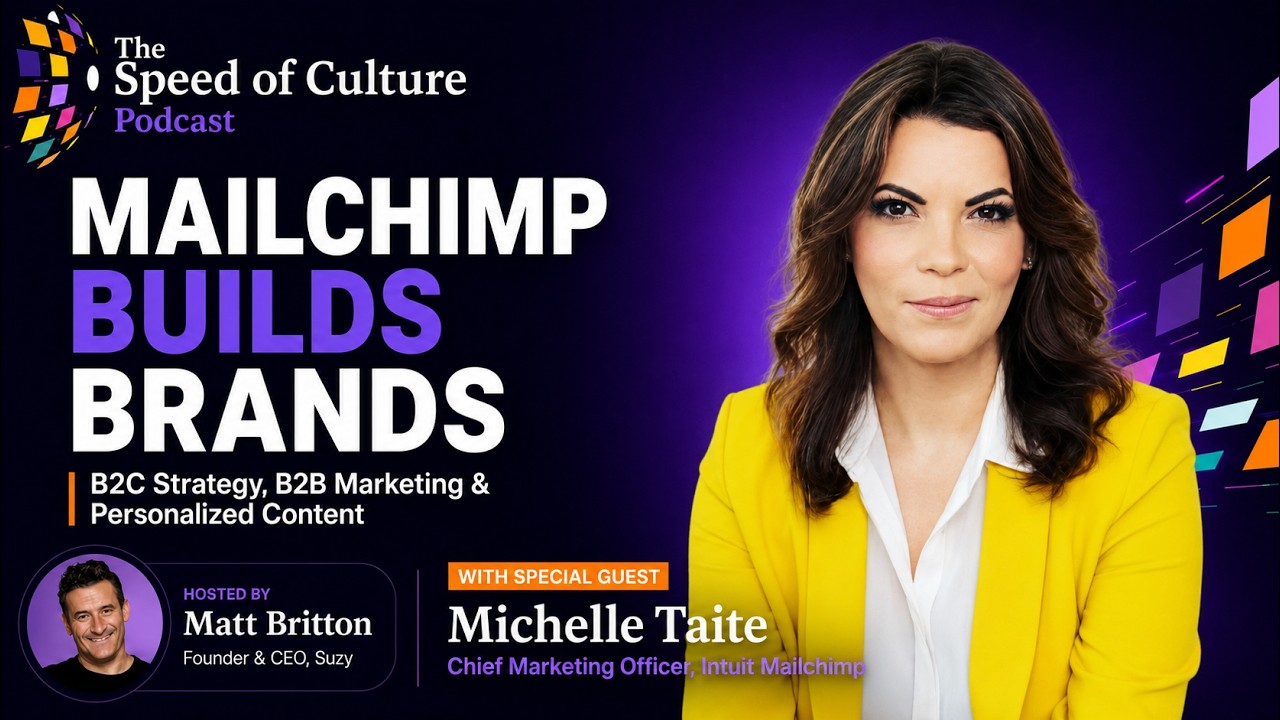
The email marketing landscape has undergone a fundamental transformation. What was once a channel dominated by batch-and-blast campaigns has evolved into a sophisticated ecosystem where artificial intelligence enables brands to deliver hyper-personalized experiences to millions of customers simultaneously. On Episode 169 of the Speed of Culture Podcast, Michelle Taite, Global CMO of Intuit Mailchimp, joins host Matt Britton, founder and CEO of Suzy, the AI-powered consumer intelligence platform, to explore how personalization at scale is reshaping email marketing and redefining what's possible in 2025.
Michelle Taite brings a wealth of experience to this conversation. As one of the most innovative Chief Marketing Officers in the technology space, she has spearheaded Mailchimp's strategic pivot toward AI-driven personalization and has been recognized as a Business Insider Most Innovative CMO (2023). Her career spans product design, consumer insights, and marketing innovation across leadership roles at Unilever, New Balance, and QuickBooks.
In her current role at Intuit Mailchimp, Taite leads global communications, market research, and the company's innovation strategy, all oriented toward a singular goal: enabling businesses of all sizes to deliver one-to-one marketing experiences that turn campaigns into customer rituals and fuel lasting loyalty.
The timing of this conversation couldn't be more relevant. As CMOs navigate an increasingly competitive landscape where consumer expectations for relevance continue to rise, the pressure to personalize at scale has become an existential business imperative. According to industry research, 79% of CMOs now view AI as an essential tool for competitive advantage in 2025, while 74% of marketers are already leveraging AI for content personalization.
Yet the disconnect remains: many organizations struggle to translate AI investments into tangible business results. Michelle Taite's insights from Mailchimp's platform, which processes 65 billion machine learning predictions daily, offer a masterclass in how to bridge that gap and unlock exponential returns from personalization strategies.
This episode dives deep into the mechanisms of modern email marketing, the role of AI as an operational and strategic force multiplier, and the philosophical shift required for marketing teams to embrace human-AI collaboration. For CMOs, marketing leaders, and digital strategists seeking to future-proof their customer engagement strategies, this conversation is essential listening.
Email remains one of the highest-ROI channels in the modern marketing stack, but its effectiveness is increasingly determined by the sophistication of personalization strategies deployed. Michelle Taite emphasizes that the transition from traditional segmentation to AI-driven personalization represents a quantum leap in marketing capability.
Traditional segmentation relies on predefined audience attributes (geography, purchase history, demographic categories) to create static groups. AI-powered personalization, by contrast, processes continuous signals from customer behavior, engagement patterns, contextual data, and predictive algorithms to deliver dynamically tailored content.
Mailchimp's approach leverages machine learning to automate what was previously a manual, labor-intensive process. The platform's 65 billion daily machine learning predictions represent an enormous computational undertaking. For each subscriber in a campaign, the system analyzes dozens of data points (open times, device preferences, time zone, engagement recency, industry benchmarks) to optimize not just send times but the precise moment when a particular individual is most receptive to a message.
This capability extends far beyond send-time optimization. Predictive personalization forecasts customer behavior, enabling marketers to recommend products, suggest relevant content, or surface timely offers before customers even realize they need them. A customer showing early signals of churn receives a retention offer precisely when intervention is most likely to succeed.
A high-value prospect receives educational content calibrated to their stage in the buying journey. These are dynamically adjusted, continuously learning systems that improve with every interaction, rather than manually created rules or static flows.
The business impact is quantifiable. Research shows that one-to-one personalization at scale increases conversion rates by 82%, while companies implementing strategic AI-driven personalization achieve 37% lower acquisition costs and 25% higher conversion rates.
Mailchimp customers report measurable improvements in open rates, click-through rates, and ultimately, revenue per email sent, all driven by the machine learning engine operating beneath the surface of every campaign. For Taite, this transformation represents a fundamental shift in how marketing teams should think about their role.
Rather than viewing personalization as a feature or a tactic, forward-thinking organizations are treating it as a core marketing communication strategy. The message is clear: in 2025, personalization is the baseline expectation.
While machine learning powers the optimization layer of email marketing, generative AI is revolutionizing the content creation process itself. Mailchimp's Email Content Generator, announced in 2024, represents a watershed moment for democratizing professional-quality email marketing.
Traditionally, creating effective email campaigns required either in-house creative resources or external agencies, a substantial fixed cost that created barriers to entry for small businesses and limited the velocity at which larger organizations could produce campaigns.
Generative AI tools eliminate this friction. Marketing teams can now brief an AI system on campaign objectives, target audience characteristics, and desired tone, and receive a draft email (subject line, body copy, calls-to-action) in seconds.
The system doesn't produce generic, templated content; it learns from patterns in high-performing campaigns, industry best practices, and the organization's own historical performance data to generate contextually relevant, on-brand messages.
But the true power emerges when generative AI is combined with machine learning optimization and marketing automation. Consider the workflow: A marketing team defines a campaign objective, re-engage lapsed customers or introduce a new product line. Generative AI drafts multiple variations of the email.
Machine learning segmentation identifies the highest-value audience subset most likely to respond. Send-time and send-day optimization determines the precise moment each person should receive their message. And triggered automations ensure that responses (clicks, opens, conversions) trigger downstream actions, creating a continuous conversation rather than a one-way broadcast.
Mailchimp's marketing automation capabilities now include 20+ AI and data science features deployed in-app: Creative Assistant for content brainstorming, Content Optimizer for subject line and copy refinement, Predictive Segmentation for audience identification, and Product Recommendations driven by purchase history and engagement patterns.
Each of these tools operates within a unified system, creating a comprehensive AI-powered operating system for email marketing.
The strategic implication for CMOs is profound: Marketing teams can now operate with dramatically higher velocity and lower per-unit cost while simultaneously improving quality and relevance. The constraint shifts from creative capacity to strategic thinking.
Organizations that embrace generative AI not just as a labor-saving device but as a strategic tool (paired with human creativity, brand strategy, and business acumen) will dramatically outpace competitors still managing campaigns manually.
Michelle Taite's most compelling insight addresses the philosophical shift required for marketing leaders to fully capitalize on AI-powered personalization. The traditional model of email marketing, and digital marketing more broadly, is fundamentally interruptive.
Marketers identify target audiences, craft messages designed to interrupt their day, and hope the message is sufficiently compelling to overcome the friction of unwanted communication. Today, that model fails spectacularly.
Consumers receive hundreds of promotional messages weekly. They've developed sophisticated filtering mechanisms, both technological (email filters, spam categorization) and cognitive (tuning out irrelevant messaging).
The marketing response has been to intensify personalization efforts, but many organizations approach personalization as a tactic within the interruption model: more targeted interruptions, better timing, more relevant offers. This is personalized interruption, not a fundamental shift in the marketing paradigm.
True personalization, at scale and powered by AI, enables a transition from interruption-based marketing to value-driven engagement. Rather than asking “How can we target this customer with our message?” the question becomes “What content or offer would be genuinely valuable to this customer at this moment?”
Consider predictive recommendations. When an email arrives with product suggestions based not on what the marketer is trying to sell but on what the customer's behavior suggests they might want to buy, the customer experiences utility rather than interruption.
Send-time optimization, when properly applied, delivers messages at moments when the customer is most likely to engage, minimizing friction and increasing the signal-to-noise ratio. Educational content triggered by a customer's progression through the awareness stage of the buyer journey educates the prospect rather than pushing them down a predetermined sales funnel.
This paradigm shift repositions email from a channel for broadcast messaging to a channel for discovery, a place where customers encounter products they didn't know they wanted, educational content they didn't know they needed, and offers uniquely tailored to their circumstances.
Email, combined with SMS and other integrated channels, becomes what industry thought leaders call a “discovery engine.” For CMOs, the implication is clear: If you're still operating email marketing primarily as a promotional channel, you're leaving money on the table.
Organizations that reframe personalization as a customer service, a way to deliver value before asking for business, will capture disproportionate share of customer attention, engagement, and lifetime value.
Understanding the theoretical potential of AI-powered personalization is one thing; executing at scale is another entirely. Michelle Taite acknowledges a persistent challenge facing marketing organizations: the personalization paradox.
Research consistently demonstrates that customers value and respond to personalization, yet many organizations struggle to transform personalization investments into measurable business outcomes. The gap often lies not in technology, but in organizational readiness.
Three categories of barriers typically emerge.
Mailchimp's platform advantage partly derives from its integration across email, SMS, e-commerce, and CRM touchpoints, creating a unified data layer that powers more sophisticated personalization.
Taite's point implicitly extends to budget allocation. In 2025, competitive advantage will increasingly correlate with how effectively organizations deploy their personalization budgets.
Forward-thinking CMOs are shifting budget allocation away from channels with lower personalization potential toward email and SMS, where AI-powered personalization capabilities are most mature and ROI is most demonstrable.
For organizations seeking to overcome the personalization paradox, the roadmap is clear: Start with data integration. Establish cross-functional governance structures. Invest in team training and change management. Set realistic timelines for achieving organizational readiness.
Then, invest in technology and platforms like Mailchimp that abstract away the complexity of implementing personalization at scale, allowing teams to focus on strategy rather than engineering.
The competitive implications of AI-powered personalization extend beyond email marketing to reshape the entire digital marketing ecosystem. Brands that successfully personalize at scale establish a compounding advantage.
Customers receiving value-driven, personalized communications exhibit higher lifetime value, lower acquisition costs, and stronger advocacy. These customers generate positive unit economics, funding further investment in personalization and technology.
Conversely, organizations that fail to personalize remain trapped in the high-cost, high-churn model of traditional marketing.
This dynamic plays out differently across industries and business models. For direct-to-consumer brands, AI-powered email personalization represents an accessible competitive lever. For B2B organizations, personalization at scale is enabling more sophisticated account-based marketing.
Mailchimp serves millions of businesses ranging from solo entrepreneurs to enterprise organizations. By embedding personalization features directly into the email platform, send-time optimization, predictive segmentation, content generation, product recommendations. Mailchimp is lowering the barriers to entry.
As smaller businesses gain access to AI-powered personalization capabilities, competitive differentiation increasingly shifts from technology access to strategy and execution.
The questions that separate winning organizations from losers are clear: Do you understand your customer deeply enough to deliver genuinely valuable experiences? Can you orchestrate personalization across all customer touchpoints? Can you measure and optimize personalization outcomes?
For CMOs navigating 2025, the strategic imperative is clear: If you haven't made AI-powered personalization a central plank of your marketing strategy, you're behind.
Mailchimp differentiates through integrated platform architecture. Rather than positioning AI as a bolted-on feature, Mailchimp embeds 20+ AI and data science capabilities directly into the email marketing platform.
This integration (across email, SMS, e-commerce, CRM, and automation) enables more sophisticated personalization powered by unified customer data. Additionally, Mailchimp serves millions of businesses globally, requiring that its AI features work reliably across vastly different industries and use cases.
The best entry point depends on organizational maturity and strategic priorities. Organizations with fundamental data infrastructure challenges should prioritize data integration before pursuing sophisticated personalization.
Once data foundations are solid, send-time and send-day optimization represent high-ROI, low-complexity entry points. Content generation and predictive segmentation require more organizational change but unlock higher-order impacts.
Email will remain fundamental to customer relationships, but the channel's character is evolving. Email is transitioning from a promotional channel to a discovery engine, where personalization drives value-based engagement rather than interruption-based marketing.
Integration across channels (email, SMS, push, web) will intensify, creating unified customer communication strategies rather than channel-specific approaches.
The most compelling metrics are business outcomes, not marketing metrics. Rather than reporting open rate or click-through rate improvements, CMOs should measure revenue per email, customer acquisition cost (CAC), customer lifetime value (CLV), and churn reduction.
Organizations implementing AI-driven personalization effectively can demonstrate 25–40% improvement in conversion rates, 37% reduction in customer acquisition costs, and measurable improvement in customer lifetime value.
As consumer expectations for relevance continue to escalate and competitive intensity in digital marketing increases, organizations that master personalization at scale will establish formidable competitive advantages.
Michelle Taite's insights into how Mailchimp is enabling this transformation reflect broader industry trends: AI is becoming infrastructure, personalization is becoming table stakes, and organizations that fail to evolve will be left behind.
For deeper insights into consumer trends, market research, and competitive intelligence that inform personalization strategy, explore Suzy, Matt Britton's AI-powered consumer intelligence platform.
To access the full episode and the complete Speed of Culture Podcast library, visit The Speed of Culture Podcast. For additional perspective on AI's impact on consumer behavior and the future of work and creativity, explore Matt Britton's latest book, Generation AI.
For marketing leaders seeking thought leadership on AI, consumer behavior, and innovation strategy, Matt Britton is available as an AI keynote speaker and can be reached through Speaker HQ.