The Advertising Playbook for Insurance Brands: Lessons from Aflac's Marketing Leadership
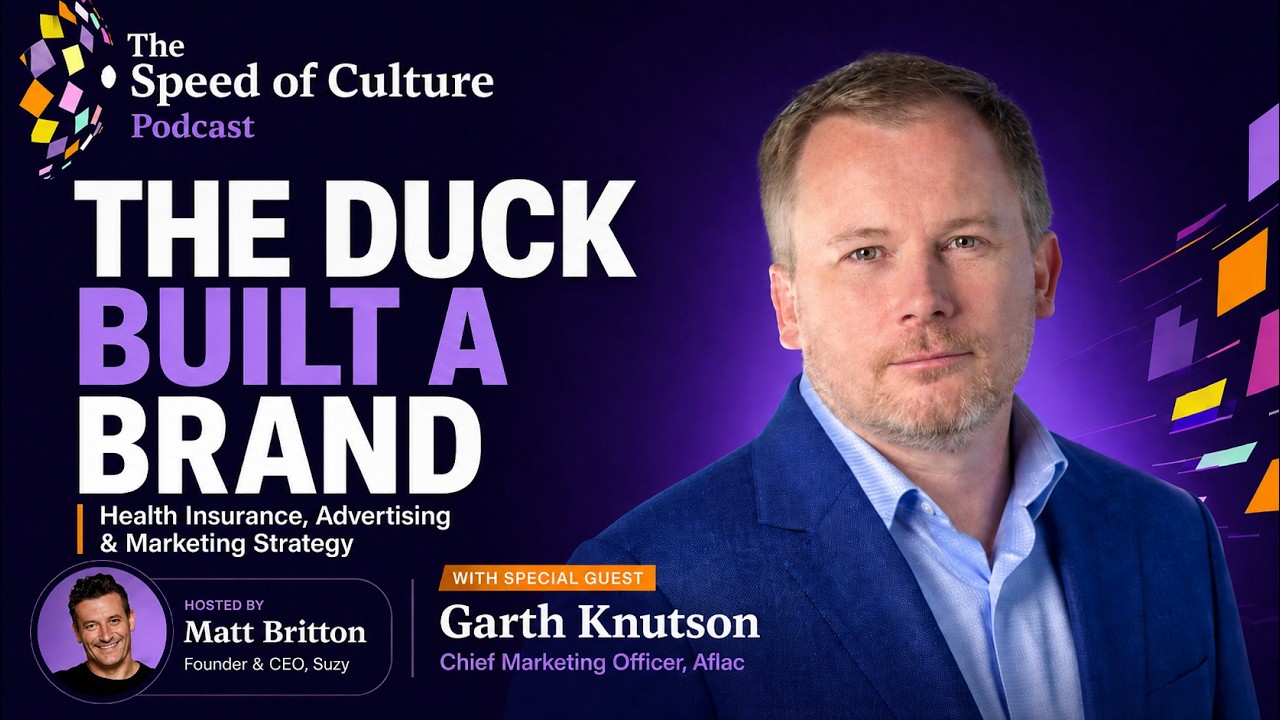
Matt Britton, founder and CEO of Suzy, the AI-powered consumer intelligence platform, recently hosted an illuminating conversation with Garth Knutson, Chief Marketing Officer at Aflac, on The Speed of Culture podcast. The episode, which aired on January 10th, 2023, offers invaluable insights into the sophisticated advertising strategies required to build and maintain a dominant brand position in the insurance industry.
Insurance products are fundamentally intangible. They exist as promises and peace of mind rather than physical goods. This unique characteristic means that insurance brands cannot rely on product differentiation alone to capture market share. Instead, advertising becomes the primary vehicle through which companies establish identity, build consumer trust, and communicate their value proposition.
Knutson's 18 years of experience developing and launching brands for Fortune 500 companies provides a masterclass in how leading organizations navigate this challenge. His work at Aflac demonstrates that advertising strategy is far more than a marketing expense; it represents a core competitive differentiator that separates winners from losers in the insurance category.
This conversation explores how savvy CMOs balance traditional media investments with emerging digital channels, manage budget constraints in an inflationary environment, and align marketing strategies with consumer behavior patterns. For business leaders seeking to understand the modern insurance marketing landscape, this episode distills the essential principles that drive success in one of America's most recognizable brands.
Building Brand Identity in an Intangible Category
Insurance presents a paradoxical marketing challenge. Unlike consumer packaged goods or technology products, insurance policies cannot be held, tested, or directly experienced before purchase. The product itself is a contract, a promise that the company will be there when the customer needs it most.
This intangibility has profound implications for how insurance brands must approach advertising and brand building. Garth Knutson emphasizes that in the insurance category, advertising investment serves as a critical competitive lever. Companies that fail to invest adequately in advertising struggle to establish any meaningful brand presence or consumer association.
For Aflac, advertising is not a discretionary expense that can be cut during economic downturns; rather, it is a strategic imperative that maintains the brand's market position and consumer awareness.
The iconic Aflac Duck represents perhaps the most successful solution to this branding challenge. Launched in 2000 through the creative work of Kaplan Thaler Group, the Duck campaign achieved remarkable results.
In the 1990s, Aflac had invested nine years in traditional advertising but had only managed to lift national brand awareness to 6-7%. However, between 2000 and 2014, the Duck campaign drove brand recognition from 11% to 94%, an extraordinary transformation that demonstrates the power of distinctive, memorable advertising.
The Duck works because it reinforces Aflac's core brand promise: to be there for consumers when they need support most. Even as the campaign has evolved over two decades, this fundamental role remains constant. The mascot has provided Aflac with sustained competitive advantage precisely because it solved the intangibility problem through humor, memorability, and consistent reinforcement.
For insurance brands seeking to build identity in crowded markets, this lesson is paramount. Advertising cannot be generic or forgettable. It must create distinctive associations that survive in consumer memory and differentiate the brand from competitors.
The scale of investment matters, but creativity and consistency matter more. A well-executed advertising strategy compounds over time, building cumulative brand equity that translates into consumer preference and pricing power.
Strategic Timing and Consumer Behavior Alignment
One of Knutson's most counterintuitive insights involves the timing of health insurance decisions. Most Americans make their health insurance choices not in spring or summer, when logical planning might occur, but during football season, the fourth quarter and into the first quarter of the following year.
This timing coincides precisely with open enrollment periods and year-end decision windows, when benefits decisions become urgent for many households.
Understanding this behavioral pattern is critical for optimizing advertising effectiveness. Aflac strategically concentrates its media investments during these peak decision-making windows, ensuring that the company's advertising reaches consumers at the moment when they are actively considering their health coverage options.
This approach maximizes return on advertising investment and improves conversion rates relative to less strategically timed campaigns.
The football season connection reveals a deeper consumer psychology insight: people often make insurance decisions in group contexts, at social gatherings where conversations about benefits and coverage arise naturally. Advertising that reaches sports viewers during these periods captures consumers in the right frame of mind.
Knutson's strategy demonstrates that sophisticated marketers do more than simply identify their target audience; they understand the temporal patterns of decision-making and align media buys accordingly.
This principle extends beyond insurance. Any brand serving categories where consumer decisions cluster around specific seasons or events (tax planning, home buying, vehicle insurance renewal, or healthcare enrollment) benefits from aligning advertising investment with consumer decision cycles.
The ROI improvement from strategic timing can be substantial, allowing marketers to reduce overall spend while improving campaign effectiveness. For insurance brands specifically, open enrollment marketing campaigns represent the highest-leverage opportunity to drive awareness, consideration, and conversion.
Navigating the Digital Transformation of Insurance Marketing
While Aflac built its dominant market position through television advertising and the iconic Duck campaign, the company recognizes that media consumption patterns have shifted dramatically. Younger generations consume far less television and engage with media differently across digital platforms, social channels, and streaming services.
This reality has forced sophisticated insurance brands to fundamentally rethink their advertising strategies.
Knutson discusses Aflac's journey toward digital and away from linear television formats as a central strategic challenge. The shift is not primarily a matter of replacing TV spend with digital spend; rather, it involves reimagining how advertising messages are created, formatted, distributed, and optimized across a fragmented media landscape.
Digital marketing for insurance requires entirely different creative approaches. Where a 30-second television spot dominated Aflac's playbook, the digital environment demands shorter-form content, social media assets, programmatic display advertising, mobile-optimized creative, and search engine marketing.
Each format requires distinct messaging, different lengths, and specialized creative production.
Moreover, digital platforms provide measurement capabilities that traditional television never offered. Insurance brands can now track precisely how many consumers see a given advertisement, how many click through to learn more, how many convert to customers, and what the customer acquisition cost represents relative to customer lifetime value.
This granular measurement enables continuous optimization and far more efficient budget allocation than historical television-based approaches.
The challenge Knutson identifies is not the existence of digital channels but the explosion of required formats. Insurance companies must now produce advertisements in dozens of sizes, lengths, and formats to reach consumers across different devices and platforms.
A single campaign concept might require creation in 15–20 different variations. In an inflationary environment where media costs are rising while marketing budgets remain relatively flat, producing all these variations while maintaining creative quality and brand consistency becomes increasingly difficult.
The insurance marketer's dilemma reflects a broader truth about 21st-century marketing: success requires managing exponentially greater complexity with relatively stable or shrinking budgets.
Budget Constraints and the Efficiency Imperative
Knutson's candid discussion of budget constraints reveals a practical reality that many marketing executives face but hesitate to discuss publicly. Media costs have increased substantially, driven by rising programming costs, streaming service competition for premium inventory, and inflationary pressures across the economy.
Simultaneously, marketing budgets at most companies have remained flat or declined in real terms. This creates a fundamental arithmetic problem: companies must achieve more marketing impact with less purchasing power.
The constraint becomes even more acute when combined with the digital proliferation challenge. Producing high-quality creative assets in 20 different formats costs considerably more than producing a single television spot.
Yet the fragmented media environment leaves companies no choice. They must invest in this diversity or sacrifice reach and effectiveness.
Aflac's response to this challenge illustrates the strategic choices facing insurance marketers. The company has increased its digital marketing budget to represent 35% of total measured media spend, recognizing where consumer attention has migrated.
However, the company continues to invest significantly in traditional television and other channels because the audience diversity across formats demands a balanced portfolio approach.
For insurance brands with less scale than Aflac, the budget constraint becomes even more serious. Smaller competitors cannot achieve the same economies of scale in creative production and media buying.
This dynamic actually reinforces Aflac's competitive moat. The company's scale allows it to fund the creative production and media diversity that smaller competitors cannot afford.
Over time, this compounds into sustained brand awareness advantages that prove difficult to overcome.
The efficiency imperative also drives greater rigor around advertising measurement and ROI analysis. Insurance marketers must understand which channels, creative approaches, and messaging strategies drive actual customer acquisition and retention.
Vanity metrics (impressions, reach, brand awareness metrics) matter less than demonstrable connections to revenue outcomes. Leading insurance brands increasingly employ marketing mix modeling, multi-touch attribution, and customer lifetime value analysis to optimize budget allocation across channels and creative strategies.
Winning Through Advertising Differentiation
Knutson's core message throughout the episode is that advertising strategy represents the greatest industry differentiator in insurance marketing. In a category where product features, pricing, and customer service are increasingly commoditized, the battle for consumer preference is won through effective, consistent, distinctive advertising.
This principle applies across insurance categories (supplemental insurance, health insurance, property and casualty, life insurance) wherever brands compete for limited consumer attention and preference.
The most successful insurance brands invest heavily in advertising as a strategic advantage rather than viewing it as a cost that should be minimized. These brands recognize that the intangibility of insurance makes advertising even more critical than in product categories where physical attributes and performance matter.
An insurance customer cannot tell the difference between two health insurance plans by using them for a few days; the customer makes a choice based on brand perception, reputation, and advertising-driven associations.
Moreover, advertising creates competitive barriers that are difficult to overcome. Once a brand like Aflac has spent decades building consumer associations through consistent advertising investment, competitors must invest dramatically more to shift consumer perceptions.
The Duck mascot, for instance, has become so strongly associated with Aflac that the company owns this distinctive brand asset in consumer minds. A competitor attempting to build comparable brand awareness would need to invest massive sums over many years, with no guarantee of success.
This makes advertising strategy a core element of competitive advantage and shareholder value creation.
Key Takeaways for Business Leaders
- Advertising is a strategic differentiator in insurance marketing. In categories with intangible products, effective advertising investment separates market leaders from followers and represents a core competitive lever that cannot be outsourced or underinvested.
- Consumer decision timing aligns with specific seasons and behaviors. Insurance brands achieve superior ROI by concentrating advertising investments during periods when consumers actively make coverage decisions, such as open enrollment periods coinciding with football season.
- Digital transformation requires exponential creative complexity. Successful insurance brands must produce marketing assets in dozens of formats and sizes while maintaining creative quality and brand consistency, a challenge that demands process innovation and production efficiency.
- Scale creates competitive moats in marketing. Larger insurance brands can afford the creative production diversity and media buying efficiency that smaller competitors cannot match, compounding competitive advantages over time.
- Measurement and ROI discipline are increasingly critical. Leading insurance marketers move beyond vanity metrics to focus on customer acquisition cost, customer lifetime value, and direct revenue attribution to optimize budget allocation and demonstrate marketing's business impact.
Frequently Asked Questions
How has the Aflac Duck campaign remained effective for over 20 years?
The Aflac Duck succeeded because it solved the core branding challenge of intangible products through a distinctive, memorable character that has consistently reinforced the brand promise. Unlike campaigns that rely on specific product claims or dated references, the Duck is timeless and works equally well across media formats.
The mascot's evolution (adapting to social media, new advertising formats, and contemporary culture) while maintaining core brand association is what has sustained its effectiveness. The campaign also evolved beyond traditional advertising into philanthropy through the Aflac Childhood Cancer Campaign, which deepened consumer emotional connection and brand trust.
Why do insurance companies spend more on advertising than companies in other industries?
Insurance companies invest heavily in advertising because their products are intangible and invisible until a claim occurs. A consumer cannot test insurance or evaluate it based on physical attributes.
Advertising creates the only opportunity to build brand association, communicate value, and establish consumer preference. Additionally, insurance is often purchased infrequently and involves complex decisions that consumers find stressful.
Advertising helps insurance brands build trust and reduce perceived risk by creating consistent, positive brand associations over time.
How should insurance marketers approach the transition from traditional television to digital channels?
The transition from television to digital is not a simple substitution but a strategic portfolio shift that requires building capabilities across many channels. Insurance brands should maintain television presence where cost-effective but redirect growth budget toward digital channels where their target audiences increasingly consume media.
The key is understanding which audience segments use which channels and tailoring frequency and creative approaches accordingly. Digital's strength lies in measurement and targeting precision, so insurance brands should use these advantages to test messaging and optimize continuously.
What role does brand mascotry play in insurance marketing strategy?
Mascots like the Aflac Duck help overcome the intangibility problem by creating emotional connection and memorability. A distinctive mascot that consistently reinforces brand values becomes a sustainable competitive advantage because consumers remember it and associate it with the brand promise.
However, mascots must authentically connect to the brand promise and prove flexible enough to evolve across channels and over time. A mascot that feels arbitrary or disconnected from brand values will underperform.
The best insurance marketing mascots evolve into cultural symbols that transcend advertising and become part of consumer language.
Looking Ahead
The conversation between Matt Britton and Garth Knutson illuminates the sophisticated thinking required to lead marketing in a major insurance company. As the insurance industry continues to evolve (facing digital disruption, changing consumer expectations, and macroeconomic pressures) the strategic principles Knutson articulates remain timeless.
Advertising will continue to serve as a critical differentiator in insurance marketing. Brands that invest strategically in distinctive, well-executed advertising will win consumer preference and build enduring competitive advantages.
For leaders interested in exploring more insights about consumer behavior, marketing strategy, and the future of brand building in the AI era, explore The Speed of Culture podcast, where Matt Britton regularly hosts industry leaders in candid conversations about how brands win in changing markets.
Additionally, learn more about consumer intelligence and how AI-powered platforms are transforming marketing decision-making by visiting Suzy.
For those seeking to develop executive-level speaking capabilities or explore how AI and consumer trends impact business strategy, discover Matt Britton's work as an AI keynote speaker and learn about his latest book, Generation AI. Leaders looking to build comprehensive speaking and thought leadership programs can explore Speaker HQ, Matt Britton's resource for executive communication excellence.
%20(400%20x%20100%20px)%20(300%20x%2050%20px)%20(150%20x%2050%20px).avif)