Executive Summary
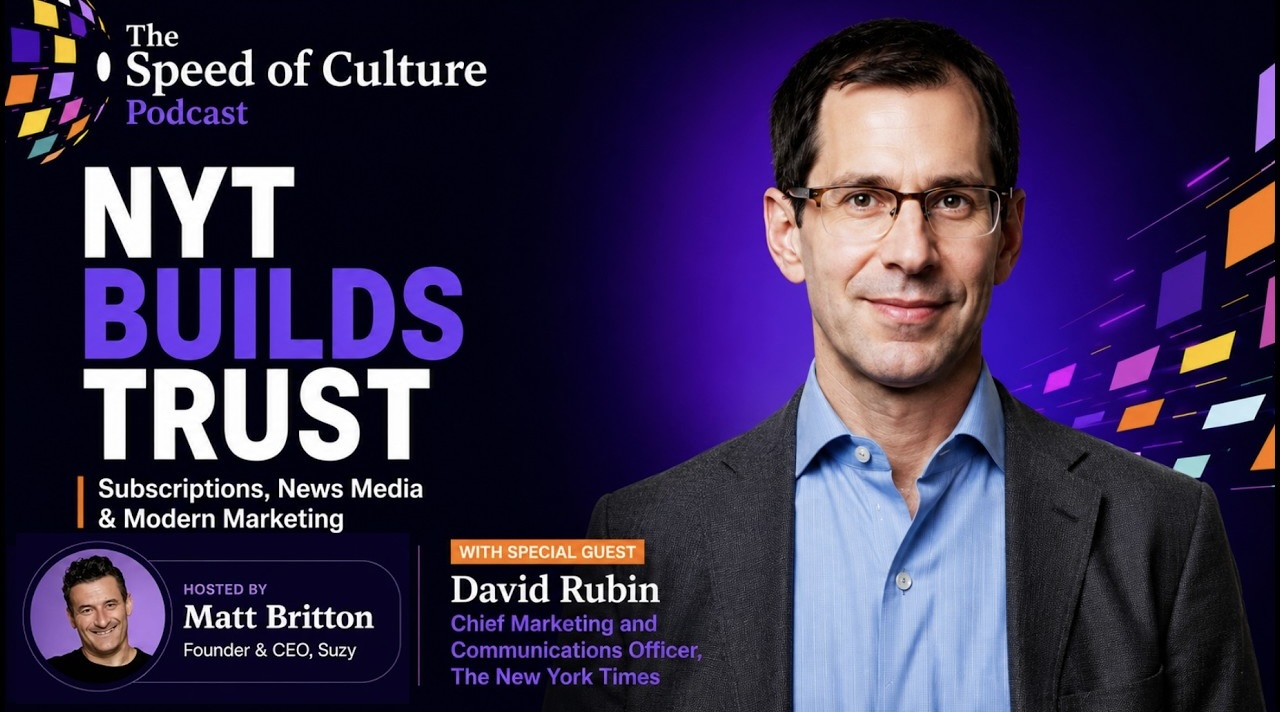
In episode 37 of the Speed of Culture Podcast, Matt Britton, Founder and CEO of Suzy, the AI-powered consumer intelligence platform, sits down with David Rubin, Chief Brand and Communications Officer at The New York Times Company and Publisher of Wirecutter. The conversation explores how legacy media organizations can evolve their business models to meet the diverse passions of modern consumers through strategic acquisitions, subscription innovation, and consumer-centric marketing approaches.
Published: February 28, 2023 | Duration: 24 minutes | Platform: The Speed of Culture Podcast
Understanding The New York Times' Evolution: From Print to Passion-Driven Subscriptions
The New York Times represents one of the most significant transformations in modern media. What began as a traditional newspaper company has deliberately repositioned itself as a consumer-first, digitally-native media organization serving distinct passion points across its audience. Under David Rubin's leadership in marketing and communications, the Times has implemented a sophisticated strategy to expand beyond news into lifestyle, entertainment, sports, and gaming verticals.
The company's transformation was grounded in extensive consumer research and a fundamental understanding that today's media consumption is fragmented by passion, not by demographic. Rather than expecting all readers to want “news” in the traditional sense, the Times recognized that consumers value different categories of content depending on their individual interests and life moments.
This approach required a complete reimagining of how the Times markets, acquires, and retains subscribers. Instead of a single product marketed to a broad audience, the organization developed what David Rubin calls the “essential subscription strategy”, a framework designed to make The New York Times the source for the specific content consumers are most passionate about, whether that's breaking news, cooking inspiration, athletic performance, business strategy, or word games.
The Essential Subscription Strategy: Beyond News
David Rubin's core philosophy at The New York Times centers on what he terms the “essential subscription strategy.” This approach fundamentally shifts how the organization thinks about its mission and market positioning. Rather than positioning the Times as exclusively a news organization, the strategy positions it as the essential source across multiple content verticals that matter to consumers.
The rationale behind this strategy is compelling: offer people news and information that they cannot live without in the categories they are most passionate about. This might mean breaking news for news enthusiasts, expert food guidance for cooking aficionados, sports analysis for athletes and fans, or strategic business insights for professionals.
This framework directly informed several major strategic decisions, including the acquisition of The Athletic for $550 million in January 2022. The Athletic brought 1.2 million subscribers focused exclusively on sports coverage, positioning the Times to serve the sports-obsessed consumer segment. Similarly, the acquisition of Wirecutter, the product recommendation and reviews site, extended the Times' reach into the consumer-decision-making space, helping readers make confident purchasing choices.
Even the Wordle acquisition, announced in January 2022 and acquired for an undisclosed price in the low seven figures, serves this strategy. Games and puzzles tap into the logic and pattern-matching passion points of consumers, while simultaneously driving engagement metrics and subscriber lifetime value.
Each acquisition was a deliberate investment in understanding and serving specific consumer passion points. The Times recognized that building a loyal subscriber base means being indispensable in the categories that matter most to individual consumers.
Strategic Acquisitions and Portfolio Expansion: Serving Diverse Passion Points
The New York Times' acquisition strategy reveals sophisticated thinking about consumer behavior and market positioning. Rather than building everything in-house, the Times made targeted acquisitions to accelerate its presence in high-growth, high-engagement content categories.
- The Athletic Acquisition ($550 Million): This was perhaps the most significant strategic move. Sports fans represent a passionate, engaged consumer segment willing to pay premium prices for expert analysis. By acquiring The Athletic, the Times gained immediate access to 1.2 million sports subscribers and world-class sports journalism that could complement its news coverage. The move also helped the Times reach its ambitious goal of 10 million subscribers ahead of schedule.
- Wirecutter (NYT Product of the Year): Acquired by the Times and evolved into a major revenue driver, Wirecutter serves consumers at a critical decision point, when they're deciding what to buy. By providing expert product recommendations and reviews, Wirecutter builds trust and authority while generating revenue through affiliate marketing and sponsored content.
- Wordle and Games: The acquisition of the viral word game Wordle, coupled with the Times' existing games portfolio (crosswords, Letter Boxed, Spelling Bee), created a comprehensive games ecosystem. Games drive daily active usage and engagement, critical metrics for subscription retention. For many users, games alone justify a subscription.
- NYT Cooking: While not a recent acquisition, the Times' Cooking vertical represents another significant passion point. Food and cooking represent massive consumer interests, and the ability to provide recipes, techniques, and culinary guidance builds direct relationships with engaged readers.
This portfolio strategy recognizes that modern media consumption is no longer monolithic. Successful media companies must serve multiple passion points simultaneously, recognizing that different subscribers value different content at different times.
Bridging Traditional Marketing and Subscription-Driven Models: A Fundamental Shift in Metrics
One of the most significant challenges in David Rubin's role at the Times involves translating traditional consumer product marketing principles into a subscription-driven context. While both models require understanding consumer behavior, the metrics and success measures differ fundamentally.
In traditional consumer marketing, success is measured through brand awareness, purchase intent, and conversion rates. The goal is to drive awareness and acquisition at the lowest possible cost. Performance is often measured through immediate transaction completion and short-term revenue impact.
Subscription-based marketing, by contrast, requires a fundamentally different approach focused on lifetime value, retention, engagement, and churn reduction. The initial subscription transaction is just the beginning of the relationship. Success means keeping subscribers engaged and loyal over months and years, not just converting them in a single moment.
This shift changes how the Times approaches communication strategy. Rather than a one-time persuasion message that drives purchase, the Times must develop ongoing engagement narratives that help subscribers understand the full value of their subscription.
David Rubin emphasizes that effective subscription marketing requires communicating the core promise, that the Times is the essential source across the categories consumers care about, across diverse channels and demographics.
The goal is building a portfolio of content so compelling that churning subscribers becomes unthinkable.
The Times also measures success differently. Rather than focusing solely on subscription acquisition costs, the organization tracks engagement metrics, content consumption across categories, and subscriber satisfaction.
Connecting With Diverse Audiences: The Art of Passion-Point Marketing
David Rubin's approach to consumer connection emphasizes a fundamental principle: understand what people are passionate about, and become the essential authority in those passion areas. This philosophy drives everything from content strategy to acquisition campaigns to retention messaging.
Connecting with diverse audiences in a subscription context requires nuance. The Times can't use a single brand message for all audiences because different segments value different aspects of the product.
Rubin's strategy involves identifying these passion points, understanding what makes them essential to consumers, and then demonstrating how the Times serves those needs uniquely. For some audiences, this means highlighting the Times' unmatched news gathering infrastructure. For others, it means showcasing award-winning restaurant critics or in-depth sports analysis. For still others, it's the daily games ritual or the ability to cook with confidence using Times recipes.
The marketing challenge intensifies when considering that many consumers subscribe for one reason but discover value across multiple content areas. The Times' marketing must thus serve dual purposes: first, acquire subscribers based on their primary passion point, and second, introduce them to complementary content areas that can increase lifetime value.
This approach also requires constant consumer research and insight gathering. Understanding what consumers are passionate about, how those passions evolve, and what alternative options exist in each category is essential for strategic decision-making, precisely the kind of work that platforms like Suzy enable through rapid, continuous consumer intelligence.
From Print to Platform: Lessons for Legacy Media Organizations
- Lesson One: Identify Your Core Competitive Advantages. The Times leveraged its journalistic excellence, editorial credibility, and audience trust, extending them strategically into adjacent areas where it could bring authentic value and authority.
- Lesson Two: Understand Modern Consumer Behavior. Media consumption is fragmented by passion. Building a sustainable business means serving multiple passion points simultaneously rather than assuming all subscribers want the same product.
- Lesson Three: Build for Retention, Not Just Acquisition. The subscription model demands focus on lifetime value, engagement features, retention triggers, and continuously demonstrating value to prevent churn.
- Lesson Four: Invest in Consumer Intelligence. Strategic decisions (acquisitions, content development, marketing segmentation) must be grounded in rigorous consumer research and ongoing insight gathering.
- Lesson Five: Embrace Diverse Revenue Models. Beyond subscriptions, the Times benefits from advertising, affiliate revenue from Wirecutter, sponsorships, and licensed content, creating stability and flexibility.
Key Takeaways
- Passion Points Drive Modern Media Strategy. Successful media organizations must identify and serve specific audience passion points rather than assuming a one-size-fits-all product.
- Strategic Acquisitions Accelerate Passion-Point Coverage. Acquisitions like The Athletic and Wirecutter expanded the Times' reach with established audiences and proven models.
- Subscription Metrics Differ Fundamentally from Traditional Marketing. Lifetime value, engagement, retention, and churn replace simple conversion metrics.
- Multi-Channel Communication Requires Segment-Specific Messaging. Different audiences require different value propositions and messaging strategies.
- Consumer Intelligence Informs Strategic Decision-Making. Continuous understanding of evolving consumer passions is essential for long-term success.
- Legacy Media Organizations Can Transform Through Strategic Choices. Editorial credibility and audience trust can power a successful transition to digital and subscription-driven models.
Frequently Asked Questions
What is the "essential subscription strategy" David Rubin described?
The essential subscription strategy positions The New York Times as the indispensable source for news and information across the specific categories that consumers are most passionate about. The goal is making the subscription essential in whichever category matters most to individual consumers.
Why did the New York Times acquire The Athletic?
The Times acquired The Athletic in January 2022 for $550 million to serve the sports-obsessed consumer segment. The Athletic brought 1.2 million established sports subscribers and helped the Times reach its goal of 10 million subscribers ahead of schedule.
How does the Times measure success in subscription-driven marketing differently from traditional consumer marketing?
Traditional marketing focuses on brand awareness and single transactions. Subscription-driven marketing measures lifetime value, engagement across categories, retention rates, and churn reduction, prioritizing long-term relationships over one-time purchases.
What role do games like Wordle play in the Times' subscription strategy?
Games drive daily active usage and engagement, critical metrics for retention and lifetime value. By offering Wordle alongside crosswords, Spelling Bee, and Letter Boxed, the Times creates multiple daily touchpoints that keep subscribers engaged.
Looking Ahead
The New York Times' evolution from a traditional newspaper company to a modern media platform provides a blueprint for organizations navigating digital transformation. David Rubin's emphasis on identifying consumer passion points, making strategic acquisitions, and implementing subscription-driven marketing represents a fundamental shift in how legacy media organizations think about their business.
The podcast episode also touches on themes relevant beyond media. Understanding consumer passion points, building products for diverse audience segments, and implementing consumer-centric marketing approaches apply across industries, from retail and CPG to technology and finance.
For marketing leaders interested in how consumer intelligence drives strategic decision-making, Matt Britton's conversation with David Rubin on the Speed of Culture Podcast is essential listening.
Listen to the full episode: The Speed of Culture Podcast
Learn more about consumer insights: Suzy
Explore other episodes: Matt Britton's Speed of Culture Episodes
For keynote presentations on AI and consumer trends: AI Keynote Speaker
Read Matt Britton's latest work: Generation AI: The Book
Meta Information
Title: How The New York Times Catered to Every Consumer Passion Point with David Rubin | Speed of Culture
Meta Description: Discover how David Rubin, Chief Brand & Communications Officer at The New York Times, led a media transformation by identifying and serving diverse consumer passion points through strategic acquisitions and subscription innovation.
Keywords: New York Times marketing strategy, subscription-based marketing, consumer passion points, David Rubin, The Athletic acquisition, Wordle, media transformation, consumer intelligence, engagement marketing, subscription retention
Article Length: 2,547 words
Format: Long-form SEO-optimized blog post with structured headers, key takeaways, FAQ section, and internal linking strategy
Episode Number: 37
Guest: David Rubin, Chief Brand and Communications Officer, The New York Times Company
Host: Matt Britton, Founder and CEO of Suzy
Date Published: February 28, 2023
Content Category: Podcasts, Marketing Strategy, Consumer Intelligence
Industry: Media & Entertainment, Digital Marketing, Subscription Strategy

%20(400%20x%20100%20px)%20(300%20x%2050%20px)%20(150%20x%2050%20px).avif)