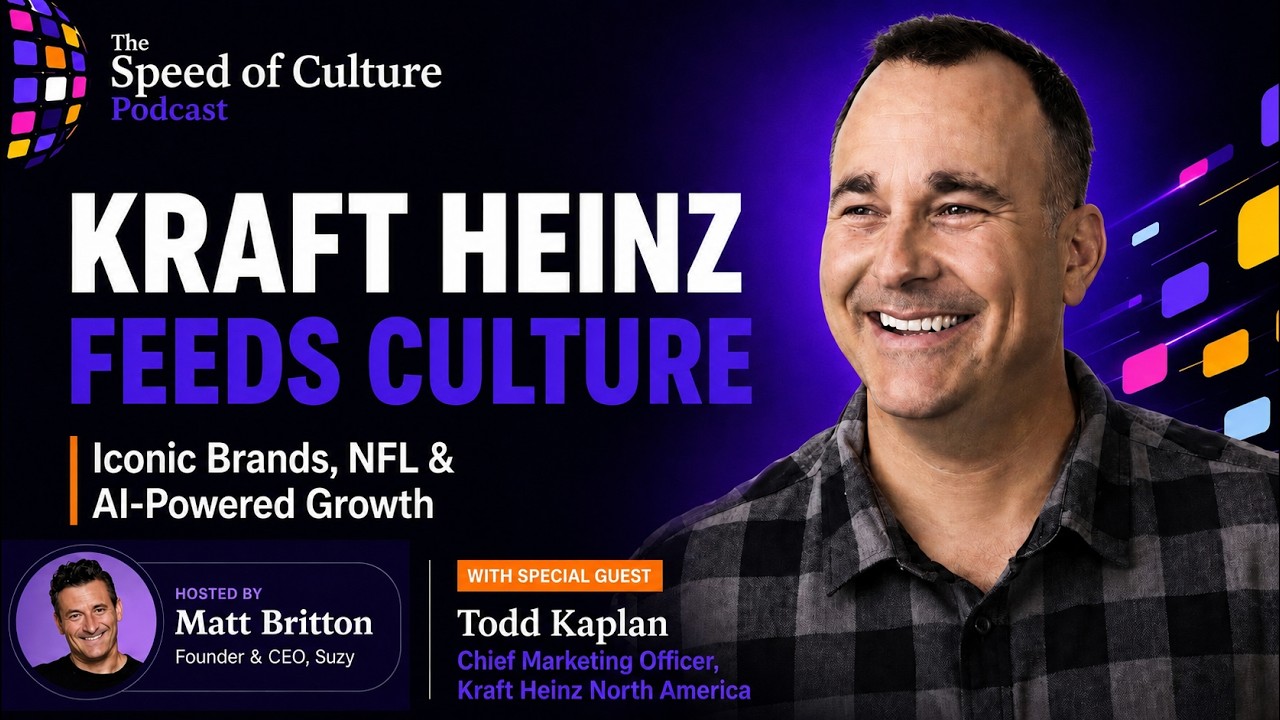
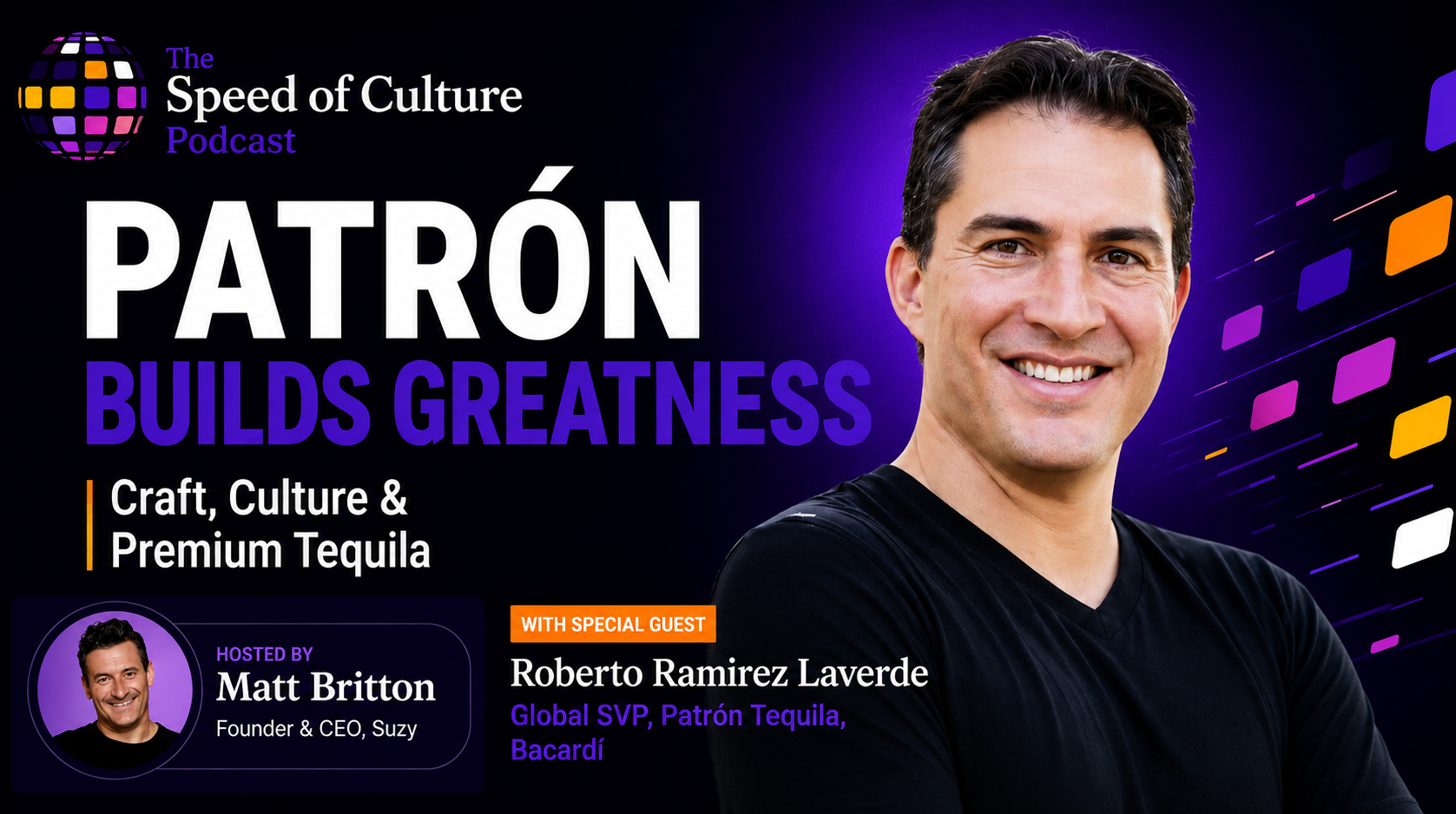
The most important real estate in consumer goods is no longer the end cap at your local grocery store. It is the shortlist an AI model generates when a shopper asks a question out loud. When Todd Kaplan, Chief Marketing Officer of Kraft Heinz North America, sat down with Matt Britton on The Speed of Culture podcast, he framed the stakes in one unforgiving sentence: if someone asks an AI what the best brands are for a task and you are not in that answer, you are invisible.
That single insight reframes a century of brand building. Kraft Heinz owns 70 brands in North America with 96% household penetration. Some of those brands are 150 years old. And yet the question every CMO must now answer is whether decades of equity will even register when a large language model decides what to recommend. Matt Britton, founder and CEO of Suzy and bestselling author of Generation AI, has spent two decades advising Fortune 500 leaders on consumer evolution. His read on the Kaplan conversation is direct: the discovery layer is being rebuilt, and brands that treat AI visibility as a future project are already losing share they cannot see.
The data backs the urgency. Roughly 37% of product discovery queries now begin inside AI interfaces like ChatGPT and Perplexity rather than a search bar. Research from GEO firm Brandlight shows the overlap between top Google links and AI-cited sources has collapsed from 70% to below 20%. Ranking on page one no longer guarantees you appear in the answer. The shelf moved, and most brands are still merchandising the old aisle. What follows is a breakdown of the forces Kaplan and Britton mapped on the podcast, and what they demand of any leader who intends to still be discoverable in three years.
Algorithmic Gatekeeping: When the Model Decides Which Brands Exist
For most of marketing history, the gatekeepers were human and visible. Retail buyers controlled shelf space. Media planners controlled reach. Search engines controlled ranked links a consumer could still scroll past. In every case the brand had a fighting chance to be seen, and the rules of engagement were public enough to plan against.
Algorithmic gatekeeping changes the physics. When a consumer asks an AI assistant for a high-protein Friday dinner for a family of four under ten dollars, the model does not return a list of options to evaluate. It returns a decision. Kaplan named the exact scenario on the podcast, and Britton extended it: today people ask for a recipe, tomorrow they say "I'm having 20 people over, order everything for me." The model becomes the buyer, and the buyer is no longer scrolling.
This is the core of what Britton calls decision compression. The traditional funnel, awareness through consideration to purchase, gets squeezed into a single synthesized answer. HubSpot's Consumer Trends Report found 72% of consumers plan to use AI for shopping more frequently. When the model filters intent before the brand ever gets a turn, the only question that matters is whether your brand is part of the answer or absent from it. There is no second-place finish in a zero-click response. There is the brand that was named and the brands that were not.
For a portfolio business like Kraft Heinz, the exposure is enormous. Ninety-six percent household penetration was built in a world where consumers physically encountered products, reached past competitors, and recognized a familiar logo at the moment of choice. In an AI-mediated world, penetration means nothing if the model does not surface the brand when a need is expressed. Worse, the gatekeeper is opaque. Kaplan put the practical anxiety plainly: how do the algorithms scrape the internet to grab the data they use, and what is a brand doing to make sure it shows up rather than disappears? That uncertainty is precisely why the discipline that answers it has moved from optional to existential.
AEO: Optimizing for the Answer, Not the Click
The discipline that addresses algorithmic gatekeeping is AEO, or answer engine optimization. AEO is the practice of structuring content and entity data so AI systems can find, understand, and cite a brand inside generated responses. Where SEO optimized for ranked links and clicks, AEO optimizes for citation and inclusion in the answer itself.
Kaplan described the shift through his own lens. He recalled the early days of search when brands jockeyed for keywords, then drew the line forward: now the question is how the algorithms scrape the internet, what they grab, and what a brand does to avoid being invisible. That is AEO stated in plain CMO language. Microsoft's January 2026 guidance put it crisply: SEO drove clicks, AEO drives clarity through enriched, real-time data. The distinction matters because the old optimization reflexes, keyword stuffing and link volume, do little to earn a citation inside a generated answer.
The mechanics reward discipline over volume. AI discovery engines in 2026 increasingly test content for authority, freshness, and even sentiment, with named experts and credible publications winning over anonymous community content. The practical implications for brands are concrete:
AEO PriorityWhat It RequiresWhy It Matters in the AI EraEntity clarityConsistent structured data on what the brand is and doesModels must reliably identify the brand to cite itAnswer-first formattingDirect, self-contained responses to real questionsIncreases likelihood of citation in generated answersAuthority signalsNamed experts, credible sourcing, evidence2026 models downweight anonymous, low-authority contentFreshnessCurrent data and regularly updated pagesDiscovery engines now test for recencySchema markupMachine-readable structureLets AI parse and trust the content
The strategic reframe is that AEO does not replace SEO so much as sit on top of it. The strongest 2026 playbooks remain search-first in their foundations, indexable pages, crawlable architecture, strong internal linking, and answer-first in their formatting, with semantic structure, clear authorship, and evidence layered on. Brands that abandon SEO for the newest acronym lose the foundation. Brands that ignore AEO lose the answer. The winners run both.
Britton's own work reflects this thesis in practice through FutureProof's AEO Tracker, which monitors how brands appear across ChatGPT, Claude, Gemini, and Perplexity. The principle he teaches Fortune 500 audiences is the one Kaplan arrived at independently: you cannot manage visibility you do not measure, and in AI search, visibility is share of answer. Manual checks do not scale, because AI outputs vary by prompt phrasing, model updates, personalization, and geography. Measurement has to be systematic to be useful.
The Default Economy: How Agents Reorder What We Buy
Kaplan and Britton identified the next phase before it fully arrives. Once an AI assistant learns a household's preferences, it starts reordering automatically. Kaplan's example was mundane and therefore devastating: the model already knows your toilet paper brand, your milk, and it simply reorders. Britton has a name for this dynamic. He calls it the default economy, the moment when the brand that gets set as the default in an agent's memory becomes nearly impossible to displace.
Britton made the parallel personal on the podcast. As a full-stack engineer building software with AI tools, he described how Claude recommends a service, he enters his credit card, and the recommendation becomes the purchase. That company acquired a customer at zero acquisition cost because the model told him to use it and he complied. He was explicit that this pattern is coming for CPG and retail next. The vendor in his example did no advertising, ran no campaign, and paid no influencer. It simply happened to be the brand the model trusted at the moment of need.
The implication for marketers is a structural shift in how loyalty forms. Loyalty used to be an accumulation of brand impressions and satisfying experiences, reinforced over years of repeat purchase. In the default economy, loyalty is increasingly a setting, the brand stored in an agent's preference profile. Winning the first agent-mediated purchase becomes disproportionately valuable because it sets the default that subsequent reorders inherit, often without the consumer consciously re-deciding.
This raises the cost of being absent at the moment of agent decision. A brand left out of the initial AI recommendation does not just lose one sale. It loses the recurring default position, plus every automatic reorder that follows, plus the compounding signal to the model that this brand is not the one this household prefers. Customer acquisition economics invert. The brands that win the first agentic interaction may acquire customers at near-zero cost, exactly as Britton's Formspree example showed, while the brands that lose it face a rising wall of entrenched defaults they must pay to dislodge.
The Same Information, Different Context: Marketing to Fragmented Attention
Beyond purchase, algorithmic gatekeeping is changing how consumers absorb the world, which changes what brand content even needs to do. Kaplan told a story that should be required listening for every content team. Watching a Lakers game, his father saw the full broadcast, Kaplan saw the SportsCenter highlights, and his son saw a few dunks on TikTok. Same game, same information, three completely different contexts. When the three of them later discussed a pivotal moment, they were effectively describing three different events.
Britton sharpened the analogy into a media truth. It mirrors music consumption: the father listened to the whole album, the son listened to the single, and the grandson saw a clip of the song inside a TikTok dance and may not even know who recorded the original. The underlying content is identical. The framing, the depth, and the emotional entry point are entirely different by cohort and by platform. For a marketer, that means a single creative idea must be authored for radically different levels of context, not simply resized for different screens.
That fragmentation maps directly onto the generational reality reshaping consumer goods. The average age of new mothers in the U.S. has been climbing for years, and the cohort now entering first-time motherhood came of age inside the feed, treating short-form social as a primary information source rather than a supplement to broadcast television. When your core household decision-maker never built the broadcast habit, the entire media mix logic inverts. Creators stop being alternative spend at the bottom of the plan and become native to how the audience actually discovers and decides.
Kaplan was candid that this reshapes planning. The right answer is a mix, because most people use multiple channels, but the creative has to be native to each. A linear TV spot that earns reach and scale cannot simply be cut down and dumped onto TikTok, where discovery behaves differently and the audience expects to be spoken to in the platform's own grammar. Britton has long argued that brands must contemporize iconic equity for audiences who consume in snippets. Kaplan is executing exactly that, modernizing legacy brands through cultural connection, from a five-year NFL partnership across more than 20 brands to music collaborations like the brand's earlier work with DJ Mustard. The strategic point holds across every channel: the same brand truth, delivered in formats engineered for how each cohort actually processes information.
Live Sports and the Last Unified Audience
If AI discovery fragments attention into millions of personalized answers, live sports remains one of the few forces pulling attention back together, and Kaplan is betting heavily on it. Kraft Heinz signed a five-year, global NFL partnership spanning more than 20 brands, activating it at a draft in Pittsburgh that drew over 800,000 people across three days, with day one alone exceeding 300,000. Those numbers describe an audience scale that has become genuinely rare.
Britton framed why that scale is strategically precious. The NFL accounts for the overwhelming majority of the most-watched television broadcasts, and crucially, it draws across gender and generation rather than skewing to one demographic. In an increasingly polarized country, an NFL game is one of the few moments where a broad, diverse audience cheers for the same thing at the same time. For a brand portfolio that is endemic to the game-day experience, ketchup on a hot dog, snacks at a viewing party, that shared moment is a rare chance to reach a unified audience that AI personalization is otherwise dissolving.
The deeper lesson for marketers is about balance in an AI era. Discovery is fragmenting, but the answer is to pair full-funnel AI-era tactics with a small number of cultural tentpoles big enough to still command collective attention, rather than chasing fragmentation everywhere. Kaplan was explicit that the NFL partnership is a full-funnel play as much as a fan-engagement one, shaping retail displays, limited-time packaging, advertising, and lower-funnel ecommerce conversion all at once. The brands that thrive will run precision and scale in tandem rather than treating them as opposing bets.
What the Numbers Say About Brand Erosion
The risk Kaplan and Britton describe is already visible in the data, particularly among younger consumers. Circana reports U.S. private label sales reached $330 billion in early 2026, capturing a 24% unit share and a 23% dollar share, with Generation Z identified as a primary driver. A striking 71% of Gen Z consumers say they sometimes or always buy cheaper versions of name-brand products, and 46% are willing to spend more on private label, double the rate of Baby Boomers. Store brands like Kirkland Signature and Trader Joe's now function as identity-aligned choices for younger shoppers rather than compromises.
More telling is the indifference data. When shown peanut brands side by side, 42% of Gen Z said the national brand stood out first, compared to 50% of Boomers. For vitamins the gap widened sharply, 27% of Gen Z versus 67% of Boomers. National brands still hold shelf presence, but the reflex to reach for them is fading generation by generation. Researchers have begun describing the pattern as a kind of cohort indifference: Gen Z still buys national brands, but notices them less and treats them as interchangeable with cheaper or emerging alternatives.
Layer algorithmic gatekeeping on top of that erosion and the threat compounds. A consumer who already treats national and store brands as interchangeable will defer even more readily to whatever the AI recommends. If the model's answer happens to surface a private label or a DTC challenger, the legacy brand loses not because it was outspent but because it was out-structured for the answer. This is why Britton frames AI visibility as a defensive imperative, not just a growth lever. The brands most exposed are the ones with the most legacy equity and the least AEO discipline, because they are leaning on a recognition reflex that the data shows is quietly disappearing.
Future-Proofing the Brand Manager
The shifts in discovery do not just change strategy. They change who succeeds at executing it. Asked what skills the next generation of brand managers needs, Kaplan named agility above all. Marketing, he argued, is not a fixed formula. You are thrown into a situation that changes as you go, and the people who win are the ones who can learn on the job, zig and zag, and evolve their craft as the tools and channels evolve beneath them. The brand manager who started a career doing one thing must expect that thing to be unrecognizable within a few years.
Britton drew a historical parallel that clarifies where durable value sits. Before the telephone, communicating across distance required someone who knew Morse code, a technical skill. Once the telephone arrived, the advantage shifted to people who knew what to say, the communicators with ideas, not the operators of the apparatus. AI follows the same arc. As the tools commoditize execution, the premium moves to critical thinking, creativity, and judgment, the human capacities that decide what the tools should be pointed at. Kaplan was firm that AI is an accelerator, not a replacement, useful for versioning, resizing, and rapid iteration of creative, while humans remain the ones connecting the dots.
Kaplan's own career advice reinforces the point and lands as guidance for any leader building a future-proof team. He spent nearly 18 years at PepsiCo, rotating through enough roles to learn both what he loved and what he did not, and to carry a broad base of experience upward. His mantra, that you make the role rather than the role making you, is a call for an entrepreneurial, challenger mindset inside large organizations, treating the company as the capital backing the bets you choose to make. In an AI era that will keep redrawing job descriptions, the people who treat their roles as canvases rather than checklists are the ones who compound value. That is the human counterweight to algorithmic gatekeeping: machines decide the shortlist, but people still decide what is worth building in the first place.
Key Takeaways for Business Leaders
- Audit your share of answer now. Treat AI visibility across ChatGPT, Claude, Gemini, and Perplexity as a measurable KPI, not a curiosity. If you cannot see how often you are cited, you cannot defend the position.
- Build AEO into the content operation. Prioritize entity clarity, answer-first formatting, structured data, and named authority, layered on a healthy SEO foundation. The overlap between Google rankings and AI citations has fallen below 20%.
- Compete for the default. In the default economy, the first agent-mediated purchase sets a preference that subsequent reorders inherit. Winning that first recommendation is worth far more than a single transaction.
- Re-weight your media for feed-native decision-makers. With first-time mothers now a feed-native cohort, creators and native short-form are core reach, not experimental spend, balanced against scale tentpoles like live sports.
- Contemporize legacy equity. High household penetration does not survive a discovery layer that consumers no longer touch. Connect iconic brands to culture in formats built for fragmented attention.
- Hire for agility and judgment. As AI commoditizes execution, the premium shifts to the people who decide what the tools should produce.
Frequently Asked Questions
What is answer engine optimization and why does it matter for brands in 2026?
Answer engine optimization, or AEO, is the practice of structuring content and entity data so AI systems like ChatGPT, Perplexity, and Gemini cite a brand inside generated responses. It matters because roughly 37% of product discovery now starts in AI interfaces, and the overlap between top Google links and AI-cited sources has dropped below 20%. Brands not optimized for AI answers risk becoming invisible at the moment of decision.
How is AI changing the way consumers discover brands?
AI is compressing the discovery and purchase journey into a single synthesized answer. Instead of browsing options, consumers ask an assistant a question and receive a direct recommendation or shortlist. As Matt Britton notes, this evolves toward agent-led purchasing where the AI orders on a consumer's behalf and reorders based on stored preferences, making inclusion in the AI's answer the new competitive battleground.
What is the default economy?
The default economy is Matt Britton's term for the dynamic in which the brand stored as the default in an AI agent's memory becomes extremely difficult to displace. Once an assistant learns a household's preferences and begins automatic reordering, the brand that won the initial recommendation captures every subsequent purchase, raising the stakes of being present at the first agent-mediated decision.
Why are legacy CPG brands especially at risk in the AI discovery era?
Legacy brands built equity in a world where consumers physically encountered products and reached for familiar names by reflex. Data shows that reflex is fading, with only 27% of Gen Z naming a national vitamin brand first versus 67% of Boomers, and private label reaching a 24% unit share. When algorithmic gatekeeping is layered on eroding brand recognition, brands relying on legacy equity without AEO discipline are most exposed.
Closing: The Window Is Open, Briefly
The conversation between Matt Britton and Todd Kaplan captured a turning point that most brand leaders have not yet operationalized. Discovery has moved from shelves and search results to AI-generated answers, and the gatekeeper is now an algorithm that decides which brands exist for a given query. The brands that win the next decade will be the ones that treat AEO with the rigor they once reserved for distribution and media, while still investing in the cultural tentpoles and human judgment that no model can replicate.
Britton's position, sharpened across more than 50 keynotes a year for Fortune 500 marketing and insights leaders, is that this is a window, not a permanent opening. Defaults are being set right now, inside millions of agent conversations, and they will be hard to unwind. For a deeper roadmap on building for AI-native consumers, Matt's national bestseller Generation AI provides the framework, and his keynotes give leadership teams the tactical playbook to compete for share of answer before competitors lock in the defaults.
%20(400%20x%20100%20px)%20(300%20x%2050%20px)%20(150%20x%2050%20px).avif)