Opening
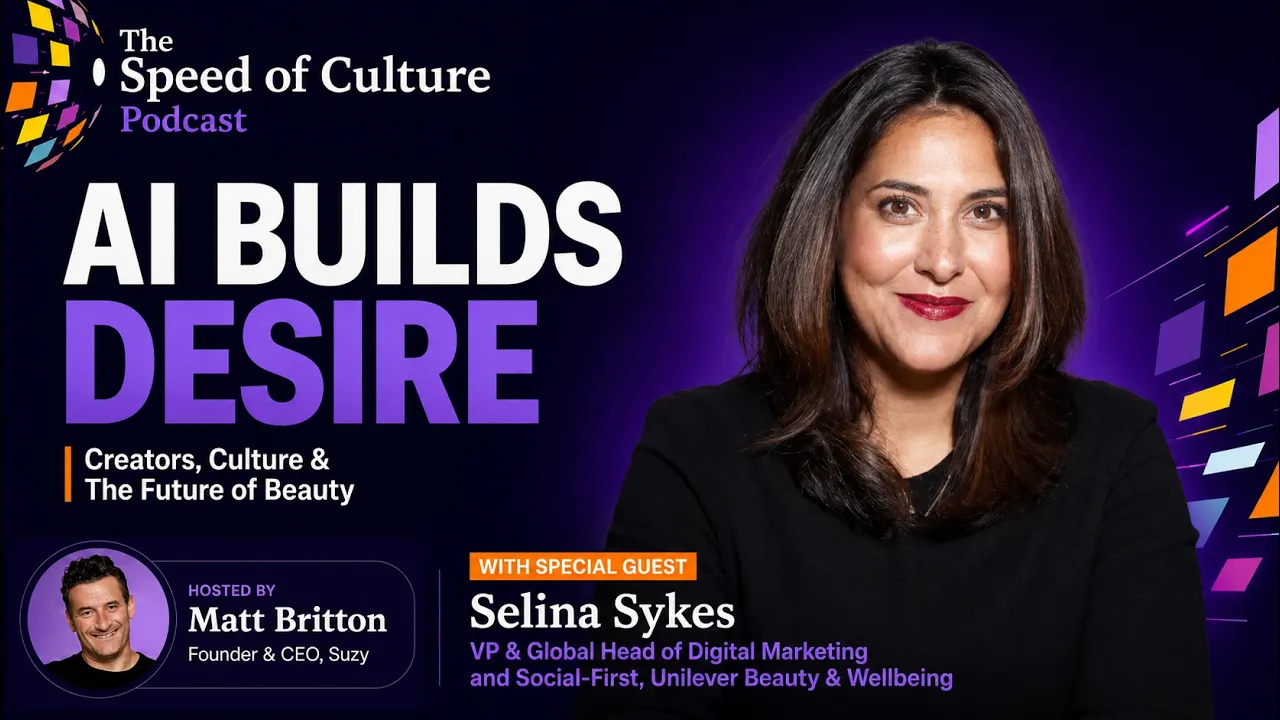
In an era where content multiplies faster than attention spans can follow, global beauty brands face a paradox: produce more, or produce better? Unilever's answer (articulated by Selina Sykes, VP and Global Head of Digital Marketing and Social-First, Unilever, Beauty & Wellbeing) reveals that the real transformation is about clarity, intentionality, and building systems that amplify human creativity rather than replace it, far more than volume.
On the Speed of Culture Podcast (Episode 230), host Matt Britton sat down with Selina to explore how Unilever is navigating one of the most complex challenges in modern marketing: scaling cultural relevance across hundreds of markets while maintaining authentic brand meaning. The conversation reveals not just a marketing transformation, but a philosophical shift in how enterprise brands should think about AI, creators, and community in the 2026 landscape.
Matt Britton, founder and CEO of Suzy, the AI-powered consumer intelligence platform, guided a discussion that moved beyond buzzwords to the operational realities of what it takes to build desire at scale. Selina shared how Unilever's Brand DNAi system, AI content supply chain, digital twins, and creator partnerships form an integrated ecosystem, each component solving real human friction points rather than chasing technological novelty. The insights emerging from this conversation carry implications far beyond beauty marketing.
Over nearly twenty years at Unilever, moving through brand building, ecommerce, incubation, and global transformation roles, Selina has witnessed multiple marketing revolutions. What makes her current work significant is timing: she's architecting a response to a moment when AI in marketing is real, creators are central to discovery, and consumer expectations for authenticity have never been higher. The speed of culture has accelerated, and the organizations that win are those that can respond with both speed and judgment.
From Broadcast to Many-to-Many: Rethinking Modern Marketing Architecture
The foundation of Unilever's marketing transformation rests on a simple but profound observation: broadcast thinking is dead. One-to-many marketing no longer reflects how people discover, share, or decide. The market now operates as many-to-many, with ideas flowing through creators, communities, platforms, and interest-based ecosystems simultaneously.
This shift demands a different infrastructure. Traditional marketing systems were built to control messages: centralize decisions, standardize assets, broadcast widely, measure impact. Today, the scarcity is the capacity to create enough good content fast enough to participate meaningfully in the ecosystems where people actually discover and decide, rather than attention to messages.
Selina describes Unilever's response as building an AI content supply chain, not to replace creators or humans, but to handle the volume and variety that a many-to-many world demands. The system allows teams to:
- Create and adapt content across markets in real time.
- Respond to cultural moments without losing brand integrity.
- Maintain consistency while allowing local nuance.
- Give marketing teams the structural freedom to operate creatively within guardrails.
The key insight is that this is about creating enough, rather than more, without sacrificing quality, meaning, or authenticity.
“We want to connect with people as people, not as consumers.”
By implementing digital twins and AI-enhanced content workflows, Unilever has reduced content production time by 30 percent while simultaneously improving performance metrics. Video completion rates doubled. Click-through rates improved. The work felt more designed, not more automated.
Brand DNAi: Memory as a Competitive Advantage
At the center of Unilever's marketing system sits Brand DNAi, a concept that reveals how forward-thinking organizations are approaching AI governance.
Brand DNAi is memory first, and technology second. After decades of building global beauty brands like Dove, Vaseline, POND'S, and CLEAR, Unilever carries enormous institutional knowledge. Historically, much of this knowledge lived in people's heads, in slide decks, or in processes that slowed teams down when speed mattered most.
Brand DNAi transforms that knowledge into a living context layer, a structured, intelligent data pool that generative AI tools can reference during creative development. Instead of asking teams to memorize brand guidelines or rely on people to apply judgment consistently, Brand DNAi makes brand understanding accessible, queryable, and actionable.
This approach reveals something crucial about AI governance in marketing: the best organizations are building intelligence to direct AI creativity rather than walls to prevent it.
“In a world shaped by AI in content creation, context becomes essential. AI can accelerate production, but it cannot decide what matters. Meaning still comes from human judgment.”
Brand DNAi essentially democratizes brand knowledge while centralizing brand strategy. For beauty brands especially, this matters enormously. By embedding human judgment into an intelligent system, Unilever ensures that scale doesn't equal homogeneity.
Digital Twins and the New Production Model
One of the most tangible examples of Unilever's marketing transformation involves digital twins. AI-generated visual replicas of products that can be adapted endlessly without reshooting.
Traditionally, filming product beauty shots required enormous production resources. A single product shoot could take weeks and cost tens of thousands of dollars. Even after that investment, only a few variations were captured.
With digital twins, Unilever creates a single high-quality 3D digital model of a product. From that model, teams can generate hundreds of variations (different angles, lighting, backgrounds, languages, packaging presentations, textures) all generated in hours, not weeks.
Unilever's use of digital twins has reduced content production time by approximately 30 percent while simultaneously improving performance metrics. Video completion rates rose. Click-through rates doubled. The system made something that was slow and expensive into something that was fast, affordable, and more creative.
Creators as Collaborators: The Vaseline Verified Blueprint
The human and cultural center of Unilever's marketing transformation emerges in the Vaseline Verified campaign, a collaboration with creators that didn't start in a boardroom.
The campaign originated with creators and consumers sharing everyday hacks using Vaseline on social platforms. Instead of watching from the sidelines, Unilever listened. The company tested those hacks in its labs, then invited creators into the process with full transparency about results.
This approach reframed Unilever's entire creator economy strategy.
“Creators build trust when treated as partners, not placements.”
At Cannes Lions 2025, the campaign won 11 Lions, two Grands Prix, and a Titanium award. But the real measure was the shift in philosophy, more than the awards. Long-term, thoughtful partnerships strengthen trust more than quick visibility boosts. In an AI-enabled world where content can be generated infinitely, authenticity becomes the scarcest resource.
Agentic Shopping and the Next Consumer Journey
Looking toward 2026 and beyond, Selina describes a shift that will rewrite how brands compete: agentic shopping and the rise of AI agents in decision-making.
Today, consumers search, compare, and decide. Tomorrow, AI agents will increasingly interpret needs, filter options, and take action on behalf of people. This shift is already visible in conversational AI tools and AI shopping assistants.
The implication is significant: your brand will increasingly be interpreted by machines before reaching people. Brand meaning, product positioning, and value proposition must be legible to AI systems, not just human consumers.
For marketers trained in an era of reach, frequency, and impression metrics, this represents a profound reorientation. The old playbook (be visible, drive traffic, convert buyers) is giving way to a new one: be clear, be trustworthy, and be represented intelligently in the systems that advise people.
Key Takeaways
- Clarity Over Volume: In markets saturated with content, reducing noise matters more than creating more.
- Brand Meaning Requires Human Judgment: AI accelerates scale, but authenticity and trust require human oversight.
- Creators as Partners, Not Placements: Long-term collaborations with genuine input build more trust than transactional influencer relationships.
- Technology Solves Real Friction: Effective AI deployments start by identifying operational friction before applying tools.
- Global Brands Need Local Fluency: Intelligent systems allow local adaptation while maintaining global consistency.
FAQ
What is Brand DNAi and How Does It Differ from Traditional Brand Guidelines?
Brand DNAi is an intelligent, living context layer that transforms brand knowledge into a queryable system. Unlike static brand guidelines stored in PDFs, Brand DNAi is interactive and adaptive, helping teams make faster, better decisions by embedding context directly into workflows.
How Are Digital Twins Changing Production Timelines and Costs in Beauty Marketing?
Unilever's use of digital twins has reduced content production time by approximately 30 percent while improving performance metrics like video completion and click-through rates. Teams generate variations in hours instead of weeks, unlocking faster experimentation and efficiency.
Why Is Authenticity Becoming More Important Than Reach in Creator Partnerships?
As audiences recognize transactional influencer relationships and algorithms prioritize genuine engagement, deep partnerships with creators who maintain editorial independence build more trust. In 2026, with de-influencing trends rising, authenticity is strategically valuable.
What Should Brands Know About Agentic Shopping Before It Becomes Mainstream?
Agentic shopping introduces AI agents as intermediaries between brands and consumers. Brands must ensure their core meaning, product information, and value propositions are structured intelligently and accessible to AI systems. Competitive advantage will shift from visibility to clarity and trustworthiness.
Looking Ahead
The Speed of Culture Podcast episode featuring Selina Sykes offers more than a case study in marketing transformation. It provides a framework for how enterprise brands should approach AI, creativity, and authenticity in 2026.
As marketing becomes increasingly mediated by technology, the organizations that will win are those that treat technology as a tool for amplifying human judgment rather than replacing it. Unilever's Brand DNAi, digital twins, AI content supply chain, and creator partnerships work together because they're designed around a coherent philosophy: scale without losing meaning.
To explore these ideas further, listen to the full episode on The Speed of Culture Podcast. For deeper dives into consumer intelligence and AI-driven strategy, explore Suzy. For broader context on AI's role in business transformation, consider Generation AI by Matt Britton. For consulting on how AI and culture intersect in your organization, visit AI Keynote Speaker services and Speaker HQ.

%20(400%20x%20100%20px)%20(300%20x%2050%20px)%20(150%20x%2050%20px).avif)