Opening
The snacking industry moves at a relentless pace. Consumer preferences shift with cultural moments, viral trends emerge overnight on TikTok, and what resonated with shoppers last quarter may feel stale today. Yet despite this volatility, Mondelēz International continues to dominate the global snacking category through one of the most counterintuitive strategies in modern marketing: rather than chasing what's trending today, the company works backward from a future state it envisions years ahead.
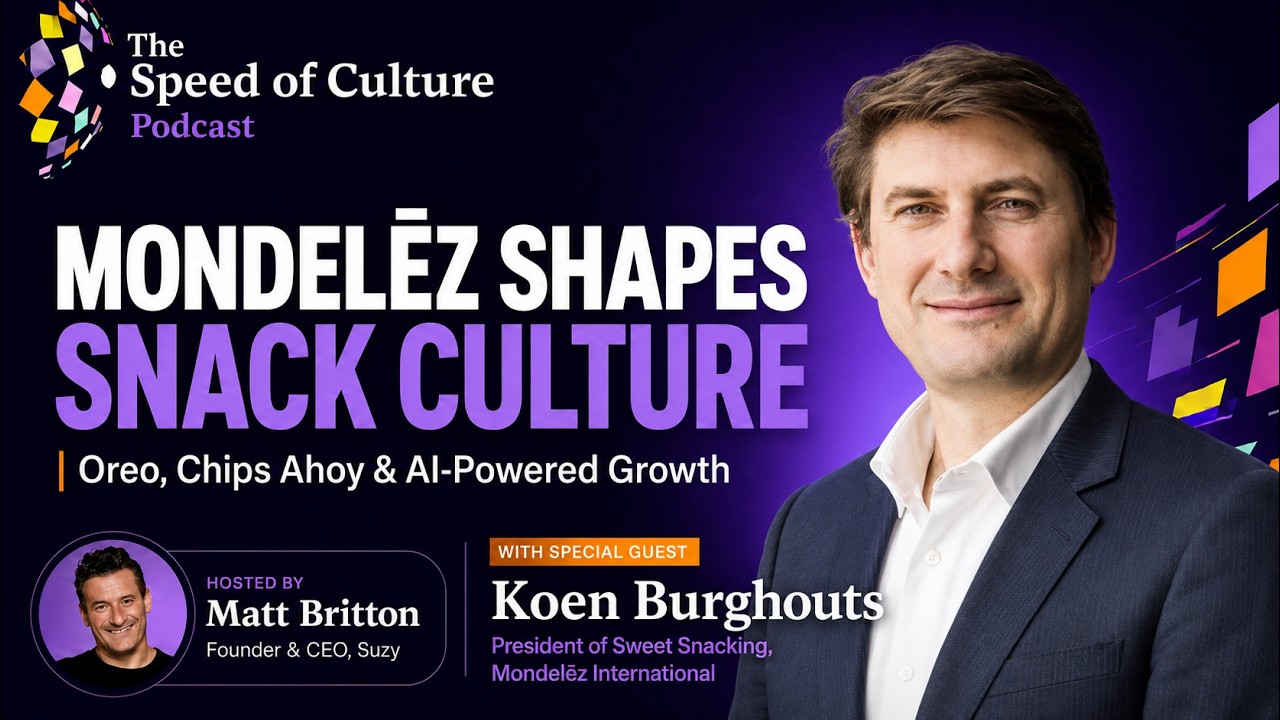
In Episode 227 of the Speed of Culture Podcast, host Matt Britton, founder and CEO of Suzy, the AI-powered consumer intelligence platform, sits down with Koen Burghouts, President of North America at Mondelēz International, to unpack how the company maintains cultural relevance for iconic brands like Oreo and Chips Ahoy in an era of unprecedented consumer fragmentation. The discussion (released on December 23, 2025) reveals that Mondelēz's secret weapon isn't innovation alone, but rather a disciplined approach to understanding where culture is headed and acting early to position beloved brands within that trajectory.
What makes this conversation particularly important for brand leaders and marketers is its clarity. Burghouts articulates a framework that transcends the snacking category: brands don't stay relevant because they are big; they stay relevant because they understand where culture is moving and act early. This philosophy shapes everything from product development to marketing strategy, from e-commerce discovery to celebrity partnerships.
In a world where speed has become table stakes, Mondelēz demonstrates that conviction, paired with data-driven insights and organizational flexibility, creates sustainable competitive advantage.
The stakes are substantial. Oreo generates over $1 billion annually. Chips Ahoy, similarly, represents enormous equity. Yet these aren't brands coasting on heritage. Both are experiencing growth, innovation, and cultural penetration that suggest Mondelēz has cracked the code on how legacy brands adapt to modern consumer behavior, generational preferences, and technological change.
For executives navigating their own transformation in a culture-forward marketplace, the insights from this episode offer a blueprint.
Working Backward to Stay Ahead: The Future-Back Philosophy
Traditional corporate strategy often begins with today's reality and projects forward. Mondelēz inverts this approach. Rather than starting with current brand positioning and asking where the market is heading, the company begins by asking: where do we want our brand to be in five or ten years? What does cultural relevance look like in 2030?
Once that clarity emerges, teams work backward, identifying the gaps between today's state and that future destination, then moving with urgency to close them.
This backward-working methodology addresses a fundamental challenge that many established brands face: the tendency to optimize for today while the market shifts beneath their feet. Burghouts explains that this approach demands cross-functional alignment across marketing, research and development, supply chain, and customer insights teams.
When everyone shares clarity on the destination, individual functions can move fast and make decisions independently without losing alignment. A product innovation team doesn't need to wait for final strategic approval if the north star is already established; they can prototype and test within the broader vision.
The practical impact is significant. When Oreo or Chips Ahoy teams evaluate a new flavor, partnership opportunity, or packaging format, they assess it not against current market share or quarterly revenue targets, but against the question: does this move us toward where we want this brand to be in the future?
This filter eliminates distracting or opportunistic moves that might chase short-term trends at the expense of long-term positioning. It also accelerates decision-making because the criteria are clear.
What's equally important is what this philosophy reveals about leadership in fast-moving consumer goods categories. Koen Burghouts emphasizes that modern leaders must understand the psychological and cultural underpinnings of consumer behavior, not just transaction data.
The snacking category, in particular, serves emotional and psychological needs, comfort, joy, moments of indulgence, social sharing, and ritual. Understanding these dimensions allows Mondelēz to position Oreo and Chips Ahoy not as commodity snacks, but as cultural touchstones that evolve to meet contemporary consumer needs while maintaining the heritage and emotional resonance that made them iconic in the first place.
The Cultural Currency of Premium Indulgence
One of the most surprising findings to emerge from snacking research in recent years is the resilience of premium and indulgent snacking categories even during periods of economic constraint. While consumers become price-sensitive across many food categories, snacking persists as a category where premium positioning, intentional indulgence, and emotional gratification drive purchasing decisions.
Mondelēz has built a substantial portion of its North American growth strategy around this insight.
The psychology underlying this trend reflects a broader shift in consumer values. As experiences become more polarized, consumers are trading down on everyday items while continuing to spend on moments of joy or intentional reward, snacks occupy a unique position as affordable luxuries.
A premium Oreo variant or limited-edition Chips Ahoy flavor allows consumers to experience a moment of indulgence without the commitment or cost of a restaurant meal or experiential purchase. This positioning has proven especially powerful for Gen Z and younger millennial consumers who grew up with social media as a medium for sharing food experiences.
A snacking moment becomes a moment worth photographing, sharing, and discussing.
Mondelēz capitalizes on this through strategic innovation that elevates the snacking experience. For Chips Ahoy, recent product innovations included a recipe update featuring higher-cacao chocolate and Madagascar vanilla extract, the most significant reformulation in nearly a decade.
The company also expanded the portfolio with new sizes (including a three-times larger format), flavors (chocolate caramel, red velvet, s'mores), and options (gluten-free varieties). Each innovation reinforces the message that Chips Ahoy is a thoughtfully crafted product worthy of intentional consumption and premium positioning.
For Oreo, the strategy focuses on limited-edition and seasonal offerings that drive collecting behavior, create urgency, and invite cultural participation. Oreo partners with cultural moments and celebrities, from K-pop acts like BABYMONSTER to established pop stars, creating products that exist at the intersection of snacking and cultural relevance.
The magic of this approach is that it preserves the core brand (the classic Oreo remains unchanged and beloved) while using limited editions as vehicles for cultural exploration and generational connection.
This strategy also demonstrates how Mondelēz thinks about channel and discovery. E-commerce, social commerce, and delivery platforms have fundamentally changed how consumers discover snacks.
A limited-edition collaboration, an influencer partnership, or a TikTok trend becomes the primary vehicle for driving awareness and trial in digital-first channels. Mondelēz invests heavily in real-time marketing, creator partnerships, and platform-native content that generates organic conversation and user-generated content. This approach turns premium innovation into a marketing engine, where the product itself becomes the story.
Artificial Intelligence and the Future of Snacking Marketing
Mondelēz's approach to artificial intelligence in marketing represents one of the most ambitious deployments of generative AI in the packaged-food industry. In partnership with Publicis Groupe and Accenture, the company invested over $40 million in developing an AI platform designed to accelerate content creation, reduce marketing production costs by 30 to 50 percent, and improve marketing personalization across channels.
The deployment timeline is aggressive: initial rollouts occurred during the 2025 holiday season, with expanded deployment anticipated for 2026 and beyond.
The strategic rationale is clear. Marketing budgets for large consumer packaged goods companies support hundreds of creative executions annually, television advertisements, digital content, social media posts, promotional materials, point-of-sale assets, and packaging designs.
Generative AI compresses this process, enabling rapid ideation, iteration, and production while freeing creative teams to focus on strategic direction and cultural insight rather than execution details.
For a company like Mondelēz, which manages a portfolio of 30+ brands across dozens of categories, the scale benefits are transformational. A global brand team can now generate 50 variations of a social media campaign for different markets, demographics, and platforms in a fraction of the time and cost of traditional production.
This agility is particularly valuable in snacking, where trends move quickly and windows of relevance for seasonal or limited-edition products are measured in weeks or months.
However, Koen Burghouts emphasizes that AI is not replacing strategic thinking or cultural understanding; rather, it's enabling faster execution of culturally informed strategy.
AI accelerates production and personalization, but the direction comes from human insight and conviction.
This distinction is critical for understanding Mondelēz's approach. The company is automating execution, while strategy remains in human hands.
Looking ahead, Mondelēz anticipates AI playing an even larger role in supply chain optimization, demand forecasting, consumer sentiment analysis, and product development. By analyzing consumer feedback in real time across social media, review platforms, and survey data, AI can identify emerging flavor preferences or cultural moments that should inform innovation pipelines.
This feedback loop, where market intelligence directly informs product development in near-real-time, positions the company to maintain its forward-back advantage, staying ahead of market shifts rather than reacting to them.
Channel-Specific Discovery and the Omnichannel Imperative
The snacking category has undergone a profound transformation over the past five years as consumers increasingly discover and purchase products through channels that didn't exist a decade ago: e-commerce direct-to-consumer, social commerce, delivery apps, and online marketplaces like Amazon.
This shift has made discovery a distinctly different challenge than in the era of physical retail dominance.
Digital commerce has inverted traditional shelf dynamics. On Amazon, a snack product can be excellent but invisible if it lacks organic search visibility and positive reviews. On TikTok, a snack becomes culturally relevant if it's mentioned or consumed in viral videos, inspiring search and purchasing behavior outside of the platform.
Each channel requires a distinct strategy for creating awareness, driving trial, and converting to repeat purchase.
Mondelēz recognized this fragmentation and has made omnichannel discovery a strategic priority. The company continuously tests new approaches to standing out in digital environments: influencer partnerships that drive organic mentions, limited-edition flavors that create urgency and conversation, packaging designs that photograph well and inspire social sharing, and strategic use of paid media to amplify organic momentum.
The company also leverages data from each channel to understand consumer behavior and preferences, then incorporates those insights into both strategy and product development.
A particularly sophisticated element of this strategy is the company's focus on authentic creator partnerships. Rather than simply paying celebrities or influencers to promote products, Mondelēz collaborates with creators who genuinely connect with and consume the brand.
The result is that the collaboration feels organic and authentic to audiences, driving meaningful engagement rather than passive exposure. Oreo's partnerships with musicians, athletes, and cultural figures demonstrate this approach: the collaborations are perceived as cultural moments worth discussing, not as advertising.
The competitive advantage that emerges from mastery of omnichannel discovery is substantial. Mondelēz's scale, marketing investment, data capabilities, and creative firepower allow the company to maintain presence and relevance across all channels simultaneously.
Building Cultural Rituals That Transcend Product Categories
Perhaps the most sophisticated element of Mondelēz's brand strategy is the recognition that truly iconic brands create rituals and invite cultural participation. Oreo, in particular, has transcended its identity as a cookie and become a platform for consumer behavior, social interaction, and shared experience.
The "twist, lick, and dunk" ritual that defines Oreo consumption is more than a product attribute; it's a participatory experience that invites play, creativity, and social sharing.
Consumers have invented thousands of variations on this ritual, different dipping mediums, novel flavor combinations, creative consumption methods. TikTok is filled with Oreo content: unboxings of limited editions, dunk tests, flavor reviews, and creative consumption methods.
This user-generated content is worth millions in earned media equivalent, yet it emerges organically because the brand has created a platform for participation.
Similarly, Chips Ahoy has evolved from a simple chocolate chip cookie into a vehicle for flavor exploration and snacking ritual. The expanded portfolio of sizes, flavors, and formats allows consumers to choose products that fit different occasions.
What's remarkable about this approach is that it positions snacking not as a passive consumption category but as an active, participatory one. Consumers don't simply eat Oreos; they engage with Oreos in ways that feel self-directed and creative.
This psychological shift, from passive consumption to active participation, creates deeper emotional connection and drives word-of-mouth advocacy that transcends traditional marketing.
For brand leaders across categories, this insight is profound: the most defensible, highest-margin, most culturally relevant brands are those that create rituals and invite consumer participation.
Mondelēz understands this and protects it fiercely. Even as the company introduces new products and flavors, the core ritual remains unchanged and sacred.
This balance between stability (the core product and ritual) and evolution (new flavors, limited editions, collaborations) allows the brand to feel both timeless and contemporary.
Key Takeaways
- Future-back thinking provides clarity and competitive advantage. By identifying long-term brand positioning and working backward from that vision, Mondelēz aligns internal teams, accelerates decision-making, and maintains cultural relevance even as market conditions shift rapidly.
- Premium indulgence is a resilient consumer trend. Even during economic uncertainty, consumers prioritize affordable moments of intentional indulgence and emotional reward, creating opportunity for snack brands positioned as premium experiences rather than commodity products.
- Artificial intelligence accelerates execution of culturally informed strategy. Mondelēz's $40 million investment in generative AI reduces marketing production costs while enabling personalization and speed, but human insight remains the critical source of strategic direction.
- Omnichannel discovery requires channel-specific strategies and continuous testing. Digital environments demand different discovery approaches than physical retail; success requires investment in influencer partnerships, limited editions, and platform-native content that generate organic conversation.
- Cultural rituals and consumer participation drive defensible brand equity. Brands that invite consumer creativity, participation, and ritual, like Oreo's twist-lick-dunk experience, create emotional connection and word-of-mouth advocacy that transcend traditional marketing.
FAQ
How does Mondelēz decide which limited-edition Oreo flavors to develop?
Mondelēz uses a combination of consumer research, trend analysis, and cultural insight to inform flavor development. The company monitors emerging preferences, whether trending on social media, appearing in consumer surveys, or emerging in new food trends, and evaluates potential collaborations based on cultural relevance and audience alignment.
Limited editions are designed not just to drive short-term sales spikes, but to reinforce Oreo's position as a culturally aware, innovative brand that invites consumer participation and conversation. Testing and learning across different markets helps inform which flavors expand globally versus remain regional.
What role does social media play in Mondelēz's marketing strategy for snacking brands?
Social media is integral to Mondelēz's discovery and engagement strategy. Platforms like TikTok, Instagram, and YouTube serve as primary discovery channels for Gen Z and younger millennial consumers, and user-generated content drives authentic advocacy that traditional advertising cannot replicate.
Mondelēz invests in creator partnerships, real-time marketing, platform-native content, and tools to amplify organic conversation. The company also monitors social sentiment to identify emerging trends and opportunities for product development and marketing innovation.
How does the company balance innovation with heritage in brands like Oreo and Chips Ahoy?
The key is maintaining a stable core while evolving at the periphery. The classic Oreo cookie and the core Chips Ahoy product remain unchanged and beloved; innovation manifests through limited editions, collaborations, new flavors, expanded sizes, and strategic partnerships.
This approach allows the brands to feel both timeless and contemporary. By protecting the core while innovating at the edges, Mondelēz maintains the emotional connection and heritage that make these brands iconic while signaling cultural awareness and forward-thinking positioning.
How is Mondelēz using artificial intelligence to improve marketing effectiveness for snacking brands?
Mondelēz's generative AI platform accelerates content creation, reduces production costs, enables personalization across channels, and supports rapid testing and iteration. The company uses AI to generate variations of advertisements, social content, and promotional materials optimized for different audiences, platforms, and markets.
This allows marketing teams to focus on strategic direction and cultural insight while AI handles production execution. The company also anticipates using AI for demand forecasting, supply chain optimization, and real-time consumer sentiment analysis to inform product development and marketing strategy.
Looking Ahead
The conversation between Matt Britton and Koen Burghouts offers more than tactical insights into snacking marketing; it provides a framework for how established brands maintain relevance in a fast-moving, culture-forward marketplace.
To dive deeper into the full conversation and explore additional episodes featuring brand leaders navigating cultural change, visit the Speed of Culture Podcast. For access to consumer intelligence insights and real-time trend analysis, explore Suzy, the AI-powered platform Matt Britton leads.
Those interested in understanding generational behavior, cultural dynamics, and the future of consumer marketing should explore Matt Britton's insights through Generation AI: The Book and his offerings as an AI Keynote Speaker.
For teams looking to apply these insights to their own organizations, Speaker HQ offers resources and speaking opportunities with Matt Britton and other industry leaders focused on the intersection of culture, consumer behavior, and business strategy.

%20(400%20x%20100%20px)%20(300%20x%2050%20px)%20(150%20x%2050%20px).avif)