Understanding Data as Cultural Currency in Modern Marketing
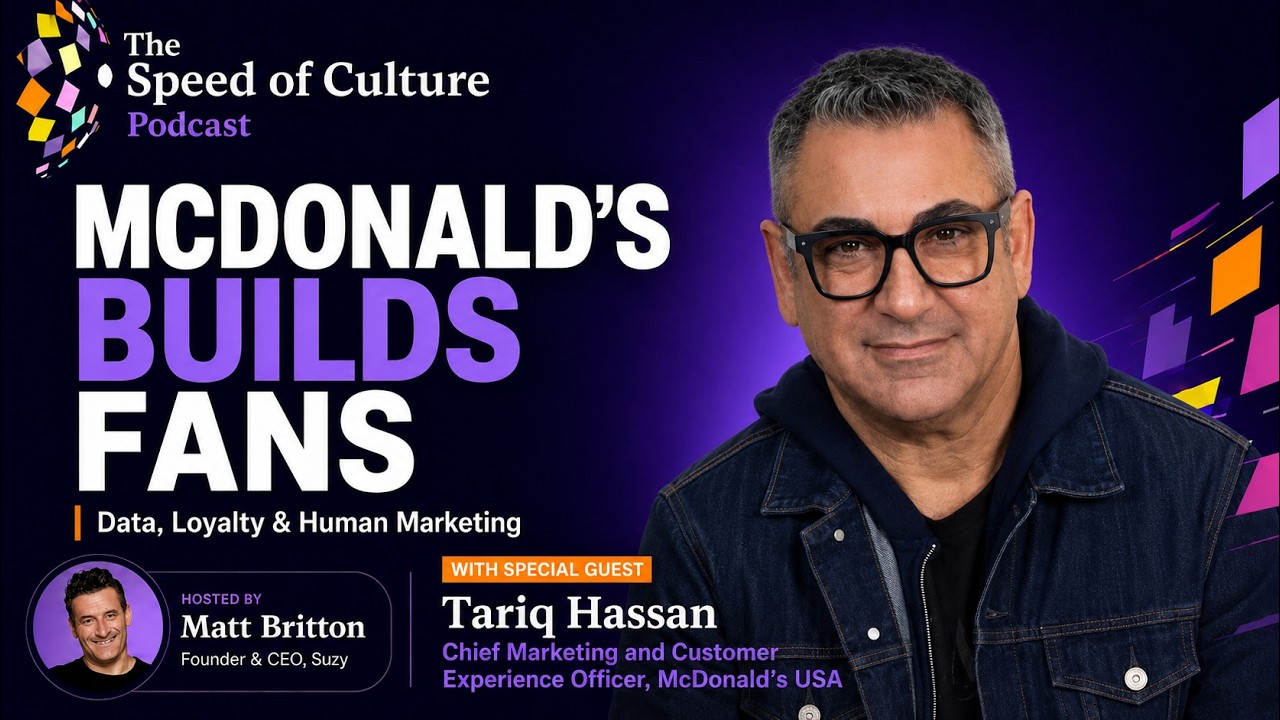
In a recent episode of the Speed of Culture podcast, Matt Britton, founder and CEO of Suzy, the AI-powered consumer intelligence platform, sat down with Tariq Hassan, Chief Marketing and Customer Experience Officer at McDonald's USA, to explore how data has fundamentally transformed the role of modern marketers. What emerged was a masterclass in balancing consumer privacy, cultural authenticity, and data-driven strategy, a framework that every CMO should understand.
Hassan brings two decades of world-class brand-building experience across diverse categories including PepsiCo, Gatorade, GM, Johnson & Johnson, Mars, HP, Mercedes-Benz, and Emirates Airlines. His rare combination of general management expertise and operational acumen has positioned him to lead McDonald's transformation into a data-first organization that doesn't sacrifice cultural relevance for technological sophistication.
The conversation revealed a critical insight: data isn't just a tool for targeting anymore. When wielded thoughtfully, it becomes a form of cultural currency, a way for brands to create genuine, permission-based relationships with customers who increasingly expect personalization without creepiness.
For McDonald's, this philosophy has resulted in building a first-party database of over 40 million known customers through their MyMcDonald's Rewards loyalty program, fundamentally reshaping how the fast-food giant acquires customers, engages them, and predicts future consumer trends.
In an era where third-party cookies are disappearing and consumer privacy expectations are rising, Hassan's approach offers a blueprint for enterprise brands seeking sustainable competitive advantage. The question he poses to the industry is simple but profound:
Can we use data more humanely while simultaneously building stronger business results?
Data as Currency: From Transactional Measurement to Cultural Intelligence
Tariq Hassan opened the discussion with a surprising statement: marketing theory hasn't fundamentally changed in decades. The principles of understanding target audiences, crafting compelling messages, and measuring impact remain constant. What has changed dramatically, however, is the medium through which we apply these timeless principles, and the precision with which we can operationalize them.
Technology has transformed three critical dimensions of marketing effectiveness: data processing, accuracy, and measurement. Where marketers once relied on demographic segmentation and broad behavioral assumptions, they now can integrate first-party customer data with sociological inputs, contextual signals, and soft data elements like passion points and cultural affinities.
This integration creates what Hassan calls "the intimacy of data", the ability to know your customer as a human being rather than as a data point.
The implications are profound. Traditional customer acquisition relied on broad media spending and mass-market messaging. Today, McDonald's uses its 40-million-customer dataset not just to target individuals but to understand consumer trends at scale, predict which menu innovations will resonate, and identify emerging cultural moments before competitors can exploit them.
This is data as predictive intelligence, not just historical measurement.
Hassan emphasized that this evolution matters because consumer preferences are inherently moving targets. The wants and needs that drove purchasing decisions three years ago no longer apply in their original form. Successful brands must invest continuously in understanding not just what customers want, but why they want it, and how those desires connect to deeper cultural shifts in music, fashion, entertainment, and social values.
Permission-based marketing becomes critical in this context. Rather than interrupting consumers with unsolicited messages, McDonald's has built its MyMcDonald's Rewards program around the premise that customers grant explicit permission to receive communications because those communications deliver clear value.
This transforms the customer relationship from adversarial (brand invades consumer attention) to collaborative (consumer and brand mutually benefit). It's the difference between surveillance marketing and intimate marketing.
The Four Pillars: McDonald's Blueprint for Cultural Relevance and Customer Connection
Hassan articulated McDonald's comprehensive approach to customer connection through what he termed the "Four Pillars", a strategic framework that demonstrates how data and cultural insight work together in practice.
Pillar One: Shaping Culture Taste Through Menu Innovation
The first pillar involves celebrating the food everyone knows and loves while using cultural trends to inform menu innovation. McDonald's doesn't simply react to food trends; the company actively shapes culinary culture by understanding which nostalgic elements resonate with consumers and how those can be reimagined for contemporary audiences.
The strategy requires marrying historical brand equity (McDonald's iconic menu items) with cultural momentum (emerging food trends, celebrity influences, regional preferences).
This is where the MyMcDonald's Rewards data becomes invaluable. By analyzing purchase patterns, loyalty member demographics, and regional engagement, McDonald's can test new menu items with core customers before broader rollout.
They can identify which demographic segments are most excited about plant-based options, which regions show strongest interest in spicy offerings, and how seasonal variations impact customer behavior across diverse markets.
Pillar Two: Immersing in Customer Creative Universes
The second pillar requires McDonald's to fully engage with customers by immersing itself in their creative universes, connecting with them through passions like music, art, and fashion. This goes far beyond traditional sponsorships.
It means participating authentically in cultural moments that matter to target audiences, whether that's collaborating with emerging fashion brands, engaging with music culture, or celebrating artistic expression.
The Cactus Plant Flea Market collaboration exemplifies this approach. What began as a Tweet from founder Cactus Plant Flea Market founder evolved into a full partnership that tapped into millennial and Gen Z nostalgia for McDonald's Happy Meals while creating limited-edition collectible toys that became cultural artifacts.
This was McDonald's recognizing what fans were already expressing and co-creating something authentic with them, rather than telling customers what they should want.
Such collaborations are data-informed but not data-driven in the traditional sense. Hassan understands that the most powerful cultural moments emerge from genuine connection rather than algorithmic calculation.
The data role here is validation and amplification, confirming the cultural resonance of an idea and measuring its impact, not determining the idea itself.
Pillar Three: Using Data Insights to Stay Ahead of Cultural Curves
The third pillar involves using data insights to anticipate future cultural movements and inform marketing strategies that evolve with culture itself. This requires real-time cultural monitoring, trend analysis, and the agility to shift strategies quickly when cultural momentum shifts.
McDonald's 40-million-person loyalty database becomes a cultural sensors network. What items are trending in specific regions? Which customer segments are driving growth? How are preferences changing quarter-over-quarter? What emerging cultural moments are generating conversation within the customer base?
By analyzing these patterns, McDonald's can identify cultural movements before they reach mainstream saturation, positioning the brand as a cultural participant rather than a follower.
This approach also surfaces opportunities for meaningful customer engagement around culture. When particular music artists, fashion trends, or entertainment moments gain traction within the McDonald's customer base, the company has the data infrastructure and decision-making agility to respond authentically.
Pillar Four: Building Fan-to-Fan Connections Rather Than Brand-to-Fan Transactions
The fourth and perhaps most revolutionary pillar shifts the fundamental relationship model from brand-to-consumer to fan-to-fan. Hassan articulated this as allowing fans to reflect their identities within the McDonald's brand itself, creating stronger and more authentic connections because customers see themselves genuinely represented.
This philosophy permeates everything from menu development to marketing partnerships to social media engagement. Rather than McDonald's dictating what's cool or trendy, the brand creates spaces where fans can co-create meaning.
The Cactus Plant Flea Market collaboration again exemplifies this: customers were participating in something that felt organically aligned with their cultural interests rather than receiving a branded message.
The MyMcDonald's Rewards loyalty program reinforces this approach. Members don't receive generic promotions; they receive rewards and offers tailored to their demonstrated preferences, purchase history, and stated interests.
The permission-based structure means customers control the nature and frequency of engagement, reinforcing the sense that McDonald's respects their autonomy.
The Intersection of AI, Privacy, and Human Connection
The conversation naturally evolved toward artificial intelligence's role in modern customer experience. Hassan was notably thoughtful about the opportunities and pitfalls of AI-driven personalization.
He acknowledged that AI enables unprecedented ability to understand customer context and tailor messaging with precision. The challenge lies in what Hassan called "operationalizing AI to create meaningful impacts" without crossing into creepy territory, a phrase that resonates because every consumer has experienced a brand that seems to know too much about them in unsettling ways.
The solution, Hassan argued, isn't to retreat from AI but to remain thoughtful about how it's deployed. Permission-based marketing creates a natural constraint: if customers have explicitly granted permission for McDonald's to use their data in specific ways, then increasingly sophisticated AI personalization feels like a benefit rather than surveillance.
The customer understands the implicit bargain, "I give you data about my preferences; you make my experience more relevant and rewarding."
Data privacy becomes non-negotiable in this framework. If customers discover that McDonald's is using their first-party data in ways that violate stated promises or consumer expectations, the entire relationship collapses.
Trust, once broken, is extraordinarily difficult to rebuild. This is why Hassan emphasized the importance of transparency about data usage and genuine customer control over how their information is deployed.
The intersection of human connection and AI is perhaps the most important insight from Hassan's perspective. AI shouldn't replace human understanding of culture; it should amplify it.
Better data and smarter algorithms allow McDonald's marketing teams to focus their creative energy on identifying cultural moments and crafting authentic responses rather than wasting time on manual data processing or conventional market research. AI becomes a tool that creates space for human creativity and cultural insight to flourish.
Building a Curious, Resilient Culture: The Human Element of Data-Driven Marketing
As the conversation moved toward career advice, Hassan emphasized that data sophistication means nothing without the human qualities that drive great marketing: curiosity, creativity, and resilience in the face of failure.
He encouraged marketers entering the industry or seeking advancement to maintain relentless curiosity about culture, consumer psychology, and emerging technologies. The marketing landscape is changing too rapidly for specialists to remain competitive; the future belongs to marketing leaders who can synthesize insights across disciplines, data science, cultural studies, psychology, business strategy, and creative arts.
Equal emphasis was placed on cultivating creative sensibility. Data creates competitive advantage only when paired with creative thinking that reimagines what's possible.
The raw insight that McDonald's millennial and Gen Z customers carry strong nostalgic associations with Happy Meal toys is just data. The creative idea of partnering with Cactus Plant Flea Market to transform those toys into limited-edition collectible art pieces is what turns data insight into cultural moment.
Finally, Hassan stressed the importance of failing.
Don't be afraid to fail.
The rapid iteration and cultural experimentation that drive contemporary marketing necessarily involve missteps, unsuccessful partnerships, and campaigns that don't resonate as expected.
The organizations that win are those that learn from failures quickly and adjust course intelligently, with no need for perfect hit rates.
This philosophy applies directly to McDonald's data strategy. The company invests in testing new ideas (menu innovations, partnership models, engagement tactics) knowing that not all will succeed.
The first-party data infrastructure allows rapid assessment of what's working and what isn't, enabling quick pivots without massive sunk costs.
Looking Ahead: The Future of Data-Driven Customer Experience
McDonald's transformation under Hassan's leadership demonstrates that the future of competitive advantage in QSR and beyond belongs to brands that master the integration of three capabilities: sophisticated data analytics, authentic cultural participation, and human-centered design that respects consumer autonomy.
The 40 million customers in the MyMcDonald's Rewards database represent far more than a marketing asset. They represent a community that McDonald's has earned permission to understand and serve.
That relationship became possible because McDonald's created genuine value through the loyalty program (rewards, personalization, convenience) rather than trying to extract value from customers.
As artificial intelligence, machine learning, and data analytics continue advancing, brands will face a critical decision: use these tools to surveil and manipulate consumers, or use them to create more meaningful, respectful, and valuable customer relationships.
Hassan's philosophy suggests the latter path is both ethically superior and more profitable. Customers grant permission, remain loyal, and advocate for brands that earn their trust through authentic engagement.
For marketing executives and customer experience leaders seeking to navigate the complex landscape of data, privacy, and cultural relevance, Hassan's framework offers actionable guidance:
- Build first-party data relationships grounded in permission and value.
- Use data to understand culture, not to predict it.
- Invest in authentic partnerships and collaborations that align with consumer passions.
- Create space for human creativity and cultural insight to flourish.
- Recognize that the most intimate relationships between brands and customers emerge when both parties understand they're mutually better off.
Key Takeaways
- Data is currency only when paired with consent: McDonald's MyMcDonald's Rewards program builds a first-party database of 40+ million customers through permission-based value exchange, creating competitive moat that third-party data can't match.
- Cultural authenticity requires active participation, not observation: McDonald's doesn't study culture from the sidelines; it participates authentically through menu innovation, artist collaboration, and fan-centered engagement that allows customers to see themselves in the brand.
- Successful AI implementation respects privacy and autonomy: Using AI to create more relevant customer experiences only succeeds when customers understand and consent to how their data is deployed, transforming potential surveillance into genuine service.
- Curiosity and creative sensibility drive sustainable competitive advantage: Data infrastructure and analytical capabilities only deliver value when paired with marketing leaders who remain curious about culture, maintain creative thinking, and embrace intelligent failure as a learning tool.
- The future belongs to "fan-to-fan" relationship models: Brands that shift from broadcasting messages to enabling customer communities create stronger loyalty, authentic advocacy, and cultural relevance that transcends traditional brand-customer dynamics.
Frequently Asked Questions
What is the MyMcDonald's Rewards program and how does it fuel McDonald's data strategy?
The MyMcDonald's Rewards loyalty program is a permission-based system where customers voluntarily share transaction data, preferences, and opt in to personalized communications in exchange for rewards and exclusive offers.
This program has built McDonald's database of over 40 million known customers, creating a first-party data asset that enables personalized marketing without relying on third-party cookies or invasive tracking methods.
The data collected helps McDonald's understand regional preferences, identify emerging menu trends, and deliver individually relevant offers, all with explicit customer consent.
How does McDonald's balance personalization with customer privacy concerns?
Hassan emphasized that permission-based marketing creates a natural balance. Customers understand and consent to the data exchange: "I give you information about my preferences; you make my experience more relevant."
Transparency about data usage and genuine customer control over their information are non-negotiable. McDonald's treats data privacy as foundational to customer trust, recognizing that any breach of stated promises would undermine the loyalty relationship.
This approach treats privacy as a competitive advantage rather than a constraint.
What can other brands learn from McDonald's approach to cultural collaboration?
McDonald's demonstrates that successful cultural partnerships emerge from authentic participation rather than forced commercialization.
The Cactus Plant Flea Market collaboration worked because it recognized what fans already cared about (nostalgic Happy Meal toys, limited-edition collectibles) and co-created something genuine with them rather than dictating what they should want.
Hassan's philosophy of "fan-to-fan" rather than "brand-to-fan" suggests that brands should listen to customer passions, identify authentic ways to participate, and create space for customers to see themselves reflected in brand partnerships.
Related Reading and Resources

%20(400%20x%20100%20px)%20(300%20x%2050%20px)%20(150%20x%2050%20px).avif)