Opening
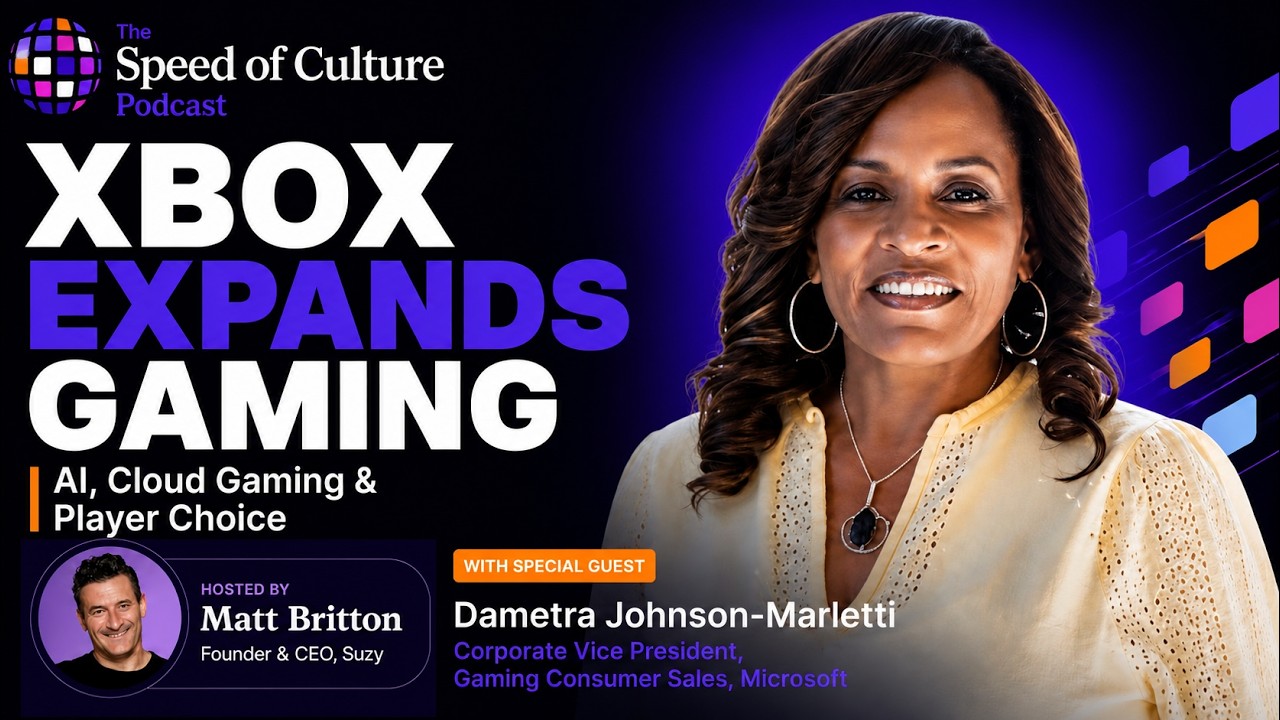
In a rapidly evolving gaming landscape where consumer preferences shift faster than ever, understanding how major technology players like Microsoft approach gaming strategy becomes critical for business leaders, marketers, and technology professionals. The Speed of Culture Podcast Episode 117, released on June 25, 2024, featured an in-depth conversation between Matt Britton, founder and CEO of Suzy, the AI-powered consumer intelligence platform, and Dametra Johnson-Marletti, Corporate Vice President of Gaming Consumer Sales at Microsoft.
This episode explores the intersection of consumer choice, technological innovation, and corporate culture that defines Microsoft's approach to gaming in 2024 and beyond.
The discussion reveals how Microsoft has fundamentally transformed its gaming business model over the past two decades. Rather than focusing solely on console hardware sales, the company has embraced an "Xbox Everywhere" strategy that prioritizes customer choice and accessibility across all devices.
Johnson-Marletti shares critical insights into how Microsoft navigated major cultural shifts under Satya Nadella's leadership, adopted AI and cloud gaming technologies to enhance player experiences, and committed to making gaming truly inclusive through accessibility initiatives and diversity programs. For executives and decision-makers evaluating technology partnerships, platform strategies, or consumer engagement approaches, this episode provides valuable frameworks for understanding how enterprise organizations can successfully pivot their business models while maintaining brand loyalty and market relevance.
The episode also delves into how Microsoft's consumer sales teams operate within a unified "One Microsoft" structure, leveraging the company's broader ecosystem to deliver comprehensive solutions to gamers worldwide. From Game Pass subscriptions to cloud-based streaming capabilities, Microsoft's strategy demonstrates how organizations can create multiple revenue streams while remaining laser-focused on customer value.
As gaming continues to represent a multi-billion-dollar industry attracting 3 billion players globally, the strategic lessons from this conversation extend far beyond gaming itself. They offer actionable insights for any enterprise navigating digital transformation, platform strategy, and customer-centric innovation.
The Evolution of Gaming: From Physical to Digital and Beyond
The gaming industry has experienced seismic shifts over the past two decades, and Microsoft's journey mirrors these transformations perfectly. What began as a console-centric business model in the early 2000s has evolved into a complex ecosystem spanning multiple platforms, distribution channels, and business models.
Johnson-Marletti emphasizes that consumer preferences have fundamentally changed how games are acquired and consumed. Where physical media once dominated, gamers would wait in line at retail locations to purchase physical discs, today's players demand flexibility in how they access content.
This evolution wasn't driven by manufacturers pushing new technologies onto consumers. Instead, it emerged from genuine shifts in consumer behavior. As broadband infrastructure improved and digital distribution became viable, players voted with their feet, preferring to download games instantly rather than travel to stores.
This preference for convenience and accessibility drove Microsoft to rethink its entire gaming strategy. The company recognized that clinging to a hardware-only model would limit their addressable market and fail to serve the diverse preferences of modern gamers.
The transition from physical to digital distribution also accelerated the rise of subscription-based models like Game Pass, which has become a cornerstone of Microsoft's gaming strategy. By offering access to hundreds of games for a monthly fee, Microsoft democratized gaming access and created new revenue streams that complement traditional game sales.
This shift in consumer behavior has profound implications for how the entire technology industry approaches product distribution, customer retention, and lifetime value optimization.
Moreover, the evolution of gaming touches broader business transformation principles. As platforms become more open and technology more accessible, companies must embrace a consumer-first mentality rather than a product-first one.
Microsoft's willingness to let go of console supremacy and reimagine itself as a gaming platform company, rather than a hardware manufacturer, demonstrates the kind of strategic flexibility that increasingly defines successful technology enterprises in the digital age.
Xbox Everywhere: Reimagining Platform Strategy in a Multi-Device World
Microsoft's "Xbox Everywhere" strategy represents a fundamental departure from traditional gaming industry orthodoxy. Rather than creating exclusive content that binds players to specific hardware, Microsoft has chosen to make Xbox games and services available across smartphones, tablets, PCs, gaming consoles, and cloud streaming platforms.
This approach reflects a sophisticated understanding of modern consumer behavior: players want access to their games and gaming communities from wherever they are, regardless of device.
The cultural shift required to implement this strategy cannot be overstated. Under previous leadership, Microsoft divisions operated with more autonomy, sometimes working at cross-purposes. Satya Nadella's leadership brought what Johnson-Marletti calls a "One Microsoft" mentality, where all business units align around shared customer outcomes rather than protecting divisional interests.
When Microsoft executives decided to bring Xbox games to PlayStation and Nintendo platforms, this required a genuinely transformative mindset shift. Gaming became about reaching players wherever they are and building lasting relationships, rather than hardware lock-in.
This strategy creates multiple competitive advantages. First, it dramatically expands addressable market size. Rather than being limited to Xbox hardware owners, Xbox Game Pass can reach PlayStation owners, Nintendo Switch users, and mobile gamers.
Second, it reinforces Microsoft's ecosystem benefits. Players using Xbox services across multiple devices naturally become more invested in the ecosystem, making them more likely to upgrade to Game Pass, purchase additional content, or choose Xbox when considering new hardware.
Third, it reduces the risk of gaming hardware disruption. Unlike companies whose entire business depends on proprietary hardware maintaining market position, Microsoft can pivot more flexibly as technology evolves.
The "Xbox Everywhere" approach also demonstrates sophisticated platform economics. Rather than competing primarily on hardware specifications or exclusive content, Microsoft competes on breadth of access and quality of service.
Game Pass, for instance, reduces friction in game discovery and purchase decisions. Players don't need to commit $70 to a single title; they can explore hundreds of options with a monthly subscription. This shift from transaction-based revenue to subscription-based revenue aligns gaming with broader technology trends where recurring revenue models increasingly dominate.
AI, Cloud Gaming, and the Future of Consumer Experience
Artificial intelligence and cloud computing technologies represent the next frontier in gaming evolution, and Microsoft is investing heavily in both. Johnson-Marletti discusses how AI enables increasingly personalized gaming experiences.
Rather than one-size-fits-all design, AI systems can analyze individual player behavior, preferences, and skill levels to optimize content discovery and difficulty scaling. This personalization extends across Microsoft's entire gaming ecosystem, helping players find games they'll love while reducing the overwhelming choice paralysis that often characterizes large platforms.
Cloud gaming technology, implemented through Xbox Cloud Gaming, removes another barrier to gaming participation. Players no longer need to purchase expensive gaming hardware to access console-quality experiences. They can stream games directly to their existing devices.
This democratizes gaming access substantially, particularly in regions with emerging gaming markets where hardware costs remain prohibitively expensive for many potential players. Microsoft reported reaching 20 million Game Pass users with access to cloud gaming capabilities, demonstrating meaningful market adoption.
The convergence of AI and cloud gaming creates powerful synergies. Cloud infrastructure generates enormous amounts of player behavior data, which AI systems can analyze in real-time to optimize experiences.
Game discovery algorithms powered by machine learning can surface content that matches individual preferences. AI-driven game balancing ensures fair competition and appropriate difficulty scaling. These technologies work together to create gaming experiences that feel increasingly personalized and engaging.
Microsoft's approach also reflects a deeper understanding about how technology adoption typically occurs. Rather than pushing experimental technologies like VR headsets as mainstream gaming platforms, Microsoft focuses on technologies with proven consumer demand.
Cloud gaming addresses genuine consumer pain points, access friction, hardware costs, portability limitations. AI personalization addresses content discovery challenges that plague large digital platforms. By focusing on consumer-centric applications of emerging technology, Microsoft reduces adoption risk while maximizing meaningful impact.
The scale of Microsoft's cloud gaming infrastructure also creates competitive advantages that smaller competitors cannot easily replicate. Building and maintaining global cloud gaming networks requires massive capital investment, sophisticated engineering, and extensive partnerships with internet service providers.
Microsoft's Azure infrastructure, developed for enterprise computing, provides the foundation for gaming services that competitors must build from scratch. This represents genuine defensible competitive advantage built on accumulated technical capabilities rather than temporary market advantages.
Accessibility, Diversity, and Inclusion as Market Expansion Strategy
One of the most striking aspects of Johnson-Marletti's perspective on gaming is treating accessibility and diversity not as corporate social responsibility initiatives but as fundamental business strategy. When Microsoft talks about reaching three billion players globally, the mathematics become obvious.
The vast majority of potential players have disabilities, live in regions with limited access to premium gaming hardware, or belong to demographic groups traditionally underrepresented in gaming communities. Expanding addressable market requires genuine inclusion.
Xbox's commitment to this principle manifests in concrete initiatives. The Gaming for Everyone Product Inclusion Framework, released in 2024, provides actionable guidance for game developers around accessibility considerations.
The development of Xbox Adaptive Controllers addresses a genuine market need, offering affordable, customizable controllers for players with disabilities. These aren't token gestures; they represent meaningful product investments serving real customer needs.
The fact that these innovations often become industry standards demonstrates how accessibility-focused design can drive innovation benefiting all players.
Johnson-Marletti emphasizes the importance of representation in game content as well. When game characters and stories reflect the diversity of the player community, it signals inclusion and welcomes broader audiences.
Representation also creates engagement incentives, players want to see themselves reflected in media they consume. By ensuring Microsoft's gaming content pipeline includes diverse stories, characters, and creators, the company simultaneously improves content quality, reaches broader audiences, and builds stronger player loyalty.
The business case for accessibility and diversity extends beyond moral imperatives. In an increasingly competitive market where switching costs have decreased, player loyalty depends heavily on whether players feel welcome and valued.
Microsoft's accessibility initiatives signal genuine commitment to players with disabilities. Diverse content offerings signal genuine commitment to underrepresented player communities. These signals build trust and loyalty that marketing budgets cannot easily replicate.
Furthermore, accessibility innovations often drive broader technological improvements. Controllers designed for accessibility frequently inspire innovations benefiting all players.
Game design choices made with cognitive disabilities in mind often improve user experience for players with poor attention spans or decision fatigue. By prioritizing accessibility from the beginning rather than retrofitting it later, game developers create better products.
Microsoft's framework-based approach to inclusion recognizes this truth and encourages developers to think about accessibility throughout the development process rather than as an afterthought.
The Role of Global Gaming Consumer Sales in a Unified Microsoft
Understanding Microsoft's success in gaming requires understanding how gaming consumer sales operates within the broader organizational context. Johnson-Marletti leads the digital gaming sales team that oversees e-commerce and global distribution.
This responsibility spans digital storefronts on PCs, Xbox consoles, and mobile devices. The complexity of coordinating across these platforms while maintaining consistent customer experience, regional compliance, and diverse payment method support is substantial.
What distinguishes Microsoft's approach is the degree to which consumer sales operates collaboratively across the organization. Rather than operating as a silo focused solely on transaction volume, consumer sales teams partner with game studios, marketing organizations, regulatory teams, and cloud infrastructure providers.
This integrated approach allows Microsoft to optimize across multiple dimensions simultaneously: conversion rate optimization, customer lifetime value, regional market adaptation, payment method accessibility, and regulatory compliance.
The global dimension adds another layer of complexity. Consumer preferences, regulatory frameworks, and payment infrastructure vary dramatically across regions.
In the United States, credit card payments dominate. In other regions, mobile payment systems, local payment methods, or carrier billing might be standard. Microsoft's consumer sales operation must accommodate these diverse preferences while maintaining secure payment processing and fraud prevention.
This requires both technological sophistication and deep understanding of regional markets.
Johnson-Marletti's emphasis on "One Microsoft" reflects how successful organizations coordinate across different functions. Rather than competing for budget and attention, different teams align around shared customer outcomes.
When sales teams understand marketing objectives and product roadmaps understand consumer preference data, organizations make better decisions. This kind of organizational integration, while challenging to implement, creates competitive advantages that persist over time.
The scale of Microsoft's gaming consumer business also creates leverage. With millions of daily transactions across global platforms, Microsoft has data and infrastructure insights that smaller competitors lack.
This allows the company to continuously optimize payment processing, fraud prevention, pricing strategies, and customer support. Incremental improvements in conversion rates, payment success rates, or customer service quality compound across millions of transactions, generating meaningful business impact.
Key Takeaways
- Gaming Industry Evolution Demands Strategic Flexibility: The transition from hardware-centric to platform-centric business models illustrates how consumer preferences can fundamentally reshape industry structure. Organizations that anticipate and adapt to these shifts gain enormous competitive advantages.
- Accessibility and Diversity Are Market Expansion Strategies: By making gaming truly accessible to players with disabilities and creating content reflecting diverse player communities, Microsoft expands addressable market while simultaneously improving product quality and player loyalty.
- Cloud Computing and AI Enable Personalization at Scale: Modern consumer expectations demand personalized experiences tailored to individual preferences. Cloud infrastructure and AI technologies enable this personalization across millions of players globally, creating competitive advantages for companies with sufficient scale and investment.
- Organizational Integration Creates Sustainable Competitive Advantage: Microsoft's "One Microsoft" approach, where different business units collaborate around shared customer outcomes, generates decisions and execution that individual silos cannot replicate.
- Consumer Choice Is a Sustainable Business Model: Rather than locking players into exclusive ecosystems, Microsoft's strategy of offering games across multiple platforms and distribution models creates loyalty by respecting consumer preferences rather than restricting them.
FAQ
What is the "Xbox Everywhere" strategy?
Xbox Everywhere represents Microsoft's strategic approach to making gaming accessible across all devices and platforms. Rather than limiting Xbox games and services to Microsoft-owned hardware, the company makes games available on PCs, smartphones, tablets, cloud streaming platforms, and even competing gaming consoles like PlayStation.
This approach reflects market research indicating that modern players want flexibility in how and where they access gaming content. The strategy prioritizes consumer choice and accessibility over hardware lock-in, allowing Microsoft to serve the broadest possible player base while building loyalty through quality services like Game Pass.
How does cloud gaming technology change the gaming landscape?
Cloud gaming removes traditional hardware barriers to gaming participation. Players no longer need to purchase expensive gaming consoles or PCs to access console-quality games. Instead, they stream games through the cloud directly to their existing devices.
This dramatically reduces upfront investment barriers, making gaming accessible to price-conscious consumers and players in developing markets. Microsoft's Xbox Cloud Gaming, with 20 million Game Pass subscribers, demonstrates meaningful market adoption.
From a business perspective, cloud gaming creates new revenue opportunities through subscription services while potentially reducing hardware-dependent revenue volatility.
Why does Microsoft prioritize accessibility in gaming?
Accessibility prioritization serves both ethical and business objectives. From a market perspective, players with disabilities represent a significant portion of the three billion potential gaming consumers globally.
By creating products accessible to players with disabilities, Microsoft legitimately expands addressable market. From a design perspective, accessibility-focused features often improve experiences for all players.
Additionally, prioritizing accessibility signals genuine inclusion and welcome, building player loyalty in communities historically underrepresented in gaming. Microsoft's investment in Adaptive Controllers and inclusive design frameworks demonstrates how accessibility considerations can drive product innovation benefiting entire player populations.
How does Game Pass fit into Microsoft's gaming strategy?
Game Pass operates as a cornerstone service within Microsoft's gaming strategy, representing the shift from transaction-based revenue (selling individual games) to subscription-based revenue (providing access to game libraries).
The service reduces friction in game discovery and purchase decisions, allowing players to explore hundreds of games with a monthly subscription rather than committing $70 to individual titles.
With over 34 million subscribers generating approximately $5 billion in annual revenue, Game Pass demonstrates the viability of subscription models in gaming. The service also creates opportunities for AI-driven personalization, cloud gaming integration, and cross-platform ecosystem building, aligning perfectly with Microsoft's broader gaming strategy.
Looking Ahead
The insights shared in Episode 117 of The Speed of Culture Podcast reflect the kind of forward-thinking, consumer-centric perspective increasingly defining successful technology leadership.
As gaming continues growing toward the three billion player market globally, the strategic frameworks discussed in this conversation, organizational integration, platform diversity, accessibility commitment, and technology-enabled personalization, will become increasingly relevant across industries.
For organizations seeking to understand modern consumer technology strategy, platform economics, or enterprise digital transformation, The Speed of Culture Podcast provides consistent, executive-focused perspectives from leading technology figures. Each episode offers actionable insights applicable far beyond the specific industry under discussion.
Learn more about consumer intelligence and research methodologies at Suzy, the AI-powered platform Matt Britton founded. Explore additional episodes and insights from The Speed of Culture Podcast.
Discover Matt Britton's perspectives on artificial intelligence's impact on consumer behavior through Generation AI. Connect with Matt Britton for speaking engagements as an AI keynote speaker or explore more resources at Speaker HQ.

%20(400%20x%20100%20px)%20(300%20x%2050%20px)%20(150%20x%2050%20px).avif)