Opening
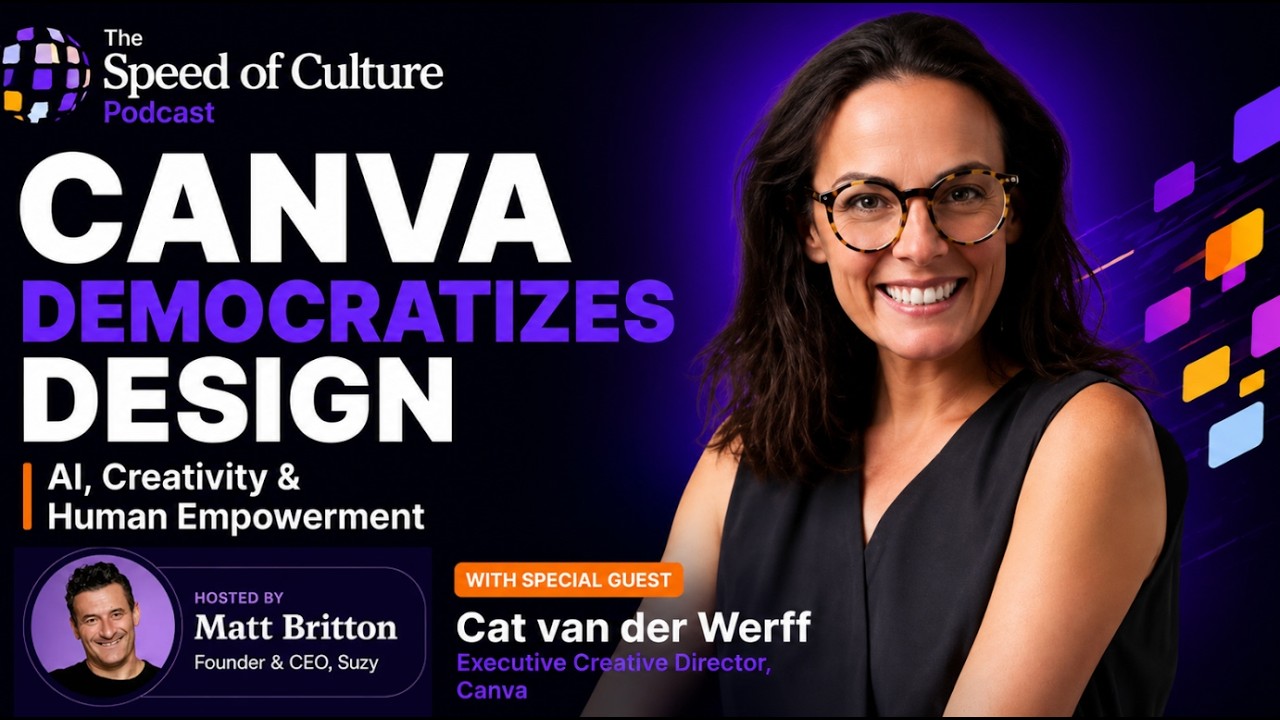
In Episode 116 of The Speed of Culture Podcast, Matt Britton, founder and CEO of Suzy, the AI-powered consumer intelligence platform, sits down with Cat van der Werff, Executive Creative Director at Canva, to explore how the world's leading design platform is transforming the creative landscape.
The conversation spans van der Werff's remarkable journey from an aspiring artist in New Zealand to leading the creative vision of a company that has fundamentally changed how millions of people approach design.
At Canva, van der Werff oversees a creative team of 130+ designers globally, orchestrating a design philosophy that centers on empowerment, accessibility, and the belief that professional-grade design tools should be available to everyone.
The episode delves into Canva's mission to democratize design, a movement that has already impacted over 220 million users across 190 countries, resulting in more than 30 billion designs created on the platform.
Through thoughtful discussion, Britton and van der Werff explore the strategic decisions, creative philosophies, and leadership lessons that have enabled Canva to build a $40 billion enterprise while maintaining its core commitment to making design accessible to non-professionals, small businesses, and enterprises alike.
For marketers, designers, and business leaders seeking to understand how design innovation shapes organizational culture and consumer experience, this episode offers invaluable insights into the intersection of creativity, technology, and purposeful business strategy.
From New Zealand Artist to Global Creative Leader: The Cat van der Werff Story
Cat van der Werff's trajectory into creative leadership began far from Silicon Valley, in the creative landscapes of New Zealand. Her early aspirations as an artist led her to pursue formal training in design, establishing a foundation in visual communication and artistic expression that would later define her approach to leadership.
Before joining Canva, van der Werff built a distinguished career across some of the world's most respected creative agencies, including roles at Landor, Designworks Ltd, Frost*collective, and Re Brand Consultancy. Her international experience (working across Paris, Sydney, and other creative hubs) exposed her to diverse design methodologies, client needs, and creative problem-solving approaches.
When van der Werff joined Canva five years prior to the podcast episode, she arrived as the sole brand designer at the company. At that time, Canva had 1.5 million registered users for Canva Create, and van der Werff faced the unique opportunity to build a brand function from the ground up during a period of explosive growth.
This role required not only exceptional design skills but also the ability to establish design principles, build teams, and scale creative operations in alignment with the company's rapid expansion.
Her evolution from individual contributor to creative director reflects the journey many creative professionals face when moving into leadership, transitioning from hands-on design execution to strategic oversight, team development, and organizational influence.
Today, van der Werff leads a global creative team of over 130 designers, demonstrating her capacity to scale creative operations while maintaining quality and vision alignment across distributed teams.
The Philosophy Behind Canva's Design Democratization Movement
Canva's approach to democratizing design stems from a fundamental belief about human capability and organizational potential. Van der Werff articulates this philosophy clearly:
“Design is the vehicle that enables people to achieve their goals.”
This statement encapsulates Canva's strategic positioning, design is not an end in itself but rather a means to empowerment.
The concept of design democratization addresses a critical business reality that has intensified over the past decade: the expectation that modern professionals possess visual communication skills.
Business research reveals that 61% of business leaders expect their non-designer employees to develop enhanced design capabilities, and 92% of business leaders say employees in non-design roles need at least some level of design acumen to perform effectively.
For organizations, this expectation creates operational constraints. When only professional designers can create marketing materials, presentations, social media content, or visual communications, bottlenecks emerge that limit organizational agility.
Marketing teams awaiting design approvals, sales teams unable to customize client presentations, and operations teams struggling to communicate internal initiatives. These scenarios play out across thousands of organizations daily.
Canva's solution democratizes the tools and capabilities historically reserved for trained designers, enabling non-professionals to produce professional-quality visual content independently.
The platform achieves this through multiple mechanisms:
- Intuitive drag-and-drop interfaces requiring no design training
- Thousands of professionally designed templates covering diverse use cases
- An extensive library of assets including fonts, images, and design elements
- AI-powered features like Magic Design and Magic Write that assist users in creative decision-making
Van der Werff's leadership philosophy extends beyond product design. She emphasizes that:
“Canva is synonymous with empowerment. It's one of the founding principles of our brand.”
This commitment to empowerment permeates the organization's approach to every stakeholder: users who gain confidence in their creative abilities, teams who experience increased efficiency, organizations who scale their visual communication capabilities, and designers who gain tools to focus on strategic creative work rather than routine production.
Strategic Evolution: From Individual Creativity to Organizational Empowerment
In describing the strategic direction of Canva's recent brand refresh, the company's first major rebrand in 10 years, launched in August 2024, van der Werff reveals an important shift in Canva's strategic thinking.
When asked about the nature of the rebrand, she characterized the update as:
“More evolution than revolution.”
This language signals maturity in brand strategy. Rather than pursuing a wholesale overhaul that might alienate existing users, Canva's creative leadership opted to refine and enhance visual elements that users already recognized and trusted, including the signature gradient logo and custom typeface.
The creative process itself served as a demonstration of Canva's product capabilities. The entire rebrand, from initial ideation through stakeholder communication and brand documentation, was created using Canva's own tools.
The creative team utilized Canva Whiteboards for ideation, Presentations for stakeholder meetings, and Websites for the brand book. This decision accomplished dual objectives: completing the rebrand project while simultaneously demonstrating the platform's versatility and power to an internal and external audience.
More significantly, the rebrand reflected a strategic pivot in Canva's market positioning. During its first decade, Canva focused primarily on individual empowerment, enabling consumers and small business owners to create beautiful designs independently.
The refreshed brand acknowledges and emphasizes an expanded mission:
“The world is more visual than ever and all modern workplaces, and all professionals, need to be able to express themselves visually.”
This positioning signals Canva's strategic focus on the enterprise market, where organizational customers require not just individual tools but coordinated systems for brand consistency, approval workflows, and collaborative creation.
Van der Werff notes that the updated brand identity aims to make professional design tools “even more accessible” while supporting the diverse needs of contemporary workplaces.
This expansion from individual to organizational empowerment represents one of the most consequential strategic decisions in Canva's maturation, enabling the company to capture value not just from individuals and small teams but from enterprise organizations seeking to operationalize visual communication at scale.
Building High-Performing Creative Teams: Leadership Lessons from Canva's Creative Director
Van der Werff's evolution from solo designer to leader of 130+ creatives globally offers important lessons for organizations building and scaling creative teams.
She identifies what may be her most significant leadership learning:
“Perfection is selfish while excellence is shared.”
This principle represents a fundamental reorientation in how creative leaders approach their work.
In traditional creative environments, particularly in design and advertising agencies, there exists an implicit assumption that the creative director must personally oversee and refine every creative output to ensure quality.
This approach, while potentially yielding exceptional individual pieces, creates severe organizational constraints. It limits the creative director's scalability, creates bottlenecks in production, and paradoxically reduces the diversity of creative thinking by funneling all work through a single sensibility.
Van der Werff's philosophy inverts this assumption. Excellence, in her framing, is achieved through collaborative creation, diverse perspectives, and distributed decision-making.
Shared excellence means establishing clear creative principles that enable team members to create high-quality work within established guidelines, providing mentorship that develops individual creative capabilities, and building organizational trust that empowers creatives to make decisions aligned with brand vision without requiring centralized approval.
This leadership approach has proven particularly valuable as Canva has scaled. With over 220 million users globally and more than 30 billion designs created on the platform, Canva's creative team must support product evolution, marketing initiatives, brand expression, and content creation simultaneously.
A creative leader pursuing perfectionism would quickly become a constraint. Van der Werff's philosophy of sharing excellence enables her team to operate with agency, develop capabilities, and contribute meaningfully to organizational success while maintaining brand coherence.
Her emphasis on trust as a leadership mechanism reflects modern organizational psychology research demonstrating that empowered, trusted employees demonstrate higher engagement, creativity, and retention.
For leaders building creative teams in marketing, design, product, and content organizations, this lesson translates directly: the most scalable creative leadership shifts focus from control to enablement, from perfectionism to principled excellence, and from centralized decision-making to distributed creative authority within clear guardrails.
Impact Metrics: How Design Democratization Delivers Business Value
The impact of Canva's design democratization extends well beyond user engagement metrics, generating measurable business value for adopting organizations.
A Forrester Total Economic Impact (TEI) analysis of Canva for Teams revealed that the platform delivers $1.7 million in total benefits over three years, translating to a 438% return on investment (ROI).
Every dollar spent on Canva Teams subscription yields measurable returns through cost savings, increased team efficiency, and improved hiring productivity.
FedEx, a global logistics organization, provides a concrete case study. After implementing Canva across the organization, FedEx cut brand review requests by 77%, a dramatic reduction in the approval friction that typically slows creative workflows.
The implementation also empowered 1,400 teams to create content in minutes instead of days. This acceleration of creative production translates to competitive advantages: faster campaign launches, more responsive marketing, and improved organizational agility.
These metrics reveal that design democratization delivers value not by replacing professional designers but by enabling non-designers to handle routine visual communication tasks independently.
This shift redirects designer time toward strategic creative work (brand development, campaign innovation, and creative direction) while enabling the organization to maintain rapid communication velocity.
The massive scale of Canva adoption underscores the business imperative behind design democratization. The platform serves over 125 million monthly active users and has generated more than 30 billion designs.
Notably, over 95% of Fortune 500 companies now use Canva, indicating that design democratization is not a consumer trend but a fundamental operating principle for enterprises seeking competitive advantage through accelerated visual communication.
From a strategic perspective, these adoption metrics and impact figures validate van der Werff's stated philosophy: design democratization addresses a genuine organizational need, delivers measurable business outcomes, and represents a durable competitive advantage for organizations that embrace it effectively.
Key Takeaways
- Perfection is selfish; excellence is shared. The most effective creative leaders transition from centralized control to distributed creative authority. Van der Werff's leadership philosophy demonstrates that empowering teams to create within clear creative principles generates both higher-quality outputs and more engaged creative professionals.
- Design is the vehicle for human and organizational empowerment. Rather than viewing design as an aesthetic consideration, Canva positions design as a capability that enables individuals and organizations to achieve objectives. This reframing elevates design from a cost center to a strategic competitive advantage.
- Design democratization addresses genuine organizational bottlenecks. The widespread expectation that modern professionals possess visual communication skills reflects real operational constraints. Canva's solution removes friction from creative production, enabling organizations to scale visual communication without proportionally scaling design teams.
- Strategic evolution requires refined rather than revolutionary change. Canva's approach to rebranding, enhancing rather than overhauling, demonstrates sophistication in brand stewardship. Organizations can evolve strategic positioning and visual identity while maintaining recognition and trust among existing stakeholders.
- Enterprise adoption validates consumer innovation. The fact that 95% of Fortune 500 companies now use Canva reveals that consumer-grade innovation, when properly extended to enterprise contexts, can achieve both market scale and organizational significance.
FAQ
What is the core mission of Canva's design democratization movement?
Canva's design democratization mission centers on making professional-grade design tools accessible to anyone, regardless of training or expertise.
Cat van der Werff articulates this as enabling people to use “design as the vehicle that enables people to achieve their goals.”
The movement recognizes that modern professionals increasingly need visual communication skills, and removes traditional barriers (expensive software, required training, design knowledge) that historically prevented non-professionals from creating professional-quality visual content.
By democratizing design, Canva has empowered over 220 million users across 190 countries to express themselves visually.
How has Canva evolved its strategic positioning from consumer focus to enterprise adoption?
Canva's first decade focused on individual empowerment, enabling consumers and small business owners to create designs independently.
The strategic evolution, reflected in Canva's 2024 rebrand, expanded this positioning toward organizational empowerment.
Van der Werff notes that “the world is more visual than ever and all modern workplaces, and all professionals, need to be able to express themselves visually.”
This shift acknowledges that design democratization extends beyond individuals to enterprises that need coordinated visual communication systems, brand consistency tools, approval workflows, and collaborative features.
The fact that 95% of Fortune 500 companies now use Canva validates this strategic expansion.
What leadership lessons does Cat van der Werff's approach to creative team management offer?
Van der Werff's most significant leadership insight. That “perfection is selfish while excellence is shared” fundamentally reorients how creative leaders approach their role.
Rather than pursuing centralized control where the creative director personally oversees every output, she builds organizational trust and establishes clear creative principles that enable distributed decision-making.
This approach scales creative output, develops individual team member capabilities, and generates higher engagement.
She emphasizes that leadership success involves “learning how to multiply ideas and impact through others, shifting from control to trust.”
This philosophy enables her to lead 130+ creatives globally while maintaining brand coherence and creative quality.
What quantifiable business value does design democratization deliver?
Research and case studies provide concrete evidence of design democratization's impact.
Forrester analysis shows that Canva for Teams delivers $1.7 million in total benefits over three years with a 438% ROI.
FedEx reduced brand review requests by 77% after implementing Canva and empowered 1,400 teams to create content in minutes instead of days.
These metrics demonstrate that design democratization removes organizational bottlenecks, accelerates creative production, and redirects designer time toward strategic work rather than routine production tasks.
The scale of enterprise adoption, 95% of Fortune 500 companies, indicates this trend represents fundamental organizational operating principles rather than temporary innovation.
Looking Ahead
The conversation between Matt Britton and Cat van der Werff on Episode 116 of The Speed of Culture Podcast reveals design democratization as one of the defining business movements of the 2020s.
As organizations increasingly recognize that visual communication drives engagement, understanding, and action, the tools and philosophies that enable this communication become strategically critical.
Canva's journey from a consumer design tool to an enterprise platform reflects broader trends in democratization, the pattern where technologies originally built for consumer audiences become essential organizational infrastructure.
For marketing leaders, design directors, and executives seeking to understand how creative capability drives organizational performance, this episode offers essential insights into the philosophy, strategy, and execution required to scale creative impact.
Explore consumer intelligence insights by visiting Suzy, and discover the latest episodes of The Speed of Culture Podcast. Learn more about AI and consumer trends from Matt Britton's book Generation AI, and book Matt Britton as an AI keynote speaker for your organization. For more speaking opportunities, visit Speaker HQ.
%20(400%20x%20100%20px)%20(300%20x%2050%20px)%20(150%20x%2050%20px).avif)