From Vintage to Visionary: How Urban Outfitters Balances AI, Creativity, and Gen Z Innovation
In a retail landscape transformed by artificial intelligence, shifting consumer expectations, and digital-first engagement strategies, few brands navigate the intersection of creativity and commerce as thoughtfully as Urban Outfitters. The company's approach to connecting with Gen Z while leveraging cutting-edge technology reveals a broader truth about modern retail: the brands that win are those that blend authentic creative vision with data-driven decision-making.
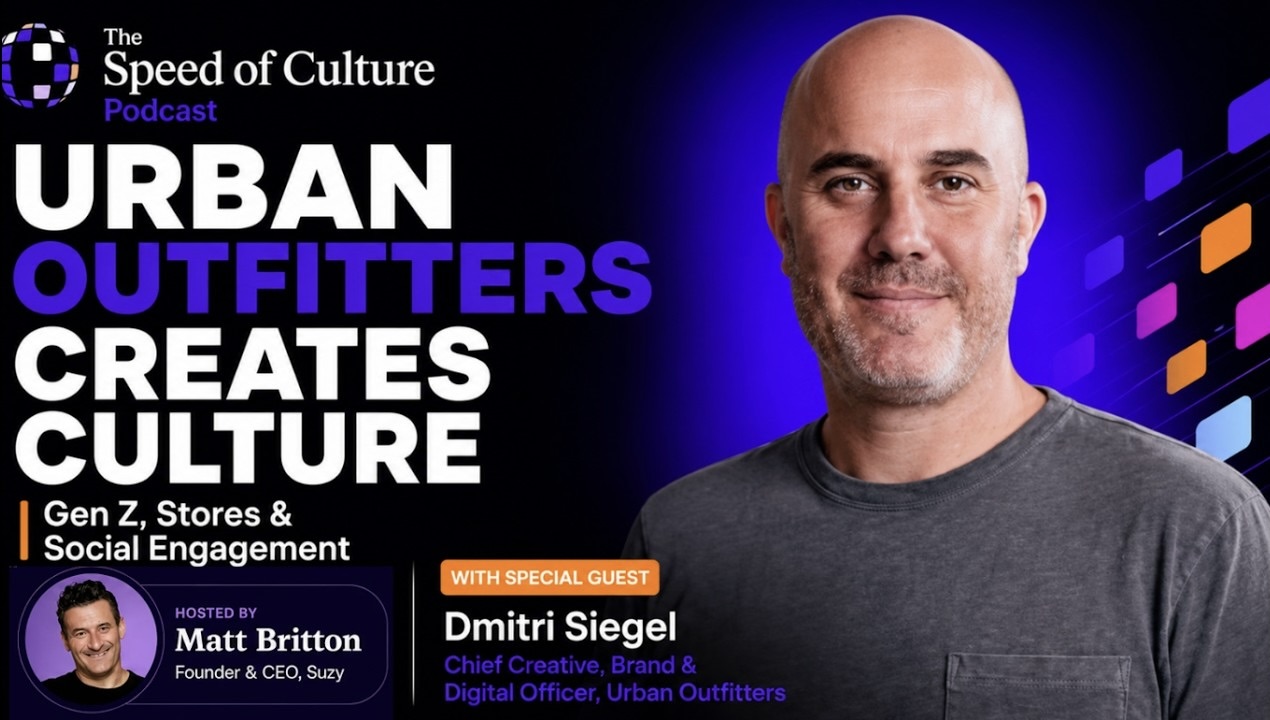
The Speed of Culture Podcast recently explored these dynamics in an in-depth conversation with Dmitri Siegel, Chief Creative, Brand, and Digital Officer at Urban Outfitters. Hosted by Matt Britton, founder and CEO of Suzy, the AI-powered consumer intelligence platform, the episode examines how Urban Outfitters transformed from a brand struggling to understand Gen Z into a retail innovator reshaping the future of in-store experiences, merchandise strategy, and digital engagement.
Siegel brings fifteen years of experience modernizing some of the world's most iconic brands, including roles as Global Executive Creative Director at Patagonia and Chief Marketing Officer at Sonos, to his current challenge: making Urban Outfitters the destination for the next generation of consumers.
This conversation arrives at a critical moment. After years of underperformance and a candid admission that the company “didn't know how to sell to Gen Z,” Urban Outfitters is executing a turnaround that goes far deeper than seasonal promotions or influencer partnerships.
Instead, Siegel and his team are fundamentally reimagining how physical retail experiences amplify digital engagement, how AI can accelerate trend cycles without compromising creative authenticity, and how understanding the profound generational gap between millennials and Gen Z can unlock sustainable competitive advantage.
The discussion touches on critical industry trends: the rise of experiential retail concepts like “On Rotation,” the exponential growth of subscription services like Nuuly, AI-powered merchandising and supply chain optimization, and the strategic imperative of treating in-store moments as content for social platforms. For marketing leaders, retail executives, and brands seeking to understand the future of consumer engagement, Siegel's insights offer a masterclass in modern brand strategy.
The Generational Divide: Why Millennials and Gen Z Require Fundamentally Different Strategies
One of Siegel's most striking insights is his framing of the generational gap between millennials and Gen Z.
“The gap between millennials and Gen Z is profound, much like the gap between baby boomers and Gen X.”
This comparison is deceptively simple but strategically crucial. Most retail brands spent the last decade chasing millennials, building inventory assortments, marketing narratives, and experience design around older Gen Z consumers who still held some millennial sensibilities.
When the pendulum swiftly shifted to a younger, true Gen Z demographic during the pandemic, many retailers, including Urban Outfitters, found themselves operating with outdated playbooks.
The differences extend beyond superficial preference variations. Gen Z consumers grew up in a fundamentally different media landscape, economic environment, and social context than millennials. While millennials celebrated aspirational consumption and the prestige of brand ownership, Gen Z prioritizes authenticity, sustainability, and experiences over possessions.
This philosophical shift has profound implications for retail strategy.
Urban Outfitters recognized this reality and made a strategic decision to become obsessed with understanding their actual customers rather than relying on inherited assumptions. This obsession manifests in continuous consumer research, ethnographic studies of store browsing behaviors, social listening across TikTok and other platforms where Gen Z congregates, and a willingness to publicly acknowledge when the brand missed the mark.
The practical outcomes of this reorientation are visible throughout Urban Outfitters' current strategy. The company has deliberately curated assortments that align with Gen Z's stated values: an expanded vintage and remade product section that caters to both sustainability concerns and nostalgia; personalization opportunities through items like custom phone cases, charms, and accessories; and a commitment to transparency about sourcing and production practices.
Siegel emphasizes that this isn't performative; it reflects a genuine shift in how the brand approaches product selection and supplier relationships.
For executives at other retail brands facing similar generational transitions, Siegel's methodology offers clear guidance: move beyond demographic data alone. Understand the worldview, media consumption, values hierarchy, and economic circumstances that shape each generation's decision-making. Build feedback loops that allow consumer voices to continuously reshape strategy rather than treating market research as a periodic exercise.
The End of Pure Performance Marketing and the Return of Creative Value
Siegel articulates a thesis that challenges the conventional wisdom of the past decade:
“The era of pure performance marketing is nearing its end.”
This statement lands with particular weight given that performance marketing, the discipline of optimizing every dollar spent for measurable return on ad spend, has dominated marketing strategy since the rise of programmatic advertising, attribution modeling, and the relentless focus on digital ROI metrics.
The reason for this shift is structural. Digital advertising ecosystems have become increasingly pay-to-play environments where customer acquisition costs continue to rise and organic reach has effectively disappeared.
Facebook and Instagram's algorithms reward paid media; Google's search results increasingly favor paid placements; TikTok's algorithm favors viral content but provides no reliable mechanism for organic brand discovery. In this environment, brands that rely exclusively on performance marketing face a paradox: they must spend more to achieve the same results, creating a profitability squeeze that forces either margin compression or exit from the channel altogether.
Into this vacuum comes a renewed recognition of creative value. Campaigns that generate genuine cultural moments, not because they spent the most money, but because they connected emotionally or offered surprising new perspectives, create multiple downstream benefits.
- They generate organic word-of-mouth.
- They earn media coverage.
- They build brand affinity that translates into customer lifetime value.
- They create content that consumers willingly share, multiplying reach without proportional ad spend.
Urban Outfitters is leaning into this insight through several concrete initiatives. The “On Rotation” concept exemplifies this philosophy.
Rather than a traditional promotional event with transactional intent, On Rotation creates curated, lounge-style in-store experiences that feel like discovery destinations. The brand partners with complementary brands, debuting with Nike in select Urban Outfitters locations in New York, Washington D.C., Scottsdale, and Southern California, to create shared retail moments that reflect how Gen Z actually shops: as a social, exploratory activity rather than a goal-oriented transaction.
These physical experiences then become content. Customers photograph and share their On Rotation discoveries on Instagram and TikTok. Influencers visit and create content.
The in-store experience compounds its value by functioning as a content factory, amplifying reach beyond the immediate physical footprint. Siegel notes that in-store moments “generate compelling content for social platforms like TikTok, strengthening community engagement and brand visibility.”
This represents a strategic inversion worth highlighting. Rather than beginning with a social media campaign and attempting to drive traffic to stores, Urban Outfitters is beginning with compelling in-store experiences and allowing social amplification to occur organically.
The creative value (the aesthetic appeal, the element of surprise, the sense of community) drives the initial engagement; performance marketing amplifies and measures the downstream impact.
For brand leaders, this shift has clear implications. It's not an argument for abandoning performance marketing entirely, but rather for treating creative excellence and data-driven optimization as complementary capabilities rather than competing priorities.
The brands winning in 2024 and beyond are those that view performance metrics as diagnostic tools for understanding what worked, rather than prescriptive constraints that determine what the creative strategy can attempt.
From Physical Experiences to Digital Amplification: The Modern Retail Ecosystem
One of the most actionable insights from Siegel's perspective is his framework for how physical and digital channels interact in contemporary retail. Traditionally, retail strategy treated channels as separate: in-store, e-commerce, mobile, social media.
Each had its own metrics, budget allocation, and success criteria. This siloed approach created inefficiencies and missed opportunities.
Siegel's approach is integrated. Physical in-store experiences are understood as the genesis of digital engagement rather than an end in themselves.
A customer's visit to Urban Outfitters, particularly the experiential On Rotation concept, is valuable not only for the potential immediate purchase, but for the content it generates, the community it builds, and the ongoing relationship it catalyzes across digital platforms.
This has practical implications for store design, merchandising, and training. Store associates need to understand themselves not just as salespeople, but as community curators and experience facilitators. Visual merchandising must prioritize Instagram-worthiness without sacrificing functionality.
The layout must encourage exploration and discovery rather than efficient transaction completion. Inventory assortments must reflect what resonates on social platforms, items that photograph well, that make for interesting stories, that align with trending aesthetics.
Urban Outfitters has also recognized that younger consumers expect the digital experience to extend beyond their phone. They expect to access inventory information via QR codes in stores. They expect to style products on Instagram and save them for later purchase.
They expect personalization across channels. That the brand remembers their browsing history, their sizes, their style preferences. They expect to be able to start a transaction on one device and complete it on another without friction.
The Nuuly subscription service exemplifies this integrated thinking. At $98 per month, subscribers receive access to a curated selection of apparel from Urban Outfitters, Anthropologie, and Free People.
Nuuly has grown from $77.9 million in revenue in Q1 2024 to $124.4 million in Q1 2025, a 60% increase in a single year.
Why? Because Nuuly combines multiple strategic benefits:
- Sustainability alignment: Rental consumption directly addresses Gen Z's values around sustainability and circular economy principles.
- Affordability: $98 per month for unlimited apparel exploration is genuinely appealing to a generation facing economic pressures.
- Discovery: The service functions as a continuous discovery mechanism; customers try pieces they might not have purchased outright, discovering new preferences.
- Data collection: Every interaction with Nuuly generates behavioral data that enhances Urban Outfitters' understanding of customer preferences, which informs broader merchandising decisions.
- Engagement: Subscription services create recurring touchpoints and engagement opportunities that transactional retail cannot match.
This integrated approach extends to technology. Urban Outfitters has partnered with o9 Solutions to deploy AI-powered Merchandise Financial Planning, Assortment Planning, Demand Planning, Allocation and Replenishment capabilities.
These systems don't replace creative decision-making; they enhance it by processing vast amounts of data on what's selling, what's trending, what resonates with different customer segments, allowing creative leaders like Siegel to make more informed decisions about which creative risks are worth taking.
AI's Impact on Trend Cycles and the Risk of Consumer Fatigue
While Siegel is clearly bullish on AI's potential to optimize retail operations, he's notably cautious about one specific dynamic: the risk that AI-accelerated trend cycles will generate consumer fatigue.
AI systems excel at identifying trends and projecting forward momentum. A trend spotted on TikTok can be analyzed, flagged, and translated into production recommendations within days rather than months.
AI-powered supply chains can move designs from concept to retail shelf faster than traditional seasonal planning cycles. This velocity is genuinely valuable; it allows brands to stay relevant and responsive to cultural moments.
However, this same velocity creates a risk. If every brand simultaneously accelerates to trend cycles powered by the same AI systems analyzing the same social signals, the result is a compression of the time consumers have to develop authentic preference for any particular aesthetic or style.
Every twelve weeks brings an entirely new aesthetic imposed from above, rather than organically emerging from creative communities. The result, in Siegel's formulation, is risk of “consumer fatigue through rapid trend turnover.”
This concern reflects deeper thinking about the relationship between creativity and commerce. The most durable, profitable consumer relationships are built on authentic alignment between brand values and consumer values rather than constant novelty.
A customer who trusts your taste and shares your aesthetic perspective will remain loyal across cycles; a customer chasing whatever trend is algorithmically surfaced this week is ephemeral and expensive to retain.
Urban Outfitters' response to this risk is multifaceted. First, the company is deliberately maintaining inventory depth in evergreen categories alongside trend-forward selections.
Second, the brand is making vintage and remade products central to its assortment. These inherently resist the commoditization of fast-trend chasing.
Third, through initiatives like Nuuly, the company is creating mechanisms where discovery and exploration are encouraged without the pressure of permanent ownership. A customer can try a hyper-trend piece without financial commitment; if it doesn't resonate, they return it and move forward.
For retail leaders, this insight suggests an important guardrail around AI adoption. Use AI-powered analytics to understand what's trending and to optimize the efficiency of your creative execution.
But maintain creative leadership responsibility for the strategic question of whether you should participate in every trend, or whether some trends conflict with your authentic brand positioning.
The brands that maintain creative judgment about which trends to amplify, and which to observe rather than lead, will likely maintain customer loyalty more effectively than those that optimize purely for trend velocity.
Building a Gen Z-Native Retail Ecosystem: On Rotation and Beyond
Urban Outfitters' transformation is most visible in new store concepts and experiences explicitly designed for Gen Z preferences and shopping behaviors. The “On Rotation” concept launched in 2024 represents a comprehensive reimagining of what a brand partnership looks like and how retail spaces can function as community gathering places rather than purely transactional environments.
On Rotation debuted in five major markets: Manhattan, Brooklyn, and Washington D.C. (initial launch), followed by expansion to Scottsdale and Southern California.
Each location features lounge-style seating, curated product installations from partner brands, and an emphasis on discovery and exploration. The initial partnership with Nike positioned the collaboration not as a promotional event, but as a genuine curation of how On Rotation's customers can integrate Nike's functionality with Urban Outfitters' lifestyle aesthetic.
The brilliance of this concept is its alignment with how Gen Z actually approaches shopping. Research consistently shows that Gen Z shoppers value experiences and community over transactional efficiency.
They're more likely to visit retail spaces as social activities (meeting friends, exploring, sharing discoveries) than as goal-oriented missions to acquire specific items. On Rotation caters directly to this preference.
The financial impact is meaningful: Urban Outfitters' Q3 fiscal 2026 results showed comparable net sales increase of 12.5% for the core Urban Outfitters brand, with total company net sales increasing 11% for the eleven-month period ended December 31, 2025.
These aren't modest improvements; they represent significant reversal of the comparable sales declines the company experienced in 2024.
The company has committed to expanding the new Gen Z-friendly store format, with 3 stores already converted by the end of 2025 and an additional 7 planned for 2026. This rollout demonstrates that leadership has conviction in the model and capital allocation to support expansion.
Beyond On Rotation, the store assortments themselves have been deliberately redesigned for local relevance. Rather than identical assortments across all locations, each Urban Outfitters store now receives merchandise tailored to local customer preferences.
The Houston store, for example, features elevated inventory in dresses, denim, and personalization items like handbags and custom charms, reflecting the actual purchase behavior of customers in that market.
This level of merchandising granularity became possible through AI-powered assortment planning, but the strategic decision of which categories to prioritize and how to interpret local preference signals remains a human creative decision.
Siegel's role is to ensure that technical optimization doesn't override creative judgment about what makes the brand distinctive and authentic.
Key Takeaways
- Generational understanding requires continuous research and willingness to acknowledge past misalignment. The brands that assume they know Gen Z are the brands that will miss them. Urban Outfitters succeeded by admitting what it didn't know and investing heavily in genuine customer understanding rather than relying on inherited assumptions from the millennial era.
- Creative value and data-driven optimization are complementary capabilities rather than competing priorities. The decline of pure performance marketing creates an opportunity for brands that can generate genuine creative moments. Measure, analyze, and optimize, but ensure that creative excellence is the input you're optimizing around, not the constraint you're working within.
- Physical retail experiences generate digital amplification when designed with that purpose in mind. In-store moments are valuable well beyond immediate transactions: for the content they generate, the community they build, and the ongoing digital engagement they catalyze. Design stores with this integrated thinking from the beginning.
- AI accelerates everything, including trend cycles, which creates both opportunity and risk. Use AI to understand what's trending and to optimize execution, but maintain human creative leadership around whether every trend aligns with your brand strategy. The brands that avoid participating in every hyper-trend will likely maintain customer loyalty more effectively.
- Subscription and rental models align with Gen Z values while creating recurring engagement opportunities. Nuuly's explosive growth demonstrates that Gen Z will embrace new consumption models when they align with sustainability and affordability values. These models also generate valuable data and create multiple engagement touchpoints beyond traditional transactional retail.
Frequently Asked Questions
How is Urban Outfitters using AI in its retail operations?
Urban Outfitters has deployed AI-powered systems across multiple functions. The company partnered with o9 Solutions for Merchandise Financial Planning, Assortment Planning, Demand Planning, Allocation and Replenishment, using machine learning and computer vision to optimize inventory decisions and personalize promotional offers in real-time.
Additionally, Urban Outfitters partnered with Inspectorio to deploy AI-powered supply chain compliance solutions, and the company is rolling out Stripe's agentic commerce solutions to streamline the customer experience.
What makes the “On Rotation” concept successful with Gen Z customers?
On Rotation succeeds because it aligns with how Gen Z actually shops: as a social, exploratory activity rather than a transactional mission.
The lounge-style installations, curated brand partnerships, and emphasis on discovery create shareable moments that function as content. Customers visit to spend time with friends and explore new discoveries, not to check items off a shopping list.
The in-store experience generates organic social amplification without requiring paid media to drive traffic.
How does Nuuly differ from traditional retail, and why is it growing so rapidly?
Nuuly is a $98-per-month subscription service that allows customers unlimited access to apparel from Urban Outfitters, Anthropologie, and Free People.
It aligns with Gen Z values around sustainability (rental consumption rather than purchase and disposal), affordability (all-you-can-wear access), and discovery (customers try pieces they might not buy outright).
The service grew from $77.9 million in Q1 2024 to $124.4 million in Q1 2025 because it solves multiple customer needs simultaneously while generating valuable behavioral data that informs broader merchandising decisions.
What does Dmitri Siegel mean by “the era of pure performance marketing is nearing its end”?
Siegel observes that digital advertising ecosystems have become increasingly pay-to-play environments where organic reach has effectively disappeared and customer acquisition costs continue to rise.
Brands that rely exclusively on performance marketing face a profitability squeeze. Into this vacuum comes renewed recognition of creative value, campaigns that generate genuine cultural moments create organic word-of-mouth, media coverage, and customer affinity that performance marketing alone cannot achieve.
The opportunity lies in combining creative excellence with data-driven optimization, rather than choosing between them.
Looking Ahead
The conversation between Matt Britton and Dmitri Siegel offers a masterclass in retail innovation for an era where AI, generational shifts, and fundamental changes in consumer expectations require brands to reimagine their fundamental approaches.
Urban Outfitters' transformation from acknowledged misalignment with Gen Z to a brand confidently executing a comprehensive turnaround demonstrates that these challenges are surmountable, but only with sustained creative leadership, genuine customer obsession, and willingness to adopt new strategies when evidence demands it.
For marketing leaders, retail executives, and brand builders, the insights from this episode extend far beyond Urban Outfitters. They speak to the universal challenge of maintaining relevance as consumer expectations evolve, of balancing creative vision with data-driven decision-making, and of building retail experiences that serve both commercial and community objectives.
Explore more insights from Suzy, discover additional episodes on the Speed of Culture Podcast, learn more about consumer behavior and AI from Generation AI, book Matt Britton as an AI keynote speaker, or explore Speaker HQ for additional resources on emerging consumer trends and retail innovation.

%20(400%20x%20100%20px)%20(300%20x%2050%20px)%20(150%20x%2050%20px).avif)