June 11, 2024
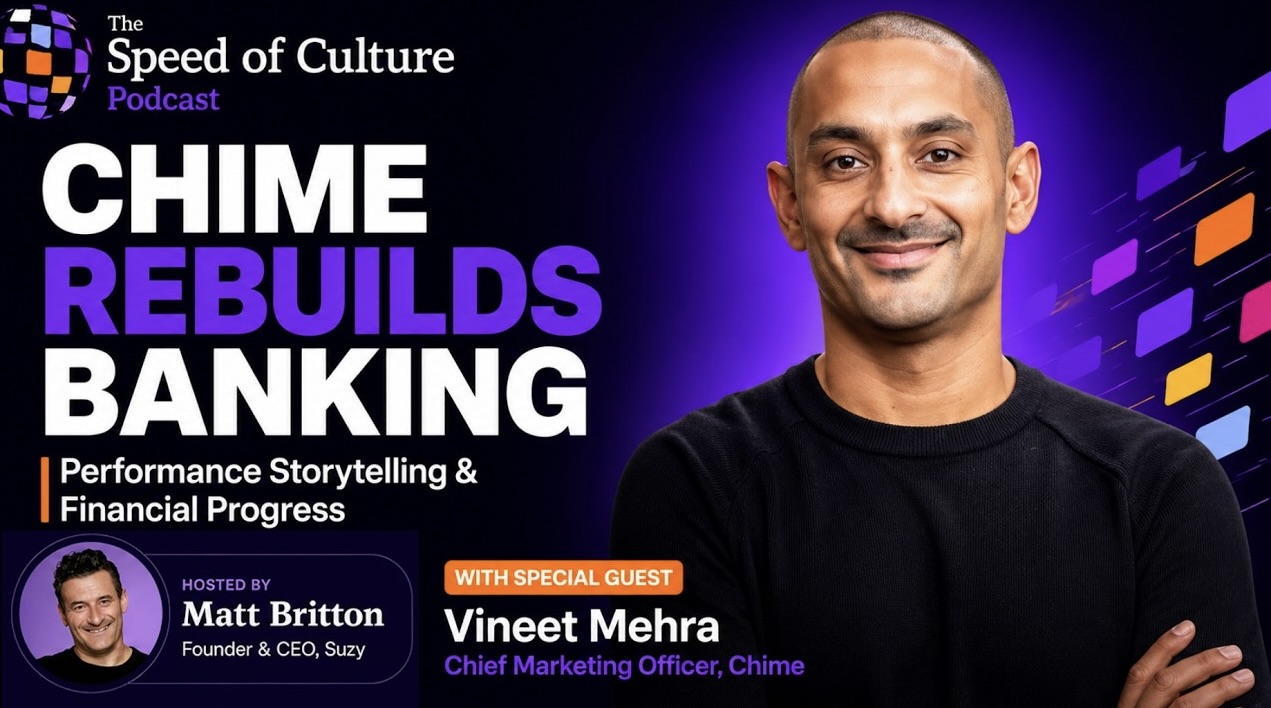
Navigating the Golden Age of Marketing with Vineet Mehra, CMO of Chime

Vineet Mehra
Chief Marketing Officer
This is some text inside of a div block.
This is some text inside of a div block.
LISTEN ANYWHERE YOU FIND YOUR PODCASTS
%20(400%20x%20100%20px)%20(300%20x%2050%20px)%20(150%20x%2050%20px).avif)

The financial services landscape is undergoing a seismic transformation, driven by fintech innovators who prioritize accessibility, transparency, and consumer-centric innovation. Among the leaders reshaping how everyday Americans manage their money is Chime, a digital banking platform that has revolutionized the way people think about financial services.
On Episode 114 of The Speed of Culture Podcast, host Matt Britton sat down with Vineet Mehra, Chief Marketing Officer of Chime, to explore the intersection of marketing innovation, fintech disruption, and the strategic pivots that define success in today’s hyper-competitive financial services industry.
This conversation, which aired on June 11, 2024, offers invaluable insights into the evolution of marketing leadership, the critical importance of understanding consumer behavior across cultures, and why we are indeed living in what Vineet calls “the golden age of marketing.”
Vineet brings a rare combination of expertise, having spent years in traditional consumer packaged goods at industry giants like Johnson & Johnson, Walgreens, and Ancestry before making a bold transition to fintech. This unique perspective positions him as a thought leader capable of bridging the gap between legacy marketing principles and cutting-edge digital strategies.
Matt Britton, founder and CEO of Suzy, the AI-powered consumer intelligence platform, brings his signature conversational style and deep understanding of consumer culture to this discussion. Through his work at Suzy, Matt has established himself as America’s leading expert on millennial and Gen Z consumer behavior, having consulted with over half of the Fortune 500 throughout his career.
The Speed of Culture Podcast, presented in collaboration with Suzy and Adweek, serves as the definitive platform for exploring how marketing innovation intersects with evolving consumer behaviors and cultural trends.
During this episode, Vineet shares candid reflections on why he left the security of a corporate powerhouse to join a fintech startup, the critical lessons he learned from operating in global markets across Europe, Asia, and North America, and how companies like Chime are leveraging performance storytelling, retail media networks, and artificial intelligence to create marketing experiences that genuinely resonate with consumers.
Whether you’re a marketing executive contemplating a career transition, a brand leader seeking to understand fintech’s disruptive potential, or simply someone interested in the future of consumer marketing, this episode delivers actionable insights grounded in real-world experience and data-driven decision-making.
Vineet Mehra’s career trajectory represents one of the most compelling narratives in modern marketing leadership. After building substantial expertise at Johnson & Johnson, one of the world’s most admired companies. Vineet made the counterintuitive decision to leave the security of an established corporate environment for the uncertain, fast-paced world of fintech.
For many, this move might seem risky. For Vineet, it was essential.
The transition from CPG to fintech illuminates a fundamental truth about contemporary marketing: traditional playbooks, while valuable, are increasingly insufficient. In the CPG world, Vineet developed deep expertise in brand building, consumer insight generation, and large-scale campaign execution.
However, the CPG industry operates within a different set of constraints and opportunities than fintech. CPG brands move products through retail channels, rely on long-standing distribution relationships, and often operate with established consumer trust.
Fintech companies, by contrast, must build trust in an industry where consumer skepticism runs deep. They must do this in a digital-first environment where direct-to-consumer engagement is not just preferred, it’s essential.
Vineet recognized that the future of marketing would be defined by companies that could seamlessly blend foundational brand-building principles with the agility, personalization, and real-time responsiveness that digital channels enable. At Chime, he discovered an organization equally committed to this integration.
When legacy CMOs and brand leaders watch someone of Vineet’s caliber move to fintech, it signals a shift in where the most innovative marketing work is happening. The fintech industry isn’t simply adopting CPG marketing tactics; it’s reimagining what marketing can be when digital native companies combine speed, personalization, and accountability in ways that traditional corporate structures cannot replicate.
For marketing professionals considering their own career evolution, Vineet’s journey offers three critical lessons:
One of the most quotable themes Vineet emphasizes is the concept of the “golden age of marketing.” While previous eras saw the rise of digital, social, and mobile, Vineet argues that today’s convergence of capabilities is fundamentally different.
I call it the golden age of marketing because it’s all there now, right? You have real-time ability to listen to customers. You have an immediate response to the media. You have measurement tools that are unlike anything we’ve ever seen before. For CPG, you’ve got the rise of retail media. And the latest thing, obviously, that everyone’s talking about is AI.
This vision reflects measurable capabilities that didn’t exist even five years ago. Real-time customer listening, powered by social listening tools and customer data platforms, allows brands to understand consumer sentiment at scale and velocity previously impossible.
Immediate media response capabilities enable teams to adjust campaigns, shift spending, pivot messaging, and test new creative in real time. If an ad underperforms in its first hours, budgets can be reallocated. If a message misses with a demographic, creative can be refreshed almost instantly.
Measurement tools now provide unprecedented clarity into attribution and ROI. Multi-touch attribution, incrementality testing, and advanced analytics allow CMOs to understand which channels and tactics truly drive business results.
The rise of retail media networks adds another transformative layer. Brands can reach consumers at the moment of purchase intent, using first-party data collected by retailers and tying measurement directly to sales.
Finally, artificial intelligence amplifies every one of these capabilities. At Chime, AI-driven marketing has enabled the company to produce advertisements up to 60% faster while projecting millions in savings on agency fees. This represents not just cost efficiency, but capability expansion.
Vineet’s career across North America, Europe, and Asia gives him a rare global perspective. One of his most important insights challenges the myth that “marketing is universal.”
Successful global marketing requires far more than translation. It demands deep engagement with local consumer behavior, cultural values, historical contexts, and communication preferences.
A message that resonates in the United States may feel tone-deaf in Europe, particularly in financial services markets shaped by the 2008 financial crisis. Strategies that work in mature Asian markets like Japan may require adjustment in emerging Southeast Asian economies with different digital adoption patterns.
Vineet advocates for what might be called localized authenticity. Core brand principles remain consistent, but execution, tone, creative approach, and channel prioritization adapt to local contexts.
For global fintech companies, this is especially critical. In the United States, fintech often disrupts legacy banks through better user experiences and lower fees. In developing economies, disruption frequently centers on financial inclusion, bringing services to unbanked populations.
To execute effectively, marketing teams should:
The rise of retail media networks represents one of the most significant shifts in how brands reach consumers. These networks leverage first-party transactional data to deliver targeted advertising within retail ecosystems.
Unlike third-party cookies, retail media relies on first-party data, making it privacy-resilient and increasingly valuable as the digital advertising landscape evolves.
For fintech, the opportunity extends into emerging financial media networks. Banks and fintech companies now build advertising ecosystems powered by transaction data and AI. Chase Media Solutions, launched in 2024, delivers over 1.3 billion personalized offers monthly, illustrating the scale of this evolution.
Complementing this channel shift is performance storytelling. Chime uses real customers, not actors, in testimonial advertising, blending emotional resonance with demonstrable product value.
When a customer shares how early paycheck access helped them avoid payday loans, the story builds trust, demonstrates functionality, and provides social proof simultaneously. In fintech, where skepticism runs high, this integration of narrative and measurable impact is especially powerful.
Vineet offers one of his most actionable insights in discussing marketing organization design. As marketing grows more complex, traditional generalist structures are increasingly inadequate.
At Chime, Vineet prioritizes specialized teams focused on domains such as data science, direct response marketing, social media strategy, and content marketing.
This structure enables deeper expertise. A marketing-focused data scientist can develop modeling capabilities and testing frameworks that generalists cannot replicate. A direct response specialist can continuously optimize conversion funnels and lifetime value models.
Specialization also enhances collaboration with marketing technology platforms and external partners. Dedicated teams can evaluate and optimize tools more effectively than broad generalist groups.
Finally, specialization strengthens talent retention. Marketers who build domain expertise feel confident in the long-term value of their skill sets.
However, this model requires strong cross-functional collaboration to prevent silos. When executed well, it results in more sophisticated execution and tighter alignment with business objectives.
At the core of Chime’s strategy is a commitment to solving real consumer problems. Its foundational innovation, no-fee banking, directly addresses the burden of overdraft fees, minimum balance fees, and payday charges that disproportionately impact lower-income Americans.
Chime’s early paycheck access feature provides customers with their paychecks two days early, helping them avoid predatory short-term lending products. Credit-building tools enable customers to improve credit scores, unlocking access to affordable financial products.
From a marketing standpoint, these innovations create authentic narratives. Rather than promoting abstract promises of “better banking,” Chime communicates specific solutions to tangible customer pain points.
When companies genuinely solve customer problems, marketing becomes less about persuasion and more about communication, helping consumers understand that solutions exist.
The conversation also highlights how the role of the Chief Marketing Officer has evolved. CMOs are no longer solely creative leaders; they must master data, technology, and financial accountability.
Modern CMOs manage budgets that can reach hundreds of millions of dollars and must justify spending against measurable ROI. Simultaneously, they remain responsible for cultural relevance and creative excellence.
Vineet, recognized as one of Forbes’ Top 50 Entrepreneurial CMOs, exemplifies this balance. He navigates data science, attribution modeling, and retail media with the same fluency he applies to brand positioning and storytelling.
For aspiring marketing leaders, the message is clear: the future belongs to CMOs who can integrate analytics, technology, creativity, and business strategy into a unified leadership approach.
Vineet’s transition demonstrates that consumer insight, brand building, and campaign execution remain relevant, but must be reimagined for digital-first, direct-to-consumer environments. Career growth often comes from applying core skills in new ecosystems where technology and agility amplify impact.
Marketing leaders should invest intentionally in real-time listening, advanced measurement, AI capabilities, and organizational structures designed to leverage emerging tools. The golden age isn’t automatic, it requires deliberate capability building.
Consumer behavior, trust levels, and communication preferences vary dramatically across regions. Companies should hire local leaders, validate campaigns regionally, build geographic feedback loops, and maintain flexible execution while protecting core brand positioning.
Specialized teams focused on domains such as data science, direct response, and social media create deeper expertise and stronger ROI accountability. Clear cross-functional collaboration ensures integration while preserving specialization benefits.
The Speed of Culture Podcast Episode 114 featuring Vineet Mehra delivers insights that extend far beyond fintech marketing. For leaders navigating a data-intensive, technology-driven landscape, the episode offers clarity on building specialized teams, adapting globally, grounding strategy in customer value, and leveraging AI effectively.
To deepen your understanding, explore: