Opening Section
The modern travel industry has fundamentally shifted from transaction-focused booking platforms to experience-driven communities. This transformation represents one of the most compelling case studies in contemporary brand marketing, and few companies have mastered the art of experiential storytelling quite like Airbnb.
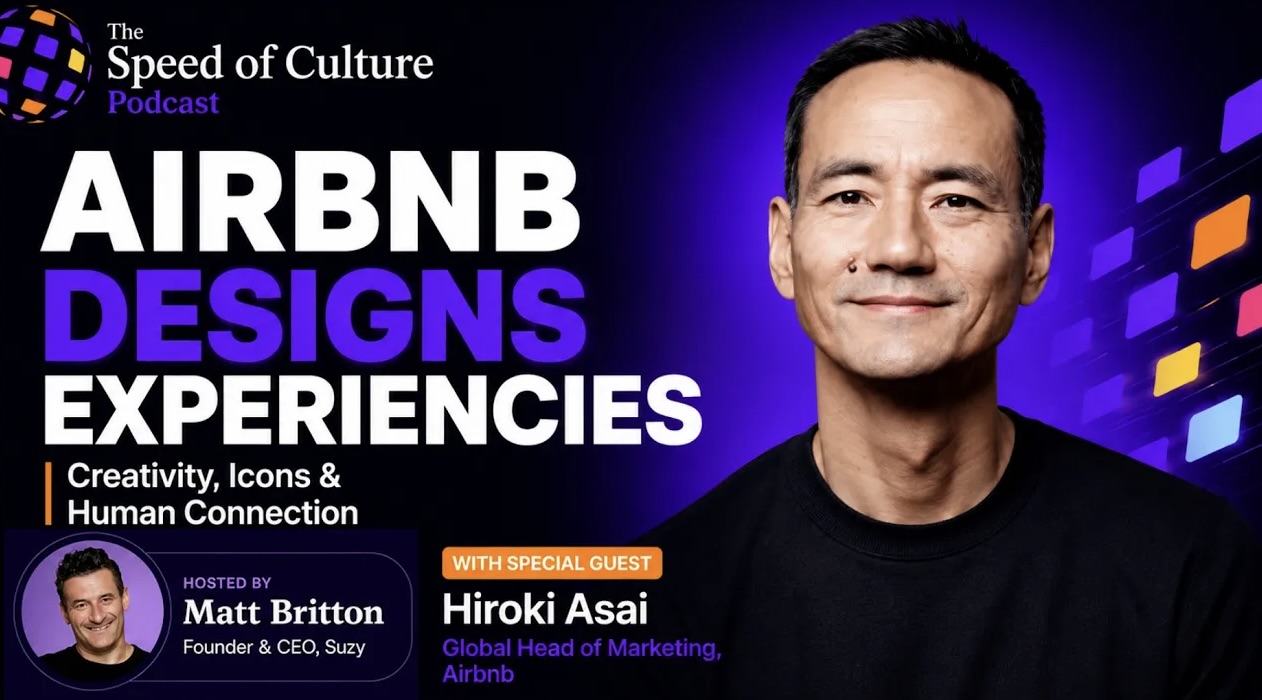
In a recent episode of the Speed of Culture Podcast, host Matt Britton, founder and CEO of Suzy, the AI-powered consumer intelligence platform, sat down with Hiroki Asai, Global Head of Marketing at Airbnb. Together, they explored how the company leverages creativity for brand storytelling and builds extraordinary travel experiences that resonate across cultures and demographics.
Hiroki Asai brings a unique perspective to the conversation, having spent sixteen years at Apple, where he contributed to the launch of iconic products and platforms including the iPhone, iOS, and Apple retail stores. His creative expertise, combined with his role in shaping Airbnb's marketing vision since 2020, positions him as one of the most influential voices in destination marketing and brand experience design.
During this discussion, Asai unpacks the philosophy behind Airbnb's strategic shift from performance-based marketing to brand-focused storytelling, the critical importance of design in creating memorable travel moments, and the company's innovative Icons program that represents a new frontier in experiential marketing.
Matt Britton's platform, Suzy, specializes in providing real-time consumer intelligence through AI-powered research, making it the ideal venue for discussing how data-informed creativity drives authentic brand experiences. The conversation between these two industry leaders reveals essential insights into how brands can build lasting emotional connections with consumers, move beyond traditional advertising metrics, and create marketing campaigns that feel less like promotions and more like cultural moments.
This episode demonstrates why the intersection of creativity, technology, and consumer psychology has become the new frontier of brand differentiation.
The Philosophy Behind Airbnb's Marketing Transformation
Airbnb's journey from a struggling startup to a global hospitality giant reflects a deliberate strategic evolution in how the company approaches brand marketing. When Hiroki Asai assumed his role as Global Head of Marketing in 2020, Airbnb faced a critical juncture.
The company had become increasingly reliant on performance marketing and metrics-driven campaigns that prioritized conversion rates and booking volumes. While these tactics generated short-term results, they obscured what made Airbnb fundamentally different from traditional hotel chains and competing accommodation platforms.
In 2021, Asai implemented a transformative shift in Airbnb's marketing budget allocation, dramatically increasing investment in brand-focused advertising at the expense of pure performance marketing. This decision was driven by an observation that Airbnb had gradually lost its distinctive identity and sense of “uniqueness” in the marketplace.
The company risked commoditization, becoming just another lodging option rather than a lifestyle brand that embodied a philosophy of global belonging and community connection.
The rebranding initiative specifically emphasized a return to the core of what Airbnb was fundamentally about: connecting hosts and guests around authentic, local experiences. Marketing campaigns shifted focus away from generic property listings and amenity checklists, instead showcasing the human stories, cultural moments, and transformative journeys that happen when travelers stay in homes rather than hotels.
This philosophical pivot acknowledged a fundamental truth: people don't just want accommodations; they want to belong.
This transformation required creative courage and a willingness to challenge conventional hospitality marketing wisdom. By reducing emphasis on immediate conversion metrics, Airbnb invested in longer-form storytelling campaigns, documentary-style content, and culturally resonant messaging that built emotional equity over time.
The strategy recognized that brand trust and emotional affinity drive lifetime customer value more effectively than short-term performance metrics alone.
Design Thinking and Creative Excellence in Experiential Marketing
Hiroki Asai's background as a graphic designer who spent sixteen years at Apple deeply informs his approach to marketing at Airbnb. Design, in his philosophy, extends far beyond aesthetic considerations; it represents a fundamental framework for solving human problems and creating meaningful experiences.
This perspective proved essential as Airbnb developed its experiential marketing strategy, particularly through initiatives that blur the lines between advertising, entertainment, and cultural participation.
The “Belong Anywhere” campaign, introduced in 2014 with Airbnb's iconic Bélo logo, represented a design-forward rebrand that communicated inclusivity, safety, and acceptance through visual language alone. Rather than relying on product-focused messaging, the campaign's design conveyed universal values that resonate across cultures and languages.
This emphasis on design-as-philosophy extends into every consumer touchpoint, from website user experience to in-app journey design to the orchestration of experiential moments.
In the context of experiential marketing, design thinking translates into meticulous attention to how consumers actually experience travel. The company moved beyond simply providing accommodations to designing entire journeys, from the moment a guest books a stay through post-trip community engagement.
Each touchpoint reflects intentional design decisions that reinforce Airbnb's brand promise of belonging and authentic connection.
This design-focused approach becomes particularly evident in Airbnb's Icons program, launched in May 2024. The initiative offers exclusive stays and experiences curated by celebrities and prominent figures across music, film, television, art, and sports.
Rather than treating celebrity partnerships as transactional sponsorships, the Icons program represents carefully designed experiences where the physical environment, the host interaction, the cultural significance, and the emotional resonance work in concert. A guest might stay in Prince's Purple Rain house in Minneapolis, not merely to occupy the space, but to participate in an immersive cultural moment complete with exclusive music content and historical context that transforms the experience into something genuinely unprecedented.
Airbnb Icons: Redefining Experiential Marketing for the Digital Age
The Icons program exemplifies how Airbnb has evolved its experiential marketing strategy to engage contemporary consumers who crave authentic, shareable moments. Launched in summer 2024, the program features eleven initial experiences spanning music, film, television, art, and sports.
The marketing genius of Icons lies not in celebrity endorsement itself, but in how the program fundamentally reconceptualizes what a “stay” means in the digital age.
Traditional hotel marketing emphasizes amenities, room quality, and service features, tangible, quantifiable attributes. Icons reframes the entire value proposition.
A guest staying in the Pixar-designed Up house doesn't just occupy a themed room; they participate in a piece of cultural history, access content typically unavailable to general audiences, and generate shareable moments that amplify Airbnb's cultural relevance across social media platforms.
Kevin Hart's “secret speakeasy” experience, Prince's Purple Rain house, and exclusive sessions with artists like Doja Cat represent opportunities for consumers to access moments and spaces typically reserved for industry insiders and celebrities.
The pricing strategy further demonstrates Airbnb's confidence in experiential value over transaction value. Most Icons experiences cost under $100 USD per guest, with many offered free or at nominal costs.
This approach inverts traditional pricing logic where scarcity and exclusivity justify premium pricing. Instead, Airbnb prioritizes cultural visibility and brand reinforcement, understanding that generating millions of social media posts and conversations about Icons experiences delivers exponentially greater marketing value than the direct revenue from bookings.
The program's reach illustrates this strategy's effectiveness. Over 4,000 tickets were made available in 2024, far exceeding demand levels and creating a selection process that adds mystique and perceived value.
The experiential marketing framework treats scarcity as a feature of desirability rather than a constraint on availability. This psychology recognizes that contemporary consumers, particularly younger demographics, increasingly value experiences and social proof over material accumulation.
An Instagram post from an Icon experience creates authentic content that resonates more powerfully than professionally produced advertising ever could.
Creativity, Brand Storytelling, and the Evolution of Destination Marketing
The conversation between Matt Britton and Hiroki Asai emphasizes that successful brand storytelling in the travel industry requires moving beyond promotional messaging toward what might be called “cultural participation.” This shift reflects broader changes in consumer behavior and expectations.
Modern travelers, especially Gen Z and younger millennial audiences, research destinations through social media, influencer content, and peer recommendations rather than traditional travel guides and tourism boards.
Airbnb recognized that destination marketing has become inseparable from cultural narrative. The company's content strategy emphasizes real stories from hosts and guests, user-generated content that captures authentic moments and transformative journeys.
In Q4 2016, 77% of Airbnb's Instagram posts were user-generated content, which drove 80% of engagement and increased followers by 13% in a single quarter.
This strategy fundamentally inverted traditional marketing hierarchies where professional content creators dictate brand narrative; instead, Airbnb empowered community members to become brand storytellers.
The “Belong Anywhere” campaign exemplified this philosophy through initiatives like the #BelongAnywhere challenge, encouraging users to share unique travel stories and fostering genuine community engagement. This user-generated approach provided Airbnb with an essentially unlimited content library of authentic experiences while simultaneously building emotional investment among customers who became part of the brand's narrative.
Hiroki Asai's emphasis on creativity within experiential marketing suggests that the future of brand differentiation lies not in product innovation but in curating meaningful moments. As hospitality becomes increasingly commoditized and traditional competitive advantages diminish, brands must compete on the depth and authenticity of emotional connection.
This requires marketing leaders who understand design as a discipline that encompasses human psychology, cultural relevance, and experiential orchestration, precisely the skill set Asai brings to Airbnb's strategic direction.
The company's approach also demonstrates how brands can integrate emerging cultural moments into their marketing without appearing exploitative or opportunistic. By partnering with authentic figures across music, film, and art, Airbnb positions itself as a curator of culture rather than merely a beneficiary of cultural trends.
This positioning requires deep cultural literacy, genuine respect for the artists and experiences being featured, and a willingness to distribute value and recognition rather than simply extracting cultural capital.
Building Global Brands Through Local Experiences
One of the central tensions Asai navigates involves balancing Airbnb's global brand identity with the inherently local nature of travel experiences. The “Belong Anywhere” philosophy acknowledges this dynamic, the promise isn't to make every destination the same, but to create the conditions for genuine belonging regardless of geography or cultural context.
This requires marketing that celebrates local distinctiveness while reinforcing universal brand values.
Airbnb's destination marketing strategy reflects this nuance. The company tailors promotional efforts to different regions, promoting unique local experiences and cultural immersion.
Marketing messages emphasize that travelers can authentically engage with local communities, sample regional cuisines, and participate in cultural practices, all while feeling welcomed and safe, which is the fundamental promise of the Belong Anywhere brand platform.
The Icons program extends this philosophy globally by partnering with cultural figures whose influence transcends geographic boundaries while remaining deeply rooted in specific places and communities.
Prince's Purple Rain house connects to Minneapolis's music and film history. Pixar's Up house and Inside Out 2 headquarters represent Los Angeles's entertainment industry significance.
These partnerships create globally relevant cultural moments that simultaneously celebrate and validate local identity.
This approach to destination marketing recognizes that contemporary travel is increasingly about cultural exchange and meaningful connection rather than checklist accumulation. Travelers want to understand how local communities live, what cultural values they hold, and how they might temporarily participate in local identity.
Airbnb's marketing strategy provides the narrative framework and community trust infrastructure that makes this type of authentic cultural engagement possible at scale.
Key Takeaways
- Brand storytelling requires prioritizing emotional connection over conversion metrics. Hiroki Asai's 2021 decision to shift Airbnb's marketing budget dramatically toward brand-focused campaigns rather than performance metrics demonstrates that sustainable competitive advantage derives from building deep emotional equity with consumers rather than optimizing for short-term booking conversions.
- Design thinking represents a fundamental competitive advantage in experiential marketing. Asai's background as a designer and his tenure at Apple informs his philosophy that every consumer touchpoint should reflect intentional design decisions. This framework transforms marketing from promotion into experience architecture, creating moments that feel valuable and meaningful rather than commercial.
- User-generated content and community participation amplify brand authenticity at scale. Airbnb's strategy of turning hosts and guests into brand storytellers through initiatives like the #BelongAnywhere challenge provides authentic content while building emotional investment. Data shows that user-generated content drives significantly higher engagement than professionally produced marketing materials.
- Cultural relevance and authentic partnerships create unprecedented marketing value. The Icons program illustrates how partnerships with legitimate cultural figures and access to iconic spaces generates organic social media amplification and positions brands as cultural curators rather than mere commercial entities seeking to exploit cultural moments.
- Global brands must celebrate local distinctiveness to build authentic belonging. The tension between global brand consistency and local relevance requires marketing strategies that validate regional identity while reinforcing universal brand values. This approach acknowledges that true belonging emerges when travelers feel welcomed in local communities rather than inserted into homogenized corporate experiences.
Frequently Asked Questions
What is the Icons program, and how does it reflect Airbnb's marketing strategy evolution?
The Icons program, launched in May 2024, offers exclusive stays and experiences hosted by celebrities and prominent figures across music, film, television, art, and sports. Rather than traditional celebrity endorsements, Icons represents experiential moments designed to create cultural relevance and organic social media amplification.
Guests might stay in Prince's Purple Rain house, attend exclusive music sessions with artists like Doja Cat, or visit Pixar-designed experiences. The program features over 4,000 experiences priced under $100 USD, prioritizing cultural visibility and brand reinforcement over direct revenue generation.
This exemplifies Airbnb's broader strategic shift from performance-based marketing toward brand-focused storytelling that creates lasting emotional connections with consumers.
How did Hiroki Asai's background at Apple influence his approach to marketing at Airbnb?
Hiroki Asai spent sixteen years at Apple, contributing to the launch of iconic products and platforms including the iPhone, iOS, and Apple retail stores. His experience shaped a design-thinking philosophy where marketing extends beyond aesthetic considerations to represent a fundamental framework for solving human problems and creating meaningful experiences.
At Airbnb, this perspective translates into meticulous attention to consumer experience design, from website functionality to in-app journey design to the orchestration of experiential moments.
His design-forward approach emphasizes that every touchpoint should reinforce brand promise and emotional connection, transforming marketing from promotional activity into experience architecture.
Why did Airbnb shift from performance marketing to brand-focused campaigns in 2021?
In 2021, Asai observed that Airbnb had become increasingly reliant on performance marketing metrics and had consequently lost its distinctive identity in the marketplace. The company risked commoditization, appearing as just another lodging option rather than a lifestyle brand embodying community and authentic belonging.
The shift involved dramatically increasing investment in brand-focused advertising while reducing pure performance marketing spend.
This strategy acknowledged that brand trust and emotional affinity drive lifetime customer value more effectively than short-term conversion optimization alone. The new approach emphasized storytelling campaigns, user-generated content, and culturally resonant messaging that built emotional equity over time.
How does the “Belong Anywhere” campaign use user-generated content to build brand authenticity?
Airbnb's “Belong Anywhere” campaign leverages user-generated content (UGC) as a core brand storytelling mechanism. The company encourages hosts and guests to share authentic travel stories and experiences through initiatives like the #BelongAnywhere challenge.
Data demonstrates significant effectiveness: in Q4 2016, 77% of Airbnb's Instagram posts were user-generated content, driving 80% of engagement and increasing followers by 13% in a single quarter.
This strategy inverts traditional marketing hierarchies where professional content creators control brand narrative; instead, community members become brand storytellers. The approach provides authentic content while simultaneously building emotional investment among customers who become part of Airbnb's brand narrative, amplifying credibility and relatability at unprecedented scale.
Looking Ahead
The conversation between Matt Britton and Hiroki Asai on the Speed of Culture Podcast illuminates a fundamental shift in how brands create competitive advantage through storytelling and experience design. As markets become increasingly saturated and consumer attention more fragmented, the ability to create authentic moments that resonate emotionally will determine which brands maintain relevance and trust.
For marketing leaders, product developers, and brand strategists, the episode provides essential case study material in how to integrate creativity with strategic business objectives. Airbnb's evolution from a transactional accommodation platform to a cultural brand demonstrates that exceptional marketing emerges not from clever tactics or cutting-edge technology, but from deep understanding of human psychology, design excellence, and authentic commitment to community and belonging.
Explore these resources to deepen your understanding of brand strategy, consumer intelligence, and the future of marketing:
- Suzy. AI-powered consumer intelligence platform for real-time insights
- The Speed of Culture Podcast. Explore the latest trends shaping consumer culture
- Generation AI. Matt Britton's book exploring AI's impact on the future generation
- AI Keynote Speaker. Matt Britton's expertise on artificial intelligence and emerging consumer trends
- Speaker HQ. Connect with industry experts and thought leaders
Listen to the full episode on the Speed of Culture Podcast for deeper insights into how global brands build authentic experiences that resonate across cultures and demographics.
Author Bio: This article synthesizes insights from Speed of Culture Podcast Episode 115, featuring conversation between Matt Britton (Founder & CEO of Suzy) and Hiroki Asai (Global Head of Marketing at Airbnb), exploring creativity, design thinking, and experiential marketing strategies that define modern brand leadership.

%20(400%20x%20100%20px)%20(300%20x%2050%20px)%20(150%20x%2050%20px).avif)