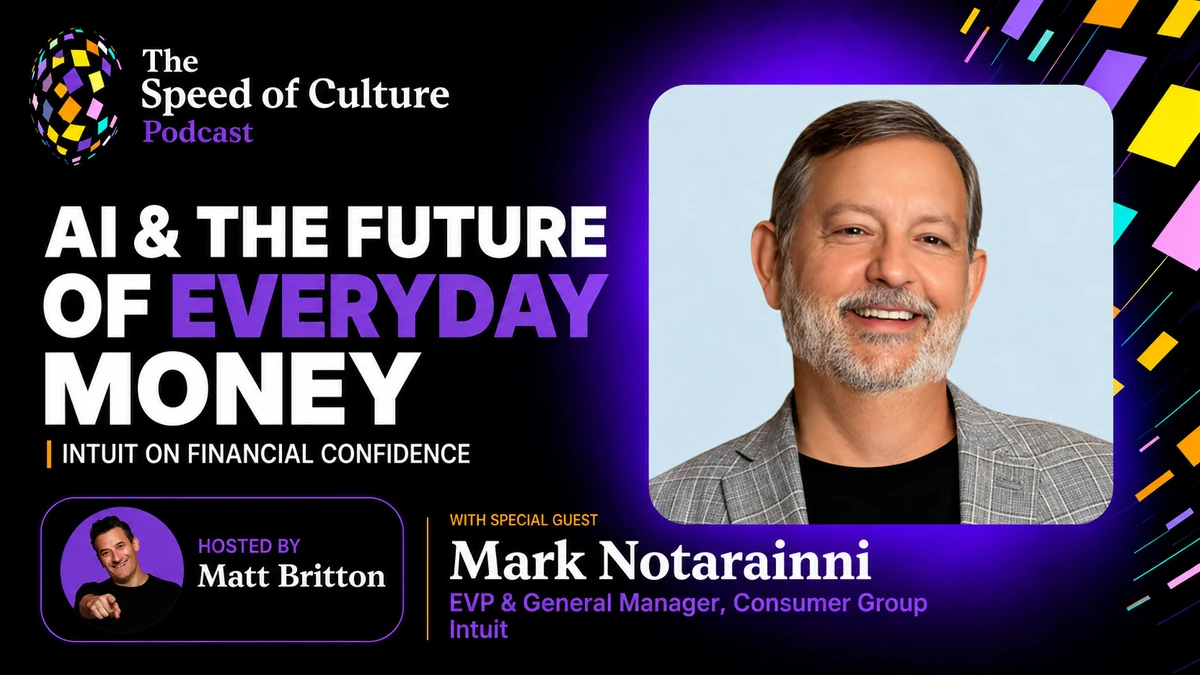
A useful financial product has to answer the question that follows the account balance: what should someone do next? That gap between seeing a problem and feeling equipped to act sits at the center of Matt Britton’s conversation with Mark Notarainni, Executive Vice President and General Manager of Intuit’s Consumer Group, on The Speed of Culture podcast.
Released September 8, 2026, the episode examines how AI could make everyday money management more practical, more continuous, and more accessible. Notarainni leads the consumer business behind TurboTax and Credit Karma. His perspective connects product strategy to the pressures people experience around the kitchen table: paying bills, understanding credit, managing debt, and deciding how to use a tax refund.
The conversation offers a grounded way to assess AI transformation. A compelling demonstration matters less than whether a customer can complete an important task with greater understanding and confidence. That theme also informs Matt Britton’s AI keynote presentations: technology changes consumer expectations when it changes what people can accomplish.
For business leaders, the episode raises several questions. How does a company turn scattered information into useful guidance? Where does human expertise become more valuable as software improves? And how should a brand serve customers who increasingly begin their questions inside someone else’s AI interface? Intuit’s approach provides concrete examples, alongside a reminder that customer control must remain visible as the experience becomes easier.
Financial Confidence Begins With the Customer’s Next Decision
Notarainni frames Intuit’s consumer mission around helping people manage their financial lives. That is a broader responsibility than making individual transactions easier. A customer may understand a displayed balance while remaining unsure about which bill needs attention, what a credit score represents, or whether a recurring expense still serves a purpose.
In the conversation, he describes an early lesson from taking TurboTax customer calls. Refunds were connected to rent, medical expenses, and other pressing household needs. Hearing those stories changed his understanding of what the product meant to the people using it. Tax preparation was attached to decisions with consequences well beyond completing a form.
That distinction should influence how leaders define product value. An internally convenient metric, such as the number of screens completed, captures only part of the experience. A more useful question is whether the customer understood the available choices and reached the intended outcome. Both efficiency and comprehension matter when the task carries emotional weight.
Consider how that principle changes research. Asking customers which dashboard they prefer may improve presentation. Asking what they were trying to decide when they opened the dashboard can reveal a different need altogether. The missing feature might be an explanation, a timely reminder, or access to a person who can clarify an unfamiliar situation.
The leadership implication is practical: organize discovery around decisions that customers struggle to make. Then connect each proposed feature to a specific obstacle in that decision. Doing so gives product, marketing, and service teams a shared definition of progress that is rooted in the customer’s life.
AI in Personal Finance Must Connect Insight to Action
The episode’s most useful AI discussion concerns the distance between identifying an issue and resolving it. Notarainni describes tools that combine a customer’s financial information with Intuit’s knowledge and network of financial partners. His example is revolving debt: seeing an outstanding balance does not automatically tell someone how to evaluate available alternatives.
He explains that an agent can monitor relevant information and help surface a path forward. The potential advantage comes from connecting several steps that otherwise require separate effort: understanding the situation, comparing possibilities, interpreting them, and reaching the place where a decision can be carried out. His examples describe Intuit’s approach, rather than a promise that every customer will receive the same result.
For leaders assessing AI investments, this suggests a useful unit of measurement: a completed customer task. Generating an answer is one event within that task. If the customer must then repeat information, search for the right application, or interpret unexplained tradeoffs, much of the original burden remains.
The conversation also makes clear that assistance and control need to develop together. Notarainni describes customers choosing where money should go. That choice is part of the product experience. An interface that makes the next step easier should also make the proposed action understandable before the customer commits.
A practical product review can therefore follow the entire journey. What information supports the recommendation? What does the customer still need to decide? Where can they ask a question? What confirms that the chosen action occurred? Answering those questions makes an AI feature more concrete and gives teams a stronger basis for evaluating whether it actually helps.
Young Consumers Need an Accessible Starting Point
Britton and Notarainni discuss financial literacy as a problem of timing as well as information. Young people can encounter consequential decisions about credit, rent, and earnings before they have much experience interpreting them. A lesson delivered long before a decision may not feel relevant when it is taught.
Notarainni describes Intuit’s use of educational experiences and gamification to help students encounter financial concepts earlier. He also discusses the challenge of entering the financial system with little or no credit history. Both examples focus on making an unfamiliar system more navigable at the moment someone is beginning to participate.
The broader consumer insight is that familiarity with technology should not be confused with confidence in every domain. A young customer may move easily through a mobile interface while still needing clear explanations of the choices inside it. That distinction is relevant to the generational expectations explored in Britton’s work on Gen Z consumer behavior.
Product teams can respond by placing education close to action. A brief explanation alongside a decision can be more useful than a large library that customers must independently search. The design challenge is to provide enough context for an informed next step without assuming extensive prior knowledge or overwhelming the customer.
Notarainni’s optimism about younger consumers centers on access to capabilities that were harder to obtain when he was starting out. Translating that ambition into a useful experience requires careful onboarding. Teams should test whether a first-time customer understands the terminology, can explain the next step, and knows how to get help. Those observations reveal whether access is becoming meaningful participation.
Human Expertise Changes When Software Handles More Preparation
The discussion of automation moves quickly to the changing role of experts. Notarainni describes a progression from performing routine work toward helping customers feel confident about decisions. In tax preparation, that can mean spending less of the interaction collecting information and more of it interpreting a customer’s particular circumstances.
Britton extends the point to other professional services: the value of producing a document can change while the value of helping someone think through a significant decision remains substantial. The business opportunity is to reconsider how expert time is allocated across the service, including the moments when a customer wants reassurance or judgment.
That shift requires operational design. An expert who receives incomplete context may spend the conversation reconstructing work the software already attempted. A better handoff gives the person enough information to understand the customer’s question, see what has already happened, and focus on what remains unresolved.
The episode also acknowledges a difficult workforce question. If early career employees traditionally learn through routine tasks, automating those tasks changes the route to experience. Notarainni sees technology as a way to accelerate learning. Leaders still need to design that learning deliberately through supervised practice, feedback, and exposure to increasingly complex situations.
For service organizations, the practical lesson is to plan the human role alongside the AI role. Define where experts add judgment, how customers reach them, and how new employees develop the skills the redesigned service requires. Otherwise, a company can improve one part of the workflow while leaving the surrounding experience underprepared. Confidence depends on how well the whole service works together.
Year-Round Relationships Can Reshape Seasonal Products
TurboTax provides an example of a seasonal product that can benefit from a more continuous customer relationship. Britton asks whether AI changes the idea of tax season itself. Notarainni distinguishes the timing of filing from the experience of preparation: he describes a future in which more work happens in the background as relevant information becomes available.
That is a product direction discussed in the episode, not evidence that every return is already prepared automatically. The strategic idea is nevertheless significant. Many decisions that affect a later task occur throughout the year. A service that participates only at the deadline sees the customer after much of that activity has already happened.
Connecting ongoing financial activity with tax preparation could reduce repeated explanations and make later interactions more specific. Notarainni describes the possibility of asking customers only the questions that remain relevant to their circumstances. The intended benefit is a process that reflects what the service already knows, while preserving room for missing context and expert advice.
Other businesses can apply the same analytical lens to renewals, applications, and annual reviews. Which parts of the task could be prepared earlier? What information changes over time? When would an intervention be useful to the customer? Those questions can reveal opportunities to improve a recurring process without simply increasing message volume.
Continuous engagement earns its place when it helps. A year-round relationship should be judged by the burden it removes and the decisions it supports. More contact is not inherently more valuable. The strongest version makes the eventual moment of action feel better informed, less repetitive, and easier to complete.
Brands Must Serve Customers Across AI Interfaces
Another important thread concerns where the customer relationship begins. Notarainni says Intuit wants to serve people who start inside tools such as ChatGPT or Claude. His description separates discovering information from completing an action that requires the company’s own product capabilities and processes.
In his credit example, a customer may begin with a question in an AI interface and later move into Credit Karma to continue the application process. The discussion emphasizes making that transition as smooth as possible. It also recognizes that some steps depend on requirements and capabilities specific to financial services.
The strategic implication extends beyond finance. A brand’s website or app may remain important even when it is no longer the first place a customer asks a question. Teams need to consider how their information and services appear along a journey that crosses multiple environments, each with a different role.
That changes the work of both marketing and product leadership. Marketing must make the offering clear enough for customers to understand when they encounter it elsewhere. Product teams must decide what context should carry into the next stage so customers can continue without rebuilding the conversation. Service teams need to anticipate the questions that emerge at those transition points.
Leaders can start by mapping one actual journey from an initial question to a completed task. Identify where the customer changes interfaces, loses context, or becomes uncertain about who is responsible. Improving those moments can make a distributed experience feel coherent. The objective is to preserve useful continuity wherever the customer chooses to begin.
Leadership Still Depends on Sound Data and Persistent Learning
Notarainni applies the same themes to his own work. He describes using Claude to ask questions about business performance and gather relevant research. The interface changes how he accesses information, but he explicitly acknowledges that the underlying data still has to exist and be structured properly.
That observation is an important corrective to superficial AI adoption. A conversational interface can make information easier to reach. It does not, by itself, resolve conflicting definitions, missing records, or unclear ownership. Leaders who want dependable answers need to preserve attention to the inputs and processes that support those answers.
The practical opportunity is to redirect time toward interpretation. If a leader can spend less effort locating reports, more of the working day can go toward testing assumptions, asking follow-up questions, and deciding what deserves attention. That benefit depends on treating an AI response as part of an inquiry and understanding the evidence behind it.
Notarainni closes with a personal emphasis on perseverance. He connects it to adapting as technology changes, both for people entering the workforce and for experienced leaders learning new tools. The lesson is less about mastering one application than sustaining the willingness to learn as familiar methods evolve.
Organizations can make that learning tangible by choosing a useful task, observing where the new approach succeeds or fails, and improving it through repeated use. Employees also need space to raise questions when an answer seems wrong. The combination of curiosity, reliable information, and deliberate practice gives AI adoption a stronger foundation than enthusiasm for a demonstration alone.
Key Takeaways for Business Leaders
- Define value around a customer decision. Identify what the person is trying to accomplish and what prevents progress. Use that decision to guide research, feature priorities, and service design so internal activity can be connected to a meaningful customer outcome.
- Evaluate the complete AI-assisted task. Examine how information becomes a recommendation, how the customer chooses an action, and how completion is confirmed. A persuasive answer is useful only if the surrounding experience helps the customer move forward with understanding.
- Teach at the moment of relevance. Test onboarding with people who lack domain experience. Explain unfamiliar concepts where they affect a choice, and make assistance easy to find. Familiarity with mobile technology does not remove the need for clear financial context.
- Design expert handoffs and training together. Give human specialists the context they need to add judgment. At the same time, create deliberate ways for less experienced employees to learn as routine work changes, including feedback on realistic customer situations.
- Earn continuity across time and interfaces. Use ongoing relationships and connected experiences to reduce repetition. Measure whether customers retain context when they return or move between services. More notifications and more touchpoints are useful only when they support the customer’s task.
- Keep investing in the foundations. Clear data definitions, accountable owners, and thoughtful review remain essential when the interface becomes conversational. Encourage persistent learning while maintaining the discipline to investigate unclear or unsupported answers before relying on them.
Frequently Asked Questions
What does Mark Notarainni oversee at Intuit?
Notarainni is Executive Vice President and General Manager of Intuit’s Consumer Group, the role identified in the episode and on Intuit’s author profile. In the conversation, he discusses the consumer platform through TurboTax and Credit Karma, with a focus on helping people understand their finances, access useful guidance, and complete important financial tasks.
How can AI improve everyday money management?
The episode describes AI as a way to connect financial information with a more useful next step. Examples include understanding debt, planning around a paycheck, and considering how to use a refund. The business principle is to reduce the effort between recognizing an issue and acting on it. Individual outcomes depend on the customer’s circumstances and the available service.
Will AI remove the need for human financial experts?
The conversation emphasizes a changing role for experts. As software performs more preparatory work, people can spend more time explaining options, addressing unusual circumstances, and helping customers make sense of consequential decisions. For employers, this requires well-designed handoffs and intentional training. The episode does not establish a universal prediction about employment across financial services.
Does continuous financial support mean tax season disappears?
Notarainni distinguishes filing dates from the preparation experience. He describes a direction in which connected information helps prepare more of the work throughout the year, leaving fewer repetitive steps when a customer is ready to file. That is a discussion of how the service could evolve; it does not mean filing requirements disappear or every customer’s tax preparation is fully automated.
Building Financial Confidence Through Better Experiences
The strongest idea in this conversation is that accessible information becomes more valuable when it helps someone make a decision. Intuit’s examples connect that idea to the realities of everyday finances, where unfamiliar terminology, scattered data, and uncertainty can slow progress even when tools are readily available.
For business leaders, the next step is to examine a specific customer journey with that standard in mind. Find the moment where someone understands that a problem exists but cannot see a clear way forward. Then assess how software, relevant context, and human expertise could work together to make that moment easier.
Matt Britton’s conversations on The Speed of Culture explore how these changes affect consumer expectations and business strategy. To bring a discussion of AI, consumer behavior, and the future of customer experience to your leadership team or next event, connect with Matt’s team about a keynote.

%20(400%20x%20100%20px)%20(300%20x%2050%20px)%20(150%20x%2050%20px).avif)