Opening
The creator economy has become one of the most transformative forces in digital commerce, reshaping how brands reach consumers, how content creators monetize their work, and how platforms like YouTube evolve to meet emerging market demands. With the influencer marketing industry valued at $16.4 billion in 2022 and projections suggesting growth to $480 billion by 2027 according to Goldman Sachs, understanding the mechanics of creator monetization and platform partnerships has never been more critical for business leaders and marketers.
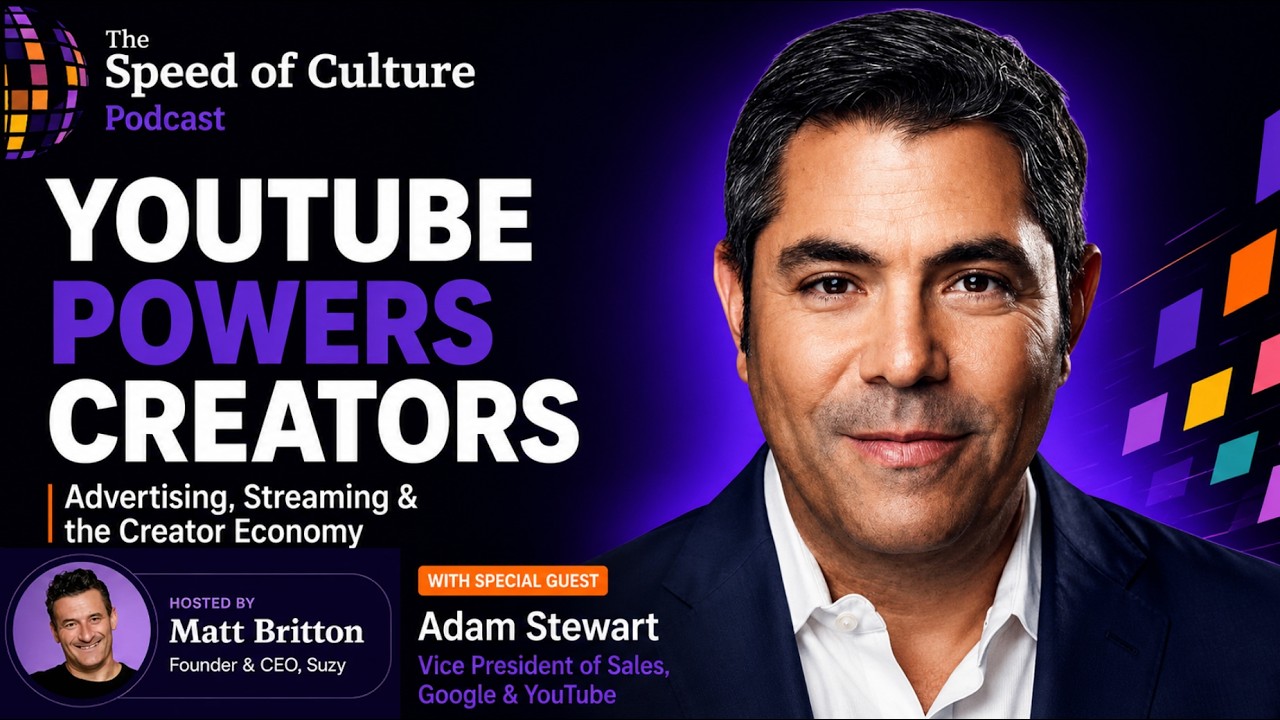
In this episode, Matt Britton, founder and CEO of Suzy, the AI-powered consumer intelligence platform, sits down with Adam Stewart, Vice President of Sales at Google and YouTube, to explore how YouTube's creator ecosystem is reshaping the digital marketing landscape and what opportunities lie ahead for brands looking to leverage creator partnerships.
Adam Stewart brings over 16 years of experience at Google to this conversation, with a unique vantage point on the intersection of advertising, brand partnerships, and creator economics. Before his tenure at Google and YouTube, Stewart served as Senior Vice President at Discovery Communications, overseeing some of media's most iconic networks including the Discovery Channel, TLC, Animal Planet, Travel Channel, and BBC America.
His previous role as Vice President of National Sales at Screenvision and his education in Communications Arts and Sciences from USC provide him with a comprehensive understanding of how traditional media, digital platforms, and modern creator networks function. During this discussion, Britton and Stewart unpack the strategic initiatives YouTube is undertaking to monetize creator content, the performance metrics that brands should track, and the future trajectory of influencer marketing as it becomes increasingly sophisticated and data-driven.
The conversation addresses several key developments that underscore YouTube's commitment to creator success, particularly the launch and evolution of YouTube Shorts. Announced in September 2022, YouTube Shorts fundamentally changed the creator monetization playbook by enabling creators to earn 45 percent of ad revenue from Shorts content, compared to 55 percent for long-form videos.
While this represents a smaller share for individual creators, the revenue opportunity is offset by the reach and engagement potential of Shorts, which reached 29 million user engagements in the United States alone. The eligibility threshold, requiring creators to maintain 1,000 subscribers and achieve 10 million Shorts views within a 90-day period, establishes a measurable pathway for emerging creators to build sustainable income from platform monetization.
Beyond individual creator monetization, the conversation explores YouTube's broader ecosystem innovations that amplify brand-creator partnerships. YouTube BrandConnect, a centralized platform for managing brand-creator collaborations, has become instrumental in scaling partnerships.
Partnership ads on Shorts have demonstrated their effectiveness, driving 20 percent higher conversions compared to advertiser-only branded ads. These metrics underline a critical insight for modern marketers: audiences increasingly engage with content that feels authentic and creator-driven rather than purely branded.
Connected TV represents another frontier in YouTube's creator and advertising ecosystem. With 63 percent of YouTube viewing occurring on television screens, and YouTube CTV present in 39.3 million U.S. households, the platform has positioned itself as a dominant force in the living room environment.
Performance data reveals that YouTube CTV campaigns are 3.1 times more effective than traditional television for consumer packaged goods campaigns, according to Nielsen multi-marketing mix modeling. For brands in the CPG, automotive, food and beverage, and entertainment sectors, YouTube CTV represents a critical channel for reaching households at scale with measurable ROI.
The creator economy's expansion reflects broader workforce and income diversification trends. In 2021 alone, the number of creators on the top 50 platforms increased by 48 percent, demonstrating both the appeal of content creation as a career path and the competitive dynamics that continue to shape platform ecosystems.
Significantly, 74.5 percent of U.S. marketers at companies with 100 or more employees planned to integrate influencer marketing into their strategy in 2022. Through this conversation, listeners and readers will gain insights into how platforms, creators, and brands are aligning around shared objectives, how data and measurement are becoming increasingly sophisticated, and what strategic moves will define competitive advantage in the creator economy going forward.
The Evolution of YouTube's Creator Monetization Strategy
YouTube's approach to creator monetization has undergone significant transformation, particularly with the rise of short-form video content. Historically, YouTube's monetization model favored long-form creators who could build substantial subscriber bases and generate consistent viewership across extended content libraries.
The introduction and scaling of YouTube Shorts represents a strategic pivot to capture engagement on shorter, mobile-first content while maintaining platform ecosystem lock-in. The September 2022 announcement of YouTube Shorts monetization established clear incentives and guardrails.
Creators can earn 45 percent of ad revenue generated from their Shorts, a figure that reflects the platform's need to reserve revenue for its operations and advertising infrastructure. The eligibility criteria, 1,000 subscribers and 10 million Shorts views within 90 days, create a meritocratic pathway that rewards content quality and audience resonance while preventing spam and low-quality content from monetizing.
The strategic advantage of Shorts monetization lies in the velocity and scale of viewership possible within the Shorts format, rather than in per-view rates (which are typically lower than long-form content). Reaching 29 million user engagements in the United States demonstrates the massive addressable audience for Shorts content.
Creators who successfully navigate the 90-day qualification window unlock multiple revenue streams: direct ad revenue from their own Shorts, potential brand partnerships through YouTube BrandConnect, and cross-promotion opportunities with long-form content that drives longer watch sessions and higher RPM rates.
From a brand perspective, the Shorts monetization framework creates unprecedented opportunities for authentic creator partnerships. Partnership ads on Shorts have demonstrated 20 percent higher conversion rates compared to advertiser-only branded ads.
The ecosystem effect is significant. As more creators achieve Shorts monetization eligibility, the platform's overall content supply increases, driving engagement metrics higher and creating a flywheel effect that benefits all creators through increased audience reach and viewership opportunities.
YouTube's Dominance in Connected TV and Premium Advertising
Connected Television represents one of the most underappreciated channels in the modern marketing stack. With 63 percent of YouTube viewing occurring on TV screens, YouTube has effectively become a television network in the digital age, one with targeting, measurement, and optimization capabilities that traditional broadcasting cannot match.
The presence of YouTube CTV in 39.3 million U.S. households means the platform has achieved distribution parity with major cable television networks, but with substantially greater audience insight and campaign flexibility.
Nielsen's multi-marketing mix modeling data shows that YouTube CTV campaigns deliver 3.1 times greater effectiveness for consumer packaged goods campaigns compared to traditional television. This multiplier effect reflects precise audience targeting, real-time campaign optimization, and attribution modeling that connects CTV impressions to downstream purchase behavior.
For brands in the CPG sector, CTV effectiveness directly translates to marketing efficiency. A brand running a $10 million YouTube CTV budget, with precise targeting and higher conversion attribution, demonstrates materially higher ROI.
The co-viewing phenomenon adds another dimension to CTV strategy. Approximately 26 percent of CTV viewing involves multiple adults watching together, creating an opportunity for brands to reach households through shared-viewing moments.
YouTube's competitive position in CTV is strengthened by its integrations with other Google properties, its massive advertiser base, and its sophisticated programmatic advertising infrastructure. Brands and agencies can execute CTV campaigns through the Google Marketing Platform and optimize campaigns in real time based on performance signals.
YouTube BrandConnect and the Future of Creator Partnerships
YouTube BrandConnect represents a strategic evolution in how platforms facilitate brand-creator partnerships. The platform provides a centralized, transparent marketplace where creators can list partnership opportunities and brands can discover creators aligned with their audiences.
Creators gain access to a formal marketplace of brand partnership opportunities, reducing their reliance on talent agencies that historically captured 10 to 20 percent of partnership value. Brands gain access to a curated network of creators with verified audience metrics, engagement rates, and audience demographics.
The 20 percent higher conversions associated with partnership ads on Shorts demonstrate that the partnership model is not merely an alternative revenue stream but a genuinely superior marketing channel.
Looking forward, BrandConnect is positioned to become the primary interface through which brand-creator partnerships form. As the platform matures, YouTube can implement additional features including portfolio curation, audience overlap analysis, performance benchmarking, and built-in dispute resolution.
The strategic implication for brands is clear: allocating budget to creator partnerships is becoming a standard component of performance marketing. 74.5 percent of U.S. marketers at large companies planned to use influencer marketing in 2022, up from 50 percent just five years prior.
The Creator Economy at Scale: Trends Reshaping Brand Marketing
The 48 percent increase in creators on top platforms in 2021 demonstrates the category's explosive growth. More significantly, it reflects a bifurcation in content consumption as audiences gravitate toward creator-driven content.
The $16.4 billion influencer marketing industry in 2022, with projections of $480 billion by 2027, represents a 2,900 percent growth trajectory over five years.
As more brands allocate budget toward influencer marketing, creator compensation increases and the supply of premium creators becomes constrained. Brands that establish relationships early and facilitate creator success gain competitive advantage.
YouTube's innovations in creator monetization, partnership facilitation, and CTV advertising are responses to these market dynamics, strengthening its competitive position while accelerating the creator economy's growth.
Strategic Imperatives for Brands in the Creator Economy
- Integrate creator marketing into core strategy. Creator marketing is now foundational, and budgeting should be comparable to paid social and search advertising.
- Invest in creator discovery and relationship management infrastructure. Brands need internal capabilities to identify aligned creators, negotiate terms, and measure performance.
- Leverage YouTube CTV as a premium channel. CTV effectiveness data demonstrates it should be a core allocation for consumer brands.
- Enable creator authenticity in partnerships. The conversion lift from partnership ads reflects authentic integration and creator endorsement.
- Measure and optimize creator marketing rigorously. Evaluate on business outcomes including conversions, customer acquisition cost, and lifetime value.
Key Takeaways for Business Leaders
- Shorts Monetization Transforms Creator Economics: The 45-percent revenue share and 29 million user engagements create substantial opportunity, with 20-percent conversion lift for partnership ads.
- Connected TV Is Not Legacy Media: 3.1x effectiveness versus traditional television and presence in 39.3 million households make CTV a core channel.
- Creator Partnerships Are Core Marketing Infrastructure: 74.5 percent adoption among large marketers and projected growth to $480 billion by 2027 signal foundational change.
- YouTube BrandConnect Reduces Partnership Friction: Centralized marketplaces streamline formation and improve transparency.
- Creator Economy Growth Reflects Audience Behavior Shifts: A 48-percent increase in creators indicates sustained momentum.
Frequently Asked Questions
How does the YouTube Shorts revenue share compare to long-form YouTube monetization?
YouTube Shorts creators earn 45 percent of ad revenue, compared to 55 percent for long-form content. While the percentage is lower, Shorts content can generate substantially higher viewership volumes. The 10-million-views-in-90-days eligibility requirement creates a meritocratic pathway for emerging creators.
Why is YouTube CTV more effective than traditional television for marketing?
YouTube CTV delivers 3.1x greater effectiveness than traditional television for CPG campaigns due to sophisticated audience targeting, real-time optimization, and granular attribution modeling. It also reaches audiences who have abandoned cable subscriptions.
How should brands approach creator partnerships to maximize performance?
Successful creator partnerships balance brand strategy with creator authenticity. Brands should identify aligned creators, establish clear objectives, allow creative freedom, and measure partnerships on business outcomes including conversions and customer acquisition cost.
What is the long-term trajectory of the creator economy, and how should brands prepare?
Goldman Sachs projects growth from $16.4 billion in 2022 to $480 billion by 2027. Brands should integrate creator marketing into core strategy, build internal capabilities, allocate meaningful budget, and apply rigorous measurement discipline.
Looking Ahead
The conversation between Matt Britton and Adam Stewart illuminates the intersection of platform innovation, creator economics, and brand strategy. Understanding how platforms like YouTube are facilitating creator monetization, brand partnerships, and advanced advertising capabilities is essential for any marketer operating in 2023 and beyond.
For deeper insights into consumer behavior and market trends, explore Suzy, an AI-powered consumer intelligence platform that helps brands make smarter decisions faster. To understand how culture shapes consumer behavior and brand strategy, visit Speed of Culture.
For leadership on the intersection of AI and business, follow Generation AI or consider engaging Matt Britton as an AI keynote speaker for your organization. Additional speaker resources are available at Speaker HQ.

%20(400%20x%20100%20px)%20(300%20x%2050%20px)%20(150%20x%2050%20px).avif)