The Future of TV Advertising: How Roku Is Reshaping Streaming with Data and Innovation
The streaming television landscape has undergone a seismic shift over the past decade. What once seemed like a disruption to traditional TV advertising has evolved into one of the most dynamic and data-rich channels available to modern marketers.
Today, brands can have both reach and precision instead of choosing between them. And leading this transformation is Roku, the largest TV operating system in the United States, powering 90 million households and reaching 120 million daily viewers.
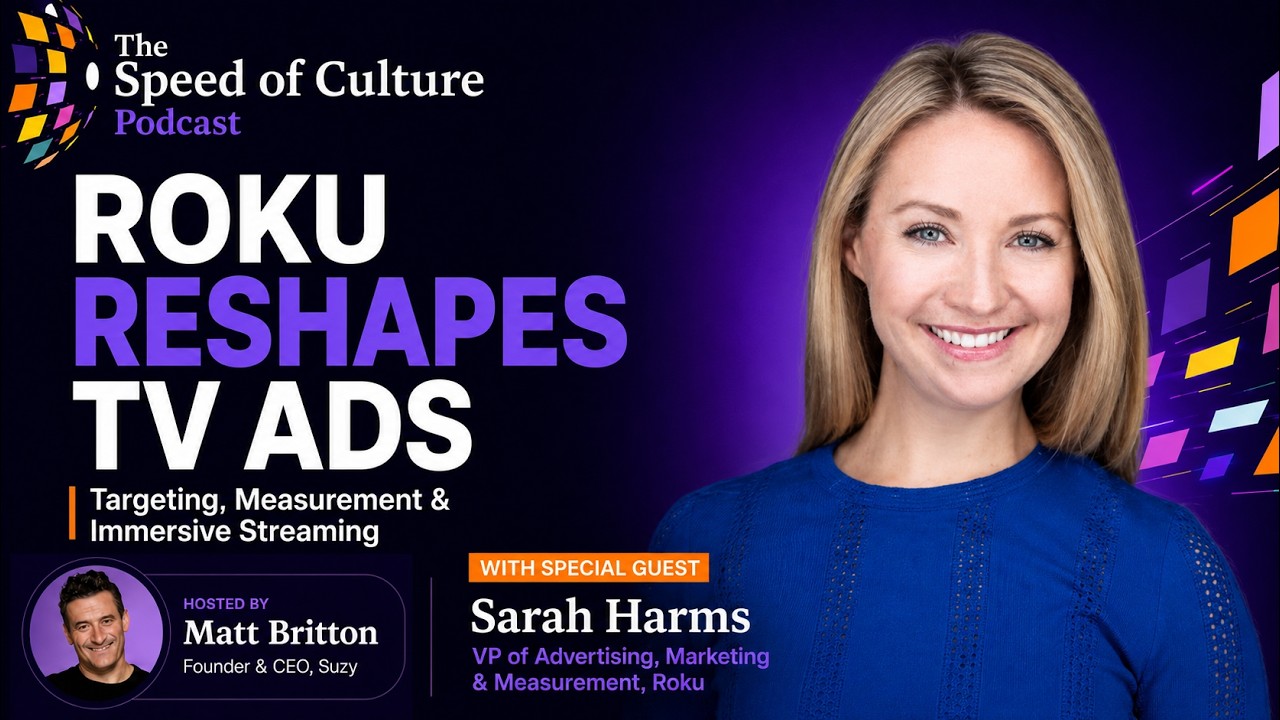
In Episode 173 of the acclaimed Speed of Culture Podcast, Matt Britton, founder and CEO of Suzy, sat down with Sarah Harms, VP of Advertising, Marketing, and Measurement at Roku, to explore how the company is reshaping streaming TV advertising.
Their conversation reveals how data-driven strategies, consumer-first thinking, and innovative ad formats are revolutionizing connected TV (CTV) advertising and positioning Roku as a game-changer in the industry.
This episode, released on March 20, 2025, provides critical insights for any marketer looking to understand where television advertising is headed and how to leverage emerging opportunities in the CTV space.
Sarah's background in ad tech, programmatic advertising, and digital media, including previous leadership roles at GroupM and Microsoft, brings a wealth of perspective to the conversation about data-driven marketing excellence.
Why Roku's Scale Matters: The Gateway to 120 Million Daily Viewers
When most people think about Roku, they picture a streaming device on someone's coffee table. The reality is far more significant.
Roku is the operating system that powers the television experience for nearly 90 million U.S. households, far more than a hardware manufacturer or a streaming platform. This scale fundamentally changes how advertisers should think about connected TV.
Sarah emphasizes that Roku's role as the gateway to streaming content means that the platform controls a critical touchpoint in the consumer journey. The Roku home screen alone delivers advertising inventory equivalent to Super Bowl-sized reach, every single day.
This reflects the sheer volume of attention flowing through Roku's ecosystem.
Beyond the home screen, Roku has developed immersive ad experiences like Roku City, which provides branded environments where consumers can explore products and services in engaging, interactive settings.
These are consumer-first experiences designed with the understanding that viewers have chosen to engage with content on their terms, a departure from the intrusive, skippable ads that have dominated digital for the past decade.
"Everything has to be consumer-first," Sarah explains on the podcast. "We're never gonna be the obnoxious, in-your-face bothering you all day with annoying ads."
This philosophy has paid dividends: The Roku Channel has become the second most-watched app on Roku devices, surpassing major competitors.
For advertisers, this creates unprecedented opportunities to reach audiences at moments when they're most receptive to brand messages.
The implications for marketers are substantial. With 120 million daily viewers, Roku offers a reach that rivals, or exceeds, traditional television, but with the targeting precision that streaming enables.
Advertisers can no longer treat television as a pure reach play; they must embrace it as a data-informed channel capable of delivering both brand awareness and direct response results.
The Data Revolution: Making CTV Measurable and Addressable
One of the most transformative shifts in television advertising has been the introduction of sophisticated data capabilities. Traditional TV was always a mystery in terms of attribution.
Brands would invest millions in primetime slots and hope for consumer response. Today's connected TV advertising operates in a completely different paradigm.
Roku has built a first-party data foundation that spans millions of households, providing advertisers with insights that were unimaginable just five years ago.
This data encompasses viewership habits, purchase behaviors, and streaming preferences, the kind of granular information that enables true audience precision.
Sarah points out that the industry has moved beyond one-size-fits-all demographic targeting. Modern CTV advertising is powered by behavioral and interest-based data that reflects how actual consumers engage with content.
The introduction of the Roku Data Cloud represents a watershed moment for the industry. This platform allows advertisers to integrate external datasets, enabling enhanced attribution and cross-platform tracking.
Instead of wondering whether a streaming ad led to a store visit or an online purchase, brands can now track customer journeys with substantially greater accuracy.
This level of transparency fundamentally changes how marketing budgets are allocated.
Roku's partnerships with major measurement providers further strengthen this data story. Advertisers can now collaborate with tools that help analyze campaign performance beyond simple impressions.
Real business outcomes (in-store visits, online purchases, website traffic, and customer acquisition) can be connected to specific streaming campaigns.
This transition from impressions to outcomes represents one of the most significant evolutions in advertising measurement since the rise of digital marketing.
For performance marketers accustomed to the real-time optimization available in paid search and social media, this represents a major unlock.
Connected TV has historically been seen as a brand-building channel, suitable mainly for large enterprises with premium budgets. The data and measurement capabilities Roku is introducing are changing that calculation for mid-market and emerging brands.
Self-Serve TV Ads: Democratizing Premium Connected Television
For decades, television advertising was an exclusive club. You needed substantial budgets, media agency relationships, and deep industry connections to access premium inventory.
Even cable, which was supposed to democratize television advertising, still maintained barriers that kept smaller brands at arm's length.
This gatekeeping has been one of the primary limitations of TV as a channel for growth marketers and small to mid-sized businesses (SMBs).
Roku Ads Manager is fundamentally changing this dynamic. For the first time, brands can use a credit card to purchase connected TV advertising.
This seemingly simple innovation actually represents a revolution in how television advertising is accessed and deployed.
SMBs that might have five-, six-, or seven-figure annual budgets can now run genuine premium video campaigns without needing to navigate the traditional TV agency ecosystem.
The self-serve platform supports performance-oriented formats specifically designed for action: QR codes that drive app downloads, interactive showrooms that let viewers explore product catalogs, and direct-response mechanisms that feel natural in the living room environment.
Unlike social media, where viewers have developed banner blindness, or search, where competition drives up cost-per-click, CTV maintains relatively low audience resistance to well-crafted advertising messages.
Sarah notes on the podcast that this is particularly valuable for brands looking to shift dollars from social media to television.
The social media ecosystem has become increasingly saturated with advertising, and user acquisition costs continue to rise.
Meanwhile, streaming audiences continue to grow, and inventory remains relatively abundant.
For performance marketers who have spent years optimizing social campaigns, the Roku Ads Manager represents an opportunity to access a new, less-crowded channel with significant scale.
The implications extend beyond just budget allocation.
When SMBs can run CTV campaigns alongside social and search, they're able to build more comprehensive marketing programs.
A consumer might encounter a brand in multiple environments, on social, in search results, and during a streaming video break.
This omnichannel approach, previously available only to large enterprises, is now accessible to emerging companies willing to experiment with connected TV.
The FAST Revolution: Lean-Back Television Makes a Comeback
When streaming video first disrupted television, it seemed like the death knell for linear, scheduled programming.
Netflix, Amazon Prime, Disney+, and other subscription services promised an on-demand experience where viewers controlled everything: what to watch, when to watch it, and how many episodes to consume in a single sitting.
The industry's surprise over the past few years has been the explosive growth of Free Ad-Supported Streaming Television (FAST).
Contrary to predictions that consumers would uniformly prefer commercial-free experiences, a significant and growing segment of the audience is choosing curated, lean-back streaming services that harken back to traditional television's appeal.
This trend represents a pendulum swing in consumer behavior. The endless choice offered by pure on-demand services has paradoxically created friction, decision fatigue.
Many consumers prefer the simplicity of turning on a channel and watching what comes next. FAST services have tapped into this desire for curation and ease.
Roku's FAST strategy has been crucial in capitalizing on this trend.
The Roku Channel has climbed the Nielsen Gauge rankings to become one of the top streaming destinations in the U.S., a remarkable achievement given the competition from Netflix, Disney+, and Amazon.
By offering live news, sports, entertainment, and curated content experiences, Roku has positioned itself as the destination for viewers who want effortless content discovery without subscription fatigue.
For advertisers, FAST represents a massive opportunity.
These services maintain traditional television's commercial structure, scheduled breaks where advertising messages appear, but with the targeting and measurement capabilities of digital.
Advertisers can reach large audiences in a lean-back environment where engagement is typically higher than with on-demand or short-form video content.
Sarah highlights that subscription fatigue is real and growing.
As consumers tire of managing multiple subscription accounts and credit cards, they're gravitating toward free, ad-supported alternatives.
This shift should excite television advertisers: it means the total available inventory in the premium video ecosystem is expanding, not contracting, as some industry observers feared.
Women's Sports: The Untapped Advertising Powerhouse
In many respects, the rise of women's sports as an advertising category exemplifies the broader transformation in television and streaming.
For years, women's sports was treated as a niche investment, interesting for specialized audiences, perhaps, but not core to mainstream broadcasting.
This perception was never supported by the data; it was simply a historical artifact of how sports media developed.
Over the past several years, the reality has shifted dramatically.
Women's soccer, basketball, volleyball, and other sports have demonstrated that audience demand was always present, it had simply been ignored by traditional sports broadcasters.
The WNBA, the U.S. Women's National Soccer Team, and professional women's basketball have all experienced explosive viewership growth.
These audiences are converting at rates that surprise even optimistic observers.
What makes women's sports particularly significant for advertising is that these audiences skew younger, more female, and more diverse than traditional sports broadcasting audiences.
They're also consumers: they buy tickets, merchandise, apparel, and engage with brands at high rates.
The opportunity cost of ignoring these audiences is enormous.
Sarah emphasizes on the podcast that women's sports have proven to be a ratings juggernaut with genuine ROI for sponsorships and advertising placements.
As media consumption shifts to streaming, advertisers have unprecedented opportunities to reach these engaged audiences through targeted placements, sponsorship integrations, and high-impact in-game advertisements.
Brands that are building women's sports into their media plans now are positioning themselves ahead of what will likely become a major advertising category in the coming years.
The streaming ecosystem amplifies this opportunity.
Rather than waiting for broadcast slots on traditional sports networks, advertisers can now reach women's sports audiences across FAST channels, subscription services, and live streaming platforms.
Roku's position as a distribution platform means that women's sports content, and the advertising within it, reaches a massive daily audience.
Data-Driven Strategy as Competitive Advantage
Throughout the podcast conversation, Sarah repeatedly emphasizes that data-driven strategy is essential in television advertising.
The platforms that succeed in winning marketing budgets will be those that provide the deepest insights into audience behavior and the clearest connection between advertising spend and business outcomes.
Roku's approach reflects this evolution.
By building first-party data capabilities, investing in measurement partnerships, and creating transparent attribution systems, the company has positioned itself as the preferred platform for marketers who demand accountability.
This is particularly important as corporate spending becomes more scrutinized and CMOs face pressure to justify marketing investments in concrete financial terms.
The traditional television industry built its business on reach and frequency, the number of times an advertisement appeared in front of audiences.
Modern marketers are asking different questions.
They want to know not just how many people saw an ad, but who those people were, what they did after seeing the ad, and whether the ad contributed to meaningful business outcomes.
Roku Data Cloud, the company's collaborative data platform, enables this shift by allowing brands to bring their own audience intelligence into the equation.
A retailer with detailed point-of-sale data can integrate that information with their Roku advertising data to understand precisely which streaming campaigns drove store visits.
An e-commerce brand can track website conversions back to specific connected TV placements.
This closed-loop measurement was once the exclusive domain of digital advertising; Roku has brought it to television.
For marketing executives evaluating television spending, this matters enormously.
In an era when every dollar of marketing spend faces scrutiny, the ability to demonstrate clear ROI separates winning companies from those that struggle to justify their investments.
Roku's data capabilities position connected TV as a channel that can compete with digital marketing on measurement and accountability, a significant shift.
Looking Ahead: The Connected TV Opportunity
The future of television advertising is being written in real time, and the trajectory is clear.
Connected TV is becoming the primary way that audiences consume video content.
Market forecasts show global CTV ad spending reaching $48 billion in 2025, up substantially from previous years.
This growth reflects both the continued shift of viewing from traditional linear television to streaming platforms and the increasing sophistication of advertising capabilities on those platforms.
For brands, this evolution creates both opportunities and imperatives.
The opportunity is access to larger, more engaged audiences with better targeting and measurement than traditional television offered.
The imperative is to develop strategies that account for the unique characteristics of streaming, consumer-first ad experiences, data-driven targeting, and outcome-focused measurement.
Roku, under Sarah Harms' leadership in advertising, marketing, and measurement, is creating the infrastructure for this future.
By focusing on scale, data, accessibility, and consumer experience, the company is addressing the fundamental tensions that have long existed in television advertising: the desire for both reach and precision, both brand awareness and direct response, both premium placements and cost-effectiveness.
The conversation between Matt Britton and Sarah Harms on Speed of Culture Episode 173 captures this pivotal moment for the industry.
It's a moment when television advertising is not fading into irrelevance but rather evolving into something more sophisticated, more measurable, and more valuable to sophisticated marketers.
Key Takeaways
- Roku's Scale Advantage: With 90 million U.S. households and 120 million daily viewers, Roku delivers Super Bowl-sized reach daily, positioning itself as the essential platform for TV advertising in the streaming era.
- Data-First Attribution: The Roku Data Cloud and first-party data capabilities enable closed-loop measurement, allowing brands to track streaming ad spend back to real business outcomes like store visits, online purchases, and customer acquisition.
- Democratized TV Access: Roku Ads Manager has opened connected TV advertising to SMBs and growth marketers, allowing brands to run premium campaigns with credit cards and performance-focused formats previously unavailable outside major agencies.
- FAST Channel Growth: Free ad-supported streaming television has defied predictions about decline, with lean-back consumption addressing subscription fatigue and expanding premium video inventory opportunities for advertisers.
- Women's Sports as Investment: Women's sports have evolved from niche content to ratings powerhouses, representing a major untapped audience for brands building diverse, forward-looking media strategies.
Frequently Asked Questions
What makes connected TV advertising different from traditional television advertising?
Connected TV (CTV) advertising combines television's reach and lean-back engagement with digital's targeting precision and measurement capabilities.
Unlike traditional TV, which relied on demographic data and broad reach, CTV enables behavioral targeting, first-party data integration, and closed-loop attribution.
Advertisers can now run on television with the same level of measurement and accountability available in digital channels.
How does Roku Ads Manager make television advertising accessible to small businesses?
Roku Ads Manager democratizes CTV by allowing brands to purchase premium streaming inventory directly using a credit card, no agency relationships or minimum spend required.
The platform includes performance-focused ad formats like QR codes and interactive showrooms designed to drive direct response, making television viable for brands with five or six-figure budgets.
What is FAST and why is it growing so quickly?
FAST (Free Ad-Supported Streaming Television) provides curated, lean-back streaming experiences with scheduled breaks for advertisements.
It's growing because audiences are experiencing subscription fatigue and increasingly prefer curation to endless choice.
For advertisers, FAST expands premium video inventory while maintaining traditional television's commercial structure.
How does Roku's first-party data improve advertising results?
Roku's first-party data spans millions of households and captures viewership habits, purchase behaviors, and streaming preferences.
When integrated with external data through Roku Data Cloud, this enables brands to understand who their audience is, what they watched, and what actions they took afterward, creating accountability and enabling continuous optimization.
Looking Ahead
The transformation of television advertising is far from complete.
As connected TV continues to grow and data capabilities become increasingly sophisticated, opportunities will multiply for brands willing to embrace this channel.
The insights shared in Speed of Culture Podcast Episode 173 by Sarah Harms represent guidance from one of the industry's most thoughtful leaders.
For deeper exploration of these topics and related insights, consider these resources:
- Suzy: The consumer insights platform founded by Matt Britton, enabling brands to understand their audiences with precision.
- The Speed of Culture Podcast: The full episode library featuring conversations with industry leaders shaping the future of marketing and media.
- Generation AI: The Book: Matt Britton's comprehensive guide to understanding artificial intelligence's impact on consumer behavior and marketing strategy.
- AI Keynote Speaker: Matt Britton's speaking engagements exploring the intersection of AI, consumer behavior, and business strategy.
- Speaker HQ: Platform connecting leading experts with organizations seeking high-impact presentations on emerging trends.
Published in collaboration with The Speed of Culture Podcast and Suzy. This article synthesizes insights from Episode 173 featuring Sarah Harms, VP of Advertising, Marketing, and Measurement at Roku, discussing the future of television advertising in the connected TV era.
%20(400%20x%20100%20px)%20(300%20x%2050%20px)%20(150%20x%2050%20px).avif)