March 25, 2025
Inside Overtime: How CEO Dan Porter Built a Billion-Dollar Sports Brand for the Next Generation

Dan Porter
CEO
This is some text inside of a div block.
This is some text inside of a div block.
LISTEN ANYWHERE YOU FIND YOUR PODCASTS
%20(400%20x%20100%20px)%20(300%20x%2050%20px)%20(150%20x%2050%20px).avif)

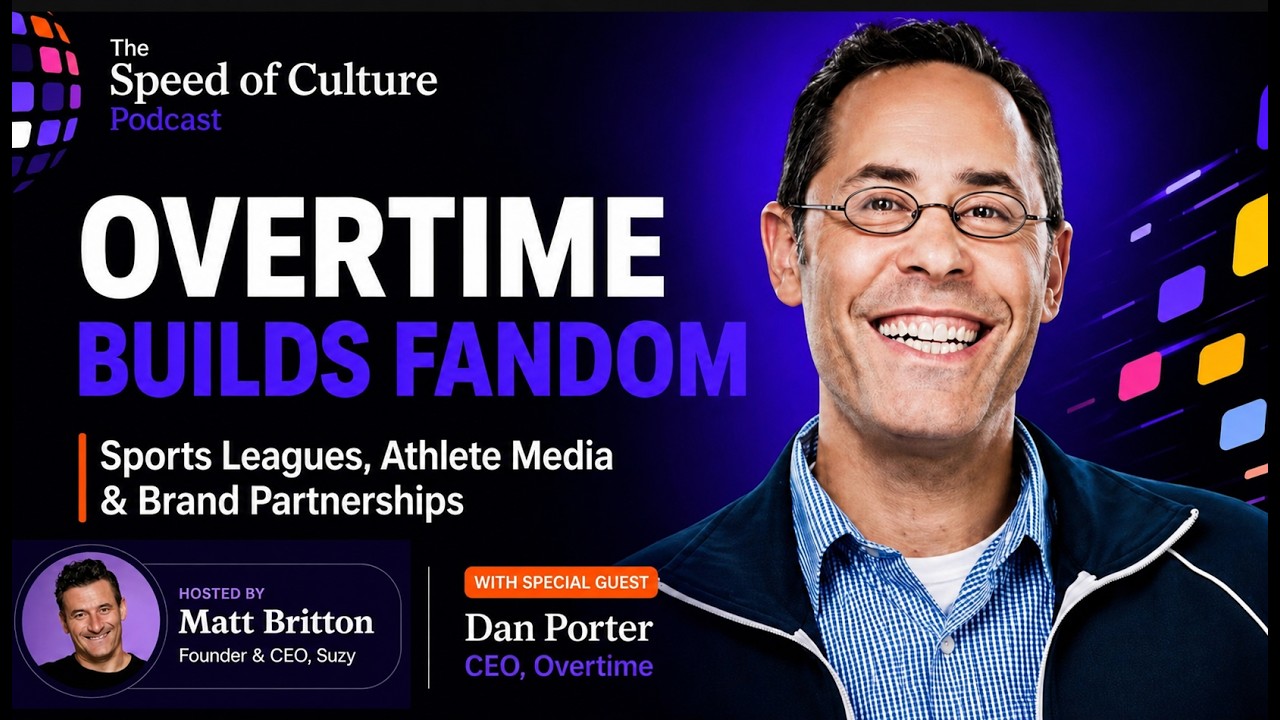
In an era where traditional sports viewership faces unprecedented headwinds, one company has quietly redefined how athletes, brands, and the next generation of sports consumers interact. Overtime, the digital-native sports media company led by CEO Dan Porter, has fundamentally disrupted the sports business model, moving away from passive television broadcasts toward participatory, creator-driven content that resonates authentically with Gen Z audiences.
On Episode 174 of The Speed of Culture Podcast, Dan Porter sits down with host Matt Britton, founder and CEO of Suzy, to discuss how Overtime transformed from a grassroots basketball content creator into a billion-dollar enterprise. This conversation explores the strategic investments, brand partnerships, and content innovation that enabled Overtime to capture over 100 million followers and 3 billion monthly views, metrics that dwarf many traditional sports networks.
The Speed of Culture Podcast, presented in collaboration with Suzy and Adweek, brings together disruptive marketing leaders, media entrepreneurs, and CMOs from the world's leading brands to explore the urgency of adaptation in rapidly evolving consumer behaviors. As brands navigate seismic shifts in how younger demographics consume content, entertainment, and sports, understanding Overtime's playbook becomes essential strategic intelligence.
The central question Porter addresses: How do you build a sports empire for audiences that have fundamentally rejected the gatekeeping models their parents accepted? The answer involves rethinking athlete development, democratizing media production, creating authentic league experiences, and architecting brand partnerships that feel native rather than invasive. For marketing executives seeking to understand Gen Z engagement, athlete sponsorships, and the future of media consumption, this episode provides a masterclass in next-generation brand strategy.
Traditional sports media operates on a decades-old model: networks acquire broadcasting rights, sign exclusive contracts with athletes, and dictate when, where, and how audiences consume content. This top-down approach has worked for decades, but it contains a fatal flaw when addressing Gen Z: it treats young audiences as passive consumers rather than active participants.
Overtime identified this vulnerability and built an alternative infrastructure. Rather than competing for broadcast rights, Overtime created original leagues, signed emerging athletes directly, and produced short-form, authentic content optimized for platforms where Gen Z actually spends time. TikTok, Instagram, YouTube Shorts, and Snapchat. The company didn't ask permission from existing sports gatekeepers; it built parallel systems that proved more engaging to younger audiences.
Under Dan Porter's leadership, Overtime has expanded beyond content into professional sports leagues. OTE (Overtime Elite) operates as a professional basketball development league with international reach, while Overtime also manages women's sports content, international basketball tournaments, and emerging athlete partnerships across multiple sports. This vertical integration, moving from content production to league ownership and athlete management, represents a fundamental reimagining of the sports media-to-athlete relationship.
The financial validation matters: Overtime's valuation exceeded $1 billion at its Series C funding round, making it one of the most valuable sports media companies in the world. Yet Overtime's real achievement transcends valuation. The company proved that you could capture, engage, and monetize Gen Z sports audiences through authenticity, creator partnerships, and participation-driven content rather than through expensive broadcasting rights or celebrity-focused sponsorships.
One of Porter's central insights involves the separation of athlete development from traditional sports infrastructure. In conventional models, young athletes pursue elite institutions (college programs, academy systems, professional scouts), which create bottlenecks and gatekeeping. Overtime inverted this: rather than waiting for existing institutions to develop talent, the company became the institution.
OTE (Overtime Elite) exists as a professional basketball league specifically designed for elite high school and college-aged athletes seeking an alternative to traditional development pathways. Players sign directly with Overtime, gaining salary, education access, and professional experience while maintaining eligibility for international competitions. More importantly, they immediately become content creators and media personalities, building personal brands and audience relationships from day one.
This model addresses a critical market gap: talented athletes no longer need to wait until they reach NBA or WNBA status to monetize their brand. They can earn as creators today while developing as professional athletes. Overtime provides the infrastructure, audience platform, and institutional credibility that would previously require signing with major sports franchises or celebrity management companies.
The result: athletes under Overtime's platform control have created authentic, relatable personas that traditional sports media struggled to cultivate. Rather than athletes reading prepared statements or submitting to formal interviews, Overtime athletes engage directly with followers through content creation, league participation, and behind-the-scenes production. This authenticity resonates powerfully with Gen Z audiences, who report lower trust in traditional institutional messaging and higher engagement with peer-to-peer creator content.
While authentic content generates audience engagement, commerce integration generates revenue. Overtime's brand partnership model reflects sophisticated understanding of where traditional sponsorships often fail: they feel disconnected from content and audience interests.
Overtime has secured major brand partnerships with companies including Adidas, Gatorade, State Farm, and Paramount. Rather than executing traditional sponsorships (logo placement, exclusive naming rights), these partnerships integrate directly into content production. A Gatorade partnership might involve Gatorade-sponsored athlete challenges, integrated product moments, or co-created content series. Paramount's involvement with Overtime reflects the streaming company's recognition that Overtime audiences represent the demographic Paramount needs to retain cord-cutting viewers.
These partnerships operate on multiple revenue tiers: traditional sponsorship rights, content production investment, exclusive product integration, and direct commerce participation. When Overtime athletes wear brand apparel, that apparel becomes available for purchase through Overtime's ecommerce integration. When athletes consume products on camera, those products can link directly to purchase pathways. The company has weaponized the creator economy's most powerful revenue lever, the direct link between content engagement and ecommerce conversion.
For brands, this represents a fundamental shift from traditional sports advertising. Rather than hoping athletes will eventually wear your logo to a major game (where millions watch), brands can activate immediately with creators who have direct, verified access to millions of daily-engaged followers. The cost structures differ substantially, paying for content partnerships scales more efficiently than investing in stadium signage or broadcast placements that reach broad but less-targeted audiences.
Dan Porter's emphasis on authentic partnerships (rather than transactional sponsorships) has become a strategic differentiator. Brands increasingly recognize that Gen Z consumers actively distrust advertising while rewarding authentic creator partnerships. Overtime's model allows brands to participate in that creator ecosystem without compromising authenticity.
Overtime's content strategy reflects sophisticated understanding of generational content consumption patterns. The company produces content optimized for multiple platforms and formats: short-form vertical video for TikTok and Instagram Reels, long-form documentary content for YouTube, interactive gaming content, live league broadcasting, and behind-the-scenes production.
This omnichannel approach matters strategically. While TikTok drives discoverability and new audience acquisition, long-form YouTube content generates deeper engagement and ad revenue. Live league content creates appointment viewing and sponsorship value. Interactive and gaming content expands engagement beyond passive viewing into participation.
The production infrastructure Overtime has built enables this diversification. Rather than treating each content format as a separate production challenge, the company's systems allow a single event (an OTE game, athlete interview, or league moment) to generate multiple content assets optimized for different platforms. This efficiency allows Overtime to scale content production across a global pipeline without proportional increases in production costs.
Notably, Overtime has begun experimenting with interactive experiences and gaming integration. As Gen Z increasingly sees sports as participatory entertainment rather than passive spectatorship, this evolution matters significantly. Overtime's ability to integrate sports events, creator content, and interactive gaming creates opportunities for audience participation that traditional sports broadcasts cannot match.
Porter's strategic focus on content diversification reflects recognition that no single platform or format dominates Gen Z media consumption. Instead, audiences migrate across multiple platforms based on context, community, and content type. Brands and media companies that fail to build omnichannel presence find themselves locked out of audience access. Overtime's platform-agnostic approach addresses this challenge directly.
The path from disruption to sustainable business requires monetization models that scale without sacrificing authenticity. Overtime's revenue streams include sponsorships, league operations, athlete payments, content licensing, merchandise, and ecommerce integration. This diversification reduces dependency on any single revenue source while creating multiple customer touchpoints.
However, questions about Overtime's path to profitability remain important. Like many high-growth media companies, Overtime has prioritized audience growth and market share over near-term profitability. The company's Series C funding validated investor confidence in the overall strategy, but quarterly profitability metrics remain private.
Dan Porter's approach to this challenge involves recognizing that Overtime operates across multiple business categories: media (content and advertising), sports (league operations and athlete management), and technology (platform and ecommerce). This diversification creates resilience. Even if one revenue stream faces pressure, the overall enterprise survives. Additionally, as Overtime's audience scale increases and production efficiency improves, margin expansion becomes increasingly achievable.
The international expansion strategy also matters significantly to long-term profitability. While Overtime's initial success centered on basketball and North American audiences, the company has increasingly invested in global expansion. This strategy reduces reliance on saturated domestic markets while accessing growth opportunities in markets where traditional sports media infrastructure remains less developed. Porter has signaled particular interest in expanding women's sports content globally, a category where Overtime sees substantial untapped growth potential.
Traditional sports networks acquire broadcasting rights, then monetize through advertising and subscription models. Overtime inverted this: it owns athlete relationships, creates original content, operates proprietary leagues, and integrates commerce directly. Rather than waiting for athletes to become famous and then covering them, Overtime develops athletes, makes them famous, and monetizes multiple dimensions of that fame simultaneously. This vertical integration creates defensibility that traditional networks struggle to match.
This represents an ongoing tension that Porter acknowledges openly. The fundamental answer involves maintaining alignment between athlete interests and brand interests. When Overtime selects brand partners, it prioritizes companies whose products athletes already use and whose values align with creator ethos. This alignment makes sponsorship integration feel native rather than invasive. Additionally, by maintaining direct relationships with audiences, athletes retain agency. They can decline partnerships or content that feels inauthentic, and audiences respect them for doing so.
Overtime has expanded basketball operations internationally, particularly in markets like Europe and Africa where soccer has traditionally dominated but basketball is growing rapidly. Additionally, Porter has signaled particular commitment to women's sports expansion globally. The company recognizes that North American sports markets, while profitable, have limited growth ceiling. International expansion accesses larger addressable markets while positioning Overtime as a truly global sports media company rather than a North American phenomenon.
Rather than competing directly with the NBA for existing fans, Overtime captures audiences who have abandoned traditional sports broadcasting entirely, particularly younger demographics who find traditional sports media less culturally relevant. Overtime's content emphasizes personality, humor, and accessibility rather than technical excellence. For audiences seeking this experience, Overtime is genuinely preferable to NBA broadcasts. However, as some athletes transition from Overtime to NBA or other professional leagues, Overtime's role increasingly becomes "development platform" rather than competitor to established leagues. This positioning actually strengthens rather than weakens Overtime's strategic position.
The success of Overtime under Dan Porter's leadership contains lessons that extend far beyond sports media. Any executive attempting to reach Gen Z audiences should recognize several fundamental principles:
Authenticity cannot be manufactured. Gen Z audiences have developed sophisticated filters for detecting inauthenticity and marketing manipulation. Successful engagement requires genuine alignment between brand values, creator values, and audience values. Overtime's brand partnerships succeed because selected partners genuinely align with athlete interests rather than attempting to overlay brands onto unrelated contexts.
Platform agnosticism is essential. The social media landscape shifts rapidly, and audiences migrate across platforms based on evolving community preferences. Organizations that bet on single platforms face existential risk. Overtime's omnichannel production approach enables the company to participate in any emerging platform without fundamental restructuring.
Vertical integration creates competitive advantages. By controlling athlete relationships, content production, league operations, and commerce pathways, Overtime created defensibility that horizontal competitors struggle to achieve. Organizations attempting to disrupt established industries should evaluate whether vertical integration strengthens their position.
Creator economy dynamics are fundamentally different from traditional institutional models. Athlete development, fan engagement, and brand partnerships all operate differently when creators control their own destiny. Organizations optimized for traditional institutional gatekeeping often find themselves paralyzed when facing creator-driven competition.
For marketing professionals seeking to understand how brands can participate in next-generation sports and media engagement, Suzy, the research and insights platform founded by Matt Britton, provides critical consumer intelligence about Gen Z behaviors, preferences, and engagement patterns. Understanding younger audiences requires quantitative and qualitative research that moves beyond traditional demographic categories.
For deeper exploration of Gen Z consumer behavior and emerging media trends, Matt Britton's book Generation AI explores the intersection of artificial intelligence, generational cohorts, and emerging consumer expectations. Additionally, for brand leaders seeking strategic perspective on these evolving dynamics, Matt Britton's keynote speaking services provide tailored exploration of how AI, generational shifts, and new consumer expectations intersect within specific industries.
For listeners interested in deeper exploration of disruptive brand strategies, emerging media, and next-generation consumer engagement, The Speed of Culture Podcast provides ongoing conversations with marketing leaders, media entrepreneurs, and CMOs navigating these transformational changes. Additionally, for organizations seeking to develop their own thought leadership on these emerging topics, Speaker HQ offers resources for developing executive speaking capabilities around generational trends and consumer behavior evolution.