Episode Overview
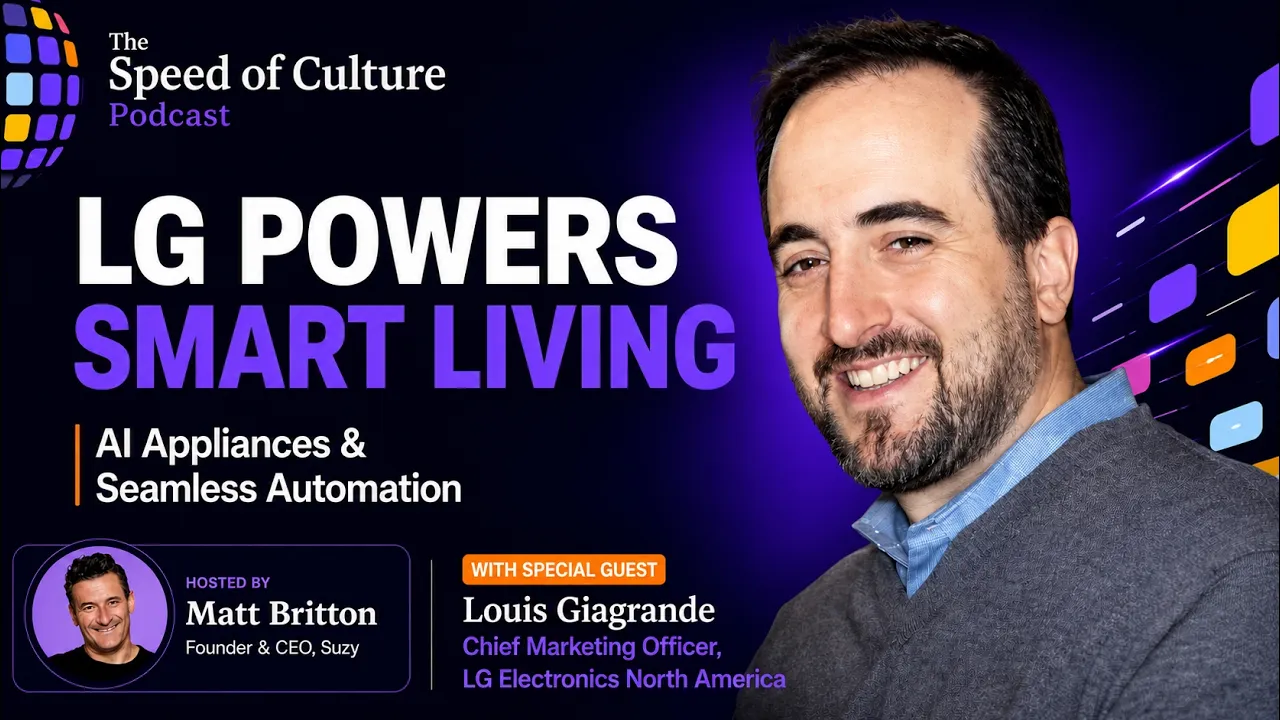
The Speed of Culture Podcast Episode 172, published on March 18, 2025, features Louis Giagrande, Chief Marketing Officer of LG Electronics North America, discussing how LG is redefining smart living through AI-driven home technology.
In this pivotal 21-minute conversation, Giagrande reveals the strategic shift transforming LG from a traditional hardware manufacturer into a Smart Life Solutions company, one that prioritizes seamless experiences, human-centered AI, and consumer-focused innovation.
For brand leaders seeking to understand the future of connected living and AI integration in consumer products, this episode offers essential insights into how market leaders are adapting to evolving consumer expectations and technological capabilities.
The episode represents a critical inflection point in the consumer technology space, where AI is no longer a futuristic concept but an immediate reality reshaping how consumers interact with their homes. LG's approach, emphasizing what Giagrande calls "affectionate intelligence" rather than artificial intelligence, provides a compelling blueprint for how brands can humanize technology while maintaining competitive differentiation.
The Strategic Pivot: From Hardware to Holistic Experiences
For decades, LG established itself as a purveyor of high-quality electronics. Refrigerators, washing machines, televisions, and climate control systems bearing the LG logo became synonymous with durability and performance.
However, this foundation, while valuable, no longer suffices in a market where consumers increasingly expect their devices to communicate, anticipate needs, and deliver integrated experiences rather than isolated functionalities.
Giagrande articulates this transformation clearly: LG is no longer primarily a hardware company selling products. Instead, the brand is evolving into a Smart Life Solutions provider that leverages AI, automation, and connectivity to enhance everyday life.
This shift represents far more than a marketing repositioning, it reflects a fundamental change in how the company develops products, architects ecosystems, and engages customers across the entire ownership lifecycle.
The market context supports this strategic pivot. The global smart home market was valued at approximately $147.52 billion in 2025 and is projected to grow to $848.47 billion by 2034, reflecting a compound annual growth rate of 21.40%.
Meanwhile, AI in smart home technology specifically has accelerated dramatically, growing from $15.3 billion in 2024 to a projected $104.1 billion by 2034. These figures illustrate that consumer demand for connected, intelligent home solutions has shifted from early-adopter enthusiasm to mainstream expectation.
For LG, this presents both opportunity and urgency. By integrating its vast product portfolio (kitchen appliances, laundry solutions, climate control, entertainment systems) into a cohesive, AI-powered ecosystem, the company can deliver value that extends far beyond individual product specifications.
Whether reducing kitchen labor through connected appliances, automating home maintenance through predictive systems, or optimizing energy consumption across the home, LG's vision positions the brand as an essential facilitator of modern living rather than merely a supplier of appliances.
The competitive advantage lies not in owning the smartest individual device, but in orchestrating the smoothest, most intuitive experience across an interconnected environment. Brands that prioritize frictionless integration over flashy technology will win consumer loyalty in an increasingly crowded market.
Affectionate Intelligence: AI That Truly Understands
One of the most compelling takeaways from Giagrande's discussion is his reframing of artificial intelligence as "affectionate intelligence." This distinction carries profound implications for how brands should conceptualize and deploy AI in consumer products.
Traditional AI in smart homes has often focused on automation and efficiency, executing commands, optimizing energy use, and performing predetermined tasks. While valuable, this approach treats AI as a servant responding to explicit instructions.
Affectionate intelligence, by contrast, positions AI as an adaptive partner that learns habits, anticipates preferences, and delivers assistance before users consciously recognize a need.
Consider the refrigerator that tracks inventory and suggests recipes based on available ingredients and household dietary patterns. Or a washing machine that not only cleans clothes but recommends optimal wash cycles for specific fabrics and levels of soil, effectively teaching users while delivering superior results.
LG's webOS-powered televisions go beyond displaying content to curating personalized recommendations that feel intuitively aligned with viewer preferences, drawing from thousands of viewing hours and behavioral signals.
This represents a critical evolution in consumer expectations. A recent analysis found that 32.6% of consumers use AI at home, slightly higher than the 28.1% who use it at work.
This preference for home-based AI reflects consumers' desire for technology that simplifies their daily lives rather than complicates them. However, consumers increasingly reject AI that feels intrusive, opaque, or disconnected from their actual behaviors and preferences.
Affectionate intelligence addresses this expectation by emphasizing human-like responsiveness, contextual awareness, and personalization. Rather than presenting generic options, affectionate intelligence learns and adapts.
It doesn't just execute commands, it anticipates, adjusts, and delivers assistance that feels natural and helpful. In a competitive landscape where features commoditize quickly, the emotional resonance of technology, how it makes users feel, becomes a decisive differentiator.
For brand leaders, this insight carries significant implications. AI implementation cannot stop at capability; it must extend to user perception and emotional experience.
The brands that succeed will be those that deploy AI as an invisible enabler of human goals rather than as a technological marvel demanding user adaptation.
Customization as Competitive Strategy: The Smart Home on Consumer Terms
A persistent challenge in smart home adoption has been the "one-size-fits-all" problem. Many manufacturers have attempted to drive consumers toward fully automated ecosystems, often resulting in complexity, privacy concerns, and resistance from users who value autonomy and manual control.
LG's approach inverts this dynamic by making customization central to its smart home strategy.
Giagrande emphasizes that different consumers have fundamentally different comfort levels with automation. Some households embrace full automation, welcoming AI to manage everything from security and lighting to energy optimization and appliance scheduling.
Others prefer a hybrid approach, leveraging smart enhancements for specific functions while maintaining manual control over others. Still others want minimal automation, preferring their connected devices to provide insights and recommendations they can act upon independently.
Rather than prescribing a single path to smart home adoption, LG offers a flexible, adaptive framework that allows consumers to customize their level of automation.
This approach acknowledges a critical insight: consumer adoption of smart home technology depends as much on user agency and comfort as on technology capability. Forcing adoption creates friction and resentment. Offering choice creates investment and loyalty.
This customization strategy also addresses privacy and data concerns, critical barriers to smart home adoption that manufacturers often underestimate.
By allowing consumers to control what data they share, what actions they authorize, and what automation they enable, LG provides transparency and agency. Consumers can gradually increase automation as their comfort and confidence grow, rather than facing an all-or-nothing decision upfront.
For brand leaders, this model suggests that the future of connected product ecosystems lies not in prescribing behavior but in enabling choice.
As the residential segment accounts for 64.8% of the smart home market in 2025, driven primarily by consumer demand for comfort, automation, and energy efficiency, brands that accommodate diverse consumer preferences will capture larger market share and generate stronger lifetime value. Flexibility is a fundamental business strategy.
The Television as Digital Hub: Competing for Content Discovery
One of the most intriguing dimensions of LG's smart home strategy involves repositioning the television from an entertainment device to the central platform for home digital life.
This shift reflects a significant market trend: fewer consumers rely on external streaming devices, meaning the television's interface increasingly determines content discovery and engagement patterns.
LG's webOS platform, which powers the company's smart TVs, has evolved into a comprehensive entertainment ecosystem featuring over 300 free ad-supported channels, integrated streaming services, and AI-driven recommendations.
This represents a strategic battleground that many brands overlook: not the quality of the display itself, but the software experience that determines how consumers discover and consume content.
The implications extend beyond entertainment. As the television becomes the primary interface for home content discovery, it inevitably becomes a gateway for interacting with other connected home systems.
LG is positioning webOS as the control center for the broader smart home ecosystem, allowing consumers to manage multiple systems and services from a single, familiar interface.
This strategy accomplishes multiple objectives simultaneously. First, it increases hardware attachment, consumers who love their TV experience become more likely to adopt LG's complementary products.
Second, it creates valuable data on consumer preferences and behaviors. Third, it establishes LG as the arbiter of the home's digital experience rather than merely one component in a larger system.
Finally, it generates ongoing value through advertising and partner relationships, creating revenue streams beyond hardware sales.
For brands in connected home technology, the lesson is clear: the future belongs to companies that own the interface and control the experience. Features and specifications become table stakes; the platform that orchestrates the entire experience becomes the strategic asset.
Customer Experience as Brand Foundation: Beyond the Point of Sale
Perhaps the most underestimated dimension of LG's smart home strategy concerns customer experience and ownership.
Giagrande emphasizes that great products are necessary but insufficient. Lasting competitive advantage comes from prioritizing the post-purchase journey, seamless onboarding, proactive customer support, lifecycle engagement, and personalization based on first-party data.
This emphasis reflects a profound recognition: in markets where product quality has commoditized and feature sets have largely converged, the experience of ownership becomes the primary differentiator.
A consumer who buys an LG smart refrigerator is purchasing more than a device that stores food and manages temperature. They're embarking on a journey where LG either helps them maximize the device's capabilities or abandons them after the initial purchase.
The contrast between these two approaches generates different outcomes. A brand that invests in customer education, proactive support, and ongoing personalization creates customers who feel valued and engaged.
They become advocates, willing to recommend the brand and to extend their trust to additional products within the ecosystem. Conversely, a brand that treats the sale as the endpoint risks customer frustration when products fail to deliver anticipated value or when consumers lack understanding of advanced capabilities.
For LG, this means integrating first-party data systems that track how customers use their products, identifying opportunities for enhancement, delivering targeted recommendations, and proactively addressing potential issues.
It means designing onboarding experiences that help new customers rapidly understand and appreciate their devices. It means creating service experiences that feel responsive and personalized rather than transactional and impersonal.
In an era where customer lifetime value increasingly determines enterprise success, the brands that invest in ownership experience will outpace those that compete primarily on price and specification. This is a fundamental business imperative.
Key Takeaways for Brand Leaders
- Experience trumps specifications. The market transition from hardware-focused to experience-focused competition is complete. Brands must prioritize how customers feel when using their products and systems, not merely what those products can do. Affectionate intelligence, AI that feels responsive and intuitive, will outperform pure automation capability.
- Ecosystem integration drives loyalty. As smart home adoption accelerates, competitive advantage accrues to brands that seamlessly integrate multiple product categories into cohesive, intuitive experiences. Consumers increasingly expect their smart home devices to communicate and coordinate rather than operate in isolation. Brands that architect ecosystems will capture disproportionate loyalty and lifetime value.
- Consumer agency and customization are essential. The one-size-fits-all approach to smart home automation has failed. Market leaders will offer flexible frameworks that allow consumers to determine their own level of automation and comfort. This approach addresses privacy concerns, reduces adoption friction, and increases consumer investment in the ecosystem.
- Own the interface; control the experience. As smart home ecosystems mature, the companies that control the primary interface (whether television, smartphone, voice assistant, or hub) will capture disproportionate value and data insights. Brands should identify opportunities to become the orchestrator of the home's digital experience rather than one component in a larger system.
- Post-purchase experience defines brand success. In markets where product quality has converged, customer experience after the sale becomes the primary differentiator. Brands that invest in onboarding, customer education, proactive support, and personalization based on first-party data will build stronger loyalty and generate higher lifetime value.
Market Context: The Smart Home Opportunity in 2025
The timing of Episode 172 of The Speed of Culture Podcast is significant.
As of early 2025, smart home technology has transitioned from early-adopter phase to mainstream adoption. The global market has matured to the point where consumer expectations around connectivity, personalization, and seamless integration have become normalized expectations rather than premium features.
Key market indicators support this shift:
- Market growth: The global smart home market reached $147.52 billion in 2025, with projections to reach $848.47 billion by 2034, representing 21.4% compound annual growth.
- AI acceleration: AI in smart home technology has become the fastest-growing segment, valued at $15.3 billion in 2024 and projected to reach $104.1 billion by 2034.
- Consumer adoption: Approximately 32.6% of consumers use AI at home, representing higher adoption rates than workplace AI (28.1%). The residential segment accounts for 64.8% of smart home market share.
- Home automation focus: Consumers increasingly prioritize home automation for enhancing convenience, improving energy efficiency, and increasing security. Remote control of lights, security cameras, appliances, and thermostats has become standard expectation.
Within this context, LG's strategic positioning addresses genuine market needs and consumer expectations that will only intensify as technology adoption deepens. Brands that align their strategies with these trends will capture disproportionate market share and customer loyalty.
Looking Ahead
The smart home revolution is here. The question for brand leaders is how to engage strategically.
Episode 172 of The Speed of Culture Podcast provides essential guidance from a market leader navigating this transformation at scale.
Louis Giagrande's insights emphasize that success in the smart home era demands more than technological capability. It requires a fundamental reorientation toward consumer experience, emotional resonance, and ecosystem thinking.
Brands that embrace this mindset, invest in personalization and customer engagement, and position themselves as facilitators of better living rather than merely suppliers of products will thrive. Those that cling to traditional hardware-centric models risk obsolescence.
The smart home revolution represents not a single technological shift but a comprehensive reimagining of how technology relates to human life. Brands that understand this distinction and act accordingly will define the next era of consumer technology.
Key Takeaways
- LG is transforming from a hardware manufacturer into a Smart Life Solutions company that leverages AI, connectivity, and automation to enhance everyday life and deliver integrated consumer experiences.
- "Affectionate intelligence" positions AI as an adaptive partner that anticipates needs and personalizes responses rather than merely executing commands, creating emotional resonance alongside technical capability.
- Customization and consumer agency are essential to smart home adoption, allowing customers to define their own comfort levels with automation rather than forcing one-size-fits-all solutions.
- The television has become the primary interface for home digital life, with webOS and similar platforms becoming strategic assets that determine content discovery and broader ecosystem engagement.
- Post-purchase customer experience has become the primary competitive differentiator, with successful brands investing in onboarding, support, and personalization based on first-party data.
FAQ
What is LG's definition of "affectionate intelligence"?
Affectionate intelligence refers to AI that feels responsive, intuitive, and human-like rather than purely transactional or mechanical. Rather than simply executing commands, affectionate intelligence learns habits, anticipates preferences, and delivers assistance that feels natural and personalized.
Examples include refrigerators that track inventory and suggest recipes, washers that recommend optimal cycles, and televisions that curate viewing recommendations based on personal preferences.
How does LG's smart home strategy differ from competitors?
LG's approach emphasizes experience integration across a broad product ecosystem (appliances, climate control, entertainment, security) rather than focusing on individual devices.
The company prioritizes consumer choice and customization in automation levels, acknowledges post-purchase customer engagement as critical to success, and positions the television as the central hub for home digital life rather than a standalone device.
What does the market data suggest about smart home adoption?
The smart home market reached $147.52 billion in 2025 and is projected to grow to $848.47 billion by 2034, indicating mainstream adoption.
The residential segment accounts for 64.8% of market share, driven by consumer demand for convenience, energy efficiency, and security.
AI in smart homes has become the fastest-growing segment, with valuations projected to grow from $15.3 billion in 2024 to $104.1 billion by 2034.
Why does LG emphasize consumer agency in smart home automation?
Consumer agency addresses critical barriers to smart home adoption, including privacy concerns, complexity anxiety, and desire for autonomy.
By allowing customers to customize their automation levels, from full automation to minimal smart enhancements, LG reduces friction, addresses concerns, and increases consumer investment in the ecosystem.
This approach acknowledges that consumer adoption depends as much on comfort and control as on technology capability.
Looking Ahead
For deeper insights into AI, consumer trends, and the future of connected technology, explore these additional resources:
- Suzy - The consumer intelligence platform founded by Matt Britton that powers real-time insights for Fortune 500 companies
- The Speed of Culture Podcast - A bi-weekly exploration of how culture, AI, and emerging trends are reshaping business and society
- Generation AI - Matt Britton's national bestseller examining how AI is reshaping childhood, culture, and the future of work
- AI Keynote Speaker - Access to Matt Britton's perspectives on AI, consumer trends, and tomorrow's generation
- Speaker HQ - Resources and expertise for keynote speaking engagements focused on AI and the evolving consumer landscape

%20(400%20x%20100%20px)%20(300%20x%2050%20px)%20(150%20x%2050%20px).avif)