April 10, 2025
Nuts & Bolts: ACE Hardware CMO Kim Lefko Retools a 100-Year-Old Brand

Kim Lefko
Chief Marketing Officer
This is some text inside of a div block.
This is some text inside of a div block.
LISTEN ANYWHERE YOU FIND YOUR PODCASTS
%20(400%20x%20100%20px)%20(300%20x%2050%20px)%20(150%20x%2050%20px).avif)

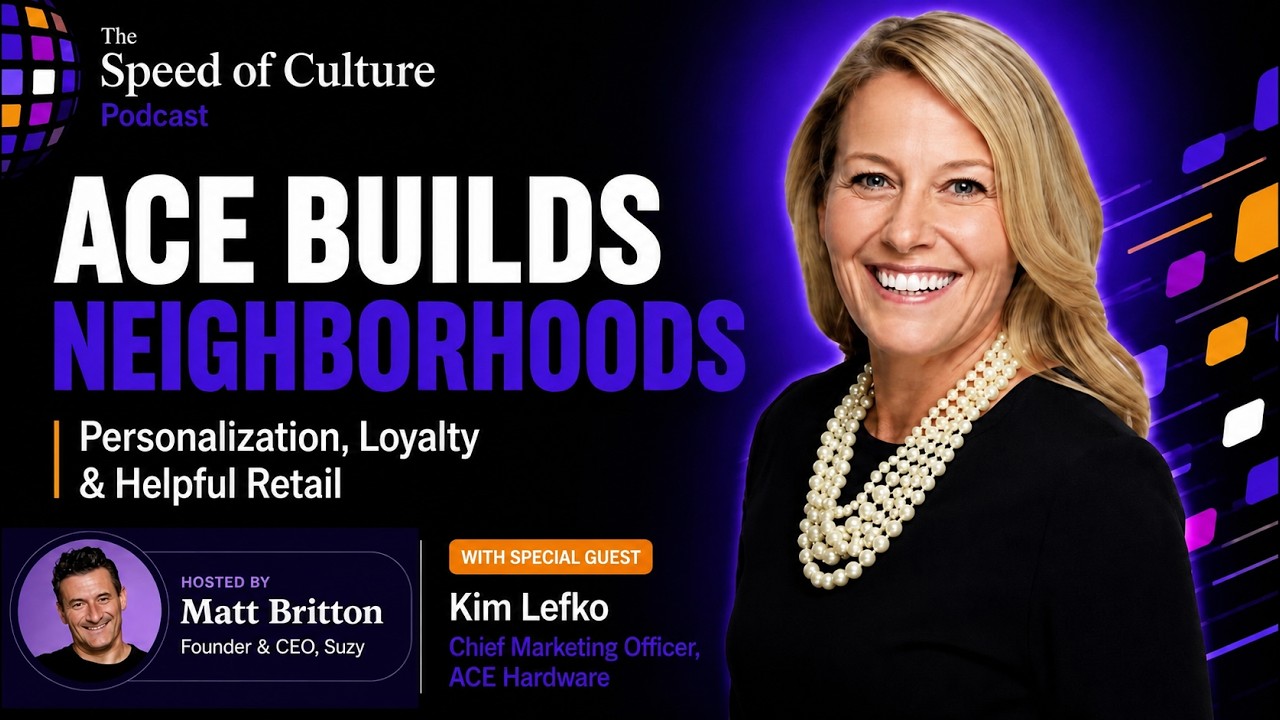
In a landmark episode of The Speed of Culture Podcast, Matt Britton, founder and CEO of Suzy, the AI-powered consumer intelligence platform, sits down with Kim Lefko, Chief Marketing Officer at ACE Hardware, to unpack the transformative journey of marketing one of America's most trusted retail institutions.
With over a century of history and more than 5,000 independently owned and operated stores worldwide, ACE Hardware represents a unique challenge and opportunity in modern retail: how to scale a global brand while preserving the hyper-local, community-driven soul that built its reputation.
During their conversation, Lefko reveals the strategic blueprint she has deployed to modernize ACE Hardware's marketing approach without sacrificing the brand's authentic heritage. From pioneering omnichannel engagement strategies to leveraging AI-powered consumer intelligence, Lefko demonstrates how legacy brands can compete in an increasingly digital marketplace.
"The power of the 'and'" the ability to offer both helpful red-vested heroes in-store and seamless digital convenience to the front door.
This philosophy extends to how she balances preparation with agility, a lesson she credits to her leadership style as both an executive and a mother.
The episode explores critical themes that resonate across enterprise marketing leadership: the importance of relationship-driven decision-making, the strategic use of consumer data and insights to fuel localization at scale, and the reimagining of brand trust in an age where consumers demand both digital convenience and authentic human connection.
Lefko's tenure at ACE Hardware spans seven years, during which she has orchestrated a significant modernization of the brand's marketing infrastructure while maintaining the locally-driven culture that differentiates it from mass-market retailers.
Under her leadership, ACE Hardware has achieved remarkable digital growth, with AceHardware.com realizing a 15% sales increase in 2024 and pacing 25% growth year-to-date. The mobile app now drives 50% higher spend and double the visit frequency among active users.
This conversation is essential listening for CMOs and brand leaders navigating the intersection of legacy and innovation, particularly those managing decentralized retail networks or leading digital transformations across traditional industries.
Lefko's insights into how preparation becomes a competitive advantage, how to balance global brand consistency with hyperlocal relevance, and how leadership principles from home apply to boardroom strategy offer a masterclass in modern brand stewardship.
The ACE Hardware brand carries over a century of equity as a trusted community resource for homeowners and professionals. Yet that equity, while valuable, also presents a strategic challenge: how does a traditional retailer remain relevant to digitally native consumers without alienating the loyal, in-store customer base that has sustained the brand?
Lefko's answer is not to abandon the past, but to build the future alongside it.
Under Lefko's leadership, ACE Hardware has embarked on a comprehensive omnichannel transformation. The brand has invested heavily in mobile and digital engagement while remaining committed to its legacy of personal service.
This dual focus reflects a fundamental insight about modern consumer behavior: shoppers no longer choose between digital or in-store; they expect a seamless experience that integrates both. The "and" in Lefko's philosophy is not a compromise, it represents the recognition that the most successful retail brands of the next decade will excel at both channels simultaneously.
The numbers validate this strategy. AceHardware.com achieved a 15% sales increase in 2024, with year-to-date growth pacing at 25%.
The Ace mobile app has become a significant driver of engagement and conversion, demonstrating 50% higher spend and double the visit frequency among active users.
These metrics are not achieved through digital investment alone; they reflect a cohesive strategy that acknowledges the strengths of ACE's distributed network of local entrepreneurs while providing them with the tools, content, and digital assets necessary to compete at scale.
The transformation is particularly noteworthy given ACE Hardware's decentralized ownership model. Unlike competitors with centralized control, ACE stores are independently owned and operated by local entrepreneurs who live and work in the communities they serve.
This structure is core to ACE's brand identity and community trust but also introduces complexity into any standardized marketing initiative.
Lefko's approach to this challenge has been to develop a framework that balances global brand strategy with hyperlocal execution. Each store can tailor its product mix to local needs, from a full fishing line in Florida to curated housewares in Austin, while the brand provides retailers with the tools and digital infrastructure to support localization at scale.
This strategic framework directly addresses what Lefko identifies as her core responsibility: marketing plays a critical role in building trust, awareness, and conversion.
For a brand with 5,000-plus independent operators, this means creating consistency in brand messaging and consumer experience while enabling each operator to differentiate based on their local market.
The result is a brand that feels both national and deeply local, a differentiation increasingly rare in retail.
In the Speed of Culture conversation, Lefko emphasizes that successful brand transformation requires moving beyond intuition to data-backed decision-making.
This principle is particularly important for a decentralized retail network where understanding consumer preferences at both the macro and micro level becomes a strategic necessity.
ACE Hardware has implemented a sophisticated measurement framework that extends far beyond traditional retail metrics like sales lift and foot traffic.
Lefko describes a multi-pronged approach to ROI measurement that incorporates digital engagement, loyalty program participation, and localized consumer behavior.
The Ace Rewards program, with over 60 million members, serves as a critical data infrastructure for understanding customer engagement and long-term brand affinity.
This loyalty platform generates insights that feed back into marketing strategy, enabling the brand to identify trends, test messaging, and optimize communications at both store and system levels.
The use of consumer intelligence tools, like those offered by Suzy, the platform founded by Matt Britton, represents a significant evolution in how traditional retailers approach brand strategy.
Rather than waiting weeks or months for quarterly reports, brands can now conduct iterative research at the speed of culture, testing hypotheses, validating messaging, and pivoting based on real consumer feedback.
For ACE Hardware, this capability is transformative. It enables the brand to understand how different consumer segments respond to different marketing approaches, how local market preferences diverge, and how digital and in-store messaging can be coordinated for maximum impact.
Lefko's commitment to data-driven decision-making also reflects a broader lesson she emphasizes throughout the episode: preparation becomes paramount in competitive markets.
By investing in research infrastructure and consumer intelligence capabilities, ACE Hardware positions itself to respond rapidly to market changes, emerging consumer preferences, and competitive threats.
This preparation is about having the foundational knowledge necessary to move with agility when circumstances demand it.
One of the most compelling dimensions of Lefko's story is how she explicitly connects her leadership approach to her experiences as a parent.
She describes herself as a "tough-love leader, extremely direct, clear, and intentional with feedback so there's no room for misunderstanding."
Notably, she observes that her parenting style mirrors her executive approach, a reflection of her values rather than a consequence of motherhood.
The overlap between managing a household and managing a global marketing function, however, has influenced how she thinks about brand trust and consumer relationships.
Lefko draws a direct parallel between parenting and leadership that is particularly insightful for brand marketers: there are few do-overs in either domain.
As a parent, she acknowledges that mistakes happen, but the reality of parenting teaches resilience and the importance of moving forward rather than dwelling on missteps.
This same principle applies to marketing. Campaigns don't perform as expected. Product launches face headwinds. Market conditions shift.
The leaders who succeed are those who learn from setbacks, adjust course, and maintain focus on long-term objectives.
This philosophy manifests in her approach to brand management. Marketing plays a critical role in building trust, awareness, and conversion, but trust is not something that can be reclaimed easily once lost.
Therefore, preparation and intentionality become paramount.
Lefko's approach to localized marketing, enabling ACE store operators to tailor their outreach to community needs while maintaining brand consistency, reflects this priority on building trust at every touchpoint.
Each interaction between a consumer and the ACE brand (whether digital or in-store) is an opportunity to reinforce the brand promise of helpful, community-driven service.
The leadership lessons Lefko emphasizes also extend to how she manages the tension between flexibility and discipline.
Modern marketers are often encouraged to embrace "agility" and "experimentation," but Lefko cautions that unchecked flexibility can undermine brand consistency and consumer trust.
Instead, she advocates for a model where careful preparation provides the foundation for strategic pivots.
This approach acknowledges that in both parenting and marketing, "picking your battles becomes critical". you focus your energy on initiatives with the biggest potential impact rather than responding reactively to every change or competitive threat.
One of Lefko's most powerful contributions to how we think about retail marketing is her articulation of how brands can deliver both scale and intimacy through what she calls the power of the "and."
Traditional retail marketing often forces false choices: standardization vs. localization, digital vs. physical, efficiency vs. relationship-building.
Lefko's approach rejects these binaries.
The beauty of the "and," she explains, is that brands don't have to choose.
ACE Hardware can simultaneously offer helpful red-vested heroes in stores (a distinctly human, relationship-driven service model) and convenient delivery to customers' front doors, a distinctly digital capability.
The brand can maintain deep community ties through its network of local entrepreneurs while offering a robust mobile app that meets digital natives where they are.
This is about recognizing that sophisticated consumers expect both conveniences and don't view them as contradictory.
This strategy directly supports ACE Hardware's brand trust metrics.
The brand was ranked #34 on Forbes' Best Customer Service 2025 list out of thousands of stores, an achievement that reflects the success of delivering trusted service through multiple channels.
Digital channels and in-store experiences are complementary, with each strengthening the other.
The implications of this "and" strategy extend beyond ACE Hardware.
As consumer behavior becomes increasingly omnichannel and consumer expectations for seamless experiences across touchpoints increase, the brands that will thrive are those that see digital and physical channels not as substitutes but as reinforcing components of a unified brand experience.
This requires significant investment in both infrastructure and culture, something Lefko emphasizes is not a one-time initiative but an ongoing commitment to meeting consumers where they are.
Looking ahead, Lefko identifies home services, including Ace Hardware Home Services and Ace Handyman Services, as major growth opportunities for the brand.
This expansion reflects an important evolution in how ACE Hardware thinks about serving customers.
The brand's core mission is to be helpful; historically, this has meant stocking the right products.
As the brand expands into services, it can extend this promise to customers who want solutions, not just supplies.
Marketing will play a critical role in this expansion by connecting loyal DIYers (Do-It-Yourself customers) with trusted DIFM (Do-It-For-Me) solutions.
This requires a different messaging strategy, different customer segments, and different metrics for success.
Yet it builds on the same brand foundation: understanding community needs, earning trust through consistent delivery, and using preparation and data-driven insights to customize offerings for local markets.
The home services expansion also underscores why Lefko's emphasis on consumer intelligence and localization is so important.
Different markets may have different demand profiles for services.
A high-growth suburban market may have different DIFM service needs than an established urban neighborhood.
Understanding these variations and using marketing to connect customers with relevant solutions becomes a significant competitive advantage.
This growth opportunity also reflects the broader context of retail evolution.
As online retailers like Amazon have commoditized product distribution, traditional retailers must differentiate through services, expertise, and localized support.
For ACE Hardware, with its network of local entrepreneurs, this is a natural evolution and a strong competitive advantage.
ACE Hardware employs a framework that balances global brand strategy with hyperlocal execution. The corporate team provides store operators with tools, content, and digital assets while enabling each store to tailor its product mix and local marketing to community needs.
This approach recognizes that local entrepreneurs are closest to their communities and understand their customers' needs better than any centralized marketing team.
Consistency is maintained through brand guidelines, shared digital infrastructure, and loyalty program data that feeds insights back to both corporate and store levels.
Rather than forcing false choices between digital and physical, standardization and localization, or convenience and relationship-building, Lefko advocates for a model where brands excel at both simultaneously.
ACE Hardware demonstrates this by offering both helpful in-store service and convenient digital channels, maintaining corporate brand consistency while enabling local differentiation, and investing in both e-commerce and community relationships.
The "and" strategy rejects the idea that these are trade-offs; instead, they are complementary components of a unified brand experience.
Beyond traditional metrics like sales lift and foot traffic, ACE Hardware employs a multi-pronged approach that includes digital engagement tracking, loyalty program participation (the Ace Rewards program has over 60 million members), and localized in-store redemption rates.
This comprehensive measurement approach enables the brand to understand both the financial impact of marketing initiatives and their effect on customer engagement and brand affinity.
The loyalty program, in particular, serves as a data infrastructure that tracks customer behavior across channels and informs future marketing strategy.
Lefko identifies home services, including Ace Hardware Home Services and Ace Handyman Services, as major growth drivers.
These services allow the brand to extend its core promise of being helpful beyond product sales to solutions.
Marketing will play a crucial role in connecting DIY customers with DIFM service solutions.
This expansion reflects how traditional retailers must differentiate in an era where product distribution is increasingly commoditized; services offer higher margins, stronger customer relationships, and defensible competitive advantages.
The insights shared by Kim Lefko on The Speed of Culture Podcast offer essential guidance for any CMO or brand leader navigating the complexities of modern retail.
In an era where consumer expectations for omnichannel experiences continue to escalate, where data-driven decision-making has become table-stakes for competitive advantage, and where legacy brands must innovate without losing their core identity, Lefko's strategic approach provides both philosophical and practical roadmap.
For brands seeking to understand how to scale without sacrificing local relevance, invest in digital without alienating physical retail communities, or lead with data while maintaining the relationship-driven culture that builds trust, ACE Hardware offers a compelling case study.
Lefko's seven-year tenure has transformed the brand's marketing capabilities while strengthening the fundamental proposition that has sustained ACE Hardware for over a century: being helpful to your community.
To dive deeper into brand transformation, consumer intelligence, and the future of retail marketing, explore these resources: