Opening Section
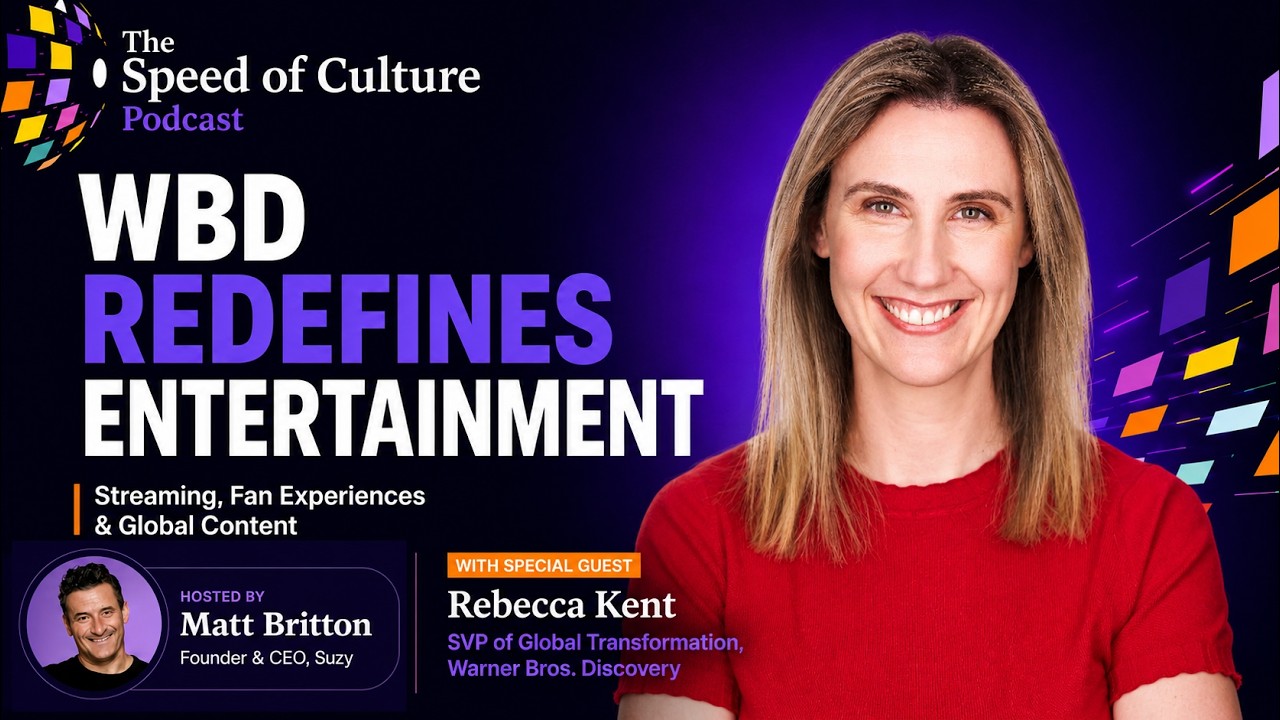
In an era where entertainment consumption has fragmented across countless platforms and devices, Warner Bros. Discovery stands at the forefront of a strategic transformation that prioritizes consumer choice, data-driven personalization, and innovative storytelling. On Episode 170 of The Speed of Culture Podcast, Rebecca Kent, Senior Vice President of Global Transformation at Warner Bros. Discovery, shares insights into how the media conglomerate is navigating the rapidly evolving streaming landscape while maintaining its position as a content powerhouse.
The conversation, hosted by Matt Britton, founder and CEO of Suzy, the AI-powered consumer intelligence platform, reveals a company fundamentally rethinking how entertainment is created, distributed, and monetized. Rather than clinging to legacy models, WBD is embracing a multi-platform approach that acknowledges a critical shift: today’s consumers demand flexibility, control, and relevance in their entertainment experiences.
This evolution extends beyond simply offering ad-supported tiers or investing in streaming technology, it represents a comprehensive reimagining of how storytelling serves modern audiences.
Kent’s perspective is grounded in practical transformation strategy. She discusses how organizational change management, coupled with sophisticated data integration across streaming, retail, and live experiences, creates sustainable competitive advantages.
As global markets become increasingly important to WBD’s growth trajectory, the company’s commitment to breaking down language barriers through AI-powered dubbing and investing in locally-produced content reflects a sophisticated understanding of global entertainment dynamics. The episode provides executives, marketers, and entertainment professionals with actionable insights into one of the industry’s most significant transformations.
Consumer Choice as the Foundation of Entertainment Strategy
The media landscape has fundamentally shifted. Where broadcasters once dictated viewing times and formats, today’s consumers expect unprecedented control over their entertainment consumption.
“The future is really about consumer choice. What’s important is meeting consumers where they are.”
This philosophical shift represents a departure from the traditional broadcast model that defined television for decades. Warner Bros. Discovery recognizes that rigid viewing structures no longer align with modern lifestyles.
Audiences consume content across mobile devices during commutes, watch movies on living room screens with family, and engage with live sports experiences in dedicated environments. Each use case demands different monetization approaches and user experiences.
WBD’s strategy acknowledges this fragmentation by offering multiple pathways to access its premium content library. The company provides ad-free subscription options for consumers willing to pay premium prices, ad-supported tiers for budget-conscious viewers, live TV packages, and theatrical experiences that cannot be replicated at home.
This flexibility extends across all major platforms, including HBO Max, Discovery+, and integrated experiences within the larger WBD ecosystem.
Critically, this approach is not primarily driven by altruism. Rather, it reflects a sophisticated understanding of market segmentation and revenue optimization.
Different consumer cohorts demonstrate varying willingness-to-pay thresholds based on factors including age, income, content preferences, and media consumption habits. By offering multiple entry points, WBD captures value across the entire demand curve rather than forcing all consumers into a single pricing model.
A teenager who consumes content primarily on mobile devices may prefer an affordable, ad-supported option, while a parent seeking commercial-free family entertainment may justify a premium subscription tier.
The challenge lies in executing this multi-format strategy while maintaining consistent brand experiences and managing operational complexity. Kent discusses how WBD focuses on transparency and data integration to ensure that whether a consumer accesses content through an ad-supported app or a premium subscription, the underlying experience quality remains high.
This requires sophisticated technology infrastructure, careful attention to UI/UX design, and continuous optimization based on consumer behavior data.
Furthermore, offering consumer choice extends beyond pricing models. WBD recognizes that audiences want control over content discovery, recommendation algorithms, parental controls, and viewing history.
Platform experiences increasingly incorporate AI-driven personalization that learns individual preferences over time, surfacing relevant content while allowing users to override algorithmic suggestions. This balance between personalization and user agency has become a critical differentiator in a crowded streaming market.
Transforming Advertising from Friction to Engagement
Advertising represents a critical tension in the streaming economy. Traditional broadcast television built an entire business model around 15-second and 30-second commercial interruptions.
However, research consistently demonstrates that viewers perceive ads as friction, interruptions that disrupt narrative flow and diminish viewing pleasure. This perception has driven subscription service adoption, with many early adopters willing to pay premium prices specifically to escape commercial breaks.
Yet as streaming has matured, the business model has shifted dramatically. Warner Bros. Discovery, like most major platforms, has recognized that ad-supported tiers represent essential revenue streams.
Rather than defend the unpopular ad model or accept that advertising inherently creates negative user experiences, the company is fundamentally reimagining how advertisements integrate into streaming services.
Rebecca Kent explains how WBD is making advertising less about interruption and more about integration. The company is implementing interactive advertising features on Max that transform passive ad consumption into participatory experiences.
Shoppable ads allow viewers to engage with branded content in context, making advertising feel relevant rather than disruptive. For example, a viewer watching a fashion-forward drama might see an ad for similar styles that they can actually purchase without leaving the viewing experience.
This approach aligns with emerging consumer research indicating that many viewers object not to advertising itself, but to irrelevant or poorly-targeted ads. When advertising delivers genuinely useful information or opportunities for engagement, consumers demonstrate greater tolerance and even interest.
Shoppable ads, product placement, and sponsored content that connects storytelling with commerce create value for consumers, advertisers, and platforms simultaneously.
The implementation of interactive advertising also generates valuable zero-party data. When a viewer clicks on a shoppable ad or indicates interest in a product placement, they’re explicitly signaling preferences and purchase intent.
This data allows WBD to refine targeting, improve ad relevance over time, and demonstrate concrete ROI metrics to advertisers. Unlike third-party data collection methods that face increasing regulatory scrutiny and privacy concerns, zero-party data collected through explicit consumer interactions maintains stronger legal standing and builds consumer trust.
Moreover, WBD’s advertising platform innovation extends beyond ad format experimentation. The company introduced the NEO platform in 2025, which provides advertisers with direct, simplified access to WBD’s entire premium video inventory across streaming services, linear television, free ad-supported streaming television (FAST), and syndication.
This unified buying experience reduces friction for advertisers while allowing WBD to maximize inventory monetization. Instead of fragmenting ad sales across multiple teams and platforms, NEO creates an efficient marketplace where buyer and seller interests align.
The evolution of ad-supported streaming from a low-price, low-margin offering to a sophisticated, interactive channel demonstrates how market maturation requires strategic reimagining rather than defensive positioning.
Data-Driven Fandom: Connecting Streaming Behavior with Holistic Entertainment Experiences
Entertainment franchises generate value across multiple touchpoints beyond streaming platforms. A fan of a DC Comics character might watch movies and series on Max, purchase merchandise online, visit theme parks, attend live events, and follow social media accounts.
Yet historically, most entertainment companies treated these channels as separate silos with limited data integration. A retailer selling DC merchandise had no information about which customers were watching related content on streaming platforms, and streaming services had minimal insight into which fans were purchasing related products.
Warner Bros. Discovery is developing sophisticated capabilities to link customer behavior across these fragmented touchpoints, creating what Kent refers to as “data-driven fandom.” By integrating data across streaming services, retail operations, theme park experiences, and other consumer interactions, WBD gains unprecedented insights into fan behavior while simultaneously personalizing customer experiences across all touchpoints.
This integrated approach creates several competitive advantages. First, it improves targeting and personalization at scale.
A streaming algorithm that knows a customer recently purchased Harry Potter merchandise can prioritize related content recommendations. Conversely, the e-commerce platform can recommend products to customers based on their confirmed interest in specific franchises demonstrated through streaming behavior.
This circular integration increases the relevance of every customer interaction.
Second, data integration enables more sophisticated customer lifetime value calculations and retention strategies. When WBD understands that a customer engages with a franchise across multiple channels, the company can identify which touchpoints drive deepest engagement and allocate marketing investments accordingly.
A customer might convert to a premium streaming subscription through a theme park experience, generating higher lifetime value than other acquisition channels.
Third, cross-platform data enables more effective content strategy. If WBD observes that fans of specific content are also high-value retail customers or frequent theme park visitors, the company gains confidence that investment in related content development will drive measurable business outcomes.
This transforms content decisions from artistic judgments to data-informed business decisions grounded in demonstrated consumer interest.
However, Kent acknowledges that WBD remains “very much in [their] infancy” regarding effective data integration across business divisions.
The challenge extends beyond technical capability. Organizational structures often create silos where streaming teams, retail operations, and theme park divisions operate independently with minimal coordination.
Data governance policies vary, privacy regulations constrain data sharing, and legacy systems sometimes cannot communicate effectively.
Overcoming these obstacles requires not just technology investment, but organizational transformation centered on shared goals and integrated metrics. Kent emphasizes the importance of including teams in transformation processes from the beginning, creating transparency about objectives and demonstrating how data integration benefits consumers, employees, and the company collectively.
Global Content Expansion Through AI-Powered Technology and Local Production Investment
The entertainment industry has traditionally been dominated by American and British content production, with international markets viewed primarily as distribution channels for English-language programming. However, this paradigm is shifting dramatically.
Global audiences increasingly prefer local-language content featuring culturally relevant stories, and streaming’s geographic reach has made non-English content viable at unprecedented scales.
Rebecca Kent highlights how WBD is investing in local-language content production while simultaneously deploying AI-powered technologies to expand the global reach of existing properties. These two strategies work synergistically to transform WBD’s competitive position in international markets.
First, the company is funding original productions in key international markets, creating content specifically designed for local audiences. This represents a significant departure from the traditional model where American studios produced content primarily for domestic audiences and sold international distribution rights.
Instead, WBD now views international production as central to its core strategy, not a secondary consideration.
Second, AI-powered dubbing technology is removing one of the primary barriers to international content consumption. Historically, dubbing was expensive, time-consuming, and produced variable quality.
Skilled voice actors had to be hired, dialogue had to be adapted to match lip movements and cultural contexts, and the process typically took weeks or months. AI-powered dubbing can produce serviceable translations in multiple languages within days, though this technology is still evolving and requires quality control oversight.
The implications are substantial. A high-quality series produced in Korea with a $2 million per-episode budget can now reach global audiences without the expense of English-language remakes or lengthy dubbing processes.
This economics enables WBD to fund diverse international productions that would be uneconomical if they depended exclusively on domestic market appeal.
Moreover, globalized content production creates significant competitive advantages. Audiences increasingly expect diverse stories featuring characters and perspectives from different cultures.
By maintaining production capabilities across multiple regions and cultures, WBD can produce content that naturally incorporates this diversity. A Korean drama produced by Korean creatives for Korean audiences often contains more authentic cultural representation than an American production attempting to portray Korean characters and storylines.
The globalization of content production also provides hedge value against market concentration risks. When production capabilities were concentrated in Los Angeles and New York, disruptions to specific labor markets or regulatory environments could significantly impact the entire industry.
Distributed production across multiple regions creates resilience and flexibility.
Organizational Transformation as a Core Competitive Capability
Perhaps the most overlooked aspect of WBD’s strategic evolution is organizational transformation. Mergers between large media conglomerates generate enormous complexity.
Warner Bros. Discovery resulted from combining Warner Bros. Entertainment with Discovery, Inc., creating a company with overlapping functions, different corporate cultures, legacy systems, and competing priorities.
Successfully integrating these organizations while maintaining current business operations and investing in future growth represents an extraordinary management challenge.
Rebecca Kent, in her role as SVP of Global Transformation, advocates for a specific approach to change management that centers on transparency and employee engagement.
Rather than imposing changes from above, Kent emphasizes including teams in transformation processes from inception, helping employees understand why changes are necessary, how they will be implemented, and how they benefit the organization and individuals.
This approach reflects emerging organizational psychology research demonstrating that change initiatives succeed more often when they incorporate bottom-up input and create psychological safety for employees.
When teams feel included in decision-making and understand the rationale behind changes, they demonstrate greater engagement, faster adoption, and higher quality implementation. Conversely, change initiatives that surprise employees or feel imposed generate resistance and poor execution outcomes.
For a company managing the complexity of WBD’s scale and scope, embedding change management discipline throughout the organization is critical.
Digital transformation requires not just new technology, but new skills, new work processes, and often new organizational structures. If employees view transformation as a threat rather than an opportunity, change initiatives will face significant headwinds.
Kent’s emphasis on transparency and participation suggests that WBD’s transformation success depends not just on strategic decisions or technology investments, but on how effectively leaders engage employees in the process.
This human-centered approach to organizational change represents a core competitive capability that is often underestimated in industry analysis but proves critical to execution.
Key Takeaways
- Consumer choice is now the foundation of entertainment strategy. Successful streaming platforms offer multiple pathways to access premium content, including ad-supported tiers, premium subscriptions, and theatrical experiences, recognizing that different consumers have different preferences and willingness-to-pay thresholds.
- Advertising must evolve from interruption to integration. Rather than defending unpopular ad models, WBD is transforming advertising into interactive, personalized, and commerce-enabled experiences that create genuine value for consumers while generating zero-party data for improved targeting.
- Data integration across touchpoints drives competitive advantage. By connecting streaming behavior with retail purchases, theme park visits, and other entertainment interactions, WBD can improve personalization, optimize customer lifetime value, and make more informed content decisions.
- Global content production and AI-powered dubbing are reshaping international expansion. Investing in local-language productions combined with AI-powered dubbing technology enables WBD to serve global audiences efficiently while producing culturally authentic content.
- Organizational transformation centered on employee engagement drives execution success. Change initiatives that include teams in decision-making processes, maintain transparency about objectives, and create psychological safety demonstrate higher adoption rates and better long-term outcomes than top-down change management approaches.
FAQ
What is Rebecca Kent’s role at Warner Bros. Discovery and what does Global Transformation encompass?
Rebecca Kent serves as Senior Vice President of Global Transformation at Warner Bros. Discovery, a role created following the merger of Warner Bros. Entertainment with Discovery, Inc. Global Transformation involves leading strategic initiatives across the combined company to drive innovation, consumer engagement, operational efficiencies, and organizational alignment.
Her work spans ad-supported streaming innovation, data integration across business divisions, international content expansion, and organizational change management.
How does Warner Bros. Discovery’s ad-supported streaming model differ from traditional advertising approaches?
Rather than treating advertisements as interruptions, WBD is implementing interactive features like shoppable ads on Max that integrate commerce directly into the viewing experience. Additionally, the company’s NEO platform provides advertisers with unified access to premium video inventory across streaming, linear TV, FAST channels, and syndication.
These innovations transform advertising from a passive experience into an opportunity for consumer engagement while generating zero-party data for improved targeting.
What competitive advantages does global content production provide Warner Bros. Discovery?
Investing in local-language productions while deploying AI-powered dubbing technology allows WBD to serve diverse international markets cost-effectively. Local productions provide culturally authentic storytelling featuring diverse perspectives, while AI-powered dubbing extends the reach of international content without the expense of traditional dubbing processes.
This approach hedge against market concentration risks and positions WBD to capitalize on the global trend toward diverse, non-English content.
How does data integration across streaming, retail, and theme parks benefit consumers and improve WBD’s business?
By connecting customer behavior across multiple touchpoints, WBD can deliver more personalized recommendations, relevant product offerings, and seamless experiences. For the company, this integration enables more sophisticated customer lifetime value calculations, more effective content strategy grounded in demonstrated consumer interest, and opportunities to identify which touchpoints drive deepest engagement.
However, Kent acknowledges the company remains in early stages of effective cross-division data integration.
Looking Ahead
The transformation of entertainment that Rebecca Kent discusses on Episode 170 of The Speed of Culture Podcast reflects fundamental shifts reshaping the entire industry.
For executives, marketers, and content creators, understanding WBD’s strategic approach provides valuable insights into how legacy media companies can successfully navigate digital transformation while competing against emerging platforms.
The key insight is this: the future of entertainment belongs to companies that can simultaneously serve multiple business models, leverage data to drive personalization and monetization, invest in culturally diverse content, and organize their teams around shared transformation objectives.
Explore these related resources to deepen your understanding of AI, consumer behavior, and business transformation:
- Suzy. AI-powered consumer intelligence platform providing research and insights for enterprise decision-making
- The Speed of Culture Podcast. Weekly episodes featuring interviews with industry leaders discussing culture, marketing, and transformation
- Generation AI: The Book. Comprehensive exploration of AI’s impact on business, culture, and consumer behavior
- AI Keynote Speaker. Learn about executive speaking on AI trends, consumer intelligence, and marketing transformation
- Speaker HQ. Marketplace connecting event organizers with expert speakers on emerging business topics

%20(400%20x%20100%20px)%20(300%20x%2050%20px)%20(150%20x%2050%20px).avif)