The most useful sentence spoken at POSSIBLE this year was a warning about inputs, with no model release attached.
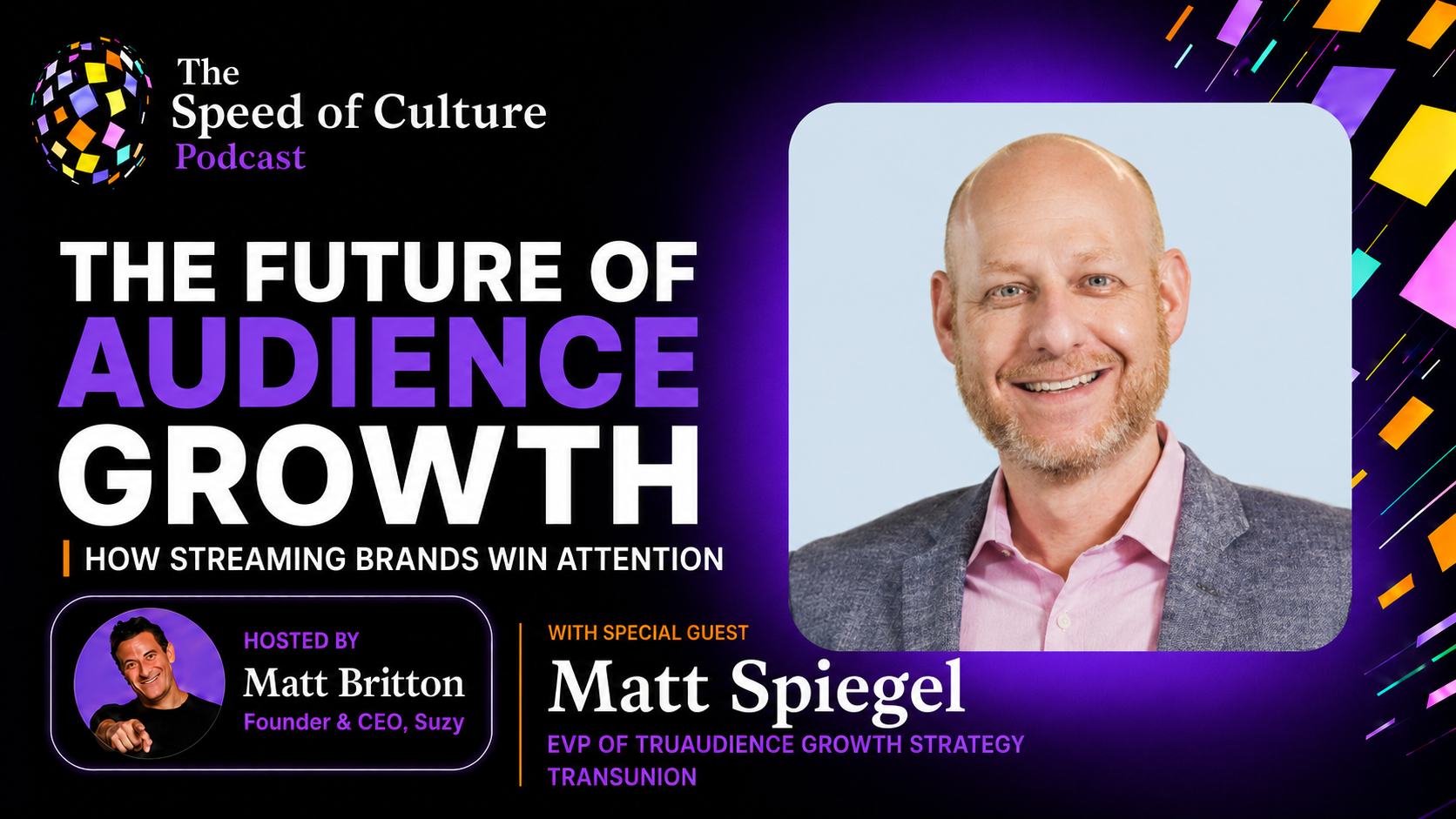
"If you use AI without great data, you're not gonna get great results," Matt Spiegel told Matt Britton on a recent episode of The Speed of Culture. Then he added the part that should concern every CMO currently funding an AI roadmap: the data does not have to be bad. It only has to be incomplete. Feed a system partial signal and you will not build the competitive difference you think you are building.
That distinction matters because it reframes where the risk sits. Most enterprise AI conversations treat capability as the variable and data as a given. Spiegel, who leads growth strategy for TransUnion's TruAudience business after twenty-five years across ad networks, search, Omnicom, and MediaLink, argues the opposite. Model access is becoming commoditized. Data completeness is not. Two companies running identical models against different data quality will produce materially different outcomes, and only one of them will know why.
Spiegel offers a proof point. Working with a partner company called ACTable, TransUnion supplied data into their models and saw roughly 10 percent better performance. No new model, no new creative, no new media strategy. Better inputs.
Britton, founder of Suzy and bestselling author of Generation AI, has spent two decades watching enterprises invest in the visible layer of a technology shift while underfunding the layer that determines whether the visible layer works. The pattern is consistent enough to be predictive. Organizations buy the model, announce the initiative, and skip the identity and data infrastructure work because it produces no demo. Then performance comes in flat and the conclusion drawn is that AI was overhyped rather than that the plumbing was never built.
For any AI transformation speaker working with Fortune 500 marketing organizations, this is the central diagnostic question of the next two years. Not what models are you using. What percentage of your customer signal is connected, and how would you know.
Technology Moves Fast, People Do Not
Spiegel's most contrarian position is that the industry is overestimating the pace of change, again.
His reasoning is structural rather than skeptical. Technology arrives first. Then comes process, and then come people, and people are always the slow part. Britton's illustration lands the point: he recently took his daughter to the dentist and filled out her intake forms on a clipboard.
Spiegel adds historical perspective that is easy to lose. Mass media, data, and technology have only genuinely intersected for about fifteen to twenty years. Programmatic buying was still becoming a thing at the start of that window. The industry has already absorbed an enormous amount of change in a short period, and it has already produced a track record of predictions that did not land on schedule.
Britton names the best example. There was a moment when the consensus view held that Procter & Gamble would run programmatic entirely in-house. It never happened.
Both are careful not to turn this into an argument for waiting. The point is calibration, not caution. Technology adoption curves in marketing are gated by organizational capacity, not by model capability, which means the useful question for a leadership team is how fast the organization can absorb the technology, and what specifically is constraining that rate, rather than how fast the technology is moving.
The Easy Button Cycle Explains Twenty Years of Failed Insourcing
Spiegel describes a pendulum he has watched swing repeatedly across his career, and he calls it the easy button.
The question underneath it is how much marketers want to be in the muck of the work versus how much they want to outsource it. In an ideal state, marketers get as close to the mechanics as possible. In practice that requires sustained investment and it is genuinely difficult. So a trend emerges, the industry leans into insourcing, insourcing turns out to be less than advertised, and the market swings back toward outsourcing as new innovation and new startup funding create fresh options. Then the cycle repeats.
Britton's explanation for why insourcing keeps failing at large brands is about incentives rather than capability. From senior management down, the outcome is not existential. Many executives want continuity, not reinvention, in a business growing two percent a year. That preference travels down the organization, and it becomes very difficult for one pocket of a company to operate with real entrepreneurial urgency inside a structure designed to protect the status quo.
Spiegel pushes it further with an observation worth pinning to a wall. The marketers at companies like Procter & Gamble do not work at marketing companies. They work at companies that build product and do marketing. That distinction shapes everything about how marketing investment gets evaluated internally.
This is the default economy operating at the org-chart level. Defaults survive because choosing them carries no career risk, and the incumbent process is always the default. Britton's framing for the way out is decision compression. When an organization has real clarity on where it is going, new capability resolves to a fast yes or a fast no. Absent that clarity, every option becomes a multi-quarter evaluation, and the pendulum keeps swinging because nobody ever commits long enough to build durable capability.
Why Marketing Still Fights for Credibility in the C-Suite
Spiegel raises a theme he says he hears constantly: marketers at the C-suite level are not getting the respect and credibility they deserve.
His diagnosis is precise. Most business practitioners do not understand marketing particularly well. And marketing remains an inexact science even after two decades of added data and precision, because a significant amount of it still runs on proxy metrics. You have to believe that brand matters. You have to accept that understanding attributes and holding an authentic voice produces value. Executives who did not come from the category do not naturally appreciate any of that.
The consequence is a specific hiring and staffing problem. Spiegel's conclusion is that progress now depends on finding people who actively want to lean into innovation, who are willing to be the change agent, and who will carry real risk tolerance into rooms with executives who do not necessarily want the envelope pushed. Change in this industry is people-driven rather than systematic.
That framing is more actionable than it first appears. If the constraint is a scarcity of internal risk-takers rather than a scarcity of technology, then the intervention is organizational. Identify who in the building will push, give them cover, and shorten their path to budget. Most transformation programs invest in tooling and leave that entirely to chance.
Identity Resolution Is the Infrastructure Layer Nobody Budgets For
The clearest explanation of what TransUnion actually does now comes from working backward through what it always did.
A credit score is a calculation of risk. Producing one requires sourcing large volumes of disparate data and running analytics capable of connecting those signals into a precise enough view of a person for a financial institution to make a lending decision. Strip out the credit context, which has limited marketing application, and the underlying capability is exactly what precision marketing at scale requires: aggregating consumer signals and using analytics to build profiles of individuals and households, with likelihood scoring attached to different actions.
TransUnion ported that capability across. Source marketing data, resolve identity, then attach attributes, roughly 15,000 of them. Britton's shorthand captures the output: this person is likely to lease a BMW based on income and a set of other signals, and you can score against that.
Spiegel's critique of the last two decades of digital is sharper than most vendors would put on record. For all the industry's talk about acting on data, it has relied on poor proxies throughout the journey. The cookie was a bad proxy for a person. Devices are a better proxy and still not a person. Combining offline data such as name, address, and phone with digital signals including hashed emails and mobile IDs produces a view of actual people and households, which is a meaningfully different asset.
The problem he encounters before any of the sophisticated work begins is more mundane and more common. Most clients' datasets are disconnected. The e-commerce data sits apart from the CRM data, structurally or through partitioning. He is Matt in one system and Matthew in the other, and nothing links them. The consumer signal is broken before any model touches it.
From there the offering resolves into three linked questions: who are your customers today, who should you reach next, and is what you are doing working. Spiegel puts unusual emphasis on the third. His view is that measurement at sufficient scale and rigor is the primary challenge as the business evolves, because without it you cannot prove or justify that the new things you are trying actually work. Put all three on a common identity layer and teams stop spending their time asking why the numbers do not match.
That last point is the quiet efficiency argument. A large share of analytics capacity inside enterprises is consumed by reconciliation rather than analysis. Fixing the identity layer does not just improve targeting. It returns headcount to actual work.
Are People Becoming the New Brands
The most interesting disagreement in the conversation is about what a brand is now.
Britton makes the case that a significant number of today's dominant brands were built during the golden age of television, when a large enough checkbook could push a brand onto consumers through linear media. His comparison is that just as Clear Channel could manufacture a top ten song through heavy rotation, brand marketers could manufacture a top three brand through sustained advertising. Many of those brands still drive volume on a moat built in that era while doing little that is new, which is itself evidence that change moves slower than predicted. But he points to Kylie Cosmetics and MrBeast and asks the obvious follow-up. When the brand is the person, and an iconic brand like Nike is struggling to recapture growth, are people becoming the new brands.
Spiegel's answer is that these are still brands, just newly defined. His nuance is where the argument gets useful. There are categories where brand matters much less, and it is genuinely easier now to build a real business selling product through social channels with no brand equity at all. But scale is a different problem. Reaching scale requires standing for something with actual meaning, and you know what MrBeast means and what the Kardashian brand stands for at some inherent level. He is bullish that more granular and accessible consumer insight helps that journey, allowing brands to assemble micro-moments into macro-opportunities.
Britton then extends the thesis into a specific prediction. Once product manufacturing was commoditized through outsourcing, the differentiator became people with distribution: Clooney with Casamigos, Dr. Dre with Beats, the Vitamin Water deals. AI is now doing to software what outsourcing did to physical product. Anybody can build software. So the next wave is business influencers attached to technology products. His example is Ryan Serhant, whose real estate sales platform Sell It sits at rough parity with a thousand other tools and raised roughly $50 million anyway, because the asset is distribution. His forward view is that a conference like POSSIBLE eventually features Daymond John and Ryan Serhant where it currently features The Trade Desk and Salesforce, because the personal brand becomes the business brand.
Spiegel's response is that he had not thought it through but there is a there there, and that brand building has fundamentally changed such that anyone can now make it happen.
The counterpoint worth holding is durability. Person-led brands carry concentration risk that institutional brands do not, and the moat is a single reputation rather than a distribution system. Both things can be true: personal brands are the fastest path to a category position right now, and they are the more fragile asset over twenty years.
One-to-One Was Always Overpromised
On personalization, Spiegel plays the useful skeptic.
Britton argues the age of one-to-many email marketing should be finished. The historical version varied a single field, the recipient's first name, and changed nothing else. His position is that every element of an email, and eventually a television ad, should be customizable against real signal.
Spiegel agrees mostly, and then draws the line. The hype of the last decade was one-to-one marketing at scale, and he never fully believed it. Microsegments are strong. AI moves the industry closer. Email is a channel where one-to-one is the right answer. Mass media still wants cohorts, only tighter ones, with customized creative against them. He is explicit that TransUnion neither buys media nor builds creative, and sits in the middle to enable both.
On the analyst question, his view is measured. Analysts do not disappear. Fewer are needed per model, per marketer, and per campaign initiative, and the honest expectation is roughly ten times the volume of work with no additional headcount. He does not believe the industry wakes up to fully autonomous machines. Parts of the journey run autonomously, and the outcome is better and more interesting marketing because teams are no longer constrained by data access or by processing capacity for modeling.
Britton pushes into agent-to-agent commerce with a lived example. While building software, an AI coding tool instructed him to go to a form service, provide payment, retrieve an API key, and return it. He did it. That vendor acquired a customer at zero acquisition cost. His argument is that this behavior scales, and that enriching the models with better data is what allows them to make contextually correct recommendations.
Spiegel's framing of TransUnion's role in that world is the cleanest articulation of the strategy: however the decision gets made, and whatever makes it, ensure it has the data necessary to make it well.
Key Takeaways for Business Leaders
- Audit data completeness before funding model capability. Incomplete data, not bad data, is the more common failure. A 10 percent performance delta from better inputs alone is the benchmark worth testing against.
- Find your identity resolution gap first. If your e-commerce and CRM systems hold the same customer under different records, every downstream model inherits that break. Fix the layer, then build on it.
- Fund measurement as a first-class capability. Without rigorous performance analysis at scale, you cannot justify the new tactics you are testing, which means the tests never convert into budget decisions.
- Staff for risk tolerance, not just skill. Progress depends on people willing to be the change agent in front of executives who do not want the envelope pushed. Identify them deliberately and give them cover.
- Calibrate your adoption timeline to organizational capacity. Technology arrives first, then process, then people. The binding constraint is almost never the model.
- Match personalization depth to channel. One-to-one is right for email. Mass media wants tighter cohorts with customized creative, not a million individual variants.
Frequently Asked Questions
Why does data quality matter more than model quality in AI marketing?
Because model access is commoditizing while data completeness is not. Two organizations running comparable models against different data quality produce materially different results. TransUnion's TruAudience business measured roughly 10 percent better performance in partner models simply by supplying better data. The failure mode is usually incomplete rather than inaccurate data, which makes it harder to detect and easier to underestimate.
What is identity resolution and why do marketers need it?
Identity resolution connects offline signals such as name, address, and phone number with digital signals such as hashed emails and mobile IDs to build a single accurate view of a person or household. Marketers need it because most enterprise datasets are disconnected, with the same customer recorded differently across CRM and e-commerce systems. Without a common identity layer, teams spend their capacity reconciling numbers instead of analyzing them.
Will AI eliminate marketing analyst roles?
Not according to Spiegel's assessment. Fewer analysts will be required per model and per campaign, and organizations should expect roughly ten times the work volume with no additional headcount. But the realistic outcome is AI plus humans, with portions of the workflow running autonomously rather than the entire process. The result is better marketing because data access and processing capacity stop being the limiting factors.
Are personal brands replacing traditional brands?
They are expanding what a brand can be rather than replacing the category. Businesses can now scale through social channels with minimal brand equity, but reaching genuine scale still requires standing for something with recognizable meaning, which is why MrBeast and the Kardashian brands persist. The newer pattern is business influencers attached to software products, where distribution rather than product differentiation is the asset.
What This Means Going Forward
Spiegel's career advice compresses into a line worth repeating to any team resisting AI adoption. He tells his high-school sophomore, who is opposed to using language models, that she should not fear the models. She should fear the people who know them better than she does.
The rest is durable regardless of technology cycle. Be curious, because it is not universal and it cannot be trained in easily. Be a student of the situation you are in, understanding what everyone in the room is after rather than only what you want. Own your career and know what you stand for. And be comfortable enough with what you do not know to raise your hand and say you do not follow, because the number of meetings where nobody understood the term and nobody asked is larger than anyone admits.
His two operating mantras close it out. The entrepreneurial version was paranoid to survive, which he has since dialed back. The current one is ask for forgiveness rather than permission, with a discipline attached: have a rational reason, be able to justify it, keep it inside your sphere of control, and accept the risk if it goes wrong. Too many people wait for an invitation, and change does not happen there.
Britton has spent his career at the intersection of AI, consumer behavior, and brand strategy, advising Fortune 500 leaders on how to convert structural change into commercial advantage. Hear the full conversation with Matt Spiegel on The Speed of Culture podcast, and to bring these frameworks to your next leadership event, explore Matt Britton's speaking platform.
The organizations that win the next cycle will not be the ones with the best models. They will be the ones whose data was already connected when the models arrived.