Every media plan built in the last twenty years starts from the same assumption: attention is scarce, and the job is to capture it. Gaming breaks that assumption, and most marketing organizations have not updated their models to account for it.
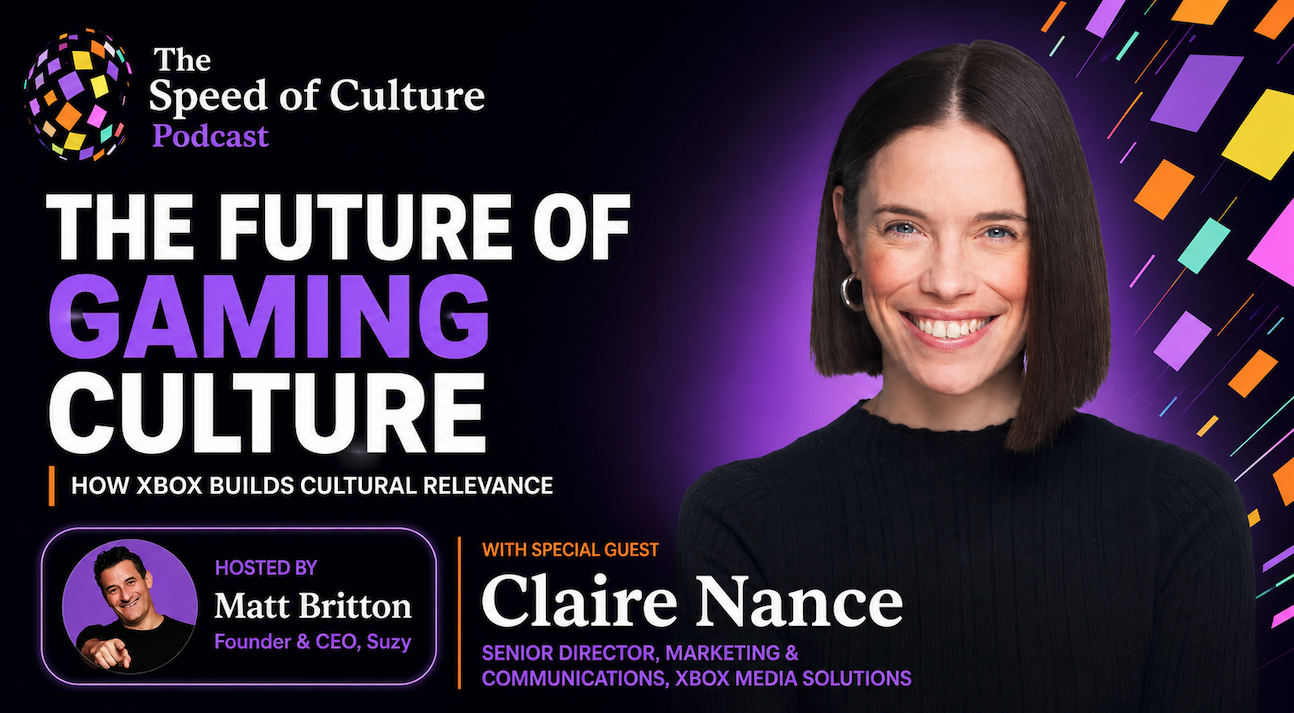
Claire Nance, Senior Director of Marketing Communications at Microsoft's Xbox Media Solutions, put it plainly on a recent episode of The Speed of Culture with Matt Britton. As marketers, the reflex is to ask how we cut through and how we capture attention. In gaming, that attention is already secured. The strategic problem inverts. The question is no longer how to interrupt someone effectively. It is how to be present without breaking a state of focus the platform has already created.
That inversion is why gaming sits so far outside conventional media logic, and why it remains persistently underbought relative to the audience it commands. Nance cites the number the industry repeats constantly: roughly 3.6 billion players globally, with something close to 80 percent of Americans playing games in some form. Those figures describe a channel with television-era reach. Ad allocation does not reflect it.
Britton, founder of Suzy and bestselling author of Generation AI, has spent two decades tracking the gap between where consumer attention actually sits and where marketing budgets go. Gaming is the clearest current example. The numbers are public and have been for years, so this is a classification problem rather than a discovery problem. Marketers have filed gaming under a demographic stereotype rather than under reach, and the filing error has cost them a decade of access.
Nance's career gives the point weight. She joined Activision Blizzard as one of the first marketing communications hires into an early-stage ads business, built the function from scratch, and moved under the Xbox Media Solutions banner following Microsoft's acquisition. Her assessment of the job has stayed remarkably consistent across both eras: the largest part of it is selling gaming as a category to an industry that still misreads it, ahead of selling Xbox or Activision titles.
Immersion Is the Superpower, and It Changes the Creative Brief
Nance describes immersion as gaming's superpower, and the phrase is more operationally useful than it first sounds.
When someone is in a game, that is the only thing they are thinking about. No competing tab, no second screen, no ambient scroll. For any consumer behavior speaker studying where engagement quality is heading, that is a meaningful outlier in a media environment defined by fractured attention and sub-two-second view times.
The consequence for advertisers runs counter to trained instinct. Because the attention already exists, the creative objective flips from interruption to integration. Nance is explicit that the goal is not to break the immersion. Brand presence has to feel seamless inside the environment rather than layered on top of it.
This is where most brands entering gaming get it wrong. They arrive with assets and a mental model built for feed-based media, where the first three seconds exist to arrest a scrolling thumb. In gaming, that creative logic is actively counterproductive, because it signals intrusion in a space where the user has voluntarily concentrated. Britton makes a related argument in his AI keynote presentations: the format follows the surface, and organizations that port creative across surfaces without re-thinking the underlying behavior consistently underperform against native competitors.
The upside is that when integration works, the engagement quality has few equivalents. Britton's framing on the episode is that being contextually present inside an immersive environment is close to a category of one, particularly in a period when every other channel is competing against a million simultaneous notifications.
The 3.6 Billion Number and the Self-Identification Gap
The reach figures are not disputed. The reason they fail to move budgets is more subtle, and Nance identifies it precisely.
A large share of players do not describe themselves as gamers. Someone playing Candy Crush on a commute does not categorize that activity as gaming, even though it is. The behavior is nearly universal while the identity label is not, which means self-reported segmentation systematically undercounts the audience. Any brand relying on survey respondents to identify as gamers before targeting them is working from a number that could be a fraction of reality.
That gap sustains the stereotype Nance spends most of her time dismantling: the teenage boy in the basement. It is a description of who played fifteen years ago, and it has almost no relationship to who plays now. Post-pandemic behavior made that especially clear. The COVID surge was driven substantially by people returning to gaming rather than discovering it, adults who had played when they were younger, still had a console at home, and picked it up again for social connection when time opened up.
The social dimension is the part marketers most consistently miss. Nance's point is that gaming is a shared activity with someone, closer to doing something together than to a call. And the connection extends past the session. Candy Crush is a single-player mobile game, and its players still gather in forums to argue about which level is unreasonably hard. Community forms around the experience whether or not the game itself is multiplayer.
For anyone building against generational consumer behavior, this matters more than the raw reach number. Britton's work in his Gen Z keynote sessions has consistently shown that shared activity produces stronger affinity than shared consumption. Gaming is one of the few channels at scale that delivers activity rather than viewing, which is a different and more durable form of engagement than a completed video view.
A Rubric That Makes Gaming Actually Buyable
Part of why gaming stalls in media planning is that it presents as one channel and behaves as several. Nance offers a rubric that resolves most of the confusion: in the game, adjacent to the game, and outside the game.
In the game is intrinsic advertising. The billboards along the track in a racing title, the stadium signage in a sports game. Notably, Nance says Xbox does not offer this, including in its own first-party titles, though other publishers and ad tech companies do.
Adjacent to the game is where Xbox Media Solutions concentrates on mobile. Rewarded video sits at natural breaks in play. A player finishes a level, runs out of lives, and can choose to watch an ad in exchange for something of value. Everything is opt-in. Nance draws a sharp line between this and the older mobile experience of an interstitial firing mid-gameplay while the user hunts for the close button. Playable ad experiences, essentially branded mini-games, sit in the same tier. On console, dashboard ad units function as the entry point into the entertainment ecosystem rather than an interruption inside it.
Outside the game covers everything happening around the title: streamers, watch behavior, community forums, and esports. This is the tier most brands are already familiar with, often without recognizing it as gaming spend.
The rubric matters because it converts a category that reads as complicated into three distinct buys with different mechanics and different measurement expectations. Nance also notes the buying model spans both programmatic and bespoke on the mobile side, which means gaming can enter a plan through existing programmatic infrastructure rather than requiring a custom process from the start. That lowers the activation cost considerably, and activation cost is usually what kills a first test.
Player-First Is a Constraint, Not a Positioning Statement
The most instructive part of the conversation for brand marketers is how Nance describes the internal dynamic at a publisher that also sells advertising.
The operating philosophy, carried from Activision Blizzard into Xbox Media Solutions, is player-first on every brand experience. What gives that teeth is the reporting reality behind it. Nance's framing is that they are a game publisher first, and the studios they work with are protective of the player experience to the point that they will not allow a bad ad into a game.
She treats that as a feature rather than friction, and she is right to. A hard constraint on ad quality produces a better player experience, and better player experience produces better brand outcomes. The value exchange logic reinforces it. When the player opts in and receives something in return, the transaction is consensual, which is a materially different psychological contract than an impression served against someone's will.
There is a real counterpoint worth naming. Constraint limits inventory and format flexibility, which is part of why gaming has been slower to scale as an ad business than its audience size would predict. Nance is candid that the mobile-first business under Activision Blizzard has only recently expanded across console and PC following the acquisition, giving the portfolio range it previously lacked. Brands accustomed to unlimited format negotiation will find gaming more prescriptive than social platforms. That prescriptiveness is exactly what protects the attention they are buying.
Why Gaming Stays Underbought
If the reach is proven and the engagement quality is superior, the obvious question is why allocation has not followed. The answer is the default economy operating in plain sight.
Media budgets flow along established paths because those paths carry no career risk. Nobody gets questioned for putting more money into the channels their agency already measures well, with the creative assets they already produced, against segments they already defined. Gaming requires new segmentation logic, new creative thinking, and an internal explanation. Each of those is a small tax, and small taxes compound into inaction.
Nance's job description is essentially the cost of that inaction made visible. Her largest workstream is not selling specific titles, because the IP she represents is among the best known in the world and needs little introduction. It is education. Breaking down misconceptions, explaining activation options, helping brands understand what the space actually is.
Her recommended starting point cuts through most of the complexity. Rather than arriving with the objective of doing gaming, come in knowing your objective and knowing your audience. Candy Crush and Call of Duty do not share an audience in any meaningful way, and treating gaming as a single monolith produces the mismatches that generate bad first tests and premature category exits. Her point is that gaming appears overwhelming but resolves quickly when a marketer returns to the two questions that governed media planning long before digital: who am I trying to reach, and what am I trying to do.
That is decision compression in practice. Clarity at the objective layer eliminates most of the deliberation at the channel layer.
Where the Category Goes Next
Nance's forward view is less about spectacle and more about the removal of barriers, which is usually the better predictor of growth.
Mobile continues to expand because it removes the hardware and cost barrier entirely. The device is already in the pocket. She adds a design point that gets overlooked: mobile game mechanics are deliberately engineered for immediate comprehension, so a new player can pick up a title and feel competent quickly. Low learning curve is a growth strategy, not an accident. Advertising and media revenue play directly into the same dynamic, functioning as a monetization stream that gives players access to more titles without upfront commitment.
Console access is following a similar path through choice rather than replacement. Subscription models like Game Pass exist alongside direct purchase, mirroring what happened across connected TV. Britton draws the comparison to buying a Nintendo cartridge at a store, then waiting a day for a download, and now instant access through a subscription. Nance's framing is that the goal is optionality, because not every player wants the same relationship with a game.
Her expectation is more people playing, more types of games being played, and more immersive styles of play as the technology advances. Britton raises the AI dimension from CES, including scenarios where players insert themselves into games and shape outcomes directly. Nance's read is that gaming has consistently functioned as a leading indicator for technology adoption, because people learn new technology through play before they adopt it in other contexts. That makes the category worth watching as a forecasting tool independent of its media value.
Key Takeaways for Business Leaders
- Stop treating gaming as a demographic and start treating it as reach. With roughly 80 percent of Americans playing in some form, gaming is a mass channel that your current segmentation is likely undercounting because most players do not self-identify as gamers.
- Invert the creative brief. Attention is already secured inside the game, so the objective is seamless presence rather than interruption. Feed-native creative built to stop a scroll works against you here.
- Use the three-tier rubric to structure the buy. In the game, adjacent to the game, and outside the game are distinct products with distinct mechanics. Naming which tier you are buying prevents most first-test failures.
- Lead with objective and audience, never with channel. Coming in wanting to do gaming produces mismatches. Candy Crush and Call of Duty audiences have minimal overlap.
- Enter through programmatic to lower activation cost. Mobile gaming inventory is available programmatically alongside bespoke formats, so a first test does not require building a custom process.
- Name the default in your allocation. Identify the portion of spend going to established channels because it is procedurally easy rather than because it delivers the best marginal return, then test gaming against that portion specifically.
Frequently Asked Questions
How big is the gaming audience for advertisers?
Industry figures cited by Microsoft's Xbox Media Solutions put the global player base at roughly 3.6 billion, with approximately 80 percent of people in the United States playing games in some form. The reach is comparable to broadcast television at its peak. Advertiser allocation has not kept pace, largely because most players do not self-identify as gamers, causing self-reported segmentation to undercount the audience substantially.
What are the main types of gaming advertising?
Gaming advertising divides into three tiers. In the game is intrinsic advertising, such as billboards inside a racing title. Adjacent to the game covers formats at natural breaks in play, including opt-in rewarded video and playable ad units. Outside the game covers the surrounding ecosystem, including streamers, community forums, and esports. Each tier carries different mechanics, inventory, and measurement expectations.
Do ads interrupt gameplay?
Not in a player-first model. Xbox Media Solutions operates on opt-in formats placed at natural breaks, such as a player choosing to watch an ad after running out of lives in exchange for a reward. Xbox does not offer intrinsic in-gameplay advertising, including in its own first-party titles. The stated objective is preserving immersion, because immersion is the value the channel delivers to advertisers.
Why is gaming still underused by major brands?
Because default media allocation carries no institutional risk while gaming requires new segmentation, new creative thinking, and internal justification. Persistent stereotypes about who plays compound the problem. The single largest workstream inside gaming ad businesses is education rather than sales, which indicates the barrier is category understanding rather than inventory, audience quality, or measurement capability.
What This Means Going Forward
Nance closes with the question she applies before committing to anything: where is the benefit? Not what are we doing, but why, and what specifically improves as a result. Britton's addition on the episode is the sharpest argument for that discipline right now. AI has lowered the barrier to entry on almost any activity, which means the constraint has shifted from capability to intent. Without a clear answer on why, organizations generate an enormous volume of activity and very little progress.
Applied to gaming, the question does real work. It stops brands from buying a channel to say they bought it, and pushes them toward the objective, the audience, and the specific tier of the ecosystem that serves both. That is the difference between a test that produces a decision and a test that produces a slide.
Britton has spent his career at the intersection of consumer behavior, AI, and brand strategy, helping Fortune 500 leaders identify where attention has already moved before their competitors reprice it. Hear the full conversation with Claire Nance on The Speed of Culture podcast, and to bring these frameworks to your next leadership event, explore Matt Britton's speaking platform.
The audience has been there for a decade. The only variable left is how long brands take to price it correctly.