March 14, 2023
Finance Marketing Strategies to Bank On with Tyrrell Schmidt, CMO at TD Bank

Tyrrell Schmidt
CMO
This is some text inside of a div block.
This is some text inside of a div block.
LISTEN ANYWHERE YOU FIND YOUR PODCASTS
%20(400%20x%20100%20px)%20(300%20x%2050%20px)%20(150%20x%2050%20px).avif)

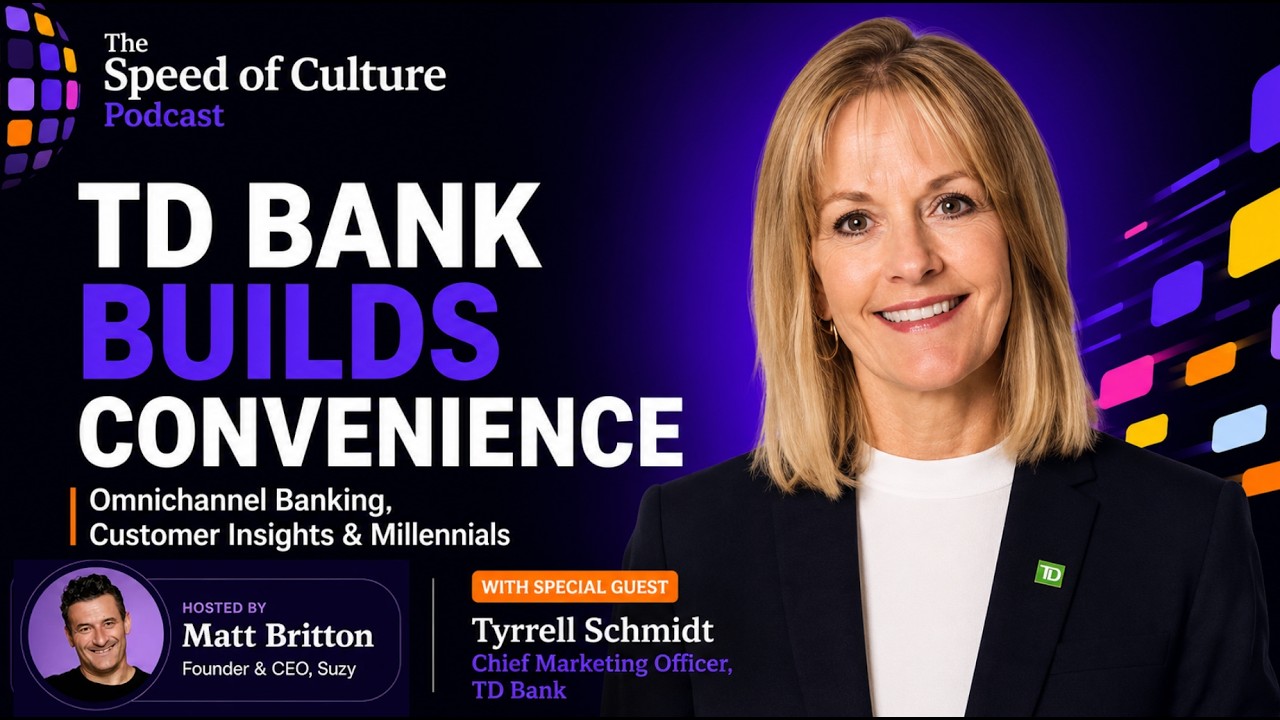
In the rapidly evolving financial services landscape, banking institutions face a unique challenge: maintaining relevance while navigating heightened regulatory requirements and shifting consumer expectations. Tyrrell Schmidt, Chief Marketing Officer at TD Bank, has spent over three decades building brands and leading marketing strategies across the financial services and healthcare sectors.
In this episode of the Speed of Culture podcast, Suzy founder and CEO Matt Britton sits down with Schmidt to explore how TD Bank differentiates itself through customer experience, omnichannel innovation, and data-driven marketing strategies.
The conversation reveals critical insights into how one of America's leading regional banks executes finance marketing strategies that resonate across generations, from traditionalists who value in-person banking relationships to millennials demanding seamless digital experiences.
Schmidt brings extensive experience from global organizations including Cigna, Standard Chartered Bank, and Discover Card, making her perspective on finance marketing strategy particularly valuable for understanding how enterprise-scale customer intelligence drives competitive advantage in financial services.
The financial services industry represents one of the most advanced marketing environments in business today. Despite, or perhaps because of, strict regulatory frameworks and inherent risk management requirements, banking and financial services companies must navigate an extraordinarily complex competitive landscape.
As a highly regulated industry with significant compliance obligations, financial institutions operate within strict guardrails that actually create opportunities for sophisticated marketing differentiation. Banks cannot simply compete on product features or pricing; they must distinguish themselves through superior customer experience, trust-building, and demonstrated value delivery.
The reality of modern finance marketing is that consumer needs are not static. Demographic shifts, technological disruption, and macroeconomic pressures force financial institutions to continually reassess their value propositions and marketing strategies.
TD Bank’s positioning as “America’s Most Convenient Bank” represents a deliberate choice to compete on accessibility, ease of use, and customer convenience rather than attempting to outmaneuver competitors on product innovation or pricing.
This strategy requires marketing discipline and enterprise-wide alignment across all customer-facing functions.
Understanding what consumers actually need from their financial institution differs substantially from understanding what financial institutions believe consumers need. This gap between perception and reality represents one of the most critical challenges finance marketing leaders face, and also the greatest opportunity for competitive differentiation.
According to Schmidt, understanding consumers' personal banking needs is an enterprise-wide imperative that reaches beyond marketing. Every function, from customer service and product development to compliance and operations, must be oriented toward delivering on the bank's core promise to customers.
When a bank claims to be “America’s Most Convenient Bank,” that promise must be reflected in every interaction, across every channel, at every stage of the customer journey.
Organizations like Suzy, the AI-powered consumer intelligence platform, enable financial services companies to move beyond traditional market research and develop deep, real-time understanding of customer motivations, pain points, and preferences.
Rather than relying on annual surveys or focus groups conducted months before implementation, modern finance marketing leaders leverage continuous consumer feedback and behavioral data to iterate on customer experience.
The stakes for getting customer insights right are substantial. A financial institution that misunderstands its customers' evolving needs risks losing relevance to digital-first competitors, struggling to attract younger demographics, or alienating its core customer base during transition periods.
TD Bank's approach demonstrates how to operationalize customer insights across an enterprise. Rather than treating customer research as an occasional exercise, Schmidt and her team treat continuous consumer understanding as foundational to strategic decision-making.
One of the most significant shifts in financial services marketing over the past decade involves generational change. Millennials and Gen Z consumers have fundamentally different banking preferences, expectations, and behaviors compared to Baby Boomers and Gen X customers.
Millennials and younger consumers expect digital-first banking capabilities. They want mobile apps that work seamlessly, instant account access, and the ability to conduct banking transactions without visiting a physical branch.
Yet this demographic cohort is not uniformly “digital only.” Many millennials still value being able to speak with a human banker when handling complex financial decisions or during times of uncertainty.
TD Bank's strategy acknowledges this complexity. Rather than attempting to force all customers onto digital-only channels, the bank is deliberately expanding its digital capabilities while simultaneously maintaining a network of approachable physical locations.
This omnichannel approach recognizes that customer preferences exist on a spectrum. Some customers prefer comprehensive self-service digital tools; others want a mix of digital and in-person interactions; still others prefer predominantly in-branch relationships.
For financial services marketing leaders, this strategy offers a clear lesson: omnichannel doesn't mean treating all channels as identical or replaceable. Instead, it means creating a seamless ecosystem where customers can choose their preferred mode of interaction while maintaining consistent service quality, product access, and brand experience across all channels.
For most banking institutions, customer acquisition remains the primary driver of revenue growth. Acquiring new customers at acceptable cost-per-acquisition levels represents a fundamental business priority, and a critical responsibility for finance marketing teams.
TD Bank's go-to-market strategy reflects several sophisticated marketing principles. The bank focuses on providing ease, value, and advice to customers through carefully orchestrated go-to-market channels.
Performance-driven, bottom-funnel acquisition channels remain important for financial services companies. Banking decisions are highly considered purchases, meaning customers typically conduct extensive research, compare multiple options, and make deliberate choices.
Simultaneously, TD Bank recognizes that full-funnel marketing, building awareness and consideration across the entire customer journey, remains essential.
One particularly noteworthy element of TD Bank's strategy involves channel selection for awareness and mid-funnel engagement. Rather than defaulting to traditional linear television advertising, TD Bank is investing in connected TV and social media platforms including TikTok.
This represents a calculated bet that where potential customers are spending attention and time has fundamentally shifted, and that banks must follow consumers to those platforms rather than expecting consumers to watch traditional broadcast television.
The conversation between Matt Britton and Tyrrell Schmidt highlights a broader principle about marketing's role in financial services leadership. Marketing is not a cost center responsible for placing ads and generating leads; instead, sophisticated finance marketing organizations serve as chief advocates for customer voice within their institutions.
CMOs and finance marketing leaders who leverage robust consumer intelligence capabilities occupy a unique position. They understand what customers actually need, what messaging resonates, what channels deliver results, and where organizational priorities may drift from customer expectations.
This requires courage, the willingness to challenge internal assumptions and advocate for customer-centric decisions even when those decisions require resource reallocation or strategic shifts.
For marketing leaders aspiring to CMO-level impact, several lessons emerge from this conversation:
The financial services industry operates as one of the most advanced marketing environments globally. Heavy regulation, multiple customer segments, and evolving expectations create both challenges and opportunities for differentiation through superior customer experience and marketing intelligence.
Delivering on customer-facing promises requires enterprise-wide commitment. Modern consumer intelligence platforms enable continuous insight generation rather than relying on infrequent surveys or focus groups.
Successful omnichannel strategies acknowledge customer diversity by investing simultaneously in digital innovation and physical branch excellence, ensuring consistent service quality across channels.
Go-to-market strategies must balance performance-driven bottom-funnel channels with full-funnel awareness building. Sophisticated leaders make deliberate channel choices based on consumer intelligence and performance data.
Finance marketing leaders who operate with robust consumer intelligence capabilities can advocate effectively for customer-centric decisions throughout their organizations, creating substantial competitive advantages.
Regional banks like TD Bank compete by emphasizing convenience, local relationships, and customer service quality. Rather than attempting to match fintech companies on pure technology capability, regional institutions differentiate through trusted relationships, human expertise, and accessible physical networks.
Marketing should serve as the voice of the customer within product development processes. Modern marketing leaders should inform product strategy based on genuine customer needs, unmet expectations, and market opportunities.
This depends on the organization's current market position and growth stage. A common approach is the “70-20-10 rule”: 70% toward proven core channels, 20% toward emerging channels with potential for scale, and 10% toward experimental initiatives.
Consumer data about banking preferences, pain points, decision-making processes, and channel preferences tends to be most actionable. Finance marketing leaders benefit most from understanding why customers choose specific banks, what frustrates them, which capabilities they prioritize, and how preferences vary by generation and segment.
The conversation between Matt Britton and Tyrrell Schmidt occurred in March 2023, a pivotal moment in financial services evolution. The banking crisis in March 2023 would validate many of the principles discussed: customer trust, convenience, and demonstrated reliability emerge as critical differentiators during periods of industry uncertainty.
For more insights about marketing innovation, customer experience strategy, and leadership perspectives from industry experts, visit Speed of Culture.
For organizations looking to build consumer intelligence capabilities that drive finance marketing and business strategy decisions, explore Suzy.
Interested in keynote speaking about marketing innovation, customer experience, and emerging consumer trends? Visit AI Keynote Speaker or Speaker HQ for more information.
For deeper exploration of how artificial intelligence is transforming business and consumer behavior, consider reading Generation AI, Matt Britton's comprehensive guide to AI's impact on strategy, marketing, and organizational transformation.





.jpeg)