Opening
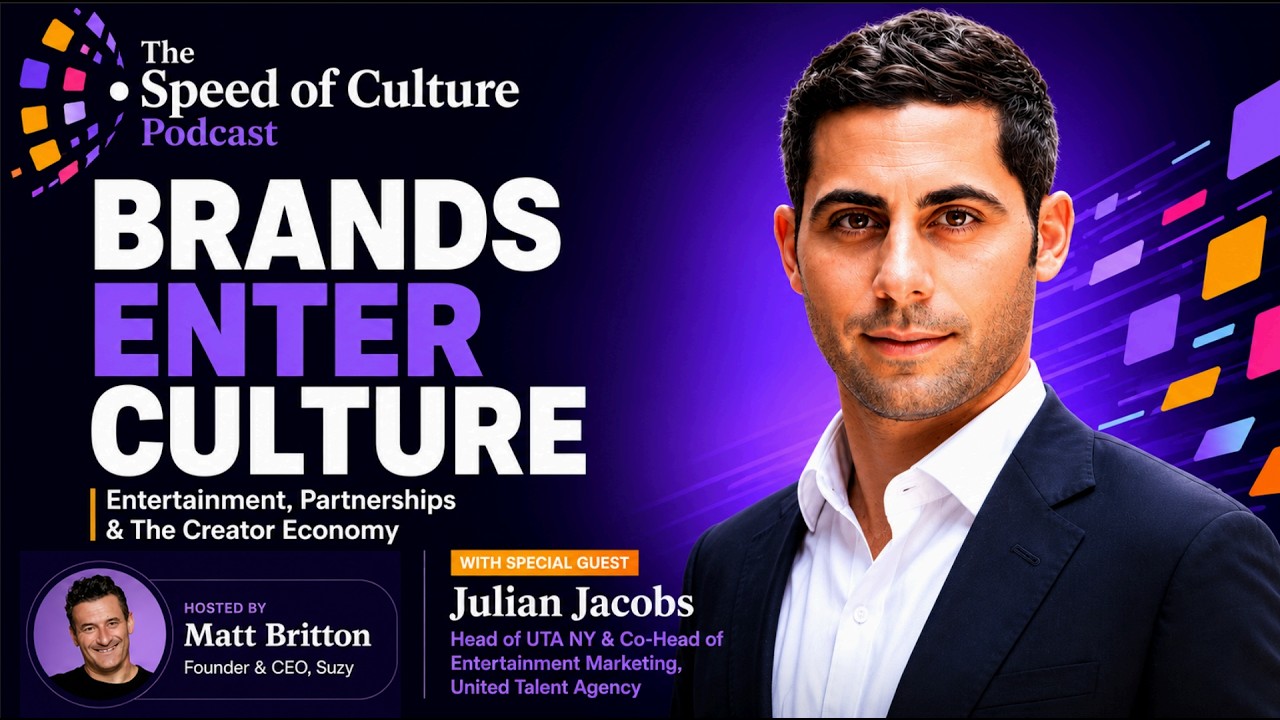
In an entertainment landscape where disruption has become the default state, brands face an unprecedented challenge: how to remain culturally relevant while navigating the fragmentation of traditional media. This question lies at the heart of Episode 157 of The Speed of Culture Podcast, where Matt Britton, founder and CEO of Suzy, the AI-powered consumer intelligence platform, sits down with Julian Jacobs, Head of UTA NY and Co-Head of Entertainment Marketing at United Talent Agency, to explore how organizations can turn industry chaos into strategic advantage.
Released on January 23, 2025, and recorded live at CES in Las Vegas, this episode unpacks the philosophy and strategy behind one of the entertainment industry's most powerful marketing firms. United Talent Agency (UTA) has become the bridge between massive global brands and the creative talent shaping culture, from iconic collaborations like Barbie with General Motors to The Bear with Coca-Cola Company. Through Jacobs's perspective, listeners gain insights into what it takes to drive meaningful impact in an era where traditional rules no longer apply.
Julian Jacobs's ascent from UTA's mailroom to one of the agency's top executive roles exemplifies the power of embracing uncertainty and cultivating meaningful mentorship. His philosophy of remaining "comfortable in being uncomfortable" has shaped not only his career trajectory but also his approach to building transformational brand partnerships. At a time when consumer attention spans fragment across platforms and audiences demand authentic value alignment, Jacobs's insights offer a masterclass in strategic thinking for marketing leaders, brand strategists, and anyone seeking to understand how entertainment and commerce intersect in the modern era.
The Speed of Culture Podcast, presented in collaboration with Suzy and Adweek, provides a platform for disruptive leaders and entrepreneurs to explore the evolving consumer behaviors, adaptation strategies, and actionable approaches necessary to thrive in a rapidly changing landscape. Through episodes like this one, the podcast helps brands and marketing professionals understand not just what's happening in culture, but why it matters to their bottom line.
The Rise of Julian Jacobs: From Mailroom Visionary to Entertainment Marketing Leader
Julian Jacobs's career at United Talent Agency represents a masterclass in internal career development and strategic leadership growth. Beginning in UTA's mailroom, traditionally considered an entry point position in the entertainment industry, Jacobs methodically built expertise across brand partnerships, entertainment marketing, and cultural strategy. His trajectory culminated in 2024 when he was named Head of UTA's New York Office, a role that positions him to oversee one of the agency's most strategic locations for brand-entertainment convergence.
What distinguishes Jacobs's rise is not merely his promotion through ranks, but his conscious philosophy about professional development. He credits much of his success to two interconnected strategies: seeking out world-class mentorship and maintaining what he calls "comfort in being uncomfortable." In an industry where comfort can breed stagnation, Jacobs deliberately positioned himself at the intersection of uncertainty and opportunity.
"Comfortable in being uncomfortable."
This mindset allowed him to identify and pursue emerging opportunities within entertainment marketing long before they became obvious to peers.
Under Jacobs's leadership (alongside co-head David Anderson), UTA's Entertainment Marketing practice has grown into an 80-person team spanning Los Angeles, New York, London, and Atlanta. This global footprint reflects the complexity of modern brand-culture partnerships, which now require coordination across multiple time zones, media platforms, and creative disciplines. The scale of this operation underscores a critical market reality: major brands now recognize that entertainment marketing is not a peripheral activity but a core business function.
Jacobs's mentors and advocates, including UTA CEO Jeremy Zimmer, have reinforced his belief in the power of connecting creative talent with commercial objectives. This relationship model, where mentorship actively shapes leadership development, has become increasingly important as the entertainment industry grapples with rapid technological and consumer behavior changes. The podcast episode reveals that Jacobs's willingness to learn from experienced leaders while maintaining his own perspective on emerging trends has been instrumental in building UTA's entertainment marketing practice into a strategic powerhouse.
Entertainment Disruption as Strategic Catalyst: Redefining Brand-Culture Partnerships
The premise of Episode 157 centers on a counterintuitive insight: industry chaos creates opportunity. While many entertainment professionals might characterize the current landscape, defined by streaming platform proliferation, AI advancement, and changing consumer consumption patterns, as destabilizing or threatening, Jacobs frames it differently. The elimination of traditional gatekeeping mechanisms has democratized cultural creation and opened pathways for brands to participate meaningfully in storytelling.
The streaming era fundamentally altered how audiences consume entertainment, fragmented advertising reach, and redistributed power among platforms, creators, and content producers. Rather than lamenting this fragmentation, Jacobs recognizes it as liberation from outdated constraints. When linear television no longer dominates the media landscape, brands can explore alternative pathways to cultural relevance.
This disruption has created what Jacobs calls "fertile ground for innovation." The traditional entertainment marketing model, where brands purchased advertising adjacent to entertainment content, operated within strict boundaries. Brands were audiences for entertainment; they were not participants in cultural creation.
Modern brand-entertainment partnerships reverse this dynamic. Today's most successful collaborations position brands as active contributors to creative experiences rather than peripheral observers.
The General Motors and Netflix partnership exemplifies this evolution. Rather than featuring GM vehicles in individual Netflix shows, the collaboration positioned GM technology throughout Netflix's entire original content universe. This partnership structure required a fundamental reconceptualization of how entertainment platforms think about brand integration.
Similarly, the Coca-Cola and The Bear collaboration went beyond product placement. The partnership integrated Coca-Cola into the narrative fabric of the show, reflecting the reality of how beverages function in restaurant kitchens and worker experiences. By adding creative value rather than merely purchasing visibility, Coca-Cola became embedded in the cultural experience that audiences connected with authentically.
Jacobs emphasizes that this shift from transactional to transformational partnerships reflects broader changes in how brands must operate. Disruption has eliminated the "sliver" of marketing devoted to cultural impact, what was once a niche, secondary consideration has become central to brand strategy. Companies that fail to recognize this reality face the risk of irrelevance with audiences increasingly skeptical of purely commercial messages.
Building Long-Term Creator Partnerships: Beyond Influencer Saturation
One of Jacobs's most important insights addresses a critical challenge facing modern marketing: influencer and creator market saturation. As social media platforms matured and influencer economics became professionalized, the space became crowded with transactional relationships. Brands paid creators to mention products; creators captured payment without necessarily believing in or committing to brand missions.
Jacobs advocates for a fundamentally different approach: treating creators as long-term business partners and venture collaborators rather than amplification channels. This philosophy reflects a deeper understanding of how cultural influence actually works. True cultural impact emerges from authentic alignment and sustained collaboration, not from one-off sponsored posts or limited-term ambassador relationships.
The Emma Chamberlain coffee brand partnership illustrates this principle. Rather than engaging Chamberlain as a spokesperson for an existing brand, UTA helped facilitate her building an independent venture aligned with her values and audience. By supporting creators in launching their own businesses, brands establish relationships with entrepreneurs who are inherently invested in long-term success.
This approach also addresses a critical generational expectation, particularly among Gen Z audiences. Younger demographics increasingly evaluate brands not just on products or services, but on whether the brand supports creators and cultural figures they admire. A brand that appears to exploit creator talent or engage in purely extractive relationships risks reputational damage among audiences who increasingly demand values alignment.
The shift toward long-term partnerships also provides greater stability for strategic planning. Instead of constantly cycling through new influencer relationships, brands can build systematic approaches to working with a smaller number of carefully selected creators over multiple years. This continuity allows for more sophisticated storytelling, deeper integration into creator content, and opportunities to evolve partnerships as both the brand and creator grow.
Cultural Relevance as Core Business Strategy: The New Marketing Imperative
Perhaps Jacobs's most significant contribution to marketing strategy thinking is his articulation of how cultural relevance has transitioned from a specialized marketing function to a fundamental business requirement. This shift reflects changing consumer expectations, demographic shifts, and the speed at which cultural movements now develop and spread.
Historically, "culture" operated within marketing departments as a subset of brand positioning. Companies would maintain cultural marketing initiatives (sponsorships, partnerships with entertainment properties, targeted messaging) but these functions existed somewhat separate from core business strategy.
This segregation has become strategically dangerous. Modern consumers, particularly younger demographics, make purchasing decisions based significantly on whether brands align with their cultural values and social positions. A brand perceived as culturally out-of-touch or out-of-step with evolving social consciousness faces rapid audience erosion.
The challenge is that genuine cultural relevance cannot be manufactured or purchased. It requires deep understanding of emerging trends, authentic commitment to values that align with target audiences, and willingness to evolve as culture itself evolves. This is precisely why UTA's model (connecting brands with creators, entertainment properties, and cultural moments) has become so valuable.
Sports represents a particularly important cultural convergence point that Jacobs highlights. Sports combines entertainment, fashion, celebrity, community identity, and live experience in ways that few other cultural phenomena do. For brands seeking to reach audiences across demographic segments, sports offers unparalleled access.
The entertainment marketing practice at UTA operates with the understanding that cultural positioning is now inseparable from brand positioning. Companies compete not just on product attributes or price, but on whether they occupy a compelling cultural position in their target audience's mind. This requires sustained attention to entertainment partnerships, creator collaboration, and cultural moment participation, precisely the services UTA provides.
The Future of Entertainment Marketing: Chaos as Competitive Advantage
As UTA continues expanding its Entertainment Marketing division, the question becomes: what constitutes strategic advantage in this environment of constant disruption? Jacobs's perspective suggests that advantage accrues to organizations that embrace rather than resist change, that view disruption as opportunity rather than threat, and that invest in understanding emerging cultural movements before they reach mainstream visibility.
The entertainment industry's evolution continues accelerating. AI advancement promises to reshape content creation, distribution, and personalization. Streaming platforms constantly experiment with new business models, and creator economy infrastructure continues improving, enabling independent creators to achieve what previously required studio resources.
Organizations positioned to thrive in this environment recognize several principles:
- Maintain privileged information about what's emerging across entertainment properties, enabling anticipatory strategy rather than reactive response.
- Build platforms and infrastructure that enable rapid iteration and experimentation rather than rigid, hierarchical approval structures.
- Commit authentically to long-term cultural participation rather than opportunistic extraction.
Jacobs's willingness to remain comfortable in discomfort, to embrace uncertainty while maintaining clear strategic principles, characterizes the leadership required to navigate entertainment's future. As the landscape continues shifting, the competitive advantage belongs to those who can guide organizations through change without losing strategic clarity or cultural authenticity.
Key Takeaways
- Discomfort Drives Growth: Julian Jacobs credits career advancement to deliberately positioning himself at the intersection of uncertainty and opportunity, coupled with intentional mentorship-seeking and strategic risk-taking rather than seeking comfort in stability.
- Disruption Enables Innovation: Entertainment industry chaos from streaming, AI, and changing consumption patterns has eliminated traditional gatekeeping mechanisms and created unprecedented opportunities for meaningful brand-culture partnerships.
- Creator Partnerships as Business Collaboration: Successful modern marketing treats creators not as transactional influencers but as long-term business partners aligned around shared ventures, creating authentic relationships that build genuine audience trust.
- Cultural Relevance Is Core Business: What was historically a specialized marketing function has become central to brand strategy, with companies now competing significantly on cultural positioning and values alignment rather than product attributes alone.
- Sustained Competitive Advantage Emerges from Anticipation: Organizations positioned to thrive in entertainment marketing maintain privileged information about emerging cultural movements, enabling anticipatory strategy and sustainable advantage over competitors trapped in reactive postures.
Frequently Asked Questions
How can brands build authentic entertainment partnerships without appearing commercial or exploitative?
Successful brand-entertainment partnerships prioritize adding creative value beyond promotional messaging. Rather than asking how to get consumers to see the brand, forward-thinking partnerships ask how the brand can enhance the creative experience. General Motors's partnership with Netflix succeeded because EV technology genuinely enhanced storytelling possibilities, the brand served the narrative rather than extracting value from it.
What's the difference between current creator partnerships and the influencer model that's becoming saturated?
The influencer model operated transactionally: brands paid creators for exposure or mentions, often without requiring creators to genuinely believe in or commit to brand missions. Modern creator partnerships treat creators as entrepreneurs and business collaborators, supporting their independent ventures and building long-term relationships aligned around shared objectives.
How should brands approach cultural moments and trending topics without appearing opportunistic or inauthentic?
Authentic cultural participation requires preparation and strategic clarity. Rather than opportunistically inserting brands into trending topics, sophisticated brands develop cultural positioning principles and identify which cultural moments align genuinely with brand values and audience expectations.
What role does data and consumer intelligence play in entertainment marketing strategy?
Consumer intelligence platforms like Suzy provide critical infrastructure for understanding what audiences actually care about, which cultural moments matter to specific demographics, and how brand positioning connects to real audience values and behaviors. As entertainment marketing becomes more central to brand strategy, the quality of underlying consumer intelligence determines competitive advantage.
Looking Ahead
The Speed of Culture Podcast continues exploring how brands navigate rapid cultural change, disruptive technology, and evolving consumer expectations. For executives, marketing professionals, and cultural strategists seeking to understand the future of brand-culture partnerships, Episode 157 with Julian Jacobs provides invaluable insights into how the world's most sophisticated brands are approaching entertainment marketing.
For deeper exploration of consumer intelligence, cultural trends, and brand strategy, visit Suzy, the AI-powered platform helping brands make smarter decisions about culture and consumer behavior. Explore more podcast episodes and insights at speedofculture.co.
To explore how AI, disruption, and cultural change are reshaping consumer behavior and business strategy, Matt Britton's book Generation AI provides comprehensive frameworks for understanding these forces. For organizations looking to deepen their cultural intelligence and strategic thinking, Matt Britton offers keynote speaking across industries at AI keynote speaker, and consulting services through Speaker HQ.
This article is part of The Speed of Culture Podcast coverage, exploring how brands navigate cultural change, consumer behavior evolution, and strategic opportunities in entertainment marketing. For more insights from cultural leaders and innovators, visit speedofculture.co and suzy.com.

%20(400%20x%20100%20px)%20(300%20x%2050%20px)%20(150%20x%2050%20px).avif)